

Giovanni Benedetto Castiglione, The Family of Abraham on the Road, 1650 to 1660. Public domain.
Genesis 11 and 15 · Place · Featured Study
Ur
Ur was a royal city of Sumer near the head of the Persian Gulf, and its ruins stand beside the old course of the Euphrates.
The first step of Abram's faith was out of one of the great cities of its age.
During his father Terah’s lifetime, Haran died in his native land, in Ur of the Chaldeans.
- Today
- Tell el-Muqayyar, near Nasiriyah
- Region
- Sumer, in southern Mesopotamia
- Site
- 30.962, 46.104 (probable)
- First named
- Genesis 11:28 “During his father Terah’s lifetime, Haran died in…”
- Last named
- Nehemiah 9:7 “You are the LORD, the God who chose…”
The first step of Abram's faith was out of one of the great cities of its age.
Summary
Ur of the Chaldeans is the first city Genesis names in the story of Abram's family.
- The LORD reminds Abram that He brought him out of Ur (Genesis 15:7), and Nehemiah 9:7 says the same.
- Its patron was the moon god Nanna, called Sin in Akkadian.
- Most scholars place Ur in the south of Mesopotamia, and some have looked for it in the north near Haran.
Ur of the Chaldeans
Genesis 11 names Ur in two verses of Terah's account.
During his father Terah’s lifetime, Haran died in his native land, in Ur of the Chaldeans.Josephus adds that Haran's tomb was still shown at Ur in his day.
And Terah took his son Abram, his grandson Lot son of Haran, and his daughter-in-law Sarai the wife of Abram, and they set out from Ur of the Chaldeans for the land of Canaan. But when they arrived in Haran, they settled there.This is the departure Genesis 15:7 later credits to the LORD.
Strong's Hebrew dictionary glosses Ur as a place in Chaldea. The Encyclopaedia Judaica explains the phrase Ur of the Chaldeans by the Chaldean tribes who held the region from the eleventh century BC.
From Ur to Haran
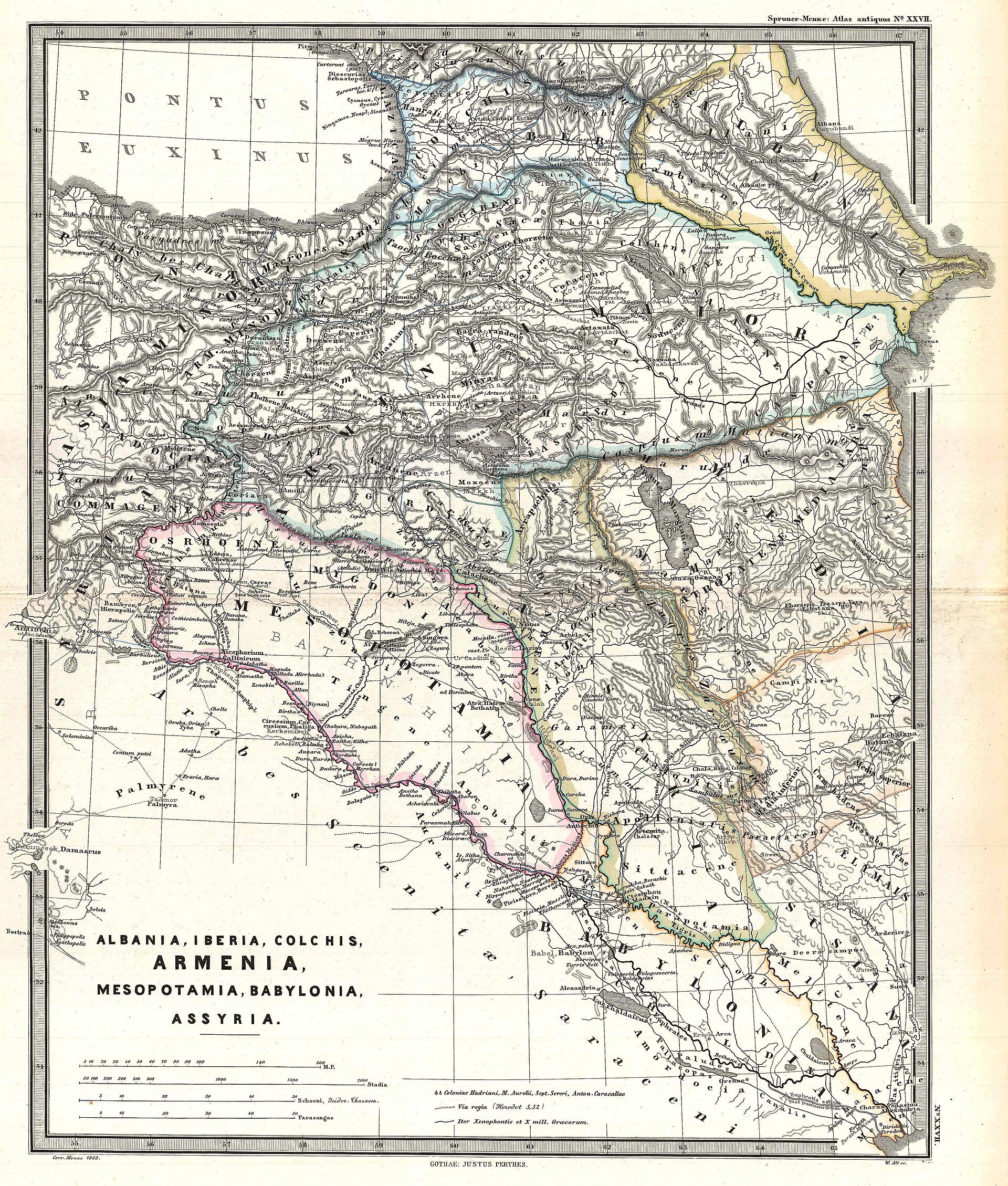
Spruner's plate of 1865 runs from the head of the Gulf to the Armenian highlands.
Haran lies far up the Euphrates from Ur, and Canaan lies beyond the plate to the west.
- Located: the site is known
- Proposed: the northern site put forward for Ur
- The route, in the order the text gives
- 1Ur, The city the family left Genesis 11:31
- 2Babylon, Nebuchadnezzar II, king at Babylon, rebuilt the shrines of Ur
- 3Haran, Where the family settled and Terah died Genesis 11:31 to 32
- 4?Urfa, OpenBible score 53, The northern proposal for Ur
Base map: Albania, Iberia, Colchis, Armenia, Mesopotamia, Babylonia, Assyria, Karl von Spruner and Theodor Menke, Atlas Antiquus, plate XXVII (Gotha: Justus Perthes, 1865), public domain. Places with a place page stand at its coordinates and the others at the point cited for each, set on the plate by Haran and Babylon, as the plate prints them.
Four places; the line joins the two places of the departure, and the dotted ring carries OpenBible's identification score out of 1,000.
Ur Through Time
Kings, conquerors and the men who dug the tell.
Six moments in the life of the city, from its royal tombs to its excavators.
- The twenty-sixth and twenty-fifth centuries BCThe First Dynasty of Ur buries its kings and queens in the Royal Cemetery
- The twenty-second and twenty-first centuries BCThe Third Dynasty of Ur rules Sumer and Akkad
- About 1940 BCUr falls to the Elamites in the reign of Ibbi-Sin
- About 400 BCThe last dated business document found at Ur is written
- 1854J. E. Taylor identifies the tell from an inscription of Nabonidus
- 1922 to 1934Leonard Woolley digs twelve seasons for the British Museum and the University of Pennsylvania
Six events in order.
The City of the Moon God
Ur's own god, and the gods Joshua remembers.
The great ziggurat at the centre of Ur housed the shrine of Nanna. Ur-Nammu built it on a base 64 m long and 45 m wide, and Nabonidus, the last king of Babylon, restored it in the sixth century BC.
And Joshua said to all the people, “This is what the LORD, the God of Israel, says: ‘Long ago your fathers, including Terah the father of Abraham and Nahor, lived beyond the Euphrates and worshiped other gods.Israel's covenant renewal at Shechem opens with this memory of the family's gods.
The Tell of Muqayyar
The size of the city in four periods, and what Woolley made of one layer.
Ur grew from about 15 hectares to 140, its largest in the Isin-Larsa period.
The four counts as a table
| Period | Area in hectares |
|---|---|
| Jemdet Nasr | 15 |
| Early Dynastic | 90 |
| Ur III | 108 |
| Isin-Larsa | 140 |
The area the city covered in four periods, each drawn from zero.
Woolley's flood layerthe Encyclopaedia Judaica, the article Ur
Outside the wall of Ur, Woolley found a layer of red soil about 2.5 m deep with no remains in it, between the early settlement below and the later city above. He took it for the mark of a great flood and linked it to the flood stories of Sumer and Babylon, and the Encyclopaedia Judaica reports that other scholars have not accepted his reading.
What Genesis Leaves Unsaid
What Genesis does not record about the call and the family's years in Ur.
Genesis 12:1 gives God's word to Abram without saying where he was when it came. Genesis does not say how long the family lived in Ur, or what Terah did there.
And Stephen declared: “Brothers and fathers, listen to me! The God of glory appeared to our father Abraham while he was still in Mesopotamia, before he lived in Haran,Stephen answers the question Genesis leaves open.
The City with Foundations
Abraham left a city men built and looked for the one God builds.
By faith Abraham, when called to go to a place he would later receive as his inheritance, obeyed and went, without knowing where he was going.Hebrews counts the departure itself as faith.
For he was looking forward to the city with foundations, whose architect and builder is God.The tents of Canaan pointed past every city of the earth, Ur among them.
The Voices
Three teachers on the city Abram left, from Jerome to Adam Clarke.
1662 to 1714 · Matthew Henry
An idolatrous country
The reading1 paragraph
Matthew Henry notes that Haran died in Ur before the family left that idolatrous country, and draws the lesson to hasten out of our natural state before death surprises us in it.
1762 to 1832 · Adam Clarke
A city whose place was not known
The reading1 paragraph
Adam Clarke calls Ur a city of some consequence in Chaldea whose situation was not well known, two decades before Taylor read the inscription at the tell.
Where Was Ur?
Two answers, each with its holders and the strongest objection.
The southern Ur, at Tell el-MuqayyarJ. E. Taylor and Leonard Woolley
The Encyclopaedia Judaica holds the southern site and explains the move to Haran by the bond between the two centres of the moon cult.
The objection: a family bound for Canaan from the south would go far out of its way to reach Haran.
A northern Ur, near UrfaJamieson, Fausset and Brown and Cyrus H. Gordon
The objection: Genesis calls it Ur of the Chaldeans, and the Chaldeans held the south.
Books to Read Next
The first of these two can be read free online.
Antiquities of the Jews, Book 1, chapters 6 and 7
Flavius Josephus, translated by William Whiston · about AD 93
Josephus tells of Terah's family leaving Chaldea and of Abram coming into Canaan.
Read at Project GutenbergUr of the Chaldees: A Record of Seven Years of Excavation
Leonard Woolley · 1929
Woolley tells the story of his first seven years of digging at Ur.
Sources
Scripture is the Berean Standard Bible.
- Strong's Hebrew dictionary, h218.
- The Encyclopaedia Judaica, the article Ur (Gale, 2007), as the Jewish Virtual Library prints it.
- Flavius Josephus, Antiquities of the Jews 1.6.5, translated by William Whiston, public domain.
- OpenBible.info, Bible Geocoding Data, ancient.jsonl, CC BY.
- Jerome, Hebrew Questions on Genesis, on Genesis 11:28.
- Matthew Henry, Commentary on the Whole Bible, 1710, on Genesis 11:28.
- Adam Clarke, Commentary on the Bible, 1832, on Genesis 11:31.
- Jamieson, Fausset and Brown, Commentary Critical and Explanatory on the Whole Bible, 1871, on Genesis 11:28.
- Cyrus H. Gordon, Abraham and the Merchants of Ura, Journal of Near Eastern Studies 17 (1958), pages 28 to 31.
- Leonard Woolley, Ur of the Chaldees: A Record of Seven Years of Excavation (London, 1929), the library record.
Keep Studying
Read it4