

American Colony Photo Department, Northern views, Dan, 1898 to 1914. Public domain.
Genesis 14 and 49 · Place · Featured Study
Dan
Dan stood at a spring of the Jordan below Mount Hermon, on the site of the older town of Laish.
A tribe given land beside the sea ended its search at the head of the Jordan.
After they had taken Micah’s idols and his priest, they went to Laish, to a tranquil and unsuspecting people, and they struck them with their swords and burned down the city. There was no one to deliver them, because the city was far from Sidon and had no alliance with anyone; it was in a valley near Beth-rehob. And the Danites rebuilt the city and lived there. They named it Dan, after their forefather Dan, who was born to Israel—though the city was formerly named Laish.
- Today
- Tel Dan (Tell el-Qadi), in the Upper Galilee
- Region
- the springs of the Jordan below Mount Hermon
- Site
- 33.249, 35.652
- First named
- Genesis 14:14 “…in pursuit as far as Dan.”
- Last named
- Amos 8:14 “…as your god lives, O Dan,’ or, ‘As…”
A tribe given land beside the sea ended its search at the head of the Jordan.
Summary
Dan was the northernmost city of Israel, and its name was the north end of the phrase from Dan to Beersheba.
- The tribe of Dan took the town of Laish, burned it and rebuilt it under their father's name.
- Jeroboam set one of his two golden calves at Dan when the northern tribes broke from Judah.
- Assyria took the region in the days of Pekah, and the mound at the site has given up a Bronze Age gate, a horned altar and an Aramaic victory stele.
From Laish to Dan
Judges tells how a quiet town far from Sidon received a new name.
The tribe's scouts had found Laish on their way north and reported a land where nothing was lacking.
After they had taken Micah’s idols and his priest, they went to Laish, to a tranquil and unsuspecting people, and they struck them with their swords and burned down the city. There was no one to deliver them, because the city was far from Sidon and had no alliance with anyone; it was in a valley near Beth-rehob. And the Danites rebuilt the city and lived there. They named it Dan, after their forefather Dan, who was born to Israel—though the city was formerly named Laish.These verses explain why a town once called Laish carries the name of a son of Jacob.
(Later, when the territory of the Danites was lost to them, they went up and fought against Leshem, captured it, and put it to the sword. So they took possession of Leshem, settled there, and renamed it after their father Dan.)Joshua records the same taking and calls the town Leshem.
The tribe's scouts had found Laish on their way north and reported a land where nothing was lacking.
(Later, when the territory of the Danites was lost to them, they went up and fought against Leshem, captured it, and put it to the sword. So they took possession of Leshem, settled there, and renamed it after their father Dan.)Joshua records the same taking and calls the town Leshem.
The March North on the Map
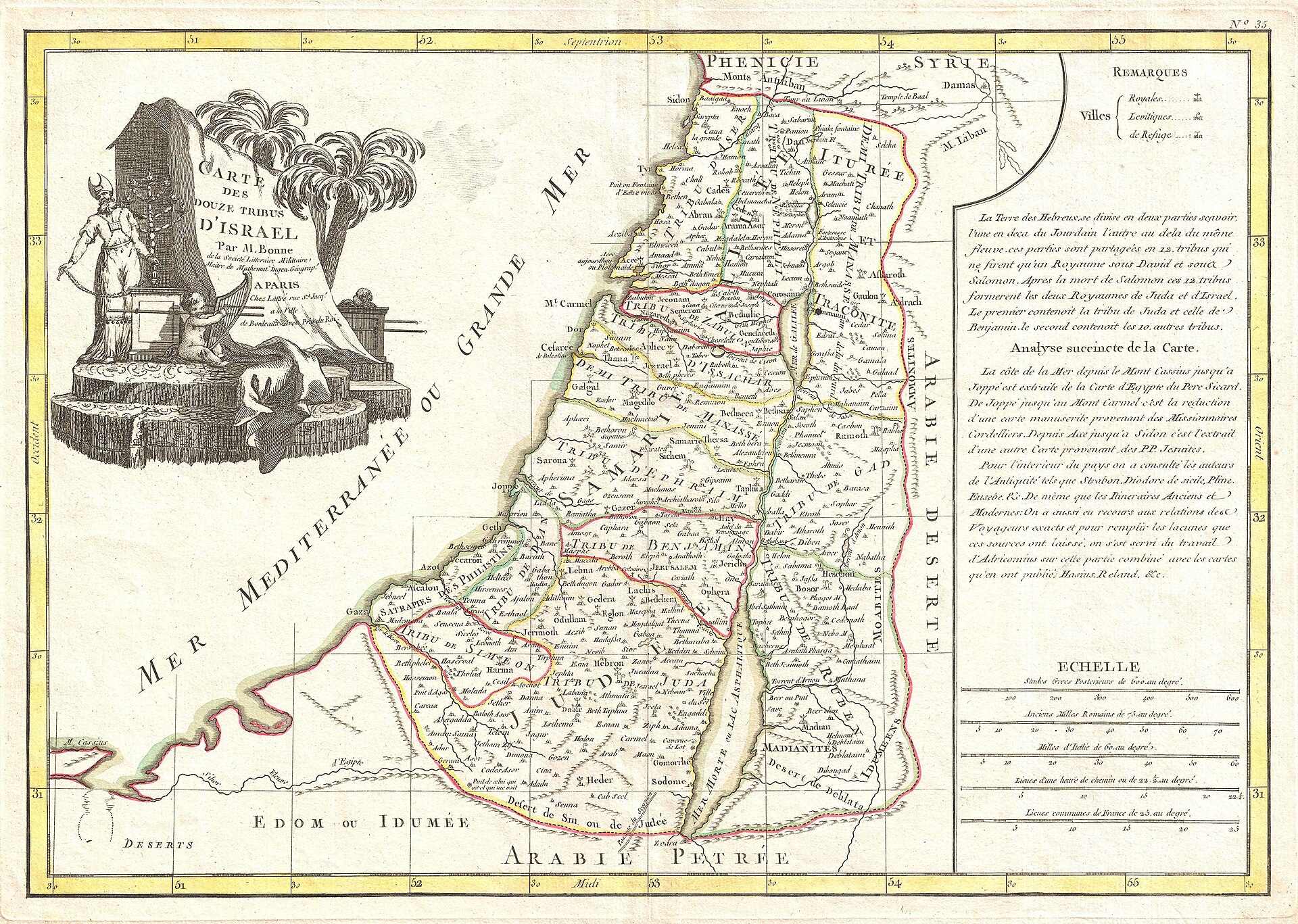
Bonne's plate of 1770 shows the land from the coast by Joppa to the springs of the Jordan.
The six hundred men of Dan marched from the low hills west of Jerusalem to the far north of the land.
- Located: the site is known
- The route, in the order the text gives
- 1Zorah, The six hundred armed men set out from Zorah and Eshtaol Judges 18:11
- 2Kiriath-jearim, They camped by the town, and the place west of it took the name Mahaneh-dan Judges 18:12
- 3Laish, renamed Dan, They burned the town and rebuilt it as Dan Judges 18:29
- 4Bethel, Jeroboam set the other calf here 1 Kings 12:29
- 5Beersheba, The south end of the phrase from Dan to Beersheba Judges 20:1
Base map: The Twelve Tribes of Israel, Rigobert Bonne (1770), public domain. Places with a place page stand at its coordinates and the others at the point cited for each, set on the plate by Hebron and Dan, as the plate prints them.
Five places; the line joins the three stops Judges names on the march, and the points of Zorah and Kiriath-jearim are OpenBible's identifications. Judges gives no site for Micah's house in the hill country of Ephraim, so the map draws none.
Dan Through Time
Scripture and the record of the mound, from the Bronze Age gate to the Assyrian conquest and the town's later shrine.
The town of Laish was old when the Danites took it, and Assyria ended the Israelite city in the eighth century BC.
- About 1750 BCA gate of mud brick with arched passages is built at Laish
- The days of AbramAbram pursues the four kings as far as DanGenesis 14:14
- The fifteenth century BCThutmose III lists Laish among the towns he conquered
- The days of the judgesThe Danites take Laish, rebuild it as Dan and set up Micah's image thereJudges 18:29 to 31
- The division of the kingdomJeroboam sets a golden calf at Dan1 Kings 12:29 to 30
- The reign of AsaBen-hadad of Damascus conquers Ijon, Dan and Abel-beth-maacah1 Kings 15:20
- The ninth century BCAn Aramean king sets up a victory stele at Dan over the king of Israel
- The reign of Jeroboam son of JehoashAmos hears men swear by the god of DanAmos 8:14
- 733 or 732 BCTiglath-pileser III of Assyria takes the city
- The Hellenistic periodA Greek and Aramaic dedication names the god who is in Dan
Ten events in order; the rows from Scripture carry their references.
The ninth century BC, The reign of Jeroboam son of Jehoash, 733 or 732 BC, The Hellenistic period
The Calf at Dan
Kings gives the king's reason for the calves in his own words.
Jeroboam feared that the people would turn back to Rehoboam if they went up to the house of the LORD at Jerusalem. Bethel lay in the south of his kingdom and Dan in the far north.
After seeking advice, the king made two golden calves and said to the people, “Going up to Jerusalem is too much for you. Here, O Israel, are your gods, who brought you up out of the land of Egypt.” One calf he set up in Bethel, and the other in Dan. And this thing became a sin; the people walked as far as Dan to worship before one of the calves.The worship begun here outlasted Jeroboam, for Jehu destroyed Baal and still kept the calves at Bethel and Dan.
Those who swear by the guilt of Samaria and say, ‘As surely as your god lives, O Dan,’ or, ‘As surely as the way of Beersheba lives’—they will fall, never to rise again.”Amos, a sheepherder of Tekoa, still hears oaths sworn by the god of Dan.
The Mound at Tel Dan
The Arabic name of the mound means the hill of the judge, which is the sense of the Hebrew name Dan.
William F. Lynch identified Tell el-Qadi as Dan in 1849, and Edward Robinson made the same identification three years later. The excavators found a gate of mud brick with three arches from about 1750 BC, a later Israelite gate, and a cultic area with a large altar bearing four horns.
The stone found in the city wallThe Tel Dan Stele, found in 1993 and 1994
In 1993 Gila Cook of Avraham Biran's team found a fragment of basalt with an Aramaic inscription among the rubble of a wall, and two more pieces came out in 1994. The king who wrote it boasts of victories over the king of Israel and over a king the excavators read as of the house of David. The excavators, Biran and Naveh, take that king to be Hazael of Damascus.
The name Dan in the Greek periodA bilingual dedication from the sanctuary
A small limestone slab found beside the altar enclosure carries three lines of Greek and one of Aramaic. Both record a vow to the god who is in Dan, and so the town still bore its name in the late third or early second century BC.
The Priest's Answer
The scouts lodged where Micah's young Levite served.
Judges records the march, the burning and the new shrine that followed and leaves the reader to weigh them.
Then they said to him, “Please inquire of God to determine whether we will have a successful journey.” And the priest told them, “Go in peace. The LORD is watching over your journey.”The priest's reply is the only word of the LORD the account reports.
Where It Points
Two prophetic words about the tribe look past the shrine at Dan.
Dan shall provide justice for his people as one of the tribes of Israel. He will be a snake by the road, a viper in the path that bites the horse’s heels so that its rider tumbles backward. I await Your salvation, O LORD.Jacob's word on Dan ends in a cry for the LORD's salvation.
“Now these are the names of the tribes: At the northern frontier, Dan will have one portion bordering the road of Hethlon to Lebo-hamath and running on to Hazar-enan on the border of Damascus with Hamath to the north, and extending from the east side to the west side.Ezekiel's list of the tribes in the restored land begins with Dan at the northern frontier.
The Voices
Three teachers on Abram's rescue, the priest of the shrine and Jeroboam's reasons, from Ambrose to Albert Barnes.
died 397 · Ambrose of Milan
On Abraham
Abram armed his household for his nephew
The quotation1 quotation
“‘When Abraham learned of this, he counted his servants born in the house’ and with 318 men won a victory and liberated his nephew. This shows that the separation had taken place in friendship, since Abraham's love for his nephew was so great that he was willing to confront even the dangers of war on his behalf. What does it mean ‘he counted’? It means he ‘chose.’ So too what Jesus said in the Gospel refers not only to the knowledge of God but also to the grace of the just: ‘Even the hairs on your head are all counted.’”
Ambrose of Milan · On Abraham · on Genesis 14:14Patristic
1662 to 1714 · Matthew Henry
Commentary on the Whole Bible
The grandson of Moses served the image
The quotation1 quotation
“The vulgar Latin reads it Moses. And if indeed Moses had a grandson that was rakish, and was picked up as a fit tool to be made use of in the setting up of idolatry, it is not the only instance (would to God it were!) of the unhappy degenerating of the posterity of great and good men.”
Matthew Henry · Commentary on the Whole Bible · on Judges 18:30Puritan
1798 to 1870 · Albert Barnes
Notes, Explanatory and Practical, on the Old and New Testaments (1832-1869)
Jeroboam feared a return to the house of David
The quotation1 quotation
“Jeroboam’s fear was lest a reaction should set in, and a desire for reunion manifest itself. He was not a man content to remain quiet, trusting simply to the promise made him 1Ki 11:38. Hence, he gave way to the temptation of helping forward the plans of Providence by the crooked devices of a merely human policy. His measures, like all measures which involve a dereliction of principle, brought certain evils in their train, and drew down divine judgment on himself. But they fully secured the object at which he aimed.”
Albert Barnes · Notes, Explanatory and Practical, on the Old and New Testaments (1832-1869) · on 1 Kings 12:26Evangelical
What the Stele at Dan Names
Two readings of the letters bytdwd on the stone found at Dan, each with its holders.
The house of David, the dynasty of JudahAvraham Biran and Joseph Naveh, with Anson Rainey and Lawrence J. Mykytiuk
Biran and Naveh published the fragments in 1993 and 1995 and read bytdwd as the house of David, beside a king of Israel in the line above. Rainey held in Biblical Archaeology Review (1994) that the presence or absence of a word divider is normally of no consequence, since compound words occur in the inscription and in West Semitic writing generally. Mykytiuk weighs the readings in Identifying Biblical Persons in Northwest Semitic Inscriptions (2004) and judges the others unlikely.
The objection: the inscription uses word dividers elsewhere, and one would be expected between byt and dwd.
A place name, or another wordNiels Peter Lemche; George Athas
Lemche, in The Israelites in History and Tradition (1998), and Athas, in The Tel Dan Inscription (2003), read bytdwd as a place name, and Athas proposed that it refers to Jerusalem. They note that dwd can also mean uncle, beloved or kettle.
The objection: most scholars accept the reading house of David, and the stone was recovered in a controlled excavation.
Books to Read Next
One of these three works can be read free online.
Antiquities of the Jews, Book 1, chapter 10
Flavius Josephus, translated by William Whiston · about AD 93
Josephus tells Abram's night attack near Dan and calls Dan the other spring of the Jordan.
Read at Project GutenbergAn Aramaic Stele Fragment from Tel Dan
Avraham Biran and Joseph Naveh · 1993
This is the excavators' first edition of the stele, printed in the Israel Exploration Journal, volume 43.
In print: find it wherever books are sold.
The Tel Dan Inscription: A Reappraisal and a New Interpretation
George Athas · 2003
Athas reads the stele afresh, dates it to Ben-Hadad III and argues his reading of bytdwd.
In print: find it wherever books are sold.
The Edge of the Land
Dan marked how far the land reached, and its shrine showed how far Israel's worship strayed from the way God gave.
The reader is called to come to God through Christ, who said that He is the way and that no one comes to the Father except through Him.
Sources
Scripture is the Berean Standard Bible.
- Strong's Hebrew dictionary, h1835 and h3919.
- OpenBible.info, Bible Geocoding Data, ancient.jsonl, CC BY.
- Ambrose of Milan, On Abraham, 397, on Genesis 14:14.
- Matthew Henry, Commentary on the Whole Bible, 1710, on Judges 18:30.
- Albert Barnes, Notes, Explanatory and Practical, on the Old and New Testaments, on 1 Kings 12:26.
- Flavius Josephus, Antiquities of the Jews 1.10.1, translated by William Whiston, public domain.
- Avraham Biran and Joseph Naveh, An Aramaic Stele Fragment from Tel Dan, Israel Exploration Journal 43 (1993), pages 81 to 98.
- Anson F. Rainey, The House of David and the House of the Deconstructionists, Biblical Archaeology Review 20, 6 (1994), page 47.
- Lawrence J. Mykytiuk, Identifying Biblical Persons in Northwest Semitic Inscriptions of 1200 to 539 BCE (Society of Biblical Literature, 2004)
- Niels Peter Lemche, The Israelites in History and Tradition (Westminster John Knox, 1998), page 43.
- George Athas, The Tel Dan Inscription: A Reappraisal and a New Interpretation (Continuum, 2003)
- Rigobert Bonne, the twelve tribes of Israel, 1770; public domain.
Keep Studying
Read it4