
Place
Ai
Also known as Hai · et-Tell (traditional identification)
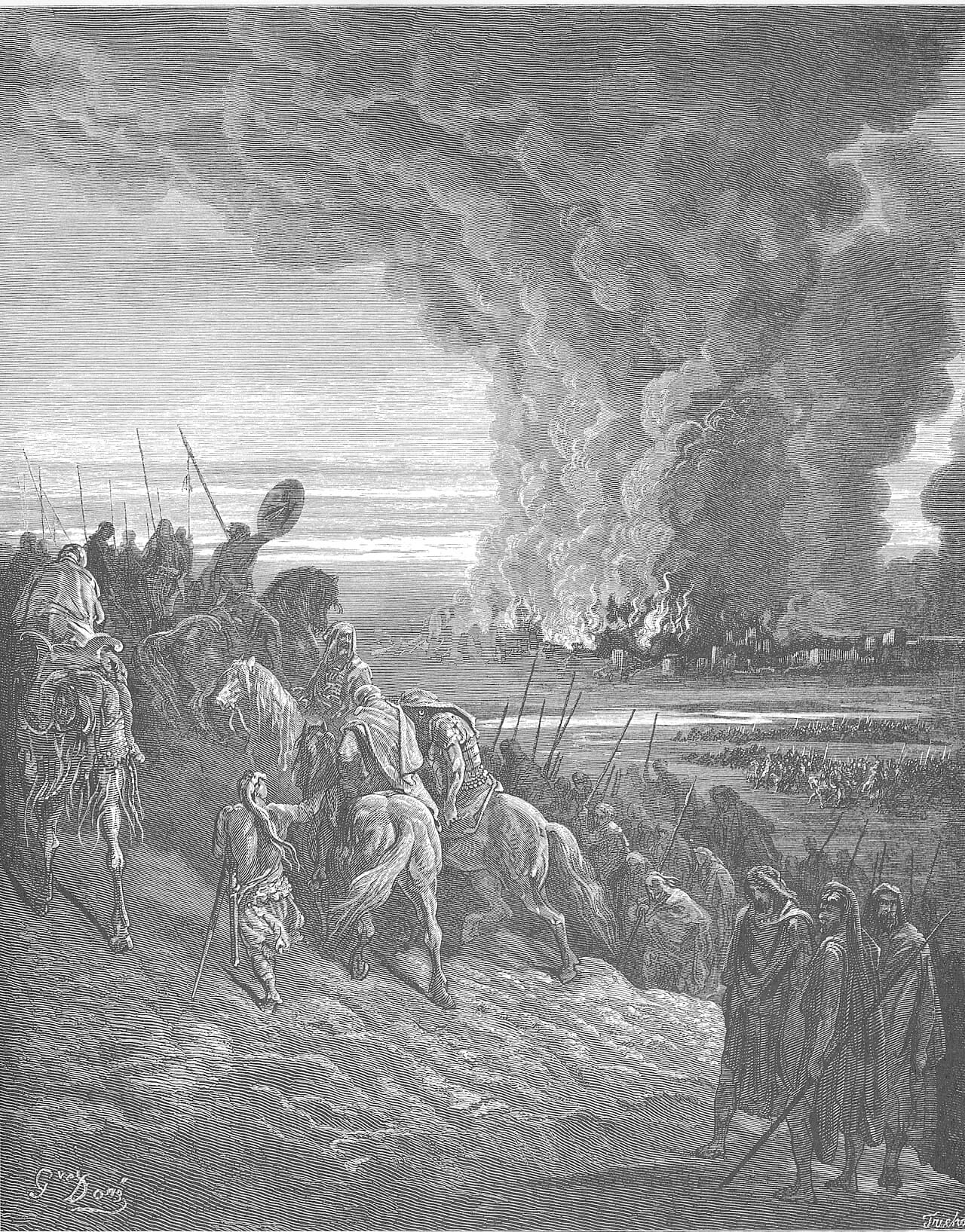
Gustave Doré, La Sainte Bible (Tours: Alfred Mame et fils, 1866). Public domain.
Summary
The town where Israel lost its first battle in Canaan because of Achan's sin, and then took the city by ambush once the sin was dealt with.
- Ai is the second city Israel attacked inside Canaan, and the first place Israel lost.
- The defeat came from one man's theft at Jericho, and Joshua 7 tells the reader the cause before it tells Joshua.
- Once the sin was dealt with, God gave Joshua the ambush that took the city.
- Joshua hanged the king of Ai on a tree and had the body taken down at sunset, the law Paul quotes of Christ in Galatians 3:13.
- The name in Hebrew means the Ruin, and where the town stood is genuinely disputed.
On this page
In Scripture
- Verses
- 33
- Books
- 5
Near Ai
- Bethel4.1 km · 2.5 mi W
- Ephraim5.4 km · 3.4 mi NE
- Ramah6.1 km · 3.8 mi W
- Gibeah11 km · 6.7 mi S
- Nob13 km · 8.3 mi S
- Mount of Olives15 km · 9.6 mi S
Straight-line distances, computed from the gazetteer coordinates.
Where it is
the country around it
- Coordinates
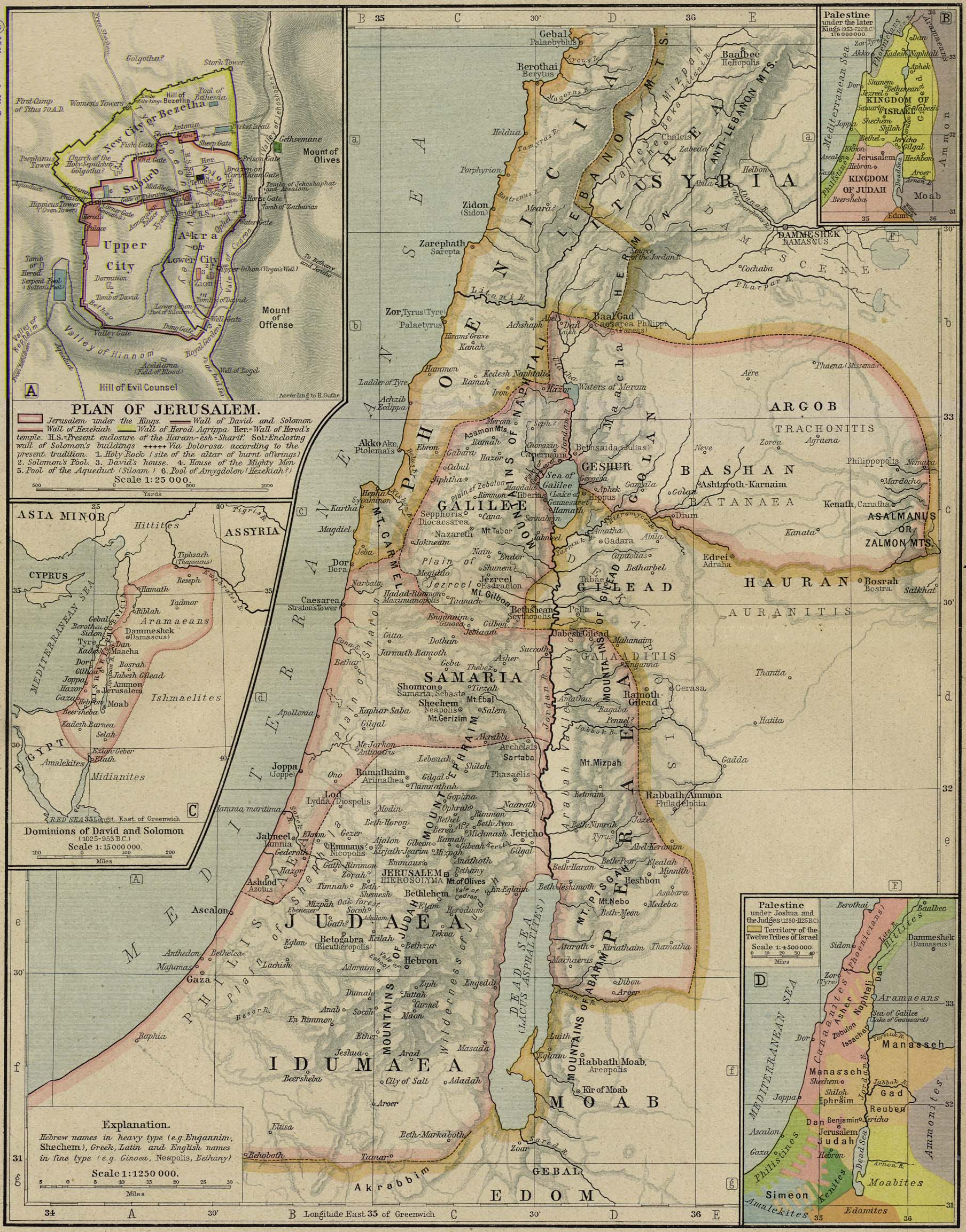
- 31.9170° N, 35.2612° Efind it on the Atlas →
- Region
- Central hill country, east of Bethel
- Kind of place
- City
4 places the record names with Ai, the farthest 18 km away
- 1Abram pitches his tent between Bethel and AiGenesis 12:8 · 4.1 kmFrom there Abram moved on to the hill country east of Bethel and pitched his tent, with Bethel to the west and Ai to the east. There he built an altar to the LORD, and he called on the name of the LORD.
- 2Gibeon hears what was done to Jericho and AiJoshua 9:3 · 18 kmBut the people of Gibeon, having heard what Joshua had done to Jericho and Ai,
- 3Jerusalem hears, and a coalition formsJoshua 10:1 · 17 kmNow Adoni-zedek king of Jerusalem heard that Joshua had captured Ai and devoted it to destruction—doing to Ai and its king as he had done to Jericho and its king—and that the people of Gibeon had made peace with Israel and were living near them.
- 4Ephraim's holdings reach as far as Ayyah1 Chronicles 7:28 · 5.4 kmTheir holdings and settlements included Bethel and its villages, Naaran to the east, Gezer and its villages to the west, and Shechem and its villages as far as Ayyah and its villages.
- Located: the gazetteer fixes one site
- ? Proposed: one candidate among several
- A dashed line ends at a place the gazetteer does not fix
Not located: Egypt, Assyria. The gazetteer records no location for them, so they are not marked.
Why Ai matters
What has been found
the evidence, and where it is disputed
The defeat at Ai and the second attack
Joshua 7 and 8, in the order it happens
Read Joshua 7 and 8, in the order it happens
- The theft, told before the battleJoshua 7:1The Israelites, however, acted unfaithfully regarding the things devoted to destruction. Achan son of Carmi, the son of Zabdi, the son of Zerah, of the tribe of Judah, took some of what was set apart. So the anger of the LORD burned against the Israelites.
- The spies say a small force will doJoshua 7:3On returning to Joshua, they reported, “There is no need to send all the people; two or three thousand men are enough to go up and attack Ai. Since the people of Ai are so few, you need not wear out all our people there.”
- Thirty-six men fall, and the camp loses heartJoshua 7:5And the men of Ai struck down about thirty-six of them, chasing them from the gate as far as the quarries and striking them down on the slopes. So the hearts of the people melted and became like water.
- The LORD names what is wrongJoshua 7:12This is why the Israelites cannot stand against their enemies. They will turn their backs and run from their enemies, because they themselves have been set apart for destruction. I will no longer be with you unless you remove from among you whatever is devoted to destruction.
- Achan confesses what he tookJoshua 7:21When I saw among the spoils a beautiful cloak from Shinar, two hundred shekels of silver, and a bar of gold weighing fifty shekels, I coveted them and took them. They are hidden in the ground inside my tent, with the silver underneath.”
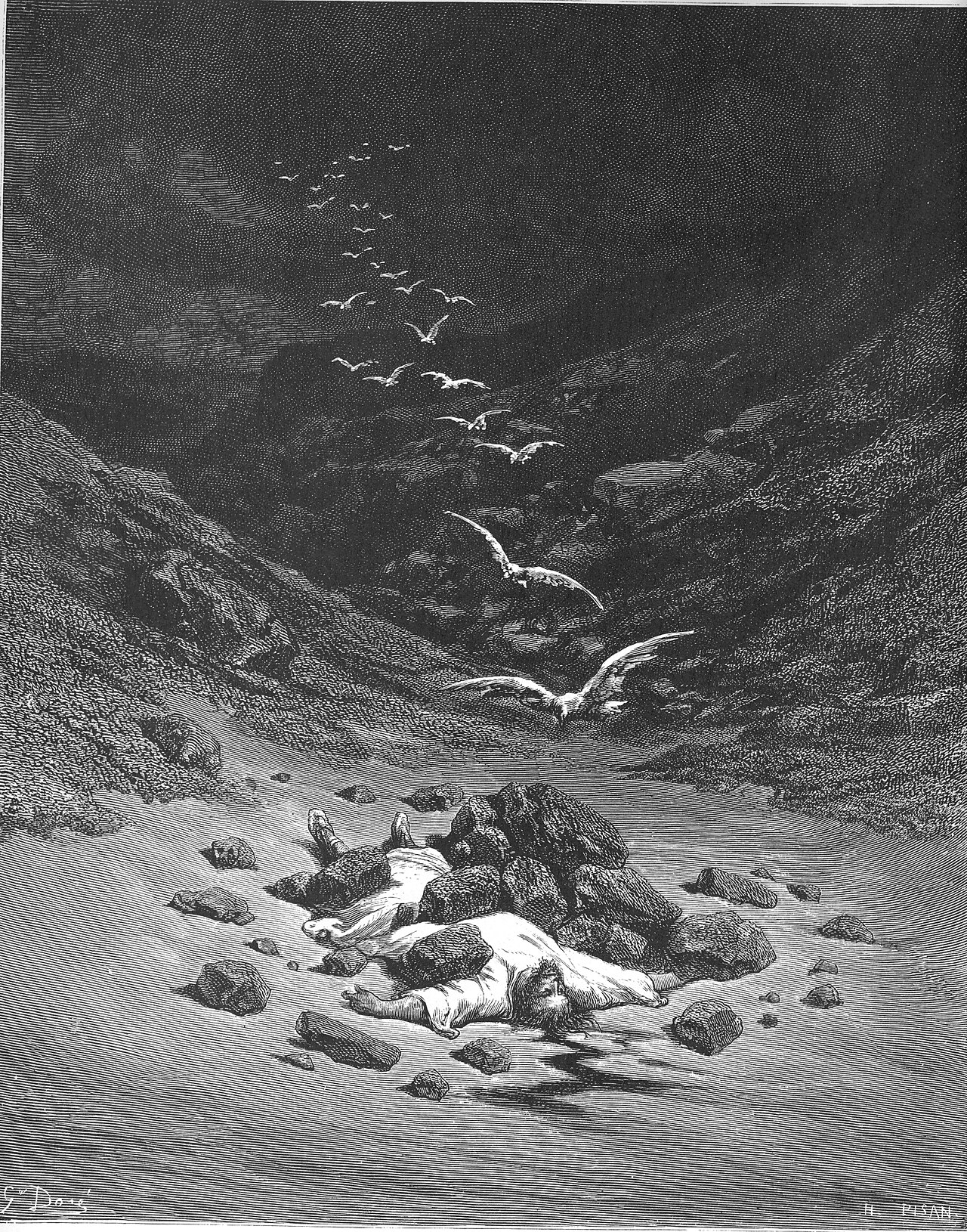
- The heap of rocks in the Valley of AchorJoshua 7:26And they heaped over Achan a large pile of rocks that remains to this day. So the LORD turned from His burning anger. Therefore that place is called the Valley of Achor to this day.
- God orders the ambushJoshua 8:2And you shall do to Ai and its king as you did to Jericho and its king, except that you may carry off their plunder and livestock for yourselves. Set up an ambush behind the city.”
- The ambush rises and the city burnsJoshua 8:19and as soon as he did so, the men in ambush rose quickly from their position. They rushed forward, entered the city, captured it, and immediately set it on fire.
- The king hanged, and taken down at sunsetJoshua 8:29He hung the king of Ai on a tree until evening, and at sunset Joshua commanded that they take down the body from the tree and throw it down at the entrance of the city gate. And over it they raised a large pile of rocks, which remains to this day.
- Every word of the law read to everyoneJoshua 8:35There was not a word of all that Moses had commanded that Joshua failed to read before the whole assembly of Israel, including the women, the little ones, and the foreigners who lived among them.
Joshua 8 does not end at the ruin. Joshua built an altar of uncut stones on Mount Ebal, wrote a copy of the law of Moses on the stones, and read the blessings and the curses aloud to the whole assembly, women, children and foreigners included. The two engravings on this page show the town burning and Achan stoned in the valley. No image held on this site shows the altar on Mount Ebal, the reading of the law before the assembly, or the king of Ai taken down from the tree at sunset.
The Joshua study: the campaign and the contested siteWhat happened here, in order
in the order the canon tells it
- Abram pitches his tent between Bethel and AiGenesis 12:8From there Abram moved on to the hill country east of Bethel and pitched his tent, with Bethel to the west and Ai to the east. There he built an altar to the LORD, and he called on the name of the LORD.
- He comes back to the same place after EgyptGenesis 13:3From the Negev he journeyed from place to place toward Bethel, until he came to the place between Bethel and Ai where his tent had formerly been pitched,
- The law about a body left hanging on a treeDeuteronomy 21:23you must not leave the body on the tree overnight, but you must be sure to bury him that day, because anyone who is hung on a tree is under God’s curse. You must not defile the land that the LORD your God is giving you as an inheritance.
- Achan and all he owned brought to the Valley of AchorJoshua 7:24Then Joshua, together with all Israel, took Achan son of Zerah, the silver, the cloak, the bar of gold, his sons and daughters, his oxen and donkeys and sheep, his tent, and everything else he owned, and brought them to the Valley of Achor.
- The ambush lies in wait between Bethel and AiJoshua 8:9So Joshua sent them out, and they went to the place of ambush and lay in wait between Bethel and Ai, to the west of Ai. But Joshua spent that night among the people.
- Twelve thousand of the people of Ai fallJoshua 8:25A total of twelve thousand men and women fell that day—all the people of Ai.
- Ai left a permanent heap of ruinsJoshua 8:28So Joshua burned Ai and made it a permanent heap of ruins, a desolation to this day.
- Joshua builds the altar on Mount EbalJoshua 8:30At that time Joshua built an altar on Mount Ebal to the LORD, the God of Israel,
- Gibeon hears what was done to Jericho and AiJoshua 9:3But the people of Gibeon, having heard what Joshua had done to Jericho and Ai,
- Jerusalem hears, and a coalition formsJoshua 10:1Now Adoni-zedek king of Jerusalem heard that Joshua had captured Ai and devoted it to destruction—doing to Ai and its king as he had done to Jericho and its king—and that the people of Gibeon had made peace with Israel and were living near them.
- Ai's king second on the list of defeated kingsJoshua 12:9the king of Jericho, one; the king of Ai, which is near Bethel, one;
- The Valley of Achor as a boundary in Judah's allotmentJoshua 15:7Then the border went up to Debir from the Valley of Achor, turning north to Gilgal, which faces the Ascent of Adummim south of the ravine. It continued along the waters of En-shemesh and came out at En-rogel.
- Ephraim's holdings reach as far as Ayyah1 Chronicles 7:28Their holdings and settlements included Bethel and its villages, Naaran to the east, Gezer and its villages to the west, and Shechem and its villages as far as Ayyah and its villages.
- The men of Bethel and Ai return from exile, 223Ezra 2:28the men of Bethel and Ai, 223;
- The same line in the other register, 123Nehemiah 7:32the men of Bethel and Ai, 123;
- Benjamites settle at Aija beside Michmash and BethelNehemiah 11:31The descendants of Benjamin from Geba lived in Michmash, Aija, and Bethel with its villages;
- Assyria enters Aiath on the march toward JerusalemIsaiah 10:28Assyria has entered Aiath and passed through Migron, storing their supplies at Michmash.
- The Valley of Achor promised as a resting placeIsaiah 65:10Sharon will become a pasture for flocks, and the Valley of Achor a resting place for herds, for My people who seek Me.
- The Valley of Achor made a gateway of hopeHosea 2:15There I will give back her vineyards and make the Valley of Achor into a gateway of hope. There she will respond as she did in the days of her youth, as in the day she came up out of Egypt.
- Paul quotes the law of the tree of ChristGalatians 3:13Christ redeemed us from the curse of the law by becoming a curse for us. For it is written: “Cursed is everyone who is hung on a tree.”
Where it points
The voices
each quoted from the work named
Sent men from Jericho to Ai - This is the place called Hai, Gen 12:8. It was in the east of Beth-el, north of Jericho, from which it was distant about ten or twelve miles. From Jos 7:4, Jos 7:5 it appears to have been situated upon a hill, and belonged to the Amorites, as we learn from Jos 7:7. It is very likely that it was a strong place, as it chose to risk a siege, notwithstanding the extraordinary destruction of Jericho which it had lately witnessed.
Ai, Bethel - See Gen 12:8 note. (Modern travelers place the former at Khan Haiy, in the neighborhood of Deir Diwan.)
The spies who were sent to Ai returned to Joshua and said to him, "Let not all the people go up; but let about two or three thousand men go up and smite Ai." This policy led to a disastrous defeat and our other text gives us the Lord's command concerning the new attack. You will find it in the eighth of Joshua and the first verse—"The Lord said unto Joshua, Fear not, neither be dismayed: take all the people of war with you, and arise, go up to Ai; see, I have given into your hand the king of Ai, and his people, and his city, and his land."
4 more teachers on these versesJamieson, Fausset & Brown · Adam Clarke · Matthew Henry · John Wesley
Joshua burnt Ai, and made it an heap for ever--"For ever" often signifies "a long time" (Ge 6:3). One of the remarkable things with regard to the tell we have identified with Ai is its name--the tell of the heap of stones--a name which to this day remains [VAN DE VELDE].
The king of Ai he hanged on a tree - He had gone out at the head of his men, and had been taken prisoner, Jos 8:23; and the battle being over, he was ordered to be hanged, probably after having been strangled, or in some way deprived of life, as in the case mentioned Jos 10:26, for in those times it was not customary to hang people alive. As soon as the sun was down - It was not lawful to let the bodies remain all night upon the tree. See the note on Deu 21:
Note, When we have faithfully put away sin, that accursed thing, which separates between us and God, then, and not till then, we may expect to hear from God to our comfort; and God's directing us how to go on in our Christian work and warfare is a good evidence of his being reconciled to us.
From thence - From the time of their repentance. Valley of Achor - Which was a large, fruitful and pleasant valley near Jericho, on the very entrance into the land of Canaan. A door of hope - That valley was a door of hope to Israel of old.
Ai in Scripture
33 verses name it, or one of its other names (Hai, et-Tell), in 5 books
Open a book to read its mentions here. Text: Berean Standard Bible.
Old TestamentNew Testamentsegment width = share of mentions
Old Testament5 books · 33 mentions
Genesis2 mentions
- Genesis 12:8From there Abram moved on to the hill country east of Bethel and pitched his tent, with Bethel to the west and Ai to the east. There he built an altar to the LORD, and he called on the name of the LORD.
- Genesis 13:3From the Negev he journeyed from place to place toward Bethel, until he came to the place between Bethel and Ai where his tent had formerly been pitched,
Joshua28 mentions
- Joshua 7:2Meanwhile, Joshua sent men from Jericho to Ai, which is near Beth-aven to the east of Bethel, and told them, “Go up and spy out the land.” So the men went up and spied out Ai.
- Joshua 7:3On returning to Joshua, they reported, “There is no need to send all the people; two or three thousand men are enough to go up and attack Ai. Since the people of Ai are so few, you need not wear out all our people there.”
- Joshua 7:4So about three thousand men went up, but they fled before the men of Ai.
- Joshua 7:5And the men of Ai struck down about thirty-six of them, chasing them from the gate as far as the quarries and striking them down on the slopes. So the hearts of the people melted and became like water.
- Joshua 8:1Then the LORD said to Joshua, “Do not be afraid or discouraged. Take the whole army with you, and go up and attack Ai. See, I have delivered into your hand the king of Ai, his people, his city, and his land.
- Joshua 8:2And you shall do to Ai and its king as you did to Jericho and its king, except that you may carry off their plunder and livestock for yourselves. Set up an ambush behind the city.”
- Joshua 8:3So Joshua and the whole army set out to attack Ai. Joshua chose 30,000 mighty men of valor and sent them out at night
- Joshua 8:9So Joshua sent them out, and they went to the place of ambush and lay in wait between Bethel and Ai, to the west of Ai. But Joshua spent that night among the people.
20 further mentions in Joshua, read them in the book.
Ezra1 mention
Nehemiah1 mention
The account
Read the account as one telling
Ai enters Scripture as a landmark rather than as a target. Abram came into Canaan, went up into the hill country east of Bethel, and pitched his tent with Bethel to the west and Ai to the east. He built an altar there and called on the name of the LORD, and after the famine took him down to Egypt he came back to the same place and the same altar. Genesis fixes his position by naming both towns, which means Ai was already old, already known and already named.
Centuries later Israel crossed the Jordan, took Jericho, and turned inland toward that ridge. Ai was the next town on the road up into the hill country. The defeat, the sin in the camp and the second attack are told above.
The battle left two monuments, raised in the same week and both said to remain to this day. One is the heap of rocks over Achan in the Valley of Achor. The other is the pile of rocks over the king of Ai at the entrance of the city gate. The town itself was burned and left a heap of ruins.
What happened at Ai changed the war. The people of Gibeon heard what Joshua had done to Jericho and Ai and came looking for a treaty. Adoni-zedek king of Jerusalem heard the same news, saw Gibeon change sides, and called a coalition of kings against Israel. When the book lists the thirty-one kings Joshua defeated, the king of Ai stands second, right after the king of Jericho.
The name does not disappear from the record after that. Ephraim's holdings are described as running out as far as a place the Chronicler spells Ayyah, which many readers take as the same site. Isaiah's account of the Assyrian army marching on Jerusalem names Aiath at the head of the route, another form of the same name.
Men of Bethel and Ai came home from Babylon counted together on one line, in both registers. Ezra gives the number as 223 and Nehemiah gives it as 123. The two lists disagree, and this page says so rather than smoothing it over. Nehemiah’s resettlement list then places Benjamites at Aija beside Michmash and Bethel, so people were living on or near the place again after the exile.
A different Ai stands east of the Jordan in Ammonite country. Jeremiah's oracle against the Ammonites mourns it beside Heshbon and Rabbah. It is not this town. A reader searching the name meets both, and the name itself explains why more than one place carried it.
The Valley of Achor has its own thread through the record. It was a real place, fixed enough to serve as a boundary marker in the allotment of Judah, though its exact site is not certain. Albert Barnes wrote in the nineteenth century that it must have lain among the ridges south of Jericho and that its site was uncertain even then. Isaiah and Hosea both give the valley back, as pasture for the herds of those who seek God and as a gateway of hope.
Common questions
Why did Israel lose at Ai after winning at Jericho?
Because of what was already in the camp. Achan of Judah had kept part of what was devoted to God at Jericho, and Joshua 7:1 tells the reader that before it tells Joshua. The LORD says plainly that Israel cannot stand against its enemies while the devoted thing is among them. The defeat was a verdict on the camp rather than a failure of tactics, and only thirty-six men died in it.
Was one man's sin really charged to the whole nation?
The text says so directly. Joshua 7:1 opens by naming the whole people for what one man did, and only then names Achan. Israel was under an oath taken together at Jericho, and Scripture treats a covenant community as answerable together. Albert Barnes reads the guilt as national and the expiation as national to match. That is also the logic Paul uses when he tells a church that a little leaven works through the whole batch of dough.
Why were Achan's sons and daughters taken to the valley with him?
Readers differ; the positions are named
The text lists them among those brought out and does not explain itself. This is one of the hardest passages in the book, and the page does not pretend otherwise.
John Wesley argued that Achan was probably an old man whose children were grown, and so able to know about the plunder hidden in the family tent and keep silent. Albert Barnes reads the family as accomplices for the same reason. Others hold that the passage records what was done under the ban without approving every part of it. The readings are named here and the question is left where the text leaves it.
Was the ambush at Ai deceitful?
Readers differ; the positions are named
God gave the order: “Set up an ambush behind the city.” So anything said about the tactic has to reckon with who commanded it, and the feigned flight was ordered too. Augustine took the question up directly around 430 in his Questions on Joshua and argued that a stratagem in a war that is itself just does not make the war unjust. That answer is Augustine’s, and it is given here as his.
How many men were in the ambush, thirty thousand or five thousand?
Readers differ; the positions are named
Both numbers stand in the chapter. Joshua 8:3 says Joshua chose thirty thousand and sent them out at night. Joshua 8:12 says he took about five thousand and set them between Bethel and Ai.
Adam Clarke sets out both readings in his note on Joshua 8:1. Either thirty thousand were the whole force with five thousand detached from them for the second position, or the thirty thousand were the number mobilised while the rest of the army stood ready. This page prints both verses and Clarke’s note and leaves the arithmetic where the text leaves it.
Where was Ai? Has it been found?
Readers differ; the positions are named
This is genuinely disputed. The traditional identification is et-Tell, beside Deir Dibwan and east of Beitin, and that is where this page’s map pin sits. Three excavations there found a very large Early Bronze Age city, then a gap of roughly a thousand years, then a small unwalled Iron Age village, and no Late Bronze occupation at all.
Four answers have been offered, by W. F. Albright, David Livingston, John Bimson, and Bryant Wood with Associates for Biblical Research. The evidence for each, and what each costs, is set out further up this page. No verdict is given here.
What is the Valley of Achor, and why do the prophets call it hope?
It is the valley where Achan was stoned and buried under a heap of stones, named for the trouble he had brought on Israel. It was a real place, used as a boundary marker in Judah’s allotment, though its exact site is not certain. Isaiah promises it back as a resting place for the herds of those who seek God, and Hosea calls it a gateway of hope. Both promises are spoken to Israel, and this page keeps them there.
Is the Ai in Jeremiah 49:3 the same town?
No. Jeremiah's oracle is against the Ammonites, and its Ai stands with Heshbon and Rabbah east of the Jordan. The Ai of Joshua is in the central hill country west of the Jordan, beside Bethel. The Hebrew name means the Ruin, and more than one place carried it.
Does 1 Enoch say anything about Ai?
No. The text of 1 Enoch held on this site as a labeled study resource was searched for Ai, the Valley of Achor, Bethel, Gilgal, Canaan, Jericho, Joshua and Achan. Every search returned nothing. 1 Enoch is silent on this place and on this event, and the silence is stated here because readers ask.
Notable art
1 verified piece depicting Ai
Sources cited
- OpenBible.info Bible Geocoding: Ai 1read 2026-09-02The coordinates on this page follow the traditional identification at et-Tell; the identification is disputed and the page says so. Used under CC-BY with attribution to OpenBible.info.
- Berean Standard BibleThe verse text quoted on this page. Public domain.
- Gustave Doré, La Sainte Bible (Tours: Alfred Mame et fils, 1866)The two engravings on this page. Public domain.
- Judith Marquet-Krause, Les fouilles de 'Ay (et-Tell), 1933-1935 (Paris: Geuthner)The first substantial excavation report for et-Tell.
- Joseph A. Callaway, excavation reports on et-Tell, 1964 to 1972The American campaign that settled the stratigraphy the whole argument rests on.
- W. F. Albright, on the Israelite conquest of Canaan in the light of archaeology, Bulletin of the American Schools of Oriental Research (1939)The etiological reading, cited for the position it argues.
- David Livingston, on the location of biblical Bethel and Ai, Westminster Theological Journal (1970), with his rejoinder and Anson F. Rainey’s reply in the same journalThe el-Bireh proposal for Bethel and the exchange it started.
- John J. Bimson, Redating the Exodus and Conquest (Sheffield: JSOT Press, 1978)The Middle Bronze reframing of the conquest horizon.
- Bryant G. Wood and Associates for Biblical Research, excavation reports on Khirbet el-Maqatir, seasons 1995 to 2000 and 2009 to 2016The Khirbet el-Maqatir proposal. A confessional excavating body, and this page says so.
- Adam Clarke, Commentary on the Bible (1832)Public domain, CCEL edition.
- Albert Barnes, Notes, Explanatory and Practical, on the Old and New Testaments (1832-1869)Public domain.
- Matthew Henry, Commentary on the Whole Bible (1710)Public domain, CCEL edition.
- John Wesley, Explanatory Notes upon the Old Testament (1765)Public domain, CCEL edition.
- Robert Jamieson, A. R. Fausset and David Brown, Commentary Critical and Explanatory on the Whole Bible (1871)Public domain. The van de Velde observation on the name of the tell is reported at second hand there.
- Charles H. Spurgeon, The Metropolitan Tabernacle Pulpit, Sermon No. 1358Public domain, CCEL edition, lightly modernized text.
- Origen, Homilies on Joshua (c. AD 253)Reception history, named and dated. Public domain.
- Augustine of Hippo, Questions on Joshua (c. AD 430)Reception history, named and dated. Public domain.
- Ambrose of Milan, On Abraham (c. AD 397)Reception history, named and dated. Public domain.
- STEPBible lexicon data, the site’s lexicon floorThe entries behind h5857 (Ai), h5856 (a ruin), h5911 (Achor), h2764 (cherem) and h1008 (Bethel). CC BY.
- Edward Robinson, Biblical Researches in Palestine (1841)Robinson's 1838 identification of Beitin with Bethel, the base identification the Ai pairing depends on. Confirmed 2026-09-02 (session 7 re-verification).
Keep studying
On this page
Studies20
Show the next 6 titles
Every page that names it1
Doorway2
Keep this page