
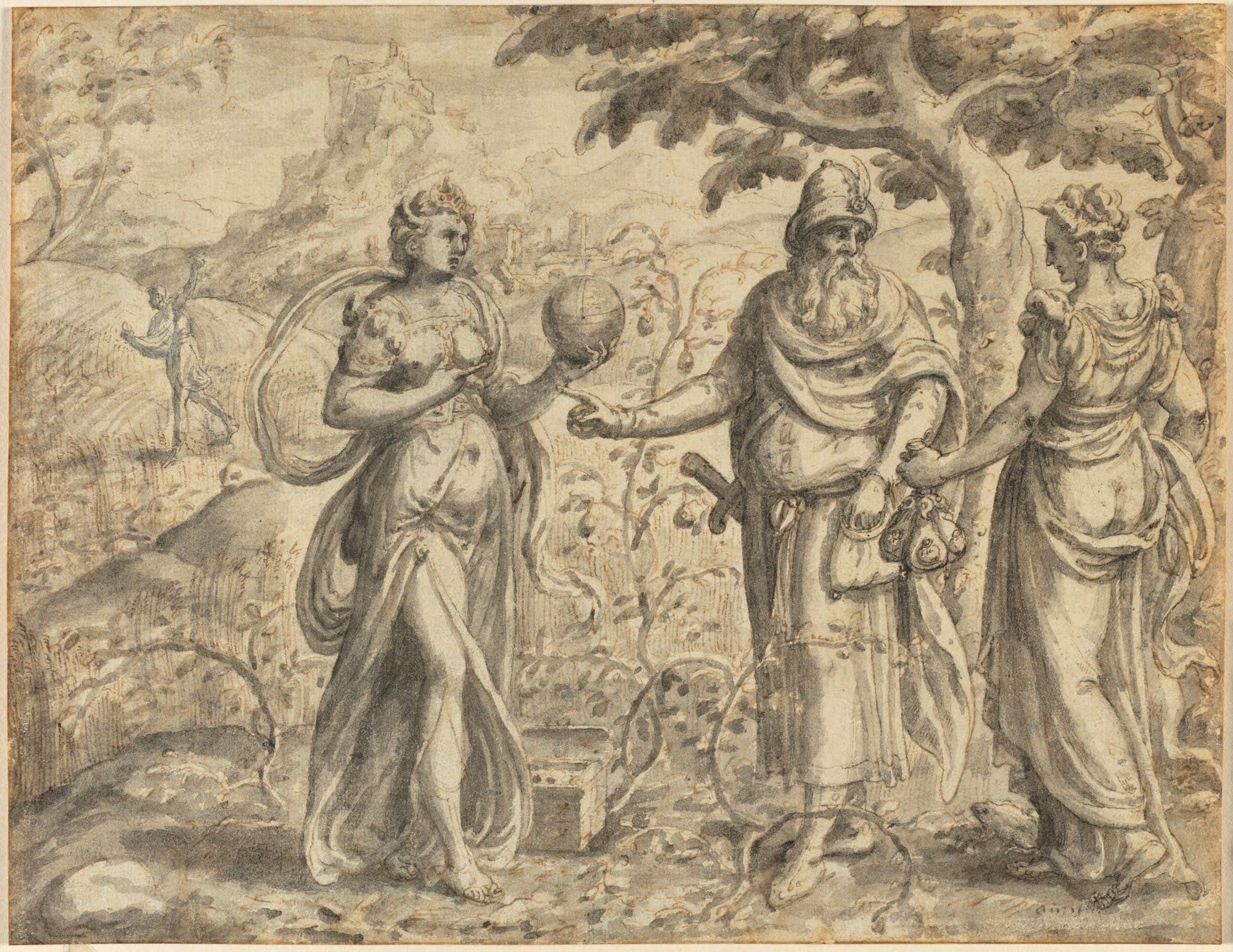
Proverbs 12:25 · Symbol · Anxiety
The Words Merimna and Deagah
Greek names anxious care with merimna and its verb merimnao, and Hebrew with deagah and its verb daag.
Ezekiel was told, “eat your bread with trembling, and drink your water with quivering and anxiety,” as a sign of what those living in Jerusalem would suffer (Ezekiel 12:18 to 19).
Anxiety weighs down the heart of a man, but a good word cheers it up.
- The word
- μέριμνα (merimna), G3308
- First appears
- Matthew 13:22 “The seed sown among the thorns is the…”
Summary
The Greek words name both the worry Jesus forbids and the care Paul praises, so what a care is for decides whether it is right. The Hebrew words name fear that weighs on the heart, from a father's worry over his son to a guilty conscience. A student who knows the words can tell the anxiety Scripture forbids from the concern it commends.
- Jesus' command in Matthew 6:25 and Paul's command in Philippians 4:6 use the same verb, merimnao.
- Paul uses merimnao for Timothy's care for the Philippians and for the care the members of the body owe one another.
- In the parable of the sower the cares of this life choke the word, and the noun there is merimna.
- Adam Clarke derived merimna from a verb for dividing the mind, and Marvin Vincent wrote that this derivation had been abandoned.
Anxious Care in Both Testaments
The vocabulary runs through the canon from Joshua to 1 Peter.
The Words Merimna and Deagah studies the Greek and Hebrew vocabulary of anxiety. It belongs to the trial of anxiety, because these words carry what Scripture means when it forbids worry, names the weight of fear, and praises a right concern.
The question it answers is what each word means and when the same word is blamed or praised. It shows the Greek noun and verb at work in the Gospels and in Paul, traces the two Hebrew words, and weighs an old account of where merimna comes from.
But in fact we have done this for fear that in the future your descendants might say to ours, ‘What have you to do with the LORD, the God of Israel?This is the first verse in the order of the canon where deagah stands, rendered fear, a fear about what the tribes' descendants might one day say.
Where the Words Stand
Merimnao carries nineteen of the forty-one uses.
| Word | Sense in the STEP Bible lexicon | Uses | One use in the Berean words |
|---|---|---|---|
| Hebrew | |||
| deagah, דְּאָגָה, H1674, noun | anxiety | 6 | Jeremiah 49:23, "their anxiety cannot be calmed" |
| daag, דָּאַג, H1672, verb | be anxious | 7 | Jeremiah 17:8, "It does not worry in a year of drought" |
| Greek | |||
| merimna, μέριμνα, G3308, noun | concern | 6 | Luke 8:14, "choked by the worries, riches, and pleasures of this life" |
| merimnao, μεριμνάω, G3309, verb | to worry | 19 | Luke 12:26, "why do you worry about the rest?" |
| promerimnao, προμεριμνάω, G4305, verb | to worry beforehand | 1 | Mark 13:11, "do not worry beforehand what to say" |
| amerimnos, ἀμέριμνος, G275, adjective | untroubled | 2 | 1 Corinthians 7:32, "I want you to be free from concern." |
promerimnao, προμεριμνάω, G4305, verb, amerimnos, ἀμέριμνος, G275, adjective
Merimna, the Cares That Choke
The Greek noun stands in Jesus' teaching on the sower and on the last day, and once in 1 Peter.
but the worries of this life, the deceitfulness of wealth, and the desire for other things come in and choke the word, and it becomes unfruitful.The verse stands for the three Gospel accounts of the parable's explanation, which all use the noun.
Jesus warns in Luke 21:34 that hearts can be “weighed down by dissipation, drunkenness, and the worries of life,” so that the last day springs on them like a snare.
Peter uses the noun once, for the anxiety that believers cast on God.
Merimnao, Forbidden and Praised
The Greek verb is used against worry and for a care Paul commends.
The verb stands six times in Matthew 6:25 to 34.
Jesus uses it of Martha, who was “worried and upset about many things” (Luke 10:41).
Paul uses it in his command “Be anxious for nothing” (Philippians 4:6).
Read the study of The Peace That Surpasses All Understanding
The verb also names a right concern. Paul writes of Timothy, “I have nobody else like him who will genuinely care for your needs” (Philippians 2:20). He wants the members of the body to “have mutual concern for one another” (1 Corinthians 12:25).
But the married man is concerned about the affairs of this world, how he can please his wife, and his interests are divided. The unmarried woman or virgin is concerned about the work of the Lord, how she can be holy in both body and spirit. But the married woman is concerned about the affairs of this world, how she can please her husband.Paul uses the verb for the married and the unmarried alike, so the object of the care sets its worth.
Jerome, as the Catena Aurea of Thomas Aquinas prints him, wrote on Matthew 6:25, “the toil is to be undergone, the anxiety put away.”
Deagah and Daag, the Weight on the Heart
The Hebrew words are used of fear for a son, of a siege and of a guilty conscience.
Proverbs 12:25 is the one verse of the wisdom books where deagah stands. John Gill, in his Exposition of the Old Testament (1748 to 1763), wrote of the anxiety in that proverb that “when it seizes a man's spirits, it depresses them, and keeps them down”.
Then He told me, “Son of man, I am going to cut off the supply of food in Jerusalem. They will anxiously eat bread rationed by weight, and in despair they will drink water by measure.The verse stands here as the first of the three uses of deagah in Ezekiel, each tied to bread and water in the judgment on Jerusalem.
The verb daag is used of Saul's father, who would “stop worrying about the donkeys and start worrying about us” (1 Samuel 9:5). Psalm 38 uses it of a guilty conscience, “I confess my iniquity; I am troubled by my sin” (Psalm 38:18).
Two Accounts of Merimna
The two commentators part on whether the noun means a divided mind.
Merimna is care that divides the mindAdam Clarke
Adam Clarke, in his Commentary on the Bible (1832), wrote on Matthew 6:25 that merimna is “anxious solicitude, from μεριζειν τον νουν dividing or distracting the mind.”
Against this reading, Paul uses the same noun for his own burden in 2 Corinthians 11:28, “the pressure of my concern for all the churches.” That care held his mind to one end.
Merimna is earnest thought, good or bad by its objectMarvin Vincent
Marvin Vincent, in his Word Studies in the New Testament (1886), recorded that the derivation from dividing “has been abandoned”. He placed the word “in a group which carries the common notion of earnest thoughtfulness.”
Against this reading, Paul writes of the married man that “his interests are divided” (1 Corinthians 7:34). The verb there is merizo, to divide, set right after merimnao.
The Object Decides the Care
Each use of these words puts two questions to the reader, what the care is for and in whose hands it is left.
Sources
Scripture is the Berean Standard Bible.
- STEP Bible, Translators Amalgamated Greek New Testament and the tagged Hebrew Bible (Tyndale House, Cambridge), CC BY 4.0.
- STEP Bible brief lexicons of Extended Strongs for Greek and Hebrew (Tyndale House, Cambridge), CC BY 4.0, with the glosses of James Strong, Strong's Exhaustive Concordance of the Bible (1890)
- Marvin R. Vincent, Word Studies in the New Testament (1886), on Matthew 6:25.
- Adam Clarke, Commentary on the Bible (1832), on Matthew 6:25.
- John Gill, Exposition of the Old Testament (1748 to 1763), on Proverbs 12:25.
- Thomas Aquinas, Catena Aurea on the Gospel of Matthew, chapter 6 (English translation, Oxford, 1841), printing Jerome on Matthew 6:25.
Keep Studying
People and groups12