
Genesis 10 · Person · Featured Study
Nimrod and the First Kingdoms
Genesis 10 records Nimrod, a son of Cush, as a mighty hunter whose kingdom held cities in Shinar and Assyria.
Nimrod is the first man in Genesis given a kingdom, and his kingdom began in Babylon.
- Family
- father: Cush; grandfather: Ham; great-grandfather: Noah
- Places
- Babylon, Nineveh
- First named
- Genesis 10:8
- Last named
- Micah 5:6
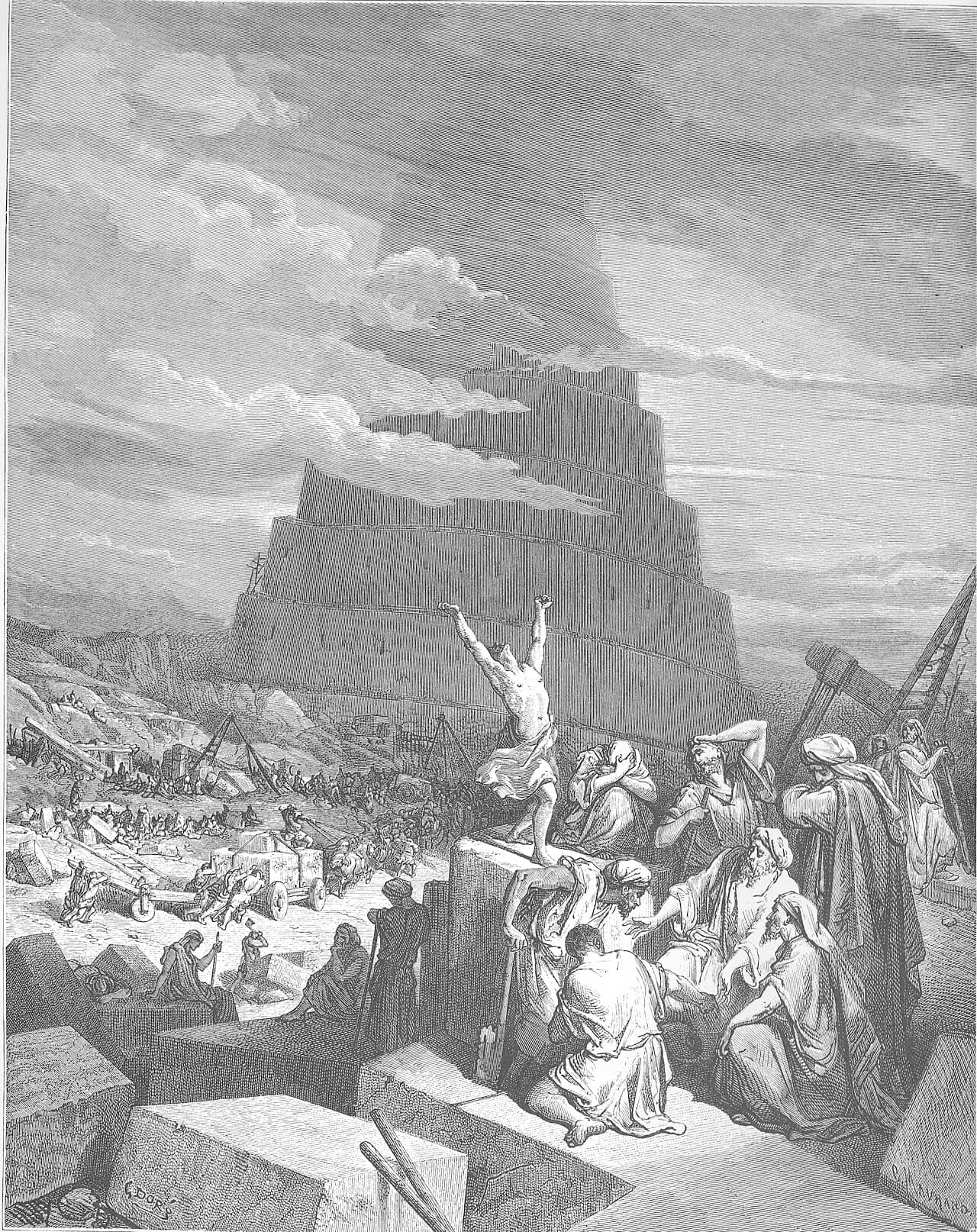
Gustave Doré, The Tower of Babel, Doré's English Bible, 1866. Public domain.
THE ARTWORKDoré engraved the building of the tower on the plain of Shinar, the land of Nimrod's kingdom (Genesis 10:10 and Genesis 11:2); Genesis names no builder of the tower.
Summary
The Table of Nations in Genesis 10 stops its list of names at Nimrod to tell what he did.
- Genesis names four cities of his kingdom in Shinar and four cities he built in Assyria, with Nineveh first.
- Jewish and Christian readers have long joined him to the tower of Genesis 11.
- Micah names the land of Nimrod beside the land of Assyria.
Where Nimrod Stands in Scripture
Four verses in three books name Nimrod.
First Chronicles copies Nimrod's first line word for word.
Cush was the father of Nimrod, who began to be a mighty one on the earth.The Chronicler keeps this one sentence of Nimrod's story in a list that runs from Adam to the chiefs of Edom.
Micah names him last, in a promise against Assyria.
And they will rule the land of Assyria with the sword, and the land of Nimrod with the blade drawn. So He will deliver us when Assyria invades our land and marches into our borders.Nimrod's name has become the name of a land, which the shepherds Micah promises will rule while the LORD delivers His people.
Nimrod, Verse by Verse
Nine rows follow his name, his cities and his land from Genesis to Micah.
- Cush is born to Hamthe line of Ham, Genesis 10:6
- Cush fathers Nimrod, a mighty oneon the earth
- A saying is made of the hunterbefore the LORD, Genesis 10:9
- His kingdom begins in four citiesthe land of Shinar, Genesis 10:10
- He builds four cities in AssyriaNineveh and its neighbours, Genesis 10:11 to 12
- The people settle in Shinarthe plain, Genesis 11:2
- The LORD scatters them from Babelthe city and the tower, Genesis 11:9
- Chronicles repeats his linethe Chronicler's genealogy, 1 Chronicles 1:10
- Micah names the land of NimrodMicah's prophecy
The rows stand in the order of the canon.
From Shinar to Assyria
Genesis 10:8 to 12 gives his rise, his saying and his cities in five verses.
Verses 8 and 9 use the Hebrew word gibbor three times, once for the mighty one and twice for the mighty hunter.
The mighty one and the hunterGenesis 10:8 to 9; Genesis 6:4
Strong's Hebrew lexicon glosses gibbor as powerful, and by implication a warrior or a tyrant, and it glosses tsayid, his hunting, as the chase or the game taken.
The Nephilim were on the earth in those days—and afterward as well—when the sons of God had relations with the daughters of men. And they bore them children who became the mighty men of old, men of renown.Genesis gives the same word gibbor to the mighty men of old before the flood.
Four cities in ShinarGenesis 10:10; Jerome; Radak
His kingdom began in Babylon, Erech, Accad, and Calneh, in the land of Shinar.The verse is the one place Genesis names the cities of his kingdom in Shinar.
Jerome, in his Hebrew Questions on Genesis, places Erech at Edessa, Accad at Nisibis and Calneh at Seleucia or Ctesiphon.
Radak, in his commentary on Genesis in Eliyahu Munk's translation, reads the verse as a conquest that began when Nimrod took Babylon and made himself king there, and went on to more distant lands.
Nineveh and the great cityGenesis 10:11 to 12; Jonah 3:3
From that land he went forth into Assyria, where he built Nineveh, Rehoboth-Ir, Calah, and Resen, which is between Nineveh and the great city of Calah.The list of his cities in Assyria ends on the words the great city, which readers attach to different cities.
Rashi, citing the Talmud at Yoma 10a, takes the great city to be Nineveh, while the Berean text gives the words to Calah.
This time Jonah got up and went to Nineveh, in accordance with the word of the LORD. Now Nineveh was an exceedingly great city, requiring a three-day journey.Jonah's own description of Nineveh is the verse Rashi reads into Genesis 10:12.
What the Text Sets Down
Two details of the wording shape how Nimrod is read.
BABYLON AND BABEL, ONE NAME
His Babylon and the city of the tower bear the one Hebrew name, Babel.
A PROVERB ALREADY IN USE
Genesis introduces the line about the hunter with so it is said, a saying people already repeated.
The Land of Shinar
Shinar recurs in Scripture from Genesis to Zechariah.
Strong's Hebrew lexicon glosses Shinar as a plain in Babylonia, and Babel as Babylon, including Babylonia and the Babylonian empire.
Shinar in the Law, Joshua and IsaiahGenesis 14:1; Joshua 7:21; Isaiah 11:11
In those days Amraphel king of Shinar, Arioch king of Ellasar, Chedorlaomer king of Elam, and Tidal king of GoiimShinar still has a king of its own in Abraham's lifetime.
When I saw among the spoils a beautiful cloak from Shinar, two hundred shekels of silver, and a bar of gold weighing fifty shekels, I coveted them and took them. They are hidden in the ground inside my tent, with the silver underneath.”Goods from Shinar had reached Canaan by Joshua's day.
On that day the Lord will extend His hand a second time to recover the remnant of His people from Assyria, from Egypt, from Pathros, from Cush, from Elam, from Shinar, from Hamath, and from the islands of the sea.Shinar becomes a land of Israel's exile.
Shinar in Daniel and ZechariahDaniel 1:2; Zechariah 5:11
And the Lord delivered into his hand Jehoiakim king of Judah, along with some of the articles from the house of God. He carried these off to the land of Shinar, to the house of his god, where he put them in the treasury of his god.The temple's vessels come to rest in Shinar, the land of Babylon.
“To build a house for it in the land of Shinar,” he told me. “And when it is ready, the basket will be set there on its pedestal.”Zechariah's vision returns wickedness to the land where Babylon stood.
The Family of Nimrod
Genesis 10 gives his forebears, his brothers, his nephews and his uncles.
| Person | Tie to Nimrod |
|---|---|
| Noah | His great-grandfather, whose sons had sons after the flood. |
| Ham | His grandfather, the son of Noah. |
| Cush | His father, the first son of Ham. |
| Seba, Havilah, Sabtah, Raamah, Sabteca | The five sons of Cush named before him. |
| Sheba and Dedan | The sons of his brother Raamah. |
| Mizraim | His uncle, father of the Ludites and of the peoples from whom the Philistines came. |
| Put | His uncle, a son of Ham. |
| Canaan | His uncle, father of Sidon and of the Canaanite clans. |
| Shem | His great-uncle, forefather of the sons of Eber. |
- Person
- Noah
- Tie to Nimrod
- His great-grandfather, whose sons had sons after the flood.
- Person
- Ham
- Tie to Nimrod
- His grandfather, the son of Noah.
- Person
- Cush
- Tie to Nimrod
- His father, the first son of Ham.
- Tie to Nimrod
- The five sons of Cush named before him.
- Person
- Sheba and Dedan
- Tie to Nimrod
- The sons of his brother Raamah.
- Person
- Mizraim
- Tie to Nimrod
- His uncle, father of the Ludites and of the peoples from whom the Philistines came.
- Person
- Put
- Tie to Nimrod
- His uncle, a son of Ham.
- Person
- Canaan
- Tie to Nimrod
- His uncle, father of Sidon and of the Canaanite clans.
- Person
- Shem
- Tie to Nimrod
- His great-uncle, forefather of the sons of Eber.
The Cities of His Kingdom
Genesis names eight cities and two lands in his story.
Erech, Accad and Calneh are the other cities of his kingdom, and Rehoboth-Ir, Calah and Resen the other cities he built.
Questions Nimrod Raises
Readers have asked who built the tower, who went into Assyria, which land bears his name, and what the midrash adds.
Did Nimrod build the tower of Babel?Genesis 11:2; Matthew Henry; John Gill
And as people journeyed eastward, they found a plain in the land of Shinar and settled there.Shinar is the one link the text draws between the tower and Nimrod's kingdom.
“And they arose and came from the land of the east; and, as they went through the land, they chanced upon the land of Shinar, which was exceeding broad; where they took in hand to build a tower. They sought means thereby to go up to heaven, and be able to leave their work as a memorial to those men who should come after them.”
Irenaeus · The Demonstration of the Apostolic Preaching · on Genesis 11:4Patristic
Matthew Henry, in his Commentary on the Whole Bible, thinks it probable that the band of ambitious Nimrod was in the work. John Gill, in his Exposition of the Old Testament, reports Jewish writers who put the words of Genesis 11:4 in Nimrod's mouth. He asks whether Nimrod was yet born, or old enough to lead such a people.
The tower itself, its building and its scattering, is taught on the Tower of Babel page.
Who went into Assyria, Nimrod or Asshur?Genesis 10:11; Jamieson, Fausset and Brown; Rashi
The King James Version reads that Asshur went out of that land and built Nineveh, and the Berean text reads that Nimrod went into Assyria.
“This raid into Assyria was an invasion of the territories of Shem, and hence the name ‘Nimrod,’ signifying ‘rebel,’ is supposed to have been conferred on him from his daring revolt against the divine distribution.”
Jamieson, Fausset & Brown · Commentary Critical and Explanatory on the Whole Bible · on Genesis 10:11Reformed
Rashi, in his commentary on the Torah after Genesis Rabbah 37:4, reads Asshur the son of Shem as the subject, who left the land when he saw his sons follow Nimrod.
Which land is the land of Nimrod?Micah 5:6; Rashi; Adam Clarke
Rashi on Micah, in the Judaica Press translation by A. J. Rosenberg, says that the land of Nimrod is Babylon. Adam Clarke, in his Commentary on the Bible, counts both Assyria, with its capital Nineveh, and Babylon as the land of Nimrod.
What does the midrash add?Rashi on Genesis 14:1 and 27:15
These are readings of the midrash, and Genesis itself tells neither story.
What Genesis Leaves Unsaid
Genesis leaves his family, his years, his worship and his hunting unrecorded.
Genesis names no mother, wife or son of Nimrod, and gives him no age and no death.
It says nothing of his worship, and it does not say what he hunted or whom.
Where His Kingdom Leads in Scripture
Two cities of his kingdom return in the Prophets.
“Get up! Go to the great city of Nineveh and preach against it, because its wickedness has come up before Me.”The city Nimrod built stands under the LORD's judgment in the days of Jonah.
the king exclaimed, “Is this not Babylon the Great, which I myself have built by the might of my power as a royal residence and for the glory of my majesty?”Babylon, Nimrod's city, is the city whose king the Most High humbles for this boast.
Voices on Nimrod, Earliest First
Readers from Jerome to Wesley saw a tyrant in Nimrod.
“The same spirit that the giants before the flood were acted by, chap. vi, 4, now revived in him; so soon was that tremendous judgment, which the pride and tyranny of those mighty men brought upon the world, forgotten.”
John Wesley · Explanatory Notes upon the Old Testament · on Genesis 10:8Evangelical
Jerome on the first tyrannyHebrew Questions on Genesis
Jerome, in his Hebrew Questions on Genesis, says that Nimrod first seized an unprecedented tyranny among the people and reigned in Babylon.
The head of gold and the TargumJohn Wesley; the Targum in Adam Clarke
Wesley, in his Explanatory Notes upon the Old Testament, says on Genesis 10:10 that Nimrod laid the foundations of a monarchy that was afterwards a head of gold. The words are Daniel's to Nebuchadnezzar in Daniel 2:38.
Adam Clarke, in his Commentary on the Bible at 1 Chronicles 1:10, gives the Targum's reading that Nimrod began to be bold in sin, a murderer of the innocent and a rebel before the LORD.
What Does Before the LORD Mean?
Jamieson, Fausset and Brown read the words as renown, and Rashi and Matthew Henry read them as defiance.
The words before the LORD stand twice in the verse about the hunter, once in the narrator's line and once in the saying.
A hunter of renownJamieson, Fausset and Brown, 1871
Jamieson, Fausset and Brown, in their Commentary Critical and Explanatory on the Whole Bible, read his hunting of wild beasts as a useful service. In their reading it earned the people's gratitude, and from it he founded the first kingdom in the world.
The objection is that Genesis calls his hunting no service to anyone and records no gratitude.
A hunter against the LORDRashi after Genesis Rabbah 37:2; Matthew Henry, 1710
Rashi reads the mighty one of verse 8 as mighty in leading the world to rebel against God by the plan of the tower. He reads the hunter of verse 9 as one who ensnared people's minds by his words.
“Note, Great conquerors are but great hunters. Alexander and Cesar would not make such a figure in scripture-history as they do in common history; the former is represented in prophecy but as a he-goat pushing, Dan. viii. Nimrod was a mighty hunter against the Lord, so the LXX; that is, (1.) He set up idolatry, as Jeroboam did, for the confirming of his usurped dominion.”
Matthew Henry · Commentary on the Whole Bible · on Genesis 10:8 to 10Puritan
The objection is that Genesis states no sin of Nimrod's in these verses.
Books to Read Next
Six works treat the verses on Nimrod.
The Demonstration of the Apostolic Preaching
Irenaeus · 202
Irenaeus treats Genesis 11:4 in his retelling of the history after the flood.
Hebrew Questions on Genesis
Jerome · about 391
Jerome works through Genesis verse by verse, from the sons of Ham to the cities of Nimrod.
Commentary on the Torah
Rashi, translated by M. Rosenbaum and A. M. Silbermann · 1929 to 1934
Rashi gathers the midrash on the generation of the tower in his notes on Genesis 10 and 11.
In print: find it wherever books are sold.
Commentary on the Whole Bible
Matthew Henry · 1710
Henry comments on Genesis 10 and 11 together, from Nimrod to the scattering.
Explanatory Notes upon the Old Testament
John Wesley · 1765
Wesley writes brief notes on Genesis 10 and 11, verse by verse.
Commentary Critical and Explanatory on the Whole Bible
Jamieson, Fausset and Brown · 1871
The commentary treats Nimrod in two notes on Genesis 10.
The Ruler from Bethlehem and the Land of Nimrod
Micah sets against the land of the mighty hunter a ruler from Bethlehem, who will shepherd His flock in the strength of the LORD and will be the peace of His people. Matthew quotes the promise of that ruler in his account of the birth of Jesus in Bethlehem.
The text asks the reader to look for safety in the strength of the LORD and in His shepherd, and to trust Christ as that peace.
Keep studying
Studies8
Peoples and groups3