
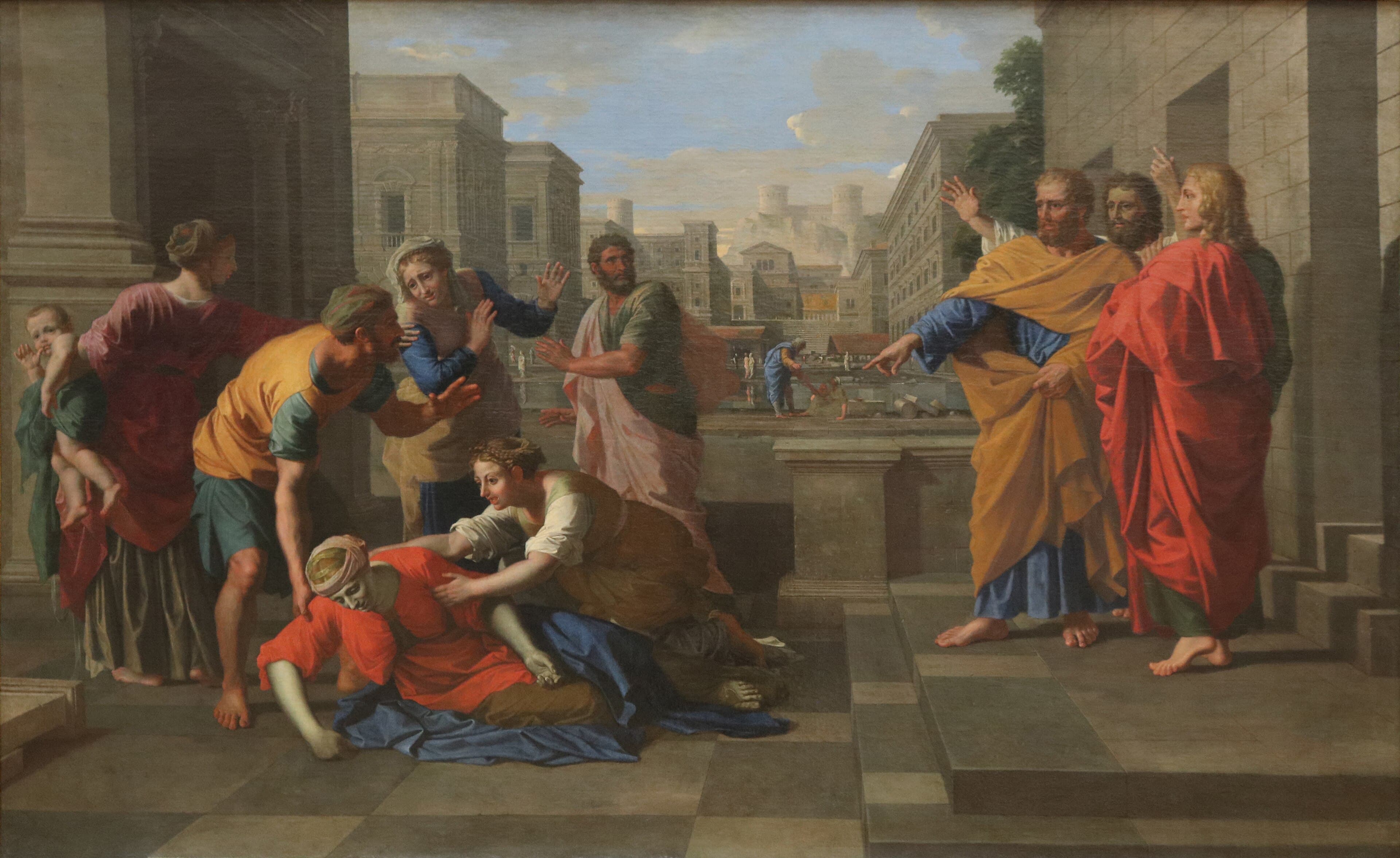
Acts 5:1 to 11 · Story · Truthfulness
Ananias and Sapphira
Luke tells in Acts 5:1 to 11 how a husband and wife of the Jerusalem church died after they lied about the price of a field.
The first sin Acts records among the believers after Pentecost was a lie about a gift.
Did it not belong to you before it was sold? And after it was sold, was it not at your disposal? How could you conceive such a deed in your heart? You have not lied to men, but to God!”
- Where
- Jerusalem
- Who
- Peter
- When
- After Pentecost, in the days of the shared goods of Acts 4:32 to 37
Summary
Ananias and Sapphira belonged to the church in Jerusalem in the days when its members shared their goods. Ananias and his wife Sapphira sold a piece of property, agreed between them to keep some of the money for themselves, and brought the rest to the apostles as though it were all. Peter exposed the deception, first to the husband and later to the wife, and each of them died at once.
- Giving land in the Jerusalem church was a free act, so the couple's sin lay in passing off a portion as the whole price.
- Acts 5:11 is the first verse of Acts where the Greek text names the believers the ekklesia, the church.
- Teachers of the church from the fourth century on have read Peter's charges as a witness that the Holy Spirit is God.
A Field Sold in Jerusalem
The verses before Acts 5 show the custom the couple copied.
Ananias and Sapphira tells of a lie told inside the first church and of what it cost. It belongs to the value of truthfulness because the deed Luke records is a false word and a false show, and the account turns on who was deceived.
The question the story answers is why a lie about a gift met so severe an end, and what it teaches about the God the believers served. The study sets the account in order, explains the Greek words Luke chose and sets the couple beside Achan at Jericho. It then names what Acts leaves unsaid and gives two readings of the couple's standing, with the voices of the church's teachers.
There were no needy ones among them, because those who owned lands or houses would sell their property, bring the proceeds from the sales, and lay them at the apostles’ feet for distribution to anyone as he had need.The apostles gave to each as he had need, so a gift laid at their feet was a gift to the poor.
Luke names one giver before the couple, "Joseph, a Levite from Cyprus, whom the apostles called Barnabas (meaning Son of Encouragement)" (Acts 4:36).
The Account in Nine Steps
Luke moves from a gift laid at the apostles' feet to two burials in one place.
Luke sets one honest gift before two deaths on the same day.
- Barnabas gives the price of a field"sold a field he owned, brought the money"Acts 4:37
- Ananias and Sapphira sell land"also sold a piece of property"Acts 5:1
- Ananias keeps some of the money with his wife's knowledge"he kept back some of the proceeds for himself"Acts 5:2
- Ananias dies when Peter has spoken"Ananias fell down and died"Acts 5:5
- The young men bury him"wrapped up his body, and carried him out"Acts 5:6
- Sapphira comes in, not knowing"About three hours later his wife also came in"Acts 5:7
- Peter asks her the price, and she gives it"“Yes,” she answered, “that is the price.”"Acts 5:8
- Sapphira dies and is buried beside her husband"buried her beside her husband"Acts 5:10
- Fear falls on the church and on all who hear"great fear came over the whole church"Acts 5:11
A timeline of nine steps from Acts 4:37 to Acts 5:11, each with Luke's words in the Berean text and its verse.
Peter asks her the price, and she gives it, Sapphira dies and is buried beside her husband, Fear falls on the church and on all who hear
His Own to Keep
Two commentators of the eighteenth and nineteenth centuries draw the lesson of Peter's questions for the church and for every reader.
Albert Barnes, in his Notes, Explanatory and Practical (1832 to 1869), wrote that Acts 5:4 "proves that there was no “obligation” imposed on the disciples to sell their property". He added that "it does not appear that it was done by all, or expected to be done by all".
Matthew Henry, in his Commentary on the Whole Bible (1710), carried the fault to every reader. He wrote that those who "make the good works they do more or better than really they are, come under the guilt of Ananias's lie".
Keeping Back, Lying and Testing
Luke's verbs for keeping back, lying and testing each carry part of the charge.
The verb for keeping back is nosphizomai, which the STEP Bible lexicon of Tyndale House glosses "to sequestrate for oneself, i.e. embezzle". It occurs three times in the New Testament, in Acts 5:2, Acts 5:3 and Titus 2:10, where slaves are told to be "not stealing from them".
Peter's charge of lying uses pseudomai, a verb of twelve uses in the New Testament. To Sapphira he used a second verb, peirazo, to test, which occurs thirty-seven times.
“How could you agree to test the Spirit of the Lord?” Peter replied. “Look, the feet of the men who buried your husband are at the door, and they will carry you out also.”Peter's word to the wife names the couple's agreement as a trial of the Spirit's patience, and it foretells her death.
Achan at Jericho
Commentators set the couple beside a man of Judah who hid part of the plunder devoted to the LORD.
The Israelites, however, acted unfaithfully regarding the things devoted to destruction. Achan son of Carmi, the son of Zabdi, the son of Zerah, of the tribe of Judah, took some of what was set apart. So the anger of the LORD burned against the Israelites.Joshua records a theft of devoted goods at the start of Israel's life in the land, as Acts 5 stands at the start of the church's.
Acts makes no mention of Achan, so the pairing is a reading of the commentators. Jamieson, Fausset and Brown (1871) wrote that the fear of Acts 5:11 "was the chief design of so startling a judgment; which had its counterpart, as the sin itself had, in Achan".
What Luke Leaves Unsaid
Acts leaves four matters of the account unrecorded.
Luke names no cause of either death. He records the deaths and their timing and adds no account of how they came.
Luke records no one going to Sapphira in the hours before she came in, and he gives no reason why no one did.
Acts gives the couple two names and one field. Their family, their home and how long they had believed are left unrecorded.
Acts says nothing of where the two stand before God after death.
Lying to the Holy Spirit
Peter's first question to Ananias names the person the couple had deceived.
Then Peter said, “Ananias, how is it that Satan has filled your heart to lie to the Holy Spirit and withhold some of the proceeds from the land?Peter places the source of the lie in Satan and its target in the Holy Spirit, the Spirit poured out on the church at Pentecost.
Basil of Caesarea, in his treatise On the Holy Spirit (chapter 16), set Peter's words to Sapphira beside his words to her husband. He wrote that they "show that sins against the Holy Spirit and against God are the same".
Voices on Acts 5
Gregory of Nyssa and Jerome each read the account inside a work written on a wider subject.
died 395 · Gregory of Nyssa
Gregory of Nyssa, in his treatise On "Not Three Gods" (fourth century), answers how Peter came to know a deed done in private.
Read the page on Gregory of Nyssa
“For Ananias became a thief of his own goods, secretly, as he thought, from all men, and concealing his sin: but the Holy Spirit at the same moment was in Peter, and detected his intent, dragged down as it was to avarice, and gave to Peter from Himself the power of seeing the secret, while it is clear that He could not have done this had He not been able to behold hidden things.”
Gregory of Nyssa · On 'Not Three Gods' · on Acts 5:3Patristic
died 420 · Jerome
Jerome, in his Letter 130 (fifth century), answers a critic who blamed the apostle for the two deaths, and he names the motive he saw behind the deed.
“For having made a vow they offered their money to God as if it were their own and not his to whom they had vowed it; and keeping back for their own use a part of that which belonged to another, through fear of famine which true faith never fears, they drew down on themselves suddenly the avenging stroke, which was meant not in cruelty toward them but as a warning to others. In fact, the apostle Peter by no means called down death upon them, as Porphyry foolishly says.”
Jerome · LETTER 130.14 · on Acts 5:3Patristic
Were Ananias and Sapphira Believers?
John Wesley and Adam Clarke placed the couple on opposite sides of the line between the church and the world.
The question is whether the couple belonged to the believers whose gifts they copied or stood outside them.
Strangers to the faith they copiedJohn Wesley
John Wesley, in his Explanatory Notes upon the New Testament (1755), held that Ananias was no believer. He wrote, "It is certain, not a believer, for all that believed were of one heart and of one soul: probably not baptized".
The objection: Luke counts the couple among the givers whose gifts came to the apostles (Acts 5:1 to 2), and Peter speaks to them as members of the church.
They professed faith with the restAdam Clarke
Adam Clarke wrote that "Ananias and Sapphira were evidently persons who professed faith in Christ with the rest of the disciples". On their end he reported that "most seem inclined to hope" that "mercy was extended to their souls".
The objection: Acts records no repentance from either of them, and Peter's question to Sapphira gave her room to tell the truth, which she did not take.
Nothing Concealed
Two texts outside Acts explain how a private deed came to light.
There is nothing concealed that will not be disclosed, and nothing hidden that will not be made known. What you have spoken in the dark will be heard in the daylight, and what you have whispered in the inner rooms will be proclaimed from the housetops.Jesus spoke the saying to His disciples before the cross, and Acts 5 shows it at work within the church.
Nothing in all creation is hidden from God’s sight; everything is uncovered and exposed before the eyes of Him to whom we must give account.The letter names the One who sees every deed, the One the couple tried to deceive.
Acts 5:13 to 14 records what came next: "no one else dared to join them", and yet "more and more believers were brought to the Lord".
Sources
Scripture is the Berean Standard Bible.
- STEP Bible, Translators Amalgamated Greek New Testament, the tagged Greek text (Tyndale House, Cambridge), CC BY 4.0.
- STEP Bible TBESG lexicon of Extended Strongs for Greek (Tyndale House, Cambridge), CC BY 4.0, based on Abbott-Smith, Manual Greek Lexicon of the New Testament (1922)
- Albert Barnes, Notes, Explanatory and Practical, on the Old and New Testaments (1832 to 1869), on Acts 5:4.
- Matthew Henry, Commentary on the Whole Bible (1710), on Acts 5:4.
- Adam Clarke, Commentary on the Bible (1832), on Acts 5:2 and 5:10.
- Robert Jamieson, A. R. Fausset and David Brown, Commentary Critical and Explanatory on the Whole Bible (1871), on Acts 5:11.
- Basil of Caesarea, On the Holy Spirit, chapter 16, section 37, Nicene and Post-Nicene Fathers, second series, vol. 8.
- Gregory of Nyssa, On "Not Three Gods", Nicene and Post-Nicene Fathers, second series, vol. 5.
- Jerome, Letter 130, section 14, Nicene and Post-Nicene Fathers, second series, vol. 6.
- John Wesley, Explanatory Notes upon the New Testament (1755), on Acts 5:1.