
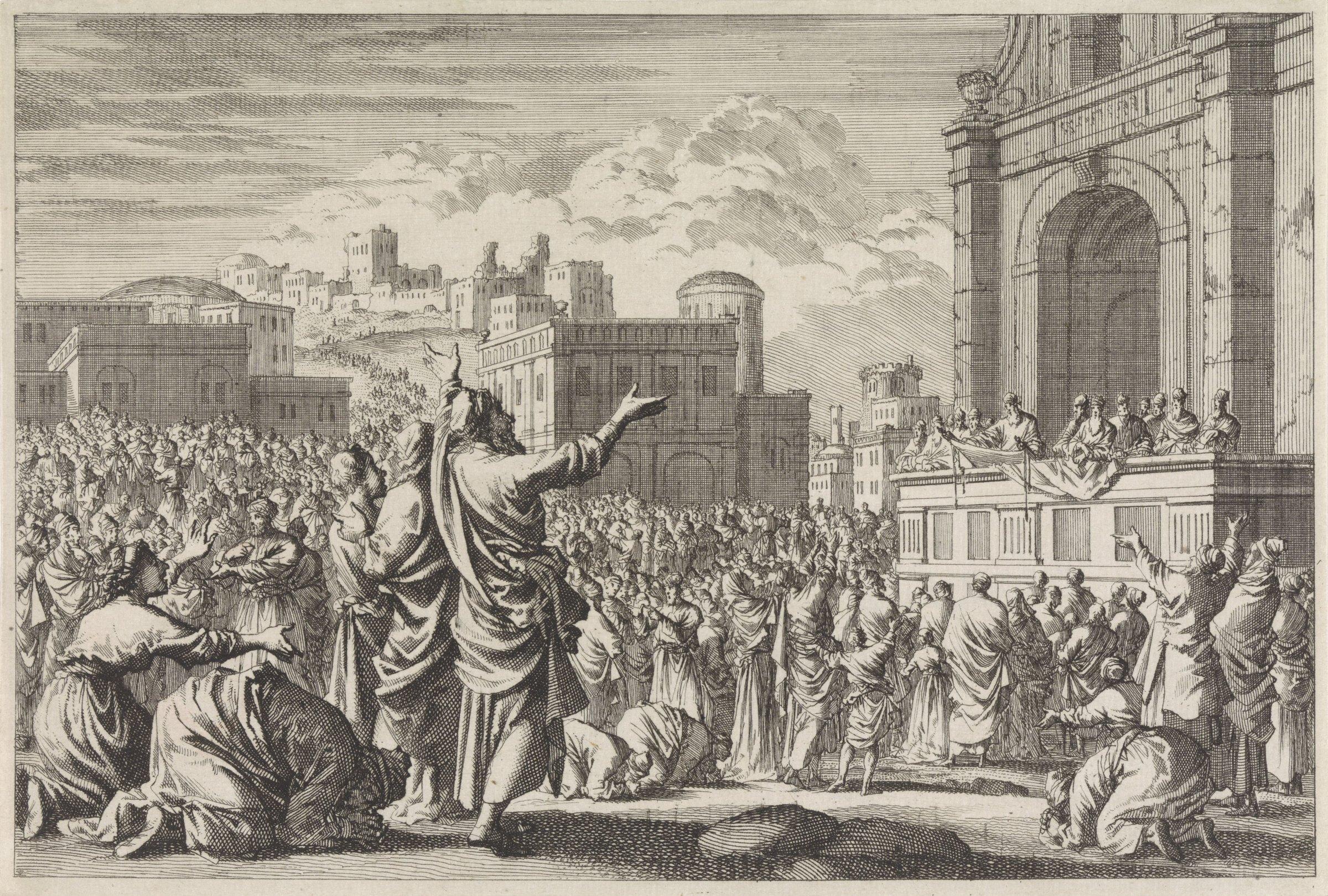
Jan Luyken, Ezra Reads the Laws of Moses in Public, 1700. CC0.
Nehemiah 9:1 to 37 · Passage · Featured Study
Israel's History Retold in Prayer
In Nehemiah 9 the Levites led Israel in a prayer that tells its history from creation to Persian rule.
But in Your great compassion, You did not put an end to them; nor did You forsake them, for You are a gracious and compassionate God.
- The passage
- Nehemiah 9:1 to 5, Nehemiah 9:6 to 8, Nehemiah 9:16 to 21, Nehemiah 9:26 to 31, Nehemiah 9:32 to 37, Exodus 34:6, Leviticus 18:5
- Books
- Nehemiah, Exodus, Leviticus
- When
- on the twenty-fourth day of the seventh month
- Hold in memory
- Nehemiah 9:29, Nehemiah 9:17, Nehemiah 9:33
A people in sackcloth called God just in all that had come upon them.
Summary
Three weeks after Ezra first read the Law, the Israelites gathered to fast and confess. The prayer the Levites led sets each wrong of Israel's past beside God's compassion. It ends by asking God to see the hardship of a people ruled by foreign kings.
- The prayer moves through eight stages of Israel's story.
- It calls God gracious and compassionate in the words of Exodus 34:6.
- Keil, Bertheau and Batten give the prayer three different speakers.
The Day of Confession
The fast came on the twenty-fourth day of the seventh month.
The people gathered in sackcloth with dust on their heads, and those of Israelite descent stood apart from the foreigners.
While they stood in their places, they read from the Book of the Law of the LORD their God for a quarter of the day, and they spent another quarter of the day in confession and worship of the LORD their God.The reading of the Law came before the confession.
Eight Levites then called the people to praise, and the prayer follows.
The Eight Stages of the Prayer
The prayer follows Israel's story in order.
Each stage sets what God did beside what Israel did.
| Stage | What God did | What Israel did |
|---|---|---|
| Creation | Made the heavens, the earth and the seas, and gives life to all things | The host of heaven worships Him |
| Abraham | Chose Abram, renamed him and made a covenant to give the land | His heart was found faithful |
| Egypt and the sea | Saw the affliction, sent signs against Pharaoh and divided the sea | The fathers cried out at the Red Sea |
| Sinai and the wilderness | Gave laws, bread from heaven, water from the rock and His good Spirit | They grew stiff-necked and cast a calf |
| The land | Gave kingdoms and subdued the Canaanites | They ate, were filled and grew fat |
| Deliverers | Gave them up to enemies and sent deliverers when they cried out | They killed the prophets and did evil again after rest |
| Prophets and exile | Warned them by His Spirit through the prophets for many years | They would not listen |
| The plea | Is just in all that has come upon them | Slaves in the land given to their fathers |
Prophets and exile, The plea
The Refrain of Compassion
Five times the prayer turns from Israel's sin to God's compassion.
After each failure the prayer names God's compassion again.
| Israel's sin | God's answer |
|---|---|
| A leader appointed to return to Egypt | A forgiving God, gracious and compassionate |
| An image of a calf | Great compassion in the wilderness |
| Disobedience and the prophets killed | Great compassion and deliverers |
| Evil done again after rest | Deliverance many times |
| Years of refusing the prophets | No end made of them |
The refrain takes up the name the LORD proclaimed to Moses on Sinai.
Then the LORD passed in front of Moses and called out: “The LORD, the LORD God, is compassionate and gracious, slow to anger, abounding in loving devotion and faithfulness,The prayer keeps four of these five terms.
The Law in the Prayer
The prayer draws its words from the books of Moses.
Nehemiah 9:29 calls the ordinances of God the ones by which a man will live if he practices them. The phrase comes from the Law of Moses.
Keep My statutes and My judgments, for the man who does these things will live by them. I am the LORD.Ezekiel 20:11, Romans 10:5 and Galatians 3:12 repeat the line.
The leader the prayer speaks of recalls the people's words in Numbers 14:4. Albert Barnes notes that the Septuagint, the old Greek translation, and several manuscripts read "in Egypt" where the Hebrew reads "in their rebellion", two words that differ by one letter. The Berean text follows the reading in Egypt.
So they said to one another, “Let us appoint a leader and return to Egypt.”Numbers records the plan, and the prayer records it as done.
What the Prayer Leaves Unsaid
The prayer leaves three things out of its long story.
It names none of the deliverers and none of the prophets it speaks of.
It names no king of Israel or Judah, and it passes over David and the temple.
It dates the hardship from the kings of Assyria and never names Babylon.
Scripture's Other Retellings
Psalms, the prophets and Acts also tell Israel's history back to God or to the people.
Psalm 106 also confesses the sins of the fathers, from Egypt and the Red Sea to captivity among the nations.
We have sinned like our fathers; we have done wrong and acted wickedly. Our fathers in Egypt did not grasp Your wonders or remember Your abundant kindness; but they rebelled by the sea, there at the Red Sea.Like Nehemiah 9, the psalm joins the present generation to the fathers' sin.
Daniel's prayer and the plea of Nehemiah 9:32 open alike.
And I prayed to the LORD my God and confessed, “O, Lord, the great and awesome God, who keeps His covenant of loving devotion to those who love Him and keep His commandments, we have sinned and done wrong. We have acted wickedly and rebelled. We have turned away from Your commandments and ordinances.Daniel counts himself among those who sinned, as the Levites do.
L. W. Batten names the speech of Stephen in Acts 7 as the New Testament parallel to the prayer.
And Stephen declared: “Brothers and fathers, listen to me! The God of glory appeared to our father Abraham while he was still in Mesopotamia, before he lived in Haran,Stephen's history begins with Abraham, where the prayer's second stage begins.
Voices on the Prayer
Matthew Henry commented on the prayer's account of Abraham.
Matthew Henry (1662 to 1714)
Commentary on the Whole Bible
The faith of Abraham in Nehemiah 9:8 drew this comment.
“And this covenant was sure, for God found Abraham's heart faithful before God, and found it so because he made it so (for faith is not of ourselves, it is the gift of God), and therefore performed his words; for with the upright he will show himself upright, and wherever he finds a faithful heart he will be found a faithful God.”
on Nehemiah 9:8Puritan
Who Spoke the Prayer?
Readers have given the prayer to the whole people, to Ezra, and to a writer of another source.
Then the Levites—Jeshua, Kadmiel, Bani, Hashabneiah, Sherebiah, Hodiah, Shebaniah, and Pethahiah—said, “Stand up and bless the LORD your God from everlasting to everlasting: Blessed be Your glorious name, and may it be exalted above all blessing and praise.The Levites led the whole peopleC. F. Keil
C. F. Keil holds that the prayer is the confession of the whole congregation. It speaks of our fathers and says we have sinned, and it begins as address to God in the last clause of Nehemiah 9:5.
Against this reading, Ernst Bertheau and L. W. Batten both hold that the prayer is the speech of one man.
Ezra spoke itThe Septuagint; Ernst Bertheau, as Keil reports him
The Septuagint sets the words and Ezra said before the prayer. Keil reports that Bertheau accepted them as part of the original Hebrew text.
Against this reading, Keil calls the added words a conjecture of the translators, and Batten holds that the note led readers to tie the prayer wrongly to Ezra.
A prayer from another sourceL. W. Batten
L. W. Batten finds the prayer quite unlike Ezra's confession in Ezra 9. He holds that it came from an individual and from another source, and that it may be a late insertion.
Against this reading, Keil points to the prayer's own words, our fathers and we have sinned, as the voice of the whole congregation.
Books to Read Next
Both works are in the public domain, and each has a free copy to read.
The Books of Ezra, Nehemiah, and Esther
C. F. Keil, translated by Sophia Taylor · 1873
Keil compares the call of Nehemiah 9:5 with the openings of Psalms 105 and 106 on page 238.
Read at the Internet ArchiveA Critical and Exegetical Commentary on the Books of Ezra and Nehemiah
L. W. Batten · 1913
Batten compares the prayer with Ezra 9 and with Stephen's speech on page 365.
Read at the Internet ArchiveA Gracious and Compassionate God
The last stage turns from history to a plea for the present.
So now, our God, the great and mighty and awesome God who keeps His gracious covenant, do not view lightly all the hardship that has come upon us, and upon our kings and leaders, our priests and prophets, our ancestors and all Your people, from the days of the kings of Assyria until today.The plea opens with the name of God that Nehemiah 1:5 also uses.
Sources
Scripture is the Berean Standard Bible.
- C. F. Keil, The Books of Ezra, Nehemiah, and Esther, translated by Sophia Taylor, T. and T. Clark, 1873, pp. 237 to 238.
- L. W. Batten, A Critical and Exegetical Commentary on the Books of Ezra and Nehemiah, International Critical Commentary, 1913, p. 365.
- Albert Barnes, Notes, Explanatory and Practical, on the Old and New Testaments, 1832 to 1869, on Nehemiah 9:17.
- Matthew Henry, Commentary on the Whole Bible, on Nehemiah 9:8.
Keep Studying
Studies1
People and groups5
Symbols1
Go further2