
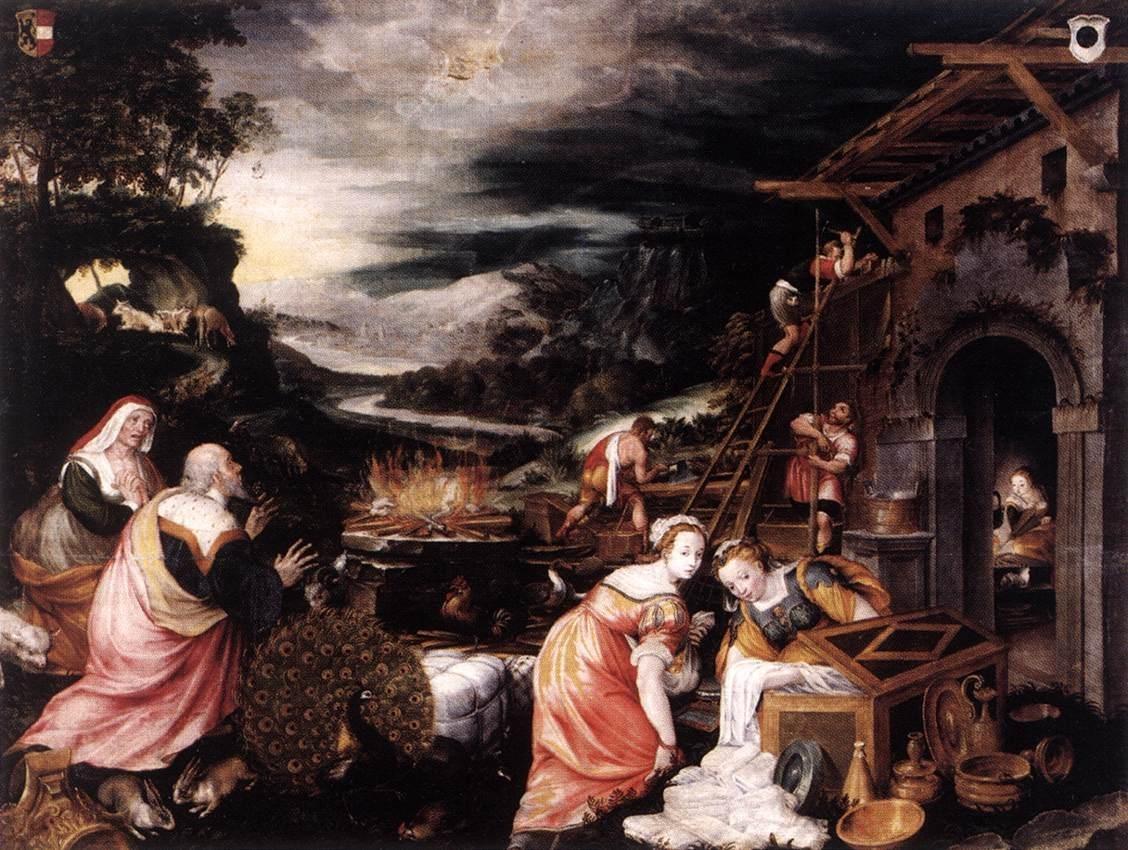
Hans Caspar Memberger the Elder, Noah's Sacrifice of Thanksgiving, 1588. Public domain.
Ezekiel 14 · Passage · Featured Study
Noah, Daniel and Job at Ezekiel 14:14
The oracle names three righteous men whose righteousness would save them alone.
then even if these three men—Noah, Daniel, and Job—were in it, their righteousness could deliver only themselves, declares the Lord GOD.
- The passage
- Ezekiel 14:12 to 23, Jeremiah 15:1, Ezekiel 28:3
- Books
- Ezekiel, Jeremiah
- When
- between the sixth and the seventh year of the exile
- Hold in memory
- Ezekiel 14:14, Ezekiel 18:20
In their own stories Noah, Daniel and Job each saved others, and in Ezekiel 14 each could deliver only himself.
Summary
Ezekiel 14:12 to 23 tries one rule against four judgments on a faithless land. Then it turns the rule on Jerusalem. A few survivors are brought out to the exiles, and their ways show the exiles that the judgment had cause.
- Ezekiel names Daniel once more, for his wisdom, in Ezekiel 28:3.
- Justin Martyr's copy of the verse named Jacob where the Hebrew names Job.
- Daniel had been in Babylon since the third year of King Jehoiakim (Daniel 1:1).
Four Cases and One Answer
The LORD swears the same oath after each of four judgments.
Then some of the elders of Israel came and sat down before me. And the word of the LORD came to me, saying, “Son of man, these men have set up idols in their hearts and put wicked stumbling blocks before their faces. Should I consult with them in any way?The setting shows to whom the rule was first spoken.
“Son of man, if a land sins against Me by acting unfaithfully, and I stretch out My hand against it to cut off its supply of food, to send famine upon it, and to cut off from it both man and beast,The first case sets out the rule the other three repeat.
Ezekiel 14:15 to 19 adds wild beasts, the sword and plague.
then as surely as I live, declares the Lord GOD, even if Noah, Daniel, and Job were in it, they could not deliver their own sons or daughters. Their righteousness could deliver only themselves.The fourth case names the three men again and ends the series.
What Each Man Did for Others
Genesis, Daniel and Job each record a rescue the man won for others.
In his own book each man is the reason others were spared.
| Man | Whom he saved in his own story | In Ezekiel 14 |
|---|---|---|
| Noah | His household, brought into the ark with him | Himself alone |
| Daniel | The wise men of Babylon, spared at his word | Himself alone |
| Job | His three friends, for whom he prayed | Himself alone |
Survivors Brought Out
Ezekiel 14:21 to 23 turns the four cases on Jerusalem itself.
For this is what the Lord GOD says: ‘How much worse will it be when I send against Jerusalem My four dire judgments—sword, famine, wild beasts, and plague—in order to cut off from it both man and beast?The rule now falls on the city the exiles still trusted.
Yet, behold, some survivors will be left in it—sons and daughters who will be brought out. They will come out to you, and when you see their conduct and actions, you will be comforted regarding the disaster I have brought upon Jerusalem—all that I have brought upon it. They will bring you consolation when you see their conduct and actions, and you will know that it was not without cause that I have done all these things within it,’ declares the Lord GOD.”The oracle ends with what the exiles will learn.
Jamieson, Fausset and Brown read the survivors as guilty people carried into exile. Adam Clarke read them as captives whose account of the city's sins would show the judgment was just.
Moses and Samuel, and the Ten in Sodom
Two other passages set the prayers of the righteous against the fate of a city.
Then the LORD said to me: “Even if Moses and Samuel should stand before Me, My heart would not go out to this people. Send them from My presence, and let them go.Jeremiah heard the rule in Jerusalem while Ezekiel spoke it to the exiles.
Finally, Abraham said, “May the Lord not be angry, but let me speak once more. Suppose ten are found there?” And He answered, “On account of the ten, I will not destroy it.”Abraham's last plea shows how few righteous could once spare a city.
What the Oracle Leaves Open
The oracle names the men's righteousness and leaves their prayers to the reader.
Matthew Henry supposed that the three are pictured praying for the land.
I searched for a man among them to repair the wall and stand in the gap before Me on behalf of the land, so that I should not destroy it. But I found no one.A later oracle names the intercessor the LORD looked for.
A Righteousness That Delivers Many
The rule holds for every person, and Paul names one man whose obedience reaches many.
The soul who sins is the one who will die. A son will not bear the iniquity of his father, and a father will not bear the iniquity of his son. The righteousness of the righteous man will fall upon him, and the wickedness of the wicked man will fall upon him.Ezekiel 18 makes the rule of chapter 14 a rule for every household.
For just as through the disobedience of the one man the many were made sinners, so also through the obedience of the one man the many will be made righteous.The verse gives the answer that Ezekiel 14 leaves open.
Therefore He is able to save completely those who draw near to God through Him, since He always lives to intercede for them.Hebrews points to Christ as the intercessor for His people.
How the Three Men Have Been Read
Jerome and Matthew Henry wrote thirteen centuries apart on what the rule means for the righteous.
Jerome (died 420)
Commentary on Ezekiel
Jerome read the four judgments with the law of Deuteronomy 24:16.
“Concerning all these, neither the teaching of spiritual parents, whom we understand as masters, nor the rulers will be able to free them, unless there is agreement of the sons, and their petitions have aided their efforts. For the justice of the just person will be upon him, and the iniquity of the wicked person will dwell in him: Each person will die for their own sin, and their righteousness will save them (Deut. XXIV, 16).”
on Ezekiel 14:21Patristic
Matthew Henry (1662 to 1714)
Commentary on the Whole Bible
Matthew Henry asked what the judgment means for the righteous who live through it.
“That, though pious praying men may not prevail to deliver others, yet they shall deliver their own souls by their righteousness, so that, though they may suffer in the common calamity, yet to them the property of it is altered; it is not to them what it is to the wicked; it is unstrung, and does them no hurt; it is sanctified, and does them good.”
on Ezekiel 14:14Puritan
Which Daniel Does Ezekiel Name?
Readers take the name as the Daniel of the exile or as an older hero named Danel.
The Daniel of the exileAdam Clarke; C. F. Keil · Protestant commentary
The objection: in Ezekiel 14:14, Ezekiel 14:20 and Ezekiel 28:3 the written Hebrew lacks the yod, the letter y, that the book of Daniel uses. The pointed form printed beside it has the letter. The Daniel of the exile was also a young contemporary set between Noah and Job.
An ancient righteous man named DanelMartin Noth; John Day · modern critical scholarship
Martin Noth and John Day, writing in the journal Vetus Testamentum in 1951 and 1980, held that Ezekiel means an ancient Danel. They found him in the tale of Aqhat from the ancient city of Ugarit. The Book of Jubilees, a Jewish writing outside the canon, names a Danel at Jubilees 4:20 as the father of Enoch's wife Edna.
The objection: Harold H. P. Dressler, in the same journal in 1979, held that the Danel of the tale is neither wise nor righteous nor able to save his son.
John Day answered that Danel's judging of the widow's and the orphan's cause shows his righteousness.
Righteousness Received by Faith
In Ezekiel 14 a righteous man's standing shelters himself alone, and Hebrews tells where Noah's standing came from.
By faith Noah, when warned about things not yet seen, in godly fear built an ark to save his family. By faith he condemned the world and became heir of the righteousness that comes by faith.Hebrews says Noah received his righteousness by faith.
Sources
Scripture is the Berean Standard Bible.
- Matthew Henry, Commentary on the Whole Bible (1710); Adam Clarke, Commentary on the Bible (1832); Jamieson, Fausset and Brown, Commentary Critical and Explanatory (1871); Jerome, Commentary on Ezekiel; Justin Martyr, Dialogue with Trypho 140.
- The Hebrew text of Ezekiel 14:14, Ezekiel 14:20, Ezekiel 28:3 and Daniel 1:6, Mechon Mamre.
- C. F. Keil, Biblical Commentary on the Prophecies of Ezekiel, on Ezekiel 14:14.
- The Book of Jubilees 4:20, translated by R. H. Charles (Oxford, 1913)
- Martin Noth, Noah, Daniel und Hiob in Ezechiel XIV, Vetus Testamentum 1 (1951) 251 to 260; Harold H. P. Dressler, The Identification of the Ugaritic Dnil with the Daniel of Ezekiel, Vetus Testamentum 29 (1979) 152 to 161.
- John Day, The Daniel of Ugarit and Ezekiel and the Hero of the Book of Daniel, Vetus Testamentum 30 (1980) 174 to 184.
Keep Studying
People and groups7