

Jacob Hogers, The Meeting of Jacob and Esau, 1655. Public domain.
Genesis 25 to 36 · Person · Featured Study
Esau
Genesis follows Isaac's firstborn twin from chapter 25 to chapter 36, and three verses of the New Testament name him.
Twenty years after the lost blessing, Esau ran to meet his twin.
The first one came out red, covered with hair like a fur coat; so they named him Esau.
- The name means
- named for the hair he was born with; also called Edom after the red stew (Genesis 25:30)
- Born
- when Isaac was sixty (Genesis 25:26)
- Family
- father: Isaac; mother: Rebekah; twin brother: Jacob; son: Eliphaz
- Places
- Beersheba, Peniel, Hebron, Edom
- First named
- Genesis 25:25 “…coat; so they named him Esau.”
- Last named
- Hebrews 12:16 “…immoral, or is godless like Esau, who for…”
Twenty years after the lost blessing, Esau ran to meet his twin.
Summary
Esau was the elder son of Isaac and Rebekah and the father of the Edomites.
- A skillful hunter and the son his father loved, he sold his birthright to Jacob for bread and lentil stew.
- Jacob took Isaac's blessing from him by a disguise, and Esau planned to kill his brother.
- He settled with his household and his herds in the hill country of Seir.
Where Esau Stands in Scripture
His birth in Genesis 25 and his name in the letter to the Hebrews
Esau is named in 89 verses of the Berean text, 67 of them in Genesis. Jeremiah, Obadiah and Malachi use his name for the nation that came from him.
The first one came out red, covered with hair like a fur coat; so they named him Esau.Genesis opens his story with his body at birth, and the New Testament's last word on him is about a choice.
See to it that no one is sexually immoral, or is godless like Esau, who for a single meal sold his birthright.The letter warns its readers by the meal for which he sold his birthright.
Esau is named in 89 verses of the Berean text, 67 of them in Genesis. Jeremiah, Obadiah and Malachi use his name for the nation that came from him.
See to it that no one is sexually immoral, or is godless like Esau, who for a single meal sold his birthright.The letter warns its readers by the meal for which he sold his birthright.
A Life in Eight Turns
From his birth to his move to Seir.
Esau's story in Genesis turns on two losses and one meeting.
- Born first, red and hairy, with Jacob holding his heel0Genesis 25:26
- Sells his birthright for bread and lentil stewnot givenGenesis 25:33
- Marries Judith and Basemath40Genesis 26:34
- Comes in from the hunt to find the blessing given to Jacobnot givenGenesis 27:30
- Resolves to kill Jacob after Isaac's deathnot givenGenesis 27:41
- Comes out of Seir with four hundred men and embraces Jacobnot givenGenesis 33:4
- Buries Isaac with Jacob120Genesis 35:29
- Moves his household to the hill country of Seirnot givenGenesis 36:8
Each row carries its verse. An age is given where Genesis states it or where it follows from Isaac's age at the twins' birth and at his death.
Buries Isaac with Jacob, Moves his household to the hill country of Seir
His Story in Genesis
Genesis 25 to 36
Before the twins were born, the LORD told Rebekah that two nations were in her womb and that the older would serve the younger.
When the boys grew up, Esau became a skillful hunter, a man of the field, while Jacob was a quiet man who stayed at home.Genesis sets the two brothers side by side in one verse.
Isaac loved Esau for the game he brought, and Rebekah loved Jacob.
Then Jacob gave some bread and lentil stew to Esau, who ate and drank and then got up and went away. Thus Esau despised his birthright.Genesis gives its own judgment on the sale in the last words of the chapter.
When Isaac was old and blind, he sent Esau out to hunt and prepare a meal, so that he could bless him. Rebekah dressed Jacob in Esau's clothes and covered his hands with goatskins, and Isaac blessed Jacob as the firstborn. When Esau came back, the blessing was gone.
When Esau heard his father’s words, he let out a loud and bitter cry and said to his father, “Bless me too, O my father!”Esau grieves aloud over the blessing, though he had sold the birthright without complaint.
Isaac then gave Esau a blessing of his own: he would live by the sword and serve his brother until he threw off the yoke. Esau held a grudge and planned to kill Jacob once the days of mourning for his father had come, and Rebekah sent Jacob away to her brother Laban in Haran.
By faith Isaac blessed Jacob and Esau concerning the future.Hebrews counts Isaac's blessing of both sons as an act of faith.
The meeting by the JabbokGenesis 32:3 to 33:16
On his way home Jacob sent messengers ahead to his brother. They returned to say that Esau was coming with four hundred men, and Jacob divided his household into two camps and sent droves of animals ahead as a gift.
Esau, however, ran to him and embraced him, threw his arms around his neck, and kissed him. And they both wept.The verse answers the fear in which Jacob had divided his household.
Esau first refused the gift because he had plenty, then accepted it when Jacob pressed him. He offered to travel with Jacob or to leave some of his men with him, and Jacob declined both. Esau went back to Seir that day.
The move to SeirGenesis 36:6 to 8
For their possessions were too great for them to dwell together; the land where they stayed could not support them because of their livestock.Genesis ties Esau's settling in Seir to the wealth both brothers had gained.
His three wivesGenesis 26:34 to 35 and Genesis 28:6 to 9
And they brought grief to Isaac and Rebekah.This verse explains why Esau later looked for a wife in Abraham's line.
When Esau saw that his father disliked the Canaanite women, he went to Ishmael and married Mahalath besides the wives he had.
Genesis 27:34, Hebrews 11:20
His World
A household of herds, a firstborn's rights and a hill country to the south
Isaac's household lived by its flocks and herds near Beersheba. Isaac meant to bless his elder son before he died, and The Birthright sets out what the right of the firstborn carried and how the blessing differed from it. Seir, which the lexicon calls a mountain of Idumaea, is the hill country south of the Dead Sea that Esau's descendants held as the land of Edom. Edom, the Nation of Esau carries its chiefs, its kings and the prophets' words against it.
He owned so many flocks and herds and servants that the Philistines envied him.The verse shows the wealth of the household Esau was born into.
The Family of Esau
His grandfather, his parents, his twin, his wives, his sons and his grandson
Esau's line ran from Abraham through Isaac to his grandson Amalek.
| Person | Tie to Esau | Verse |
|---|---|---|
| Abraham | His grandfather, who died when the twins were fifteen. | Genesis 25:7 |
| Isaac | His father, the son of Abraham and Sarah. | Genesis 25:19 |
| Rebekah | His mother, the daughter of Bethuel the Aramean of Paddan-aram. | Genesis 25:20 |
| Jacob | His twin brother, later given the name Israel. | Genesis 32:28 |
| Judith and Basemath | His first wives, daughters of Beeri and of Elon, Hittites. | Genesis 26:34 |
| Mahalath | His third wife, the sister of Nebaioth. | Genesis 28:9 |
| Adah and Oholibamah | Two of his wives as Genesis 36 names them; the third there is Basemath, daughter of Ishmael. | Genesis 36:2 |
| Eliphaz | His son by Adah. | Genesis 36:4 |
| Reuel | His son by Basemath. | Genesis 36:10 |
| Jeush, Jalam and Korah | His sons by Oholibamah, born in Canaan. | Genesis 36:5 |
| Amalek | His grandson, the son of Eliphaz by Timna. | Genesis 36:12 |
Adah and Oholibamah, Eliphaz, Reuel, Jeush, Jalam and Korah, Amalek
The Places of His Life
Five places, from his father's camp at Beersheba to the hill country of Seir
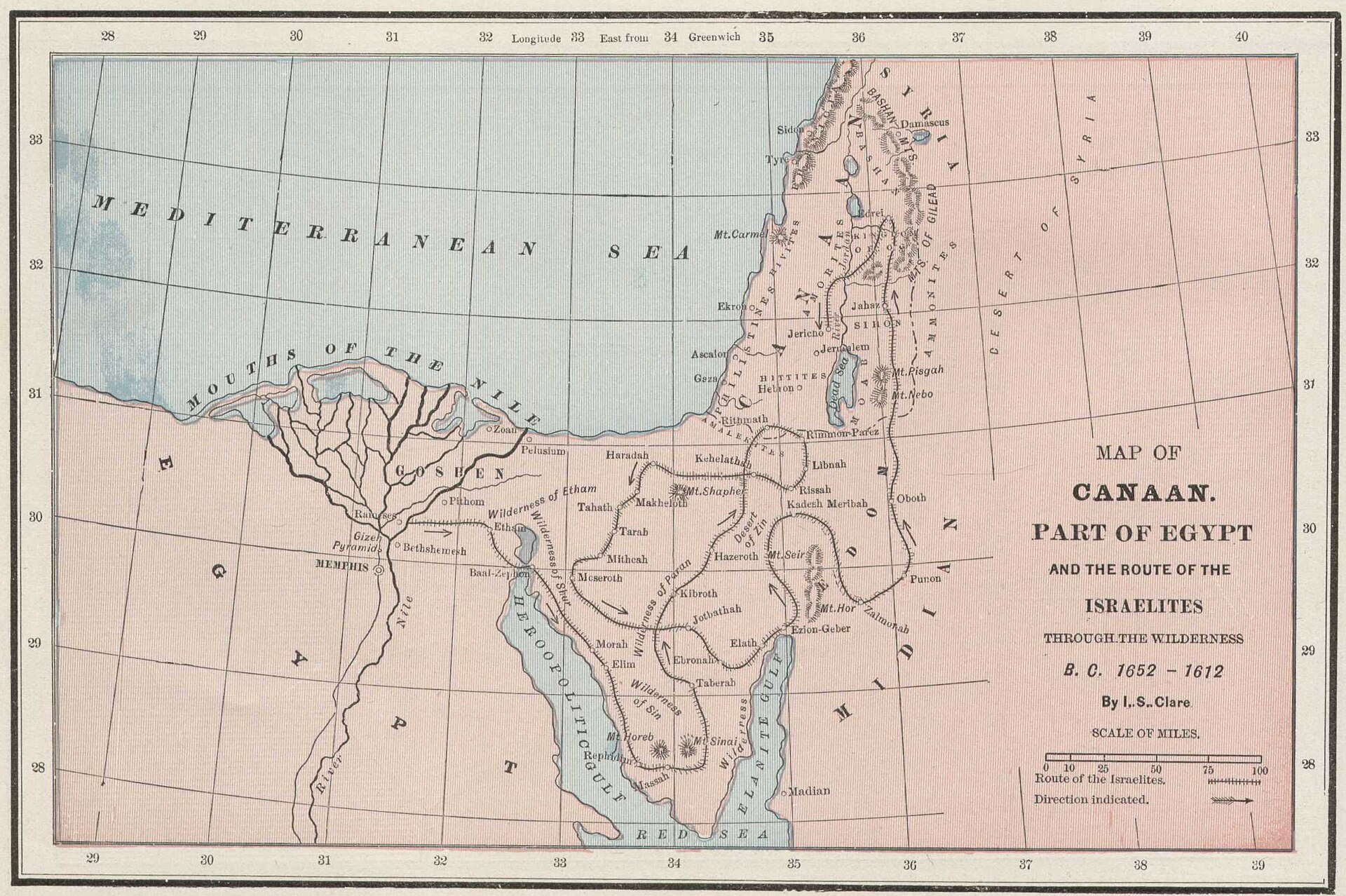
Esau's life ran between his father's camps in southern Canaan and the hill country of Seir.
- Located: the site is known
- Probable: the region OpenBible scores 500 to 799
- 1Beersheba, Jacob set out from Beersheba after he took the blessing. Genesis 28:10
- 2Seir, Esau had made his home here before Jacob returned from Haran. Genesis 32:3
- 3Peniel, The sun rose on Jacob as he passed Peniel, on the morning he met Esau. Genesis 32:31
- 4Succoth, Jacob turned aside here while Esau went back to Seir. Genesis 33:17
- 5Hebron, Isaac lived at Mamre near Hebron until his death. Genesis 35:27
Base map: The route of the Israelites through the wilderness, George F. Cram atlas plate, public domain. Places with a place page stand at its coordinates and the others at the point cited for each, set on the plate by Jerusalem and Mount Sinai, as the plate prints them.
Five places, each with its verse, drawn over Cram's plate of Canaan and the wilderness. Seir is marked at the point OpenBible gives for the range.
Where Scripture Stops
Three things Genesis leaves unsaid about him
When and where did he die?not recorded
Genesis lists his descendants and the chiefs of Edom and gives no account of his death or his burial.
Did he call on the LORD?never stated
Genesis records no prayer, altar or vow of Esau's, and no word in which he names God.
Did he meet Jacob's family again?Genesis 36:6 to 8
Genesis follows Esau's line into Seir and leaves the question there.
Where He Points
Malachi, Paul and the letter to the Hebrews read his story
Hebrews 12 sets Esau before readers who have come to Jesus, the mediator of a new covenant.
For you know that afterward, when he wanted to inherit the blessing, he was rejected. He could find no ground for repentance, though he sought the blessing with tears.The letter turns from the sale to what followed it in Genesis 27:34 to 38.
Voices on Esau
Three teachers on the twins, their parents and the meeting, from Origen to Matthew Henry.
died 253 · Origen of Alexandria
HOMILIES ON GENESIS 12.3
Two peoples within each reader
The quotation1 quotation
“I think that this can be said also of each of us as individuals that ‘two nations and two peoples are within you.’ For there is a people of virtue within us, and there is no less a people of vice within us. ‘For from our heart proceed evil thoughts, adulteries, thefts, false testimonies’ but also ‘deceits, contentions, heresies, jealousies, revelings and such like.’ Do you see how great a people of evil is within us?”
Origen of Alexandria · Homilies on Genesis 12.3 · on Genesis 25:23Patristic
died 397 · Ambrose of Milan
On Jacob and the Blessed Life, Book 2, Chapter II, Section 5
Parents who favour one child
The quotation1 quotation
“However, even parents should not be excused for abandoning us, because they have preferred a younger son to an older one. At the same time, care must be taken that no one, while following their example, has an unfair judgment between their children; so that they think one should be loved, the other should be disregarded. For from this fraternal hatred is aroused, and a crime of parricide is made from the despicable gain of money. The same measure of piety should nourish offspring.”
Ambrose of Milan · On Jacob and the Blessed Life, Book 2, Chapter II, Section 5 · on Genesis 25:28Patristic
1662 to 1714 · Matthew Henry
Commentary on the Whole Bible
The two brothers as they met
The quotation1 quotation
“Observe what a different figure these two brothers made. Esau is attended with a guard of 400 men, and looks big; Jacob is followed by a cumbersome train of women and children that are his care, and he looks tender and solicitous for their safety; and yet Jacob had the birthright, and was to have the dominion, and was every way the better man.”
Matthew Henry · Commentary on the Whole Bible · on Genesis 33:1 to 2Puritan
Was Esau's Kiss Sincere?
The Hebrew marks the word for kissed with dots, and two readings explain them
His pity was stirred and he kissed him wholeheartedlyRabbi Simeon bar Yohai in Sifre, as Rashi reports him; Adam Clarke; John Wesley
Rashi, on Genesis 33:4, reports Rabbi Simeon bar Yohai's answer from Sifre: Esau hated Jacob, but at that moment his pity was aroused and he kissed him with his whole heart. Adam Clarke, in his Commentary of 1832, calls Esau's conduct sincere, genuine and magnanimous. John Wesley, in his Explanatory Notes of 1765, says Esau ran to meet Jacob in love and that God turned his heart.
The objection: the scribes marked this one word with dots, and the other reading in Sifre takes the mark as a sign against a whole-hearted kiss.
The dots mark a kiss given grudginglythe first reading in Sifre, as Rashi reports it
Rashi reports that some in Sifre explained the dots as meaning that Esau did not kiss Jacob with his whole heart.
The objection: Genesis records no hostile word or act of Esau's at the meeting.
Books to Read Next
Two works, each free to read online
Rashi on Genesis
Rashi, translated by M. Rosenbaum and A. M. Silbermann · 1929 to 1934
Rashi reports the two readings of the dotted word in Genesis 33:4 from Sifre.
Read at SefariaCommentary on the Whole Bible
Matthew Henry · 1710
Henry follows Esau through the sale, the lost blessing and the meeting by the Jabbok.
Read at CCELSources
Scripture is the Berean Standard Bible.
- Strong's Hebrew dictionary, h6215 and h123.
- Rashi on Genesis 33:4:2, citing Sifrei Bamidbar 69.2, in the Pentateuch with Rashi's commentary by M. Rosenbaum and A. M. Silbermann, 1929 to 1934, public domain.
- Origen of Alexandria, Homilies on Genesis 12.3, on Genesis 25:23.
- Matthew Henry, Commentary on the Whole Bible, 1710, on Genesis 33:1 to 2.
- Ambrose of Milan, On Jacob and the Blessed Life, Book 2, chapter 2, section 5, on Genesis 25:28.
- Adam Clarke, Commentary on the Bible, 1832, on Genesis 33:4.
- John Wesley, Explanatory Notes upon the Old Testament, 1765, on Genesis 33:4.
- OpenBible.info, Bible Geocoding Data, ancient.jsonl, CC BY.
Keep Studying
Read it5
People and groups5