
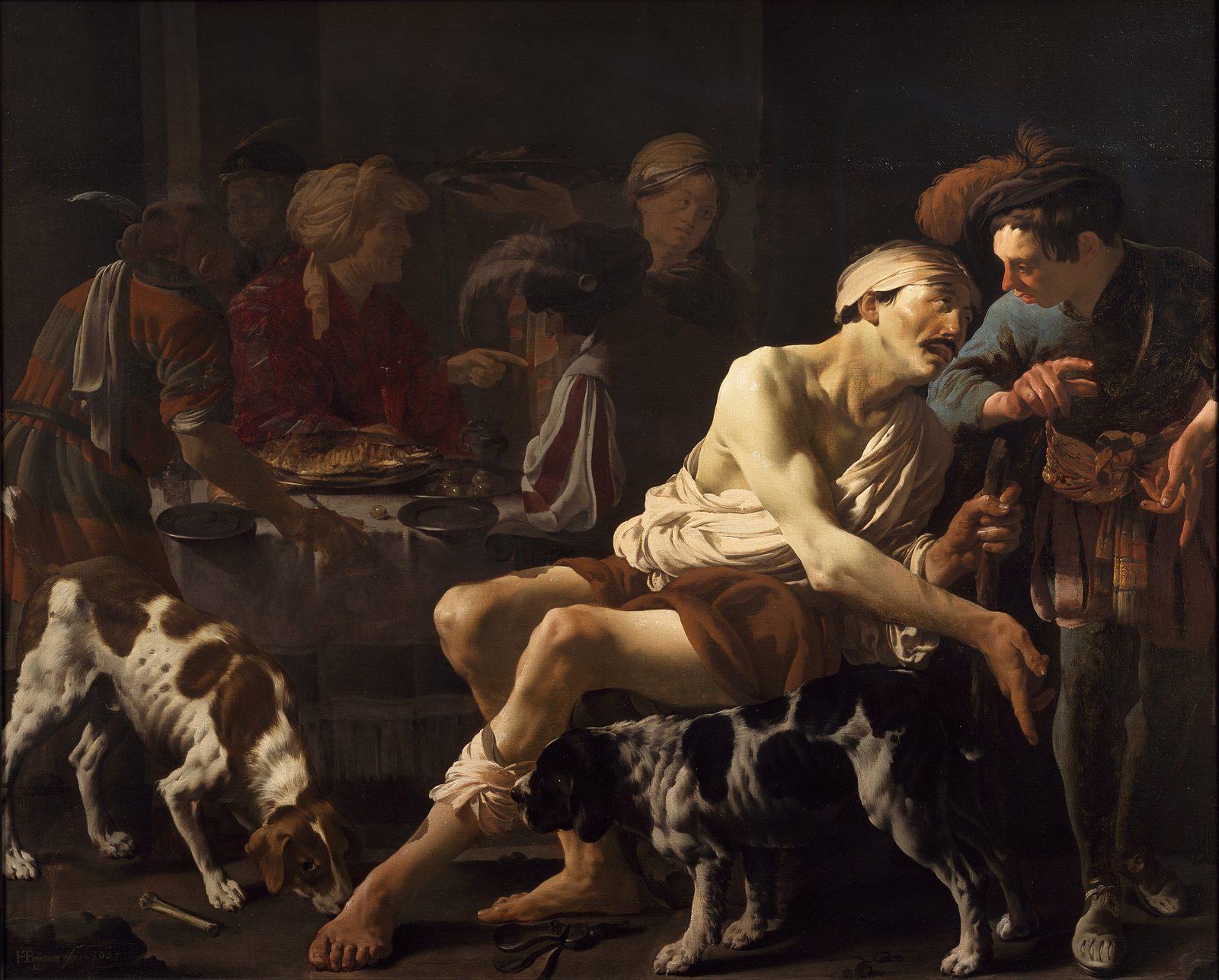
Hendrick ter Brugghen, The Rich Man and the Poor Lazarus, 1625. Public domain.
Luke 16:19 to 31 · Passage · Featured Study
The Rich Man and Lazarus
The story comes right after Jesus' saying that no servant can serve both God and money.
Then Abraham said to him, ‘If they do not listen to Moses and the prophets, they will not be persuaded even if someone rises from the dead.’”
- The passage
- Luke 16:19 to 31
- Book
- Luke
- Hold in memory
- Luke 16:31, Luke 16:25
A beggar who had nothing but a name is carried by angels to Abraham.
Summary
Jesus told this story of two men in Luke 16. A rich man feasted every day while a sick beggar named Lazarus lay at his gate. Both men died. Lazarus was comforted at Abraham's side, and the rich man was in agony in Hades.
- The rich man calls Abraham father, and Abraham answers him as his child.
- The rich man asks for a messenger from the dead, and Abraham sends him back to Moses and the Prophets.
- Readers differ over whether the story shows the state of the dead before the resurrection.
The Story Jesus Told
Luke sets the story in a chapter about money and trust.
The Pharisees, who loved money, heard that saying of Luke 16:13 and scoffed at Jesus (Luke 16:14).
So He said to them, “You are the ones who justify yourselves before men, but God knows your hearts. For what is prized among men is detestable before God.Jesus answers the scoffers with a warning about what God values, and the story follows it.
Matthew Henry explained why the story was told to these hearers.
“As the parable of the prodigal son set before us the grace of the gospel, which is encouraging to us all, so this sets before us the wrath to come, and is designed for our awakening; and very fast asleep those are in sin that will not be awakened by it. The Pharisees made a jest of Christ's sermon against worldliness; now this parable was intended to make those mockers serious.”
Matthew Henry · Commentary on the Whole Bible · on Luke 16:19Puritan
Two Men, Two Ends
Each thing the rich man had in life is set against what the beggar lacked, and death turns both around.
The rich man feasts and the beggar starves in life, and their places change at death.
| Point | The rich man | Lazarus |
|---|---|---|
| His clothing and food | purple and fine linen, splendour every day | covered with sores, longing for crumbs |
| His place in life | inside, at his table | outside, at the gate, with the dogs |
| His death | he died and was buried | he died and angels carried him |
| His place after death | in Hades, in torment | at Abraham's side |
| What he asks for | a drop of water, then a messenger | he says nothing in the story |
The Great Chasm and the Five Brothers
The rich man makes two requests, and Abraham refuses both.
The rich man first asks that Lazarus cool his tongue with a drop of water (Luke 16:24).
And besides all this, a great chasm has been fixed between us and you, so that even those who wish cannot cross from here to you, nor can anyone cross from there to us.’Abraham's refusal rests on the chasm this verse describes.
The rich man then asks that Lazarus be sent to warn his five brothers (Luke 16:27 to 28).
Parable or Account?
Readers since the third century have asked whether Jesus told of real men, because the beggar has a name.
An account of real menTertullian, A Treatise on the Soul, chapter 7; Ambrose of Milan, in Thomas Aquinas, Catena Aurea
Tertullian asked why the story would give the name of Lazarus if it were not a real event. Ambrose of Milan drew the same point from the name.
“This seems rather a narrative than a parable, since the name is also expressed.”
Ambrose of Milan · Catena Aurea by Aquinas · on Luke 16:20Patristic
The objection: Luke gives the story in a run of parables, and the name can carry a meaning of its own. John Chrysostom read Lazarus as one who was helped, because the Lord helped the poor man.
A parable that teaches what may happenAlbert Barnes, Notes on the New Testament, on Luke 16:19
Albert Barnes held that there is no evidence of a real history. He read the story as a parable that teaches that such cases might happen, to be understood from the talk about money before it.
The objection: Tertullian answered that even an imagined story would still bear witness to what is true.
A comparison built on a man the Jews rememberedCyril of Alexandria, in Thomas Aquinas, Catena Aurea, on Luke 16:19 to 20
Cyril of Alexandria read the story as a comparison in the manner of a parable. He also reported a Jewish tradition of a poor and sick Lazarus in Jerusalem at that time, whom Jesus named to give His words more point.
The objection: Cyril gives no source for the tradition he reports.
Abraham's Side and Hades
Three commentators explain the names Hades and Abraham's side.
Albert Barnes explained Hades as the place where departed spirits go. Jamieson, Fausset and Brown note that Hades is the unseen world, distinct from the word Jesus used for the final place of the lost.
John Wesley explained Abraham's side as the name the Jews gave to paradise.
Moses and the Prophets
Abraham's last answer says that Scripture is enough to warn the living.
The rich man thinks his brothers will repent if someone comes back from the dead (Luke 16:30).
Adam Clarke drew from Abraham's answer that the sacred writings carry their own proof, and that a man who rose from the dead could add nothing to it.
What It Shows of the Dead
Three readings take the places of the dead in the story in three different ways.
The soul lives and knows after deathJohn Wesley, Explanatory Notes upon the New Testament (1755); Albert Barnes, Notes on the New Testament, on Luke 16:31
Wesley called Abraham's side the place where the souls of good men remain from death to the resurrection. Barnes drew from the story that the soul does not die with the body and is conscious after death, and that it does not sleep until the resurrection.
The objection: the story also gives the dead eyes, a tongue and a finger, so not every detail can be read as a description of the soul.
A picture of the Jewish peopleGregory the Great, Forty Gospel Homilies, Homily 40 (604); John Gill, Exposition of the New Testament (1746 to 1748)
Gregory the Great read the rich man in purple as the Jewish people, who had the law and used it for show. John Gill applied the story to the Pharisees after death, and he read the five brothers as the Jews still living.
The objection: Gregory himself passed quickly over this reading to the moral sense, and Abraham's own answer in Luke 16:25 concerns how each man lived.
The Pharisees' own belief, turned against themE. W. Bullinger, The Rich Man and Lazarus: An Intermediate State?
E. W. Bullinger held that the framework of the story is what the Pharisees believed and taught, and that Jesus used their own teaching to judge them. He read the rest of Scripture as speaking of the dead as knowing nothing until the resurrection.
The objection: Jesus tells the story with no sign that He is quoting another teacher. Luke also records Him promising the thief that he would be with Him in Paradise that day (Luke 23:43).
One Who Rose from the Dead
Jesus raised another Lazarus at Bethany, and many who saw it believed in Him.
Jesus called Lazarus of Bethany out of his tomb (John 11:43 to 44). From that day the council plotted to kill Jesus (John 11:53), and Jamieson, Fausset and Brown saw in this the answer Abraham gave.
After His own resurrection, Jesus opened the Scriptures to two disciples on the road to Emmaus.
And beginning with Moses and all the Prophets, He explained to them what was written in all the Scriptures about Himself.The risen Jesus points the disciples to the same Moses and Prophets that Abraham named.
Sources
Scripture is the Berean Standard Bible.
- Matthew Henry, Commentary on the Whole Bible (1710), on Luke 16:19.
- Robert Jamieson, A. R. Fausset and David Brown, Commentary Critical and Explanatory on the Whole Bible (1871), on Luke 16:23 and 16:31.
- John Wesley, Explanatory Notes upon the New Testament (1755), on Luke 16:20 and 16:22.
- John Gill, Exposition of the New Testament (1746 to 1748), on Luke 16:26 and 16:28.
- Tertullian, A Treatise on the Soul, chapter 7, on Luke 16:23.
- Ambrose of Milan (397), on Luke 16:20, in Thomas Aquinas, Catena Aurea (1264)
- Albert Barnes, Notes, Explanatory and Practical, on the New Testament (1832 to 1869), on Luke 16:19, 16:20, 16:23 and 16:31.
- John Chrysostom (407), on Luke 16:20, in Thomas Aquinas, Catena Aurea (1264)
- Cyril of Alexandria (444), on Luke 16:19 to 20, in Thomas Aquinas, Catena Aurea (1264)
- Gregory the Great, Forty Gospel Homilies, Homily 40 (604), on Luke 16:19.
- E. W. Bullinger (1837 to 1913), The Rich Man and Lazarus: An Intermediate State? (date not given)
- Adam Clarke, Commentary on the Bible (1832), on Luke 16:31.
Keep Studying
Studies7
People and groups3