
Genesis 15 · The Covenant Cut with Abram
The Covenant of the Pieces
Genesis 15 tells of one vision and one night in which the LORD promised Abram an heir and swore the land to his offspring.
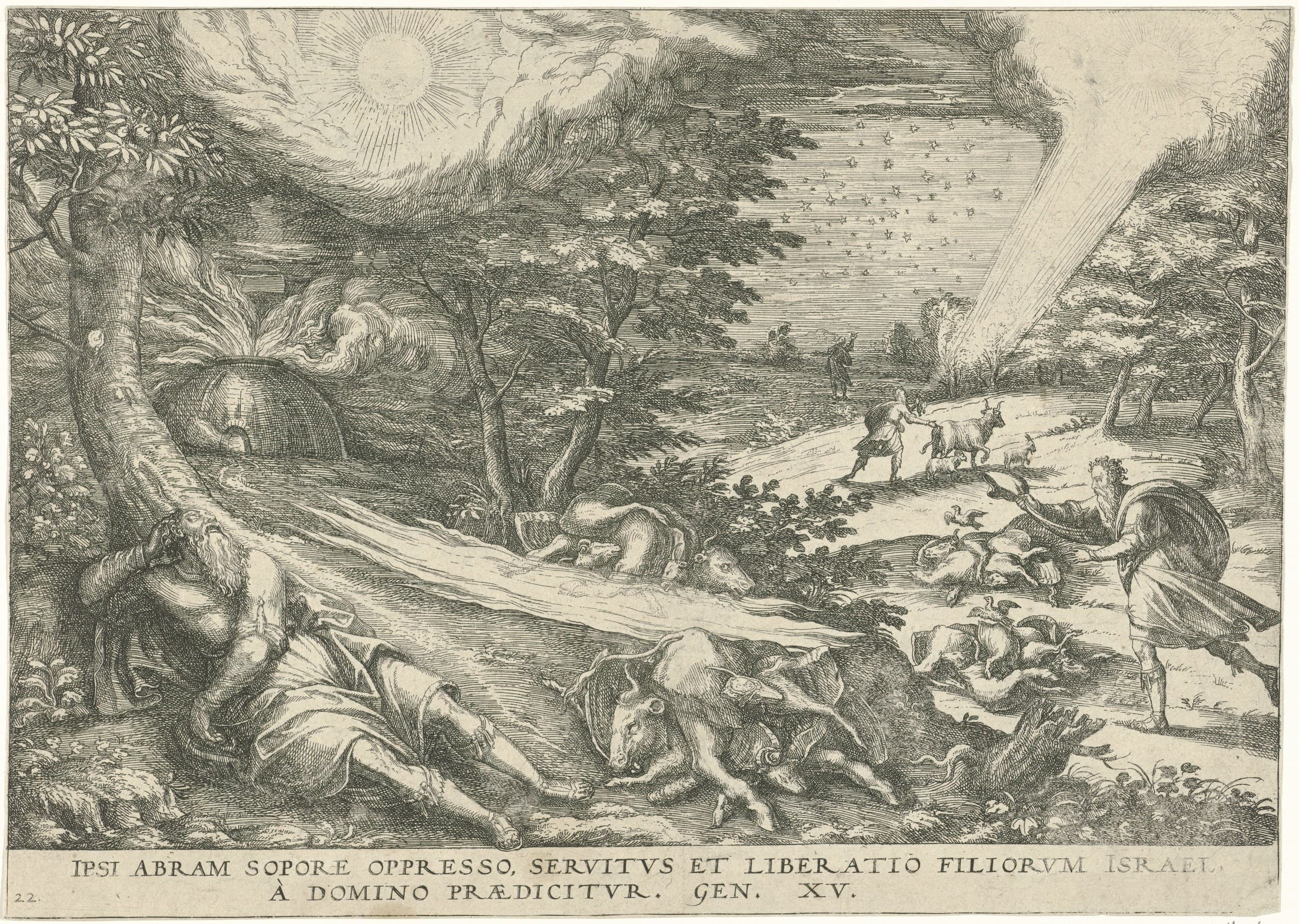
Attributed to Symon Novelanus, God's Covenant with Abraham, Figurae et imagines bibliorum, Cologne, between 1577 and 1627, Rijksmuseum, Amsterdam, RP-P-1886-A-11029. Public domain, via Wikimedia Commons.
THE ARTWORKThe etcher sets the whole of Genesis 15 in one landscape, from the stars of verse 5 and the birds of prey of verse 11. It ends with the smoking firepot, drawn as an oven, and the fire passing between the pieces in verse 17. Abram appears several times, and in the foreground he lies in the deep sleep of verse 12.
Abram asked the LORD how he could know the land would be his, and the answer was a covenant cut over animals.
Summary
The LORD made a covenant with Abram and gave his offspring the land from the river of Egypt to the great River Euphrates.
- Abram believed the LORD, and it was credited to him as righteousness.
- Abram split a heifer, a goat and a ram and laid the halves opposite each other.
- After dark a smoking firepot and a flaming torch passed between the halves.
- Readers divide over whether the covenant binds the LORD alone or also lays obligations on Abraham.
A Word in a Vision
In Genesis 15:1 to 6 the LORD promises Abram an heir, and Abram believes Him.
The chapter opens after Abram's return from defeating Chedorlaomer and the kings allied with him, the battle of Genesis 14 in which he rescued Lot.
After these events, the word of the LORD came to Abram in a vision: “Do not be afraid, Abram. I am your shield, your very great reward.”The chapter's first promise comes before Abram has asked for anything.
But Abram replied, “O Lord GOD, what can You give me, since I remain childless, and the heir of my house is Eliezer of Damascus?” Abram continued, “Behold, You have given me no offspring, so a servant in my household will be my heir.”Abram sets his childlessness before the LORD twice, and he names Eliezer of Damascus as his heir.
Then the word of the LORD came to Abram, saying, “This one will not be your heir, but one who comes from your own body will be your heir.” And the LORD took him outside and said, “Now look to the heavens and count the stars, if you are able.” Then He told him, “So shall your offspring be.”The answer turns Abram's complaint into a promise he can see each night.
Abram's answer to the promise is faith, and the narrator records how the LORD received it.
Abram believed the LORD, and it was credited to him as righteousness.This is the first verse of Scripture to say that faith was credited as righteousness.
Where Scripture Returns to the Night
Scripture returns to the promises of Genesis 15:13 to 21 from Genesis 50 to Acts 7.
- What it takes up from Genesis 15
- God will bring his brothers up to the land He promised on oath to Abraham
- What it takes up from Genesis 15
- Israel goes out of Egypt after 430 years, to the very day
- What it takes up from Genesis 15
- Moses names seven nations the LORD will drive out
- What it takes up from Genesis 15
- Solomon reigns from the Euphrates to the border of Egypt
- What it takes up from Genesis 15
- the descendants enslaved four hundred years and then brought out to worship
Five texts, each set beside the promise of Genesis 15 it takes up.
The Covenant, Verse by Verse
Genesis 15:7 to 21 falls into four parts, from Abram's question to the boundaries of the land.
1. Genesis 15:7 to 11, the animals and the birds of prey2 passages, 2 quotations
The LORD also told him, “I am the LORD, who brought you out of Ur of the Chaldeans to give you this land to possess.” But Abram replied, “Lord GOD, how can I know that I will possess it?”Abram's question is the request that the rite of the following verses answers.
And the LORD said to him, “Bring Me a heifer, a goat, and a ram, each three years old, along with a turtledove and a young pigeon.” So Abram brought all these to Him, split each of them down the middle, and laid the halves opposite each other. The birds, however, he did not cut in half. And the birds of prey descended on the carcasses, but Abram drove them away.The LORD's answer is a rite: Abram splits three animals, keeps two birds whole and guards the halves.
Radak, David Kimhi of Provence (1160 to 1235), in his commentary on Genesis, reads Abram's question as free of doubt, since the verse before it has just credited his faith. He takes it to ask how Abram's offspring could be sure of keeping the land, when the peoples living in it were about to lose it for their sins.
John Wesley explains why each animal is three years old.
“God appointed that each of the beasts used for his service should be three years old, because then they were at their full growth and strength. God must be served with the best we have. We do not read that God gave Abram particular directions how to manage these, knowing that he was well versed in the custom of sacrifices.”
John Wesley · Explanatory Notes upon the Old Testament · on Genesis 15:9Evangelical
Matthew Henry draws a lesson for worship from Abram's guarding of the sacrifice.
“Note, A very watchful eye must be kept upon our spiritual sacrifices, that nothing be suffered to prey upon them and render them unfit for God's acceptance. When vain thoughts, like these fowls, come down upon our sacrifices, we must drive them away, and not suffer them to lodge within us, but attend on God without distraction.”
Matthew Henry · Commentary on the Whole Bible · on Genesis 15:11Puritan
2. Genesis 15:12 to 16, the deep sleep and the four hundred years2 passages, 1 quotation
As the sun was setting, Abram fell into a deep sleep, and suddenly great terror and darkness overwhelmed him. Then the LORD said to Abram, “Know for certain that your descendants will be strangers in a land that is not their own, and they will be enslaved and mistreated four hundred years.The second half of the night begins here, and its first word is what Abram's descendants will suffer before the promise is kept.
But I will judge the nation they serve as slaves, and afterward they will depart with many possessions. You, however, will go to your fathers in peace and be buried at a ripe old age. In the fourth generation your descendants will return here, for the iniquity of the Amorites is not yet complete.”The promise of the land carries a date and a judgment, and these verses set both.
The Hebrew word for the deep sleep is tardemah, the word used of the sleep the LORD God caused to fall on the man in Genesis 2:21, as Adam Clarke notes on this verse.
Adam Clarke, following Henry Ainsworth's Annotations upon the Five Books of Moses, counts the four hundred years from Ishmael's mocking of Isaac in Genesis 21:9.
Matthew Henry reads the delay of verse 16 as the patience of a righteous judge with the Amorites.
“The righteous God has determined that they shall not be cut off till they have persisted in sin so long, and arrived at such a pitch of wickedness, that there may appear some equitable proportion between their sin and their ruin; and therefore, till it come to that, the seed of Abram must be kept out of possession. Note, (1.) The measure of sin fills gradually.”
Matthew Henry · Commentary on the Whole Bible · on Genesis 15:16Puritan
3. Genesis 15:17, the firepot and the torch2 passages, 1 quotation
When the sun had set and darkness had fallen, behold, a smoking firepot and a flaming torch appeared and passed between the halves of the carcasses.The rite is completed while Abram still lies in the sleep of verse 12.
And those who have transgressed My covenant and have not fulfilled the terms of the covenant they made before Me, I will treat like the calf they cut in two in order to pass between its pieces. The officials of Judah and Jerusalem, the court officials, the priests, and all the people of the land who passed between the pieces of the calf, I will deliver into the hands of their enemies who seek their lives. Their corpses will become food for the birds of the air and the beasts of the earth.This is the one other passage of Scripture where people pass between the halves of a cut animal, and it gives the penalty the rite carried.
Adam Clarke, in his Commentary on the Bible, reads the smoking firepot as an emblem of Israel's affliction in Egypt and the flaming torch as the sign of the divine presence that ratified the covenant. John Wesley reads the fire as the sign that God accepted the sacrifice.
“It is probable this furnace and lamp, which passed between the pieces, burned and consumed them, and so compleated the sacrifice, and testified God's acceptance of it, as of Gideon's, Jude vi, 21, Manoah's, Jude xiii, 19, 20, and Solomon's, 2 Chron. vii, 1. That God's covenants with man are made by sacrifice, Psalm l, 5, by Christ, the great sacrifice.”
John Wesley · Explanatory Notes upon the Old Testament · on Genesis 15:17Evangelical
4. Genesis 15:18 to 21, the covenant and the land2 passages, 1 quotation
On that day the LORD made a covenant with Abram, saying, “To your descendants I have given this land—from the river of Egypt to the great River Euphrates—This is the verse that names the night's rite a covenant and states what it secured.
the land of the Kenites, Kenizzites, Kadmonites, Hittites, Perizzites, Rephaites, Amorites, Canaanites, Girgashites, and Jebusites.”The land is named by the ten peoples who held it, from the Kenites to the Jebusites.
Rashi, Rabbi Shlomo Yitzchaki of Troyes (1040 to 1105), in his commentary on Genesis, counts ten peoples here and notes that Israel was given the land of seven. He reads the Kenites, the Kenizzites and the Kadmonites as Edom, Moab and Ammon, whose lands are to be possessed in the future.
Clarke explains karat berit, the Hebrew of verse 18, as to cut a covenant, because the rite of making one required an animal cut in two.
Matthew Henry sets this verse beside the promise of Genesis 12:7.
“He had said before, To thy seed will I give this land, ch. xii. But here he says, I have given it; that is, (1.) I have given the promise of it, the charter is sealed and delivered, and cannot be disannulled. Note, God's promises are God's gifts, and are so to be accounted.”
Matthew Henry · Commentary on the Whole Bible · on Genesis 15:18Puritan
What the Text Leaves Unsaid
Genesis 15 leaves three questions open.
The text gives no reason why Abram left the turtledove and the young pigeon whole when he split the three animals.
The LORD names neither the nation that will enslave Abram's descendants nor the land of their stay; Exodus later names Egypt.
The text does not say what the two objects of verse 17 stand for, and every reading of them is a commentator's.
Faith Counted as Righteousness
Paul and the writer to the Hebrews both build on the faith of Genesis 15.
Paul builds his case for justification by faith on Genesis 15:6, which he quotes in Romans 4:3 and Galatians 3:6; James quotes it in James 2:23.
Is this blessing only on the circumcised, or also on the uncircumcised? We have been saying that Abraham’s faith was credited to him as righteousness. In what context was it credited? Was it after his circumcision, or before? It was not after, but before. And he received the sign of circumcision as a seal of the righteousness that he had by faith while he was still uncircumcised. So then, he is the father of all who believe but are not circumcised, in order that righteousness might be credited to them.Genesis 15 comes before the sign given in Genesis 17, and Paul draws his argument from that order.
In Galatians 3 Paul calls those who have faith the sons of Abraham, and he reads the promise of the seed as spoken of Christ.
What I mean is this: The law that came 430 years later does not revoke the covenant previously established by God, so as to nullify the promise. For if the inheritance depends on the law, then it no longer depends on a promise; but God freely granted it to Abraham through a promise.Paul measures the years from the promise to Sinai to show that the promise stands first.
Hebrews 11 sets Abraham and Sarah among the people who lived by faith.
And so from one man, and he as good as dead, came descendants as numerous as the stars in the sky and as countless as the sand on the seashore.Hebrews closes the story the stars of Genesis 15:5 began.
Romans 4:18 to 22, the night of the stars in Paul1 passage
Against all hope, Abraham in hope believed and so became the father of many nations, just as he had been told, “So shall your offspring be.” Without weakening in his faith, he acknowledged the decrepitness of his body (since he was about a hundred years old) and the lifelessness of Sarah’s womb. Yet he did not waver through disbelief in the promise of God, but was strengthened in his faith and gave glory to God, being fully persuaded that God was able to do what He had promised. This is why “it was credited to him as righteousness.”Paul quotes the LORD's word under the stars and sets Abraham's age against it.
Galatians 3:29, the heirs of the promise1 passage
And if you belong to Christ, then you are Abraham’s seed and heirs according to the promise.The inheritance promised to Abram reaches every believer in the Messiah.
Voices on Abram's Complaint
Matthew Henry, Jamieson, Fausset & Brown and John Wesley comment on the heir and the stars.
Matthew Henry finds in Abram's words leave for a believer to bring his grievances to God.
“Note, Though we must never complain of God, yet we have leave to complain to him, and to be large and particular in the statement of our grievances; and it is some ease to a burdened spirit to open its case to a faithful and compassionate friend: such a friend God is, whose ear is always open.”
Matthew Henry · Commentary on the Whole Bible · on Genesis 15:2 to 3Puritan
Jamieson, Fausset & Brown weigh what an heir by adoption would have meant to Abram.
“But this man could have become his son only by adoption; and how sadly would that have come short of the parental hopes he had been encouraged to entertain! His language betrayed a latent spirit of fretfulness or perhaps a temporary failure in the very virtue for which he is so renowned--and absolute submission to God's time, as well as way, of accomplishing His promise.”
Jamieson, Fausset & Brown · Commentary Critical and Explanatory on the Whole Bible · on Genesis 15:3Reformed
John Wesley sets the dust of Genesis 13:16 beside the stars of this chapter.
“Abram feared he should have no child at all, but God tells him his descendents should be so many as not to be numbered. So illustrious, as the stars of heaven for splendour; for to them pertained the glory, Rom. ix, 4. Abram's seed according to the flesh were like the dust of the earth, Chap. xiii, 16, but his spiritual seed are like the stars of heaven.”
John Wesley · Explanatory Notes upon the Old Testament · on Genesis 15:5Evangelical
Who Is Bound by the Covenant
The question turns on verse 17 and on the charges of Genesis 17 and Genesis 22.
The LORD alone is bound
Moshe Weinfeld, in The Covenant of Grant in the Old Testament and in the Ancient Near East (Journal of the American Oriental Society, 1970), compared the covenants with Abraham and David to the royal grant. In a grant a king gives land or a dynasty to a loyal servant as a lasting gift.
On this reading the passing of the fire alone in verse 17 means that the LORD alone takes the oath. Jamieson, Fausset & Brown read the verse this way.
“According to these ideas, which have been from time immemorial engraven on the minds of Eastern people, the Lord Himself condescended to enter into covenant with Abram. The patriarch did not pass between the sacrifice and the reason was that in this transaction he was bound to nothing.”
Jamieson, Fausset & Brown · Commentary Critical and Explanatory on the Whole Bible · on Genesis 15:17Reformed
When God made His promise to Abraham, since He had no one greater to swear by, He swore by Himself, saying, “I will surely bless you and multiply your descendants.” And so Abraham, after waiting patiently, obtained the promise. Men swear by someone greater than themselves, and their oath serves as a confirmation to end all argument. So when God wanted to make the unchanging nature of His purpose very clear to the heirs of the promise, He guaranteed it with an oath. Thus by two unchangeable things in which it is impossible for God to lie, we who have fled to take hold of the hope set before us may be strongly encouraged.Hebrews ties the certainty of what Abraham received to the One who swore it.
The objection rests on the two texts the second reading draws, Genesis 17:1 to 2 and Genesis 22:16 to 18.
The covenant carries obligations
On verse 10 Clarke holds that no one, God or man, can make a covenant with himself, so there must be at least two parties.
When Abram was ninety-nine years old, the LORD appeared to him and said, “I am God Almighty. Walk before Me and be blameless. I will establish My covenant between Me and you, and I will multiply you exceedingly.”The LORD sets a charge before Abram and then promises to establish His covenant with him.
saying, “By Myself I have sworn, declares the LORD, that because you have done this and have not withheld your only son, I will surely bless you, and I will multiply your descendants like the stars in the sky and the sand on the seashore. Your descendants will possess the gates of their enemies. And through your offspring all nations of the earth will be blessed, because you have obeyed My voice.”The oath repeated after the binding of Isaac rests on Abraham's obedience.
The objection: these charges come years after the night of chapter 15, and the first reading rests on that night's rite.
The Faith the Chapter Asks For
Genesis 15 asks its reader to trust the LORD as Abram did.
Abram held nothing of what he was promised on the night of Genesis 15 except the word of the LORD and the fire between the halves.
Now the words “it was credited to him” were written not only for Abraham, but also for us, to whom righteousness will be credited—for us who believe in Him who raised Jesus our Lord from the dead.Paul applies the crediting of Abram's faith to his own readers.
Keep studying
Read it1
Studies1
Symbols1
Doctrines8