
Place
Sodom
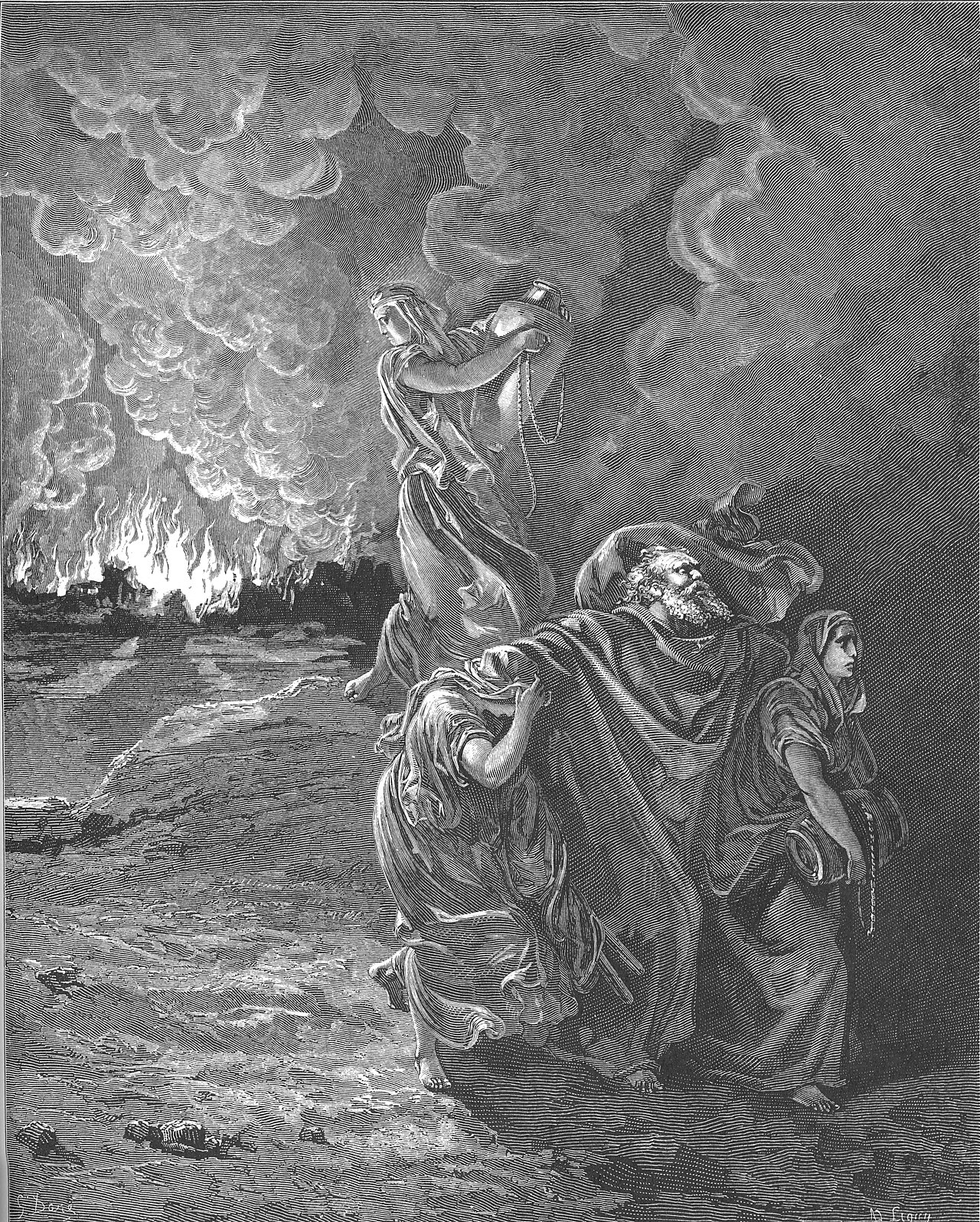
Gustave Doré, La Sainte Bible (Tours: Alfred Mame et fils, 1866). Public domain.
Summary
The city of the plain that Abraham pleaded for and that fire from heaven destroyed while Lot fled, named by the prophets, by Peter, by Jude and by the Lord himself as the standing picture of judgment.
- Sodom was one of five cities on the plain, and Scripture names all five.
- Abraham argued God down from fifty righteous people to ten, and God agreed at every step. There were not ten.
- Genesis 19 and Ezekiel 16 both testify to the sin of the city, and this page carries the whole testimony.
- Jesus named Sodom three times, always to warn towns that had seen more than Sodom saw and repented less.
- No excavated site has been shown to be Sodom. Two candidates are argued in print and the dispute is live.
On this page
In Scripture
- Verses
- 47
- Books
- 14
Near Sodom
- Gomorrah8.6 km · 5.3 mi SE
- En-gedi29 km · 18 mi N
- Machpelah45 km · 28 mi NW
- Hebron47 km · 29 mi NW
- Mamre49 km · 30 mi NW
- Tekoa52 km · 32 mi N
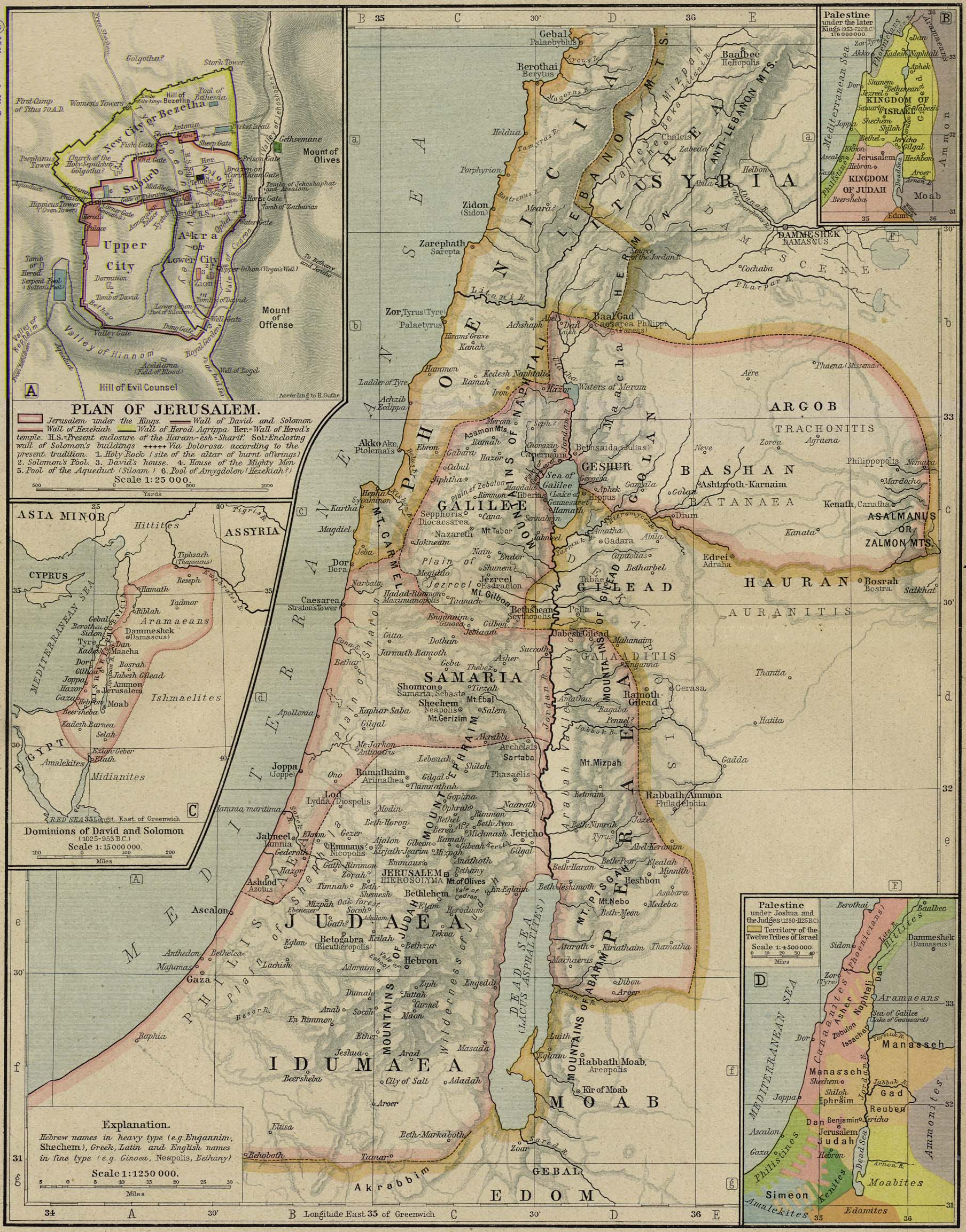
Straight-line distances, computed from the gazetteer coordinates.
Where it is
the country around it
- Coordinates
- 31.1966° N, 35.3965° Efind it on the Atlas →
- Region
- Cities of the plain
2 places the record names with Sodom, the farthest 66 km away
- 1Sodom named on the border of CanaanGenesis 10:19 · 8.6 kmand the borders of Canaan extended from Sidon toward Gerar as far as Gaza, and then toward Sodom, Gomorrah, Admah, and Zeboiim, as far as Lasha.
- 2The prophets of Jerusalem called SodomJeremiah 23:14 · 66 kmAnd among the prophets of Jerusalem I have seen a horrible thing: They commit adultery and walk in lies. They strengthen the hands of evildoers, so that no one turns his back on wickedness. They are all like Sodom to Me; the people of Jerusalem are like Gomorrah.”
- Located: the gazetteer fixes one site
- Placed: the point stands for an area, or is rounded
- ? Proposed: one candidate among several
- A dashed line ends at a place the gazetteer does not fix
Not located: Egypt, Canaan. The gazetteer records no location for them, so they are not marked.
Why Sodom matters
What has been found
the evidence, and where it is disputed
Abraham's intercession, and the fire
Genesis 18:16 to 19:29, in the order it happens
Read Genesis 18:16 to 19:29, in the order it happens
- The visitors look out over the cityGenesis 18:16When the men got up to leave, they looked out over Sodom, and Abraham walked along with them to see them off.
- The outcry is greatGenesis 18:20Then the LORD said, “The outcry against Sodom and Gomorrah is great. Because their sin is so grievous,
- Two go on, and Abraham staysGenesis 18:22And the two men turned away and went toward Sodom, but Abraham remained standing before the LORD.
- Will the Judge of all the earth do rightGenesis 18:25Far be it from You to do such a thing—to kill the righteous with the wicked, so that the righteous and the wicked are treated alike. Far be it from You! Will not the Judge of all the earth do what is right?”
- The bargain ends at tenGenesis 18:32Finally, Abraham said, “May the Lord not be angry, but let me speak once more. Suppose ten are found there?” And He answered, “On account of the ten, I will not destroy it.”
- The two angels reach Sodom at eveningGenesis 19:1Now the two angels arrived at Sodom in the evening, and Lot was sitting in the gateway of the city. When Lot saw them, he got up to meet them, bowed facedown,
- The whole city comes to the doorGenesis 19:4Before they had gone to bed, all the men of the city of Sodom, both young and old, surrounded the house.
- Lot is taken by the hand and led outGenesis 19:16But when Lot hesitated, the men grabbed his hand and the hands of his wife and his two daughters. And they led them safely out of the city, because of the LORD’s compassion for them.
- Sulfur and fire, after sunriseGenesis 19:24Then the LORD rained down sulfur and fire on Sodom and Gomorrah—from the LORD out of the heavens.
- God remembered AbrahamGenesis 19:29So when God destroyed the cities of the plain, He remembered Abraham, and He brought Lot out of the catastrophe that destroyed the cities where he had lived.
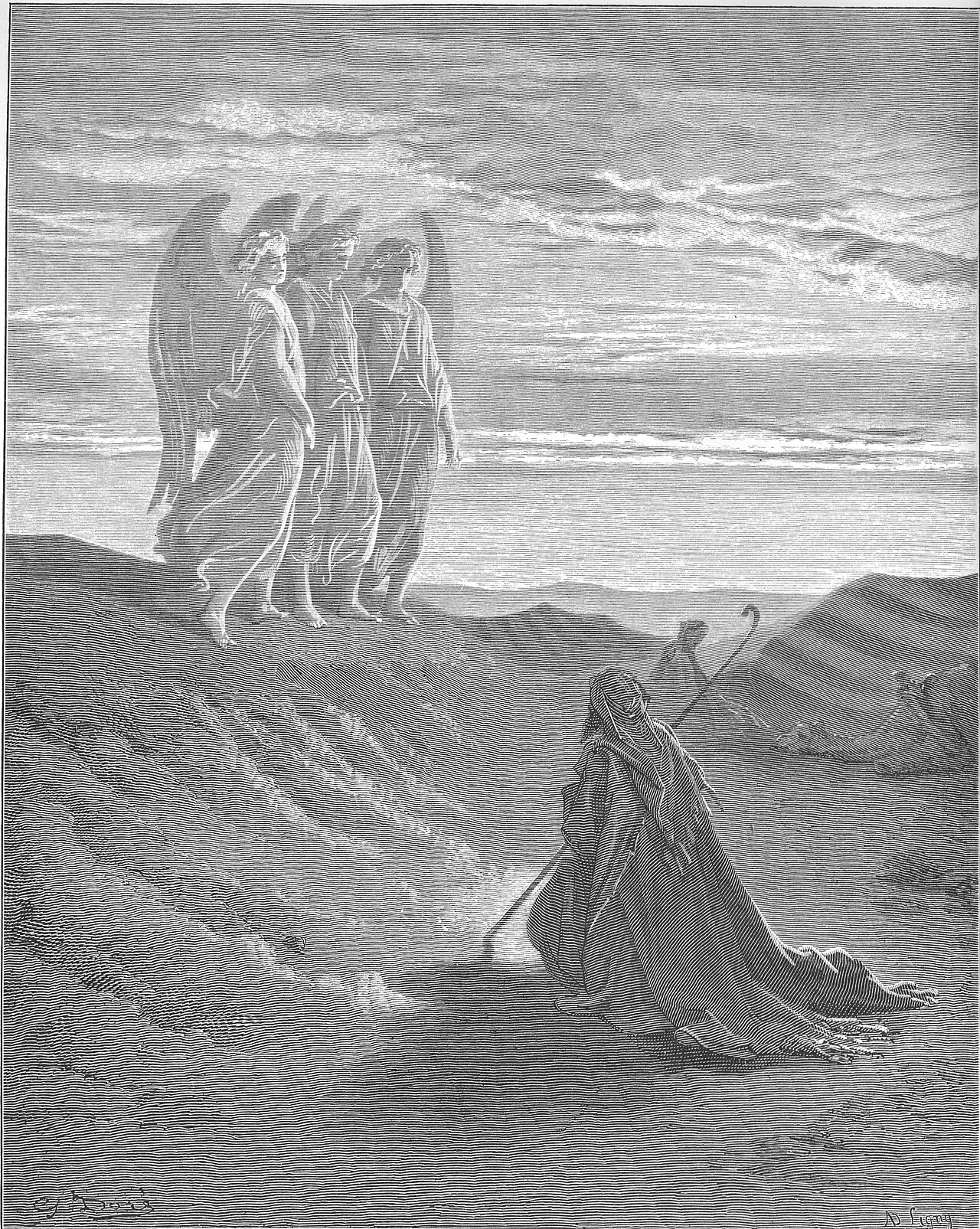
No verified image of Abraham bargaining with God, or of him looking down at the smoke the next morning, exists on this site. The two engravings this page carries show the visit that opens the account and the flight that ends it.
Sodom and Gomorrah: the full studyWhat happened here, in order
in the order the canon tells it
- Sodom named on the border of CanaanGenesis 10:19and the borders of Canaan extended from Sidon toward Gerar as far as Gaza, and then toward Sodom, Gomorrah, Admah, and Zeboiim, as far as Lasha.
- Lot pitches his tent toward SodomGenesis 13:12Abram lived in the land of Canaan, but Lot settled in the cities of the plain and pitched his tent toward Sodom.
- The verdict on the men of the cityGenesis 13:13But the men of Sodom were wicked, sinning greatly against the LORD.
- Lot carried off in the war of the kingsGenesis 14:12They also carried off Abram’s nephew Lot and his possessions, since Lot was living in Sodom.
- The outcry against Sodom reaches GodGenesis 18:20Then the LORD said, “The outcry against Sodom and Gomorrah is great. Because their sin is so grievous,
- The intercession ends at ten righteousGenesis 18:32Finally, Abraham said, “May the Lord not be angry, but let me speak once more. Suppose ten are found there?” And He answered, “On account of the ten, I will not destroy it.”
- Sulfur and fire on Sodom and GomorrahGenesis 19:24Then the LORD rained down sulfur and fire on Sodom and Gomorrah—from the LORD out of the heavens.
- Lot brought out because God remembered AbrahamGenesis 19:29So when God destroyed the cities of the plain, He remembered Abraham, and He brought Lot out of the catastrophe that destroyed the cities where he had lived.
- The ground described as sulfur and saltDeuteronomy 29:23All its soil will be a burning waste of sulfur and salt, unsown and unproductive, with no plant growing on it, just like the destruction of Sodom and Gomorrah, Admah and Zeboiim, which the LORD overthrew in His fierce anger.
- Judah spared the fate of Sodom by a remnantIsaiah 1:9Unless the LORD of Hosts had left us a few survivors, we would have become like Sodom, we would have resembled Gomorrah.
- The prophets of Jerusalem called SodomJeremiah 23:14And among the prophets of Jerusalem I have seen a horrible thing: They commit adultery and walk in lies. They strengthen the hands of evildoers, so that no one turns his back on wickedness. They are all like Sodom to Me; the people of Jerusalem are like Gomorrah.”
- Sodom overthrown in an instantLamentations 4:6The punishment of the daughter of my people is greater than that of Sodom, which was overthrown in an instant without a hand turned to help her.
- The iniquity of Sodom named item by itemEzekiel 16:49Now this was the iniquity of your sister Sodom: She and her daughters were arrogant, overfed, and complacent; they did not help the poor and needy.
- God says He will restore Sodom and her daughtersEzekiel 16:53But I will restore Sodom and her daughters from captivity, as well as Samaria and her daughters. And I will restore you along with them.
- Israel warned as a firebrand snatched from the blazeAmos 4:11“Some of you I overthrew as I overthrew Sodom and Gomorrah, and you were like a firebrand snatched from a blaze, yet you did not return to Me,” declares the LORD.
- More bearable for Sodom than for the town that refuses the messageMatthew 10:15Truly I tell you, it will be more bearable for Sodom and Gomorrah on the day of judgment than for that town.
- Sodom would have remained if it had seen what Capernaum sawMatthew 11:23And you, Capernaum, will you be lifted up to heaven? No, you will be brought down to Hades! For if the miracles that were performed in you had been performed in Sodom, it would have remained to this day.
- Remember Lot's wifeLuke 17:32Remember Lot’s wife!
- The cities reduced to ashes as an example2 Peter 2:6if He condemned the cities of Sodom and Gomorrah to destruction, reducing them to ashes as an example of what is coming on the ungodly;
- The great city figuratively called SodomRevelation 11:8Their bodies will lie in the street of the great city—figuratively called Sodom and Egypt—where their Lord was also crucified.
Where it points
The voices
each quoted from the work named
Though all are sinners, yet some are greater sinners than others. The men of Sodom were sinners of the first magnitude, sinners before the Lord, that is, impudent daring sinners; they were so to a proverb.
When Abraham stood before the Lord in Genesis 18, he was not having a casual chat. He was engaging in heavenly diplomacy a legislative session in the courts of heaven that would determine the fate of entire cities.
And in this manner, through a series of questions and answers, even if he finds ten righteous people in the city, he promises impunity to the entire people on account of the righteousness of a few. Where do we learn how great a wall is for our country, a virtuous man, how we should not envy holy men, nor disrespect them lightly. For their faith saves us, their justice defends us from destruction. Even Sodom, if it had ten righteous men, could have not perished.
4 more teachers on these versesCharles Spurgeon · Adam Clarke · Albert Barnes · Victorinus of Pettau
THE destruction of Sodom was, undoubtedly, a literal fact. And the record of it in Genesis is as true a piece of history as any event that is recorded by Tacitus or Josephus. But it was also intended to be a great parabolic lesson to us—a lesson in the shape of a parable—by which we might receive both instruction and blessing. The Old Testament is a great Book of texts and the New Testament contains the sermons upon them.
This was the iniquity of thy sister Sodom - If we are to take this place literally, Sodom was guilty of other crimes besides that for which she appears to have been especially punished; in addition to her unnatural crime, She is charged with pride, luxury, idleness, and uncharitableness; and these were sufficient to sink any city to the bottomless pit.
Even as Sodom and Gomorrha - Notes, 2Pe 2:6. And the cities about them - Admah and Zeboim, Gen 14:2; Deu 29:23; Hos 11:8. There may have been other towns, also, that perished at the same time, but these are particularly mentioned. They seem to have partaken of the same general characteristics, as neighboring towns and cities generally do. In like manner - “In a manner like to these,” (τὸν ὅμοιον τούτοις τρόπον ton homoion toutois tropon.) The Greek word “these,” is in the plural number. There has been much diversity in interpreting this clause.
"And their dead bodies shall lie in the streets of the great city, which spiritually is called Sodom and Egypt." But He calls Jerusalem Sodom and Egypt, since it had become the heaping up of the persecuting people. Therefore it behoves us diligently, and with the utmost care, to follow the prophetic announcement, and to understand what the Spirit from the Father both announces and anticipates, and how, when He has gone forward to the last times, He again repeats the former ones.
Sodom in Scripture
47 verses name it, in 14 books
Open a book to read its mentions here. Text: Berean Standard Bible.
Old TestamentNew Testamentsegment width = share of mentions
Old Testament8 books · 38 mentions
Genesis20 mentions
- Genesis 10:19and the borders of Canaan extended from Sidon toward Gerar as far as Gaza, and then toward Sodom, Gomorrah, Admah, and Zeboiim, as far as Lasha.
- Genesis 13:10And Lot looked out and saw that the whole plain of the Jordan, all the way to Zoar, was well watered like the garden of the LORD, like the land of Egypt. (This was before the LORD destroyed Sodom and Gomorrah.)
- Genesis 13:12Abram lived in the land of Canaan, but Lot settled in the cities of the plain and pitched his tent toward Sodom.
- Genesis 13:13But the men of Sodom were wicked, sinning greatly against the LORD.
- Genesis 14:2went to war against Bera king of Sodom, Birsha king of Gomorrah, Shinab king of Admah, Shemeber king of Zeboiim, and the king of Bela (that is, Zoar).
- Genesis 14:8Then the king of Sodom, the king of Gomorrah, the king of Admah, the king of Zeboiim, and the king of Bela (that is, Zoar) marched out and arrayed themselves for battle in the Valley of Siddim
- Genesis 14:10Now the Valley of Siddim was full of tar pits, and as the kings of Sodom and Gomorrah fled, some men fell into the pits, but the survivors fled to the hill country.
- Genesis 14:11The four kings seized all the goods of Sodom and Gomorrah and all their food, and they went on their way.
12 further mentions in Genesis, read them in the book.
Deuteronomy2 mentions
- Deuteronomy 29:23All its soil will be a burning waste of sulfur and salt, unsown and unproductive, with no plant growing on it, just like the destruction of Sodom and Gomorrah, Admah and Zeboiim, which the LORD overthrew in His fierce anger.
- Deuteronomy 32:32But their vine is from the vine of Sodom and from the fields of Gomorrah. Their grapes are poisonous; their clusters are bitter.
Isaiah4 mentions
- Isaiah 1:9Unless the LORD of Hosts had left us a few survivors, we would have become like Sodom, we would have resembled Gomorrah.
- Isaiah 1:10Hear the word of the LORD, you rulers of Sodom; listen to the instruction of our God, you people of Gomorrah!
- Isaiah 3:9The expression on their faces testifies against them, and like Sodom they flaunt their sin; they do not conceal it. Woe to them, for they have brought disaster upon themselves.
- Isaiah 13:19And Babylon, the jewel of the kingdoms, the glory of the pride of the Chaldeans, will be overthrown by God like Sodom and Gomorrah.
Jeremiah3 mentions
- Jeremiah 23:14And among the prophets of Jerusalem I have seen a horrible thing: They commit adultery and walk in lies. They strengthen the hands of evildoers, so that no one turns his back on wickedness. They are all like Sodom to Me; the people of Jerusalem are like Gomorrah.”
- Jeremiah 49:18As Sodom and Gomorrah were overthrown along with their neighbors,” says the LORD, “no one will dwell there; no man will abide there.
- Jeremiah 50:40As God overthrew Sodom and Gomorrah along with their neighbors,” declares the LORD, “no one will dwell there; no man will abide there.
Lamentations1 mention
Ezekiel6 mentions
- Ezekiel 16:46Your older sister was Samaria, who lived with her daughters to your north; and your younger sister was Sodom, who lived with her daughters to your south.
- Ezekiel 16:48As surely as I live, declares the Lord GOD, your sister Sodom and her daughters never did as you and your daughters have done.
- Ezekiel 16:49Now this was the iniquity of your sister Sodom: She and her daughters were arrogant, overfed, and complacent; they did not help the poor and needy.
- Ezekiel 16:53But I will restore Sodom and her daughters from captivity, as well as Samaria and her daughters. And I will restore you along with them.
- Ezekiel 16:55And your sisters, Sodom with her daughters and Samaria with her daughters, will return to their former state. You and your daughters will also return to your former state.
- Ezekiel 16:56Did you not treat your sister Sodom as an object of scorn in the day of your pride,
Amos1 mention
Zephaniah1 mention
New Testament6 books · 9 mentions
Matthew3 mentions
- Matthew 10:15Truly I tell you, it will be more bearable for Sodom and Gomorrah on the day of judgment than for that town.
- Matthew 11:23And you, Capernaum, will you be lifted up to heaven? No, you will be brought down to Hades! For if the miracles that were performed in you had been performed in Sodom, it would have remained to this day.
- Matthew 11:24But I tell you that it will be more bearable for Sodom on the day of judgment than for you.”
Luke2 mentions
Romans1 mention
2 Peter1 mention
Jude1 mention
The account
Read the account as one telling
Genesis first names Sodom in a border list. Genesis 10:19 puts it at the edge of Canaan's territory with Gomorrah, Admah and Zeboiim beside it. Genesis 14:2 names all five cities of the plain: Sodom, Gomorrah, Admah, Zeboiim, and Bela, which is Zoar. Four of the five were destroyed. Zoar was spared.
Lot chose the plain for himself. Abram had given him first pick of the land, and Lot looked east at well watered country and took it, settling in the cities of the plain and pitching his tent toward Sodom. Genesis 13:13 gives the verdict on the town he moved next to.
Genesis 14 is the one chapter where Sodom's king speaks and acts. Four kings from the east came to put down a rebellion by five kings of the plain. The kings of Sodom and Gomorrah fled, some of their men fell into the tar pits of the Valley of Siddim, and the raiders carried off the city's goods and Lot with them. Abram armed 318 trained men of his household, chased the raiders as far as Dan and brought everything back. Melchizedek, king of Salem and priest of God Most High, met him with bread and wine. Then the king of Sodom offered him the goods, and Abram would not take a thread or a sandal strap from him.
In Genesis 18 three visitors come to Abraham at the oaks of Mamre. When they get up to leave they look out over Sodom, and the LORD says the outcry against the city is great. Two of them go on toward the town. Abraham stays where he is and begins to bargain.
The two reach Sodom at evening, and Genesis 19:1 calls them angels in its first sentence. Lot is sitting in the gateway, takes them home and bakes them bread. Before the night is over every man of the city has surrounded the house and is demanding the visitors. Lot goes outside, shuts the door behind him, pleads with the crowd, and offers them his two daughters instead. Scripture records that offer and does not defend it.
The crowd turned on Lot for judging them and moved to break the door down. The angels pulled him inside, struck the men at the entrance with blindness, and told him to get his family out of the city. He warned his sons-in-law and they thought he was joking. At daybreak he was still hesitating, and the angels took him, his wife and his two daughters by the hand and led them out.
Lot asked to run to a small town nearby instead of the mountains, and it was spared at his asking and named Zoar. He reached it as the sun rose. Then sulfur and fire fell on Sodom and Gomorrah, on the whole plain, on the people, and on everything that grew in the ground. Lot's wife looked back and became a pillar of salt. Abraham went back to the place where he had stood the day before and saw smoke going up from the land like smoke from a furnace.
The chapter does not stop there. Lot left Zoar afraid and lived in a cave with his two daughters, and Genesis 19:30 to 19:38 records that they made him drunk and bore sons by him. Those sons were Moab and Ben-ammi, the fathers of Moab and Ammon. Scripture reports it without comment or praise. Ruth the Moabitess later stands in the line of Christ.
Common questions
What was the sin of Sodom?
Genesis 19:4 to 19:9 shows every man of the city, young and old, surrounding Lot's house and demanding the two visitors for sex, then turning on Lot when he refused them. Ezekiel 16:49 to 16:50 names what the outcry had been building on for years: they were arrogant, overfed and complacent, they did not help the poor and needy, they were haughty, and they committed abominations.
Jude 7 names sexual immorality and the pursuit of strange flesh, and 2 Peter 2:7 calls what Lot lived with day after day the depraved conduct of the lawless. Adam Clarke held both halves of the testimony in one sentence in 1832, and this page keeps them together the same way. Neither the cruelty nor the sexual sin is traded away to make room for the other.
How many cities were destroyed, and what happened to Zoar?
Genesis 14:2 names five cities of the plain: Sodom, Gomorrah, Admah, Zeboiim, and Bela, which is Zoar. Four burned. Zoar was spared because Lot asked for it, and the angel told him he could do nothing until Lot reached it.
The other three stayed in Israel's memory for centuries. Deuteronomy 29:23 lists Admah and Zeboiim beside Sodom and Gomorrah, and Hosea 11:8 has God ask how He could treat Israel the way He treated them.
Why did Abraham stop at ten?
Scripture does not say. He asked for fifty and worked down by fives and tens, and God agreed at every step without one refusal, ending at ten. Nothing in the text says God ended the conversation.
Adam Clarke's reading is that Abraham knew Lot's household was in the city and could not imagine it held fewer than ten righteous people, so he saw no reason to press further. John Wesley asked the same question in 1765 and left it open, and this page leaves it where Wesley did.
Did God destroy the righteous with the wicked?
No, and the account goes out of its way to say so. Abraham's question at Genesis 18:25 is whether the Judge of all the earth will do what is right, and the answer comes in the narrative rather than in a speech. The angel tells Lot he cannot do anything until Lot reaches Zoar, and the fire falls only after Lot is inside the town.
Genesis 19:29 says God remembered Abraham and brought Lot out. Peter reads the whole episode as proof that the Lord knows how to rescue the godly from trials and to hold the unrighteous for punishment on the day of judgment.
Where was Sodom? Has archaeology found it?
Readers differ; the positions are named
No excavated site has been shown to be Sodom, and there is no inscription or object that carries the name. Two candidates are argued in print.
On the southern shore, Bab edh-Dhra and Numeira were excavated by Paul Lapp and then by Walter Rast and R. Thomas Schaub between 1965 and 1981, and both burned around 2350 BC, several centuries earlier than the usual date for Abraham. At the northern end of the Dead Sea, Steven Collins has argued since 2005 that Tall el-Hammam is the city, reading the Hebrew word for the plain in Genesis 13:10 as the disk of the Jordan at its northern end. Bill Schlegel answers him on geography and Eugene Merrill on chronology, since that site's destruction falls around 1650 BC.
The evidence and the names are set out in full further up this page. The map pin marks the traditional southern candidate and does not settle the question.
Was Sodom destroyed by an asteroid or a comet?
Readers differ; the positions are named
In 2021 a team led by Ted Bunch published a paper in Scientific Reports arguing that a Tunguska sized airburst destroyed Tall el-Hammam, and it was widely reported as proof of the Genesis account. The journal retracted that paper on 24 April 2025, saying the editors were no longer confident in the conclusions and that the proposed destruction mechanism appears not to be sufficiently supported by the data. Eleven of the authors disagreed with the retraction.
Genesis 19:24 says the LORD rained down sulfur and fire from the heavens, and it does not name a mechanism. The retraction settles nothing about whether Tall el-Hammam is Sodom, which is a separate question argued on other grounds.
Is Lot's wife still standing at the Dead Sea?
Mount Sodom, or Jebel Usdum, is a ridge of rock salt about 8 km long on the southwestern shore, forced up through the sediments above it and still rising a few millimetres a year. Rain and groundwater have cut caves and free standing pillars into it, and one pillar carries the local name Lot's wife. The name is old and the pillar is real.
Nothing ties that pillar to Genesis 19:26. Adam Clarke's advice on this verse is worth taking: Scripture says very little here, and the opinions piled on it have gone a long way past what it says.
What did Jesus say about Sodom?
He named it three times, and each time to warn people who had more light than Sodom ever had. Sending out the disciples He said it would be more bearable for Sodom and Gomorrah on the day of judgment than for a town that refused them. Over Capernaum He said that if the miracles done there had been done in Sodom, Sodom would have remained to this day.
Speaking of the day the Son of Man is revealed He described ordinary life in the days of Lot, eating, drinking, buying, selling, planting and building, and then the fire. He ended with two words: "Remember Lot's wife!"
Jude 7 says Sodom sinned "in like manner" to the angels of verse 6. What does that mean?
Readers differ; the positions are named
Jude 6 describes angels who abandoned their proper dwelling, and Jude 7 says that in like manner Sodom and Gomorrah pursued strange flesh. The Greek word for "these" is plural, which is why the sentence has been read two ways for a very long time.
One reading takes the comparison at face value, that in both cases a boundary between kinds was crossed, and notes that Genesis 19:1 calls the visitors angels, so the men of Sodom were reaching for what was not human. The other reading takes strange flesh to mean flesh other than what is natural, and reads the comparison as one of manner rather than of kind.
Albert Barnes laid out the Greek in the nineteenth century and said plainly that the clause has been interpreted in many ways. This page does the same.
Notable art
1 verified piece depicting Sodom
Sources cited
- OpenBible.info Bible Geocoding: Sodomread 2026-08-20The coordinates on this page. Used under CC-BY with attribution to OpenBible.info.
- Gustave Doré, La Sainte Bible (Tours: Alfred Mame et fils, 1866)Plates 012 and 013, the engravings on this page. Public domain.
- Walter E. Rast and R. Thomas Schaub, Bâb edh-Dhrâ': Excavations at the Town Site (1975-1981) (Winona Lake: Eisenbrauns, 2003)The town site report behind the southern identification.
- Expedition to the Dead Sea Plain, project pages on Bab adh-Dhra and NumeiraThe 1973 survey and the relationships between the five southern sites.
- Steven Collins, "Where Is Sodom? The Case for Tall el-Hammam," Biblical Archaeology Review 39:2 (2013)The northern identification, in the author's own words.
- Steven Collins and Latayne C. Scott, Discovering the City of Sodom (New York: Howard Books, 2013)The book-length case for Tall el-Hammam.
- Todd Bolen, "Arguments Against Locating Sodom at Tall el-Hammam," BiblePlaces (2013)Carries Bill Schlegel on geography and Eugene H. Merrill on chronology.
- Retraction Note: A Tunguska sized airburst destroyed Tall el-Hammam a Middle Bronze Age city in the Jordan Valley near the Dead Sea, Scientific Reports, 24 April 2025The retraction of the 2021 airburst paper by Ted E. Bunch and others (Scientific Reports 11, 18632), with the editors' stated reasons and the author response counts.
- Elisabeth Bik, "Blast in the Past: Image concerns in paper about comet that might have destroyed Tall el-Hammam," Science Integrity Digest, 1 October 2021The image duplication concerns raised in 2021.
- "Pseudoscience About the Tall el-Hammam Site," SAPIENSBackground on the reporting of the airburst paper and the response to it.
- Konstantinos D. Politis, Sanctuary of Lot at Deir 'Ain 'Abata in Jordan: Excavations 1988-2003 (Amman: Jordan Distribution Agency, 2012)The Byzantine pilgrimage site, its mosaic inscriptions of 606 and 691, and the Greek inscriptions naming Saint Lot.
- The Madaba Map, floor mosaic of the church of Saint George, Madaba, Jordan, sixth centuryThe oldest surviving map of the Holy Land, placing Zoar and the sanctuary of Saint Lot at the southeastern end of the Dead Sea.
- Flavius Josephus, The Wars of the Jews 4.483 to 4.485, William Whiston translationThe first century description of the country of Sodom. Public domain.
- Wikipedia, "Mount Sodom"Dimensions, composition and growth rate of Jebel Usdum. Physical measurements only, and the figures on this page are approximate.
- Matthew Henry, Commentary on the Whole Bible (1710)Public domain, CCEL edition.
- Adam Clarke, Commentary on the Bible (1832)Public domain, CCEL edition.
- Albert Barnes, Notes, Explanatory and Practical, on the Old and New Testaments (1832 to 1869)Public domain.
- Charles H. Spurgeon, The Metropolitan Tabernacle Pulpit, Sermon No. 2642Public domain, CCEL edition, lightly modernized text.
- Ambrose of Milan, On Abraham (c. AD 397)Public domain translation, quoted from this site's curated quote pool.
- Victorinus of Pettau, Commentary on the Apocalypse of the Blessed John (c. AD 304)Ante-Nicene Fathers volume 7. Public domain translation.
- Clement of Rome, Letter to the Corinthians 11 (c. AD 95)The earliest Christian reading of the rescue of Lot. Public domain translation.
- Charlie Shamp, Mantle of the Standing Generation: Reclaiming the Lost Art of Priestly Intercession (2026)In copyright. Quoted at 38 words with the work named, under the site's cite-only rule.
Keep studying
On this page
Keep this page