
Place
Mamre
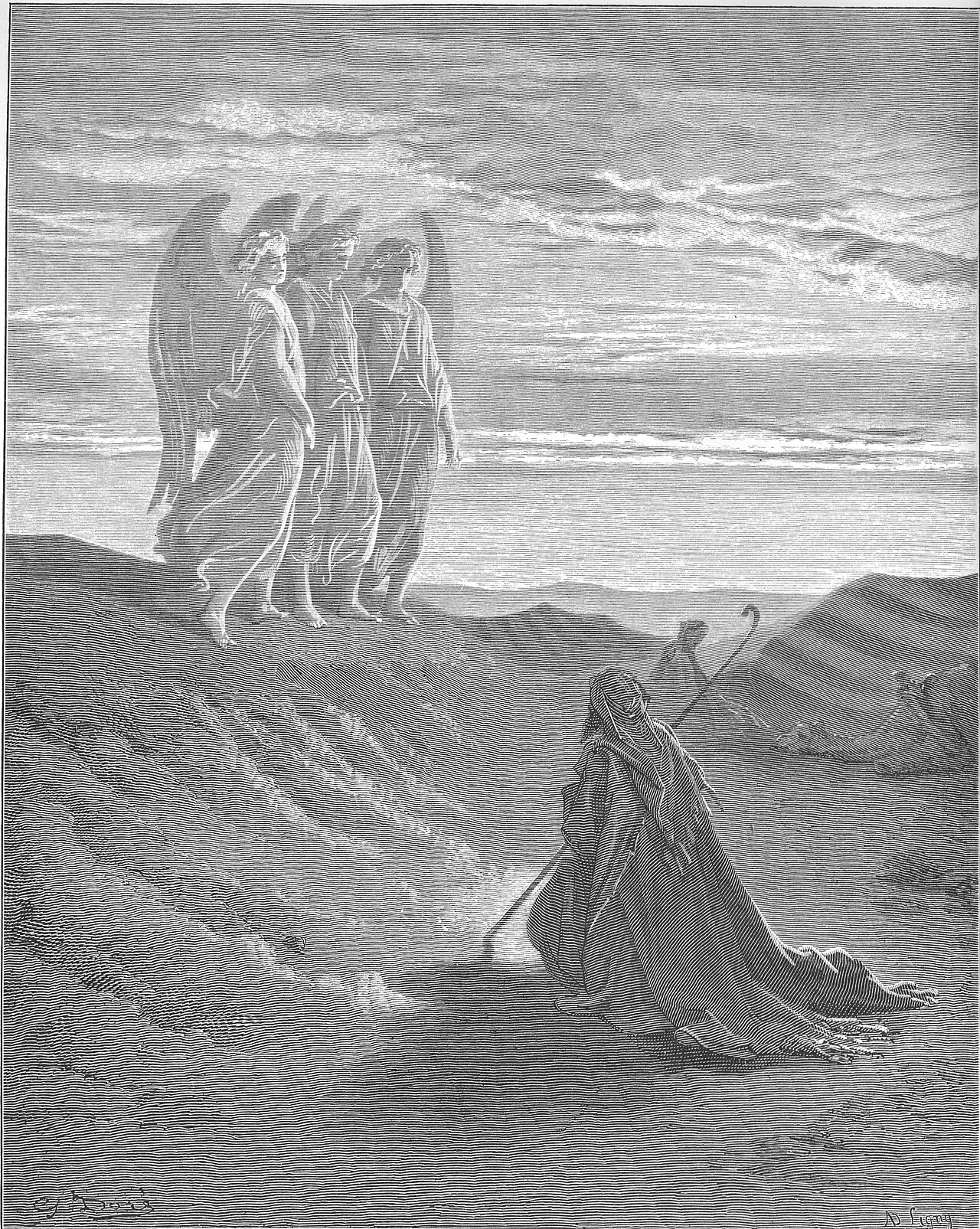
Gustave Doré, La Sainte Bible (Tours: Alfred Mame et fils, 1866). Public domain.
Summary
The oaks where the LORD appeared to Abraham and the promise of Isaac and the plea for Sodom were spoken (Gen 18).
- The LORD appeared to Abraham here with two others, and the text calls the pair "angels" once they arrive at Sodom.
- Sarah laughed at the promise that she would have a son within the year, and the LORD asked her why.
- Abraham pleaded for Sodom here, working the number of righteous people down from fifty to ten.
- Abram had already built an altar at these oaks years before, and Jacob came home to Isaac at the same spot a generation later.
- Sarah's burial field, bought at Machpelah, is described in Genesis itself as facing these same oaks.
On this page
In Scripture
- Verses
- 10
- Books
- 1
Near Mamre
- Hebron1.5 km · 0.9 mi S
- Machpelah3.2 km · 2.0 mi SE
- Tekoa15 km · 9.3 mi NE
- The Valley of Elah20 km · 12 mi NW
- Bethlehem20 km · 13 mi NE
- Lachish23 km · 15 mi W
Straight-line distances, computed from the gazetteer coordinates.
Where it is
the country around it
- Coordinates
- 31.5491° N, 35.0936° Efind it on the Atlas →
- Region
- Near Hebron
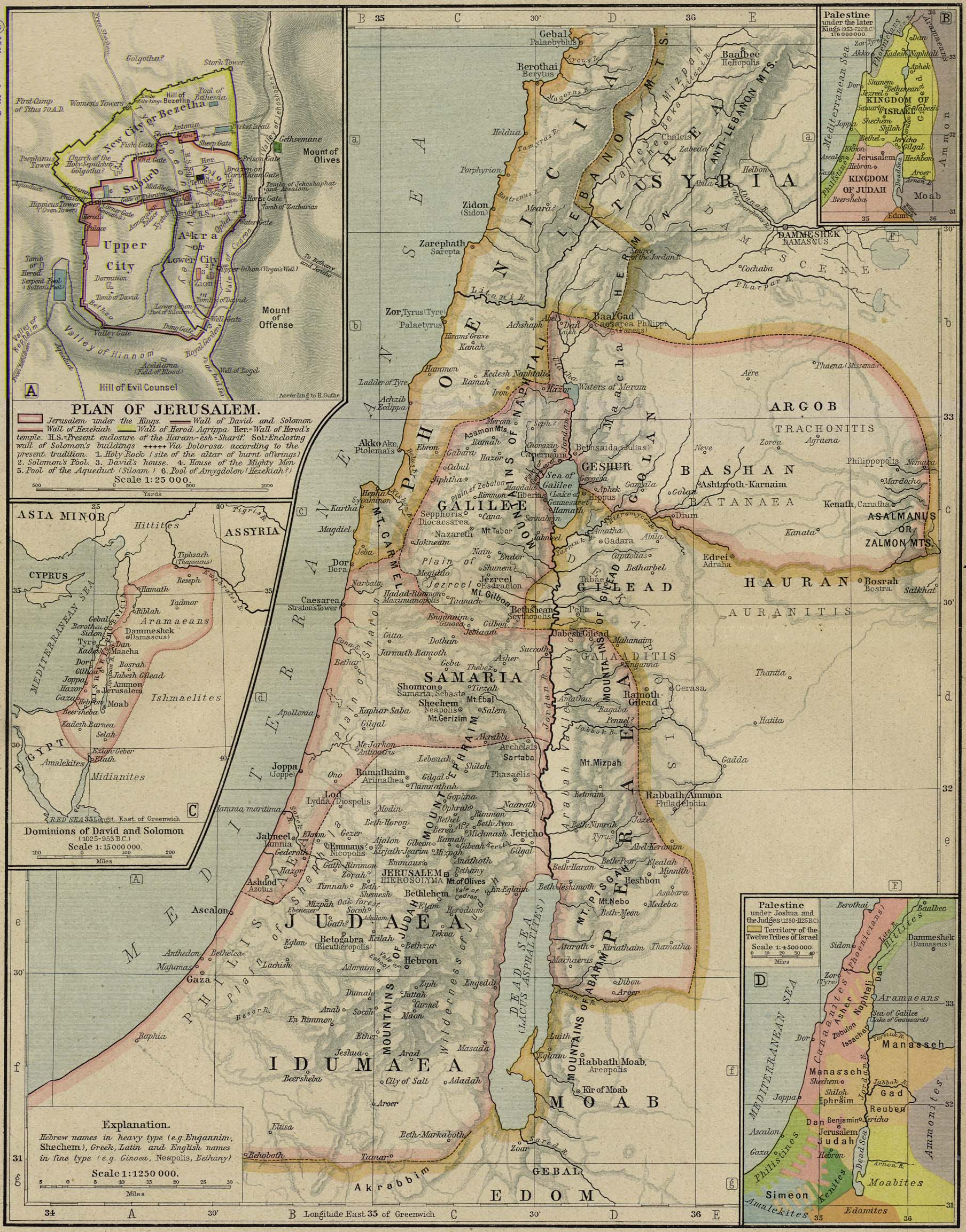
2 places the record names with Mamre, the farthest 3.2 km away
- 1Abram settles by the Oaks of Mamre and builds an altarGenesis 13:18 · 1.5 kmSo Abram moved his tent and went to live near the Oaks of Mamre at Hebron, where he built an altar to the LORD.
- 2Sarah's burial field is described as facing MamreGenesis 23:17 · 3.2 kmSo Ephron’s field at Machpelah near Mamre, the cave that was in it, and all the trees within the boundaries of the field were deeded over
- Located: the gazetteer fixes one site
- Placed: the point stands for an area, or is rounded
- A dashed line ends at a place the gazetteer does not fix
Not located: Canaan. The gazetteer records no location for it, so it is not marked.
Why Mamre matters
The three visitors, the promise, and the plea for Sodom
Genesis 18, in the order it happens
Read Genesis 18, in the order it happens
- The LORD appears at the oaksGenesis 18:1Then the LORD appeared to Abraham by the Oaks of Mamre in the heat of the day, while he was sitting at the entrance of his tent.
- Three men, and Abraham runs to meet themGenesis 18:2And Abraham looked up and saw three men standing nearby. When he saw them, he ran from the entrance of his tent to meet them and bowed low to the ground.
- The promise of a son within the yearGenesis 18:10Then the LORD said, “I will surely return to you at this time next year, and your wife Sarah will have a son!” Now Sarah was behind him, listening at the entrance to the tent.
- Sarah laughs to herselfGenesis 18:12So she laughed to herself, saying, “After I am worn out and my master is old, will I now have this pleasure?”
- The question the whole scene turns onGenesis 18:14Is anything too difficult for the LORD? At the appointed time I will return to you—in about a year—and Sarah will have a son.”
- The two men turn toward Sodom; Abraham stays before the LORDGenesis 18:22And the two men turned away and went toward Sodom, but Abraham remained standing before the LORD.
- The intercession beginsGenesis 18:23Abraham stepped forward and said, “Will You really sweep away the righteous with the wicked?
- Down to tenGenesis 18:32Finally, Abraham said, “May the Lord not be angry, but let me speak once more. Suppose ten are found there?” And He answered, “On account of the ten, I will not destroy it.”
- The pair are named angels, arriving at SodomGenesis 19:1Now the two angels arrived at Sodom in the evening, and Lot was sitting in the gateway of the city. When Lot saw them, he got up to meet them, bowed facedown,
The text names its own distinction. Genesis 18:1 opens with the LORD appearing; 18:22 has "the two men" turn toward Sodom while Abraham remains standing before the LORD; Genesis 19:1 then calls the pair who arrive at Sodom "the two angels."
What happened here, in order
in the order the canon tells it
- Abram settles by the Oaks of Mamre and builds an altarGenesis 13:18So Abram moved his tent and went to live near the Oaks of Mamre at Hebron, where he built an altar to the LORD.
- Mamre the Amorite, Abram's allyGenesis 14:13Then an escapee came and reported this to Abram the Hebrew. Now Abram was living near the Oaks of Mamre the Amorite, a brother of Eshcol and Aner, all of whom were bound by treaty to Abram.
- The visitors ask for Sarah by nameGenesis 18:9“Where is your wife Sarah?” they asked. “There, in the tent,” he replied.
- The men look out toward Sodom as they prepare to leaveGenesis 18:16When the men got up to leave, they looked out over Sodom, and Abraham walked along with them to see them off.
- The LORD states the outcry against SodomGenesis 18:20Then the LORD said, “The outcry against Sodom and Gomorrah is great. Because their sin is so grievous,
- Will not the Judge of all the earth do what is right?Genesis 18:25Far be it from You to do such a thing—to kill the righteous with the wicked, so that the righteous and the wicked are treated alike. Far be it from You! Will not the Judge of all the earth do what is right?”
- The LORD departs, and Abraham returns homeGenesis 18:33When the LORD had finished speaking with Abraham, He departed, and Abraham returned home.
- Sarah's burial field is described as facing MamreGenesis 23:17So Ephron’s field at Machpelah near Mamre, the cave that was in it, and all the trees within the boundaries of the field were deeded over
- Sarah buried near MamreGenesis 23:19After this, Abraham buried his wife Sarah in the cave of the field at Machpelah near Mamre (that is, Hebron) in the land of Canaan.
- Jacob comes home to Isaac at MamreGenesis 35:27Jacob returned to his father Isaac at Mamre, near Kiriath-arba (that is, Hebron), where Abraham and Isaac had stayed.
The voices
each quoted from the work named
The appearance of God to Abraham seems to have had in it more of freedom and familiarity, and less of grandeur and majesty, than those we have hitherto read of; and therefore more resembles that great visit which, in the fullness of time, the Son of God was to make to the world, when the Word would be flesh, and appear as one of us.
And the Lord (Jehovah) said, etc. - So it appears that one of those three persons was Jehovah, and as this name is never given to any created being, consequently the ever-blessed God is intended; and as he was never seen in any bodily shape, consequently the great Angel of the covenant, Jesus Christ, must be meant. See note on Gen 16:7.
And the men turned their faces - That is, the two angels who accompanied Jehovah were now sent towards Sodom; while the third, who is called the Lord or Jehovah, remained with Abraham for the purpose of teaching him the great usefulness and importance of faith and prayer.
Mamre in Scripture
10 verses name it, in 1 book
Open a book to read its mentions here. Text: Berean Standard Bible.
Old Testament1 book · 10 mentions
Genesis10 mentions
- Genesis 13:18So Abram moved his tent and went to live near the Oaks of Mamre at Hebron, where he built an altar to the LORD.
- Genesis 14:13Then an escapee came and reported this to Abram the Hebrew. Now Abram was living near the Oaks of Mamre the Amorite, a brother of Eshcol and Aner, all of whom were bound by treaty to Abram.
- Genesis 14:24I will accept nothing but what my men have eaten and the share for the men who went with me—Aner, Eshcol, and Mamre. They may take their portion.”
- Genesis 18:1Then the LORD appeared to Abraham by the Oaks of Mamre in the heat of the day, while he was sitting at the entrance of his tent.
- Genesis 23:17So Ephron’s field at Machpelah near Mamre, the cave that was in it, and all the trees within the boundaries of the field were deeded over
- Genesis 23:19After this, Abraham buried his wife Sarah in the cave of the field at Machpelah near Mamre (that is, Hebron) in the land of Canaan.
- Genesis 25:9His sons Isaac and Ishmael buried him in the cave of Machpelah near Mamre, in the field of Ephron son of Zohar the Hittite.
- Genesis 35:27Jacob returned to his father Isaac at Mamre, near Kiriath-arba (that is, Hebron), where Abraham and Isaac had stayed.
2 further mentions in Genesis, read them in the book.
The account
Read the account as one telling
Common questions
Who were the three visitors, and who was "the LORD" among them?
Readers differ; the positions are named
The text draws its own line. Genesis 18:1 opens with the LORD appearing, and 18:22 has two of the three turn toward Sodom while Abraham remains standing before the one called the LORD; Genesis 19:1 then calls the pair who arrive at Sodom the two angels.
This site's tradition, following the same reading it gives other Old Testament appearances of the LORD in human form, holds that the figure who stays with Abraham is the pre-incarnate Son. Adam Clarke reads it exactly this way: "one of those three persons was Jehovah... consequently the great Angel of the covenant, Jesus Christ, must be meant," and again, "the third, who is called the Lord or Jehovah, remained with Abraham." Other readers hold the appearance was a created angel or angels acting and speaking in God's name and authority, without the Son being personally present. This page names the reading and does not force it on every visitor to the site.
Why did Sarah laugh, and was it sin?
She laughed to herself after long years of waiting, saying she was too old for the pleasure of a child. Scripture does not call the laugh a sin outright; it records that she was afraid and denied it, and that the LORD corrected her plainly rather than condemning her.
What was Abraham arguing for in his intercession, and how far did it go?
He pleaded for Sodom to be spared for the sake of the righteous inside it, working the number down in stages from fifty to forty-five, forty, thirty, twenty, and finally ten. The text does not record him asking for fewer than ten, and this page does not guess why he stopped there.
Were the oaks of Mamre a specific pair of trees?
The Hebrew word behind "oaks," elon, names an oak or another strong tree broadly rather than one specific pair. Scripture treats the grove as a known landmark near Hebron across several generations, from Abram's first tent there to Jacob's homecoming, without describing its size or extent.
Is the traditional site of Mamre known today?
A later tradition places an enclosure near Hebron on what it identifies as the site of Mamre. The German archaeologist Evaristus Mader excavated the enclosure, known as Ramat el-Khalil, in 1926 to 1928, and found layers going back before the fourth century, including an altar associated with pagan sacrifice. Around AD 325 the emperor Constantine had those pagan features removed and a basilica built over the site, enclosing the well and the tree the tradition already pointed to. This page names the tradition and its excavation history and carries no detail about the site's present-day condition or ownership.
Sources cited
- OpenBible.info Bible Geocoding: Mamreread 2026-08-20The coordinates on this page. Used under CC-BY with attribution to OpenBible.info.
- Berean Standard BiblePublic domain since 2023. Every verse quoted on this page, from the site's own verse store.
- Gustave Doré, La Sainte Bible (Tours: Alfred Mame et fils, 1866)The engraving on this page. Public domain.
- Matthew Henry, Commentary on the Whole Bible (1710)Quoted on Genesis 18:1. Public domain, active in the site's pull_quotes pool.
- Adam Clarke, Commentary on the Bible (1832)Quoted on Genesis 18:13 and 18:22. Public domain, active in the site's pull_quotes pool.
- The site's lexicon_entries table, Strong's Hebrewelon, oak or strong tree, h436, occurring nine times.
- "Mamre," Wikipedia, summarizing Evaristus Mader's 1926-1928 excavation report and the Constantinian basilicaNames Mader's excavation dates and Constantine's basilica, ca. AD 325. Cited here because Mader's own published excavation report was not directly available for this re-verification pass. Confirmed by web search, 2026-09-02.
Keep studying
On this page
Books that name it1
Doorway2
Keep this page