
Genesis 18:23
in Genesis 18Abraham stepped forward and said, “Will You really sweep away the righteous with the wicked?
BSB
The same verse in ASV and KJV ▾
ASV
And Abraham drew near, and said, Wilt thou consume the righteous with the wicked?
KJV
And Abraham drew near, and said, Wilt thou also destroy the righteous with the wicked?
⋯
This verse in Genesis 18
Commentary
8 notes on this verseWilt thou also destroy the righteous with the wicked? - A form of speech similar to that in Gen 18:17, an invariable principle of justice, that the righteous shall not be punished for the crimes of the impious. And this Abraham lays down as the foundation of his supplications. Who can pray with any hope of success who cannot assign a reason to God and his conscience for the petitions he offers? The great sacrifice offered by Christ is an infinite reason why a penitent sinner should expect to find the mercy for which he pleads.
This site's exposition
Abraham remained standing before the LORD
on Genesis 18:22-23
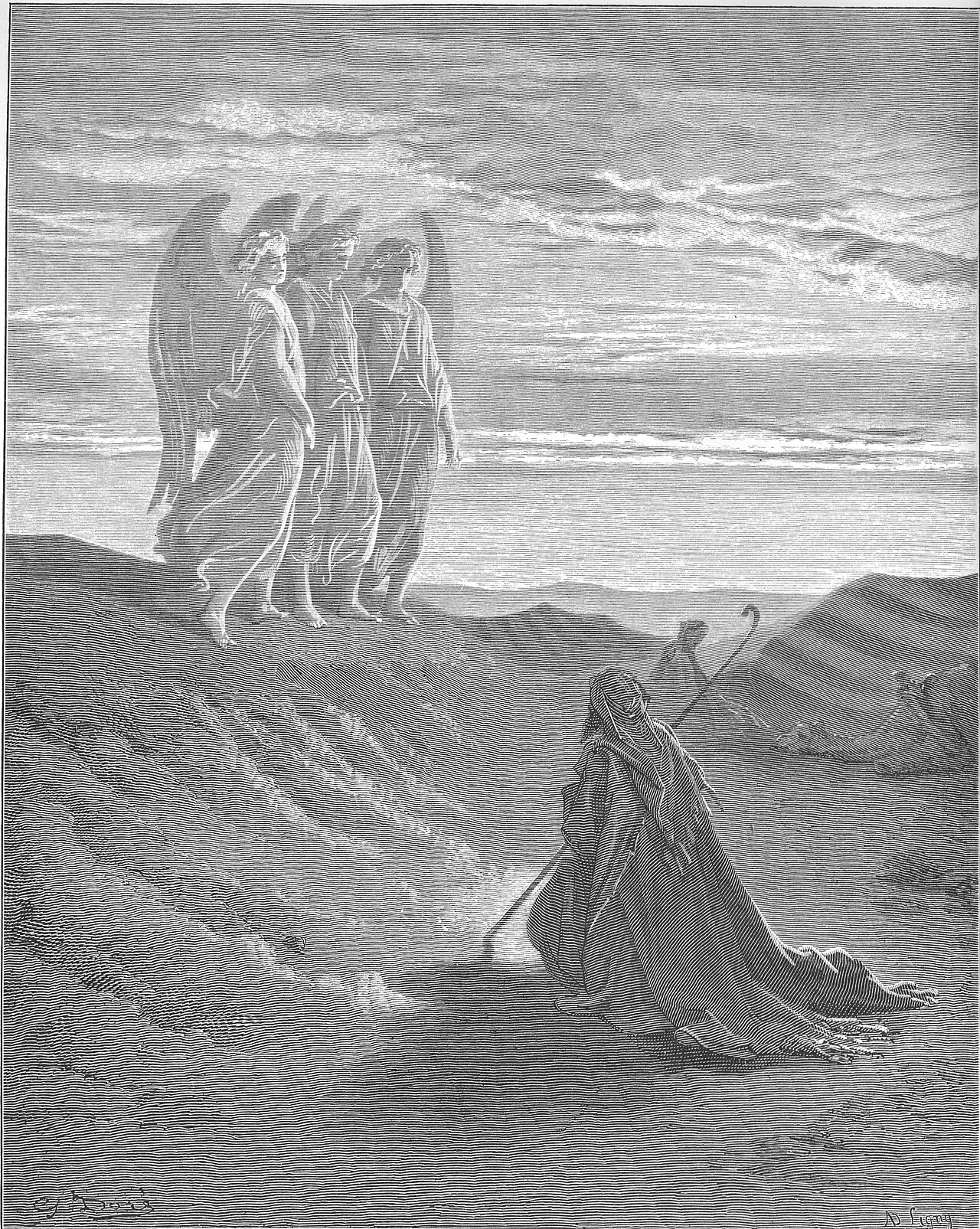
The two men turned away toward Sodom, and Abraham remained standing before the LORD. Clarke reads those two as the angels who reach Lot's gate in the next chapter. Abraham stepped forward and asked whether God would sweep the righteous away with the wicked. He had rescued this city once already, in chapter 14.
This site's exposition
sweep away the righteous with the wicked
Abraham speaks for the righteous in the city. Adam Clarke calls his ground an unchanging rule of justice, that the LORD will never sweep away the righteous with the wicked. Every plea from fifty down to ten is built on it.
The record, by era
The Medieval Church1 voice
And they turned themselves from there and went towards Sodom; but Abraham still stood before the Lord, and approaching he said: Will you indeed destroy the righteous with the wicked?
The Puritans and the Awakening3 voices
Whenever we draw near to God, it becomes us reverently to acknowledge the vast distance that there is between us and Him. He is the Lord of glory, we are worms of the earth.
), as most think, or whether the third left them before they came to Sodom, and the Lord before whom Abraham stood was the shechinah, or that appearance of the divine glory which Abraham had formerly seen and conversed with, is uncertain.
quarantine:debris (2026-07-29) — leading-punctuation+unbalanced-parens
And Abraham drew near,....
The Nineteenth Century1 voice
A commentator
Jamieson, Fausset & Brown1802–1910
Commentary Critical and Explanatory on the Whole Bible (1871)
proposed
Abraham drew near, and said, &c.--The scene described is full of interest and instruction--showing in an unmistakable manner the efficacy of prayer and intercession.
The words behind it
8 Hebrew wordsEvery Hebrew word of this verse in the order it stands, with what it means and the door to its own study. The last column counts the times a word stands in the whole Bible: the rarer the word, the more the places it appears belong together.
| Hebrew | Sound | Meaning | Word study | In the Bible |
|---|---|---|---|---|
| וַיִּגַּ֥שׁ | vaiyigash | and he drew near | H5066 → | 125 times |
| אַבְרָהָ֖ם | ʾavraham | Abraham | H85 → | 175 times |
| וַיֹּאמַ֑ר | vaiyomar | and he said | H559 → | 5305 times |
| הַאַ֣ף | haaf | ¿ also | H637 → | 134 times |
| תִּסְפֶּ֔ה | tispeh | will you sweep away | H5595 → | 19 times |
| צַדִּ֖יק | tzadik | [the] righteous | H6662 → | 206 times |
| עִם־ | ʾim- | with | H5973 → | 1050 times |
| רָשָֽׁע׃ | rasha' | [the] wicked | H7563 → | 263 times |
וַיִּגַּ֥שׁand he drew near
vaiyigashH5066 →125 times
אַבְרָהָ֖םAbraham
ʾavrahamH85 →175 times
וַיֹּאמַ֑רand he said
vaiyomarH559 →5305 times
הַאַ֣ף¿ also
haafH637 →134 times
תִּסְפֶּ֔הwill you sweep away
tispehH5595 →19 times
צַדִּ֖יק[the] righteous
tzadikH6662 →206 times
עִם־with
ʾim-H5973 →1050 times
רָשָֽׁע׃[the] wicked
rasha'H7563 →263 times
A shaded row is a word that stands 400 times or fewer in the Bible.
The walk
8 stopsEach card is a verse this one points to, and under it the verses that one points to in turn. Where several paths arrive at the same place, that place is listed first: the text keeps returning to it.
Through
Numbers 16:22But Moses and Aaron fell facedown and said, “O God, the God of the spirits of all flesh, when one man sins, will You be angry with the whole congregation?”
it leads to
- Numbers 27:16
“May the LORD, the God of the spirits of all flesh, appoint a man over the congregation
- Job 12:10
The life of every living thing is in His hand, as well as the breath of all mankind.
- Zechariah 12:1
This is the burden of the word of the LORD concerning Israel. Thus declares the LORD, who stretches out the heavens and lays the foundation of the earth, who forms the spirit of man…
- Ecclesiastes 12:7
before the dust returns to the ground from which it came and the spirit returns to God who gave it.
- Hebrews 12:9
Furthermore, we have all had earthly fathers who disciplined us, and we respected them. Should we not much more submit to the Father of our spirits and live?
- Numbers 27:16
Through
2 Samuel 24:17When David saw the angel striking down the people, he said to the LORD, “Surely I, the shepherd, have sinned and acted wickedly. But these sheep, what have they done? Please, let Your hand…
it leads to
- 1 Chronicles 21:16–17
When David lifted up his eyes and saw the angel of the LORD standing between heaven and earth, with a drawn sword in his hand stretched out over Jerusalem, David and the elders, clothed…
- Psalms 74:1
Why have You rejected us forever, O God? Why does Your anger smolder against the sheep of Your pasture?
- 2 Samuel 24:10
After David had numbered the troops, his conscience was stricken and he said to the LORD, “I have sinned greatly in what I have done. Now, O LORD, I beg You to take away…
- 1 Chronicles 21:16–17
Where this verse is studied
By subject
Prayer34 verses
On this page
About Genesis
Who and where
1 name in this verse with a page on the site.
This page draws on Adam Clarke, Commentary on the Bible; Bede, Commentary on Genesis (Hexaemeron); Jamieson, Fausset & Brown, Commentary Critical and Explanatory on the Whole Bible; John Gill, Exposition of the Old Testament (1748-1763); John Wesley, Explanatory Notes upon the Old Testament and Matthew Henry, Commentary on the Whole Bible.