
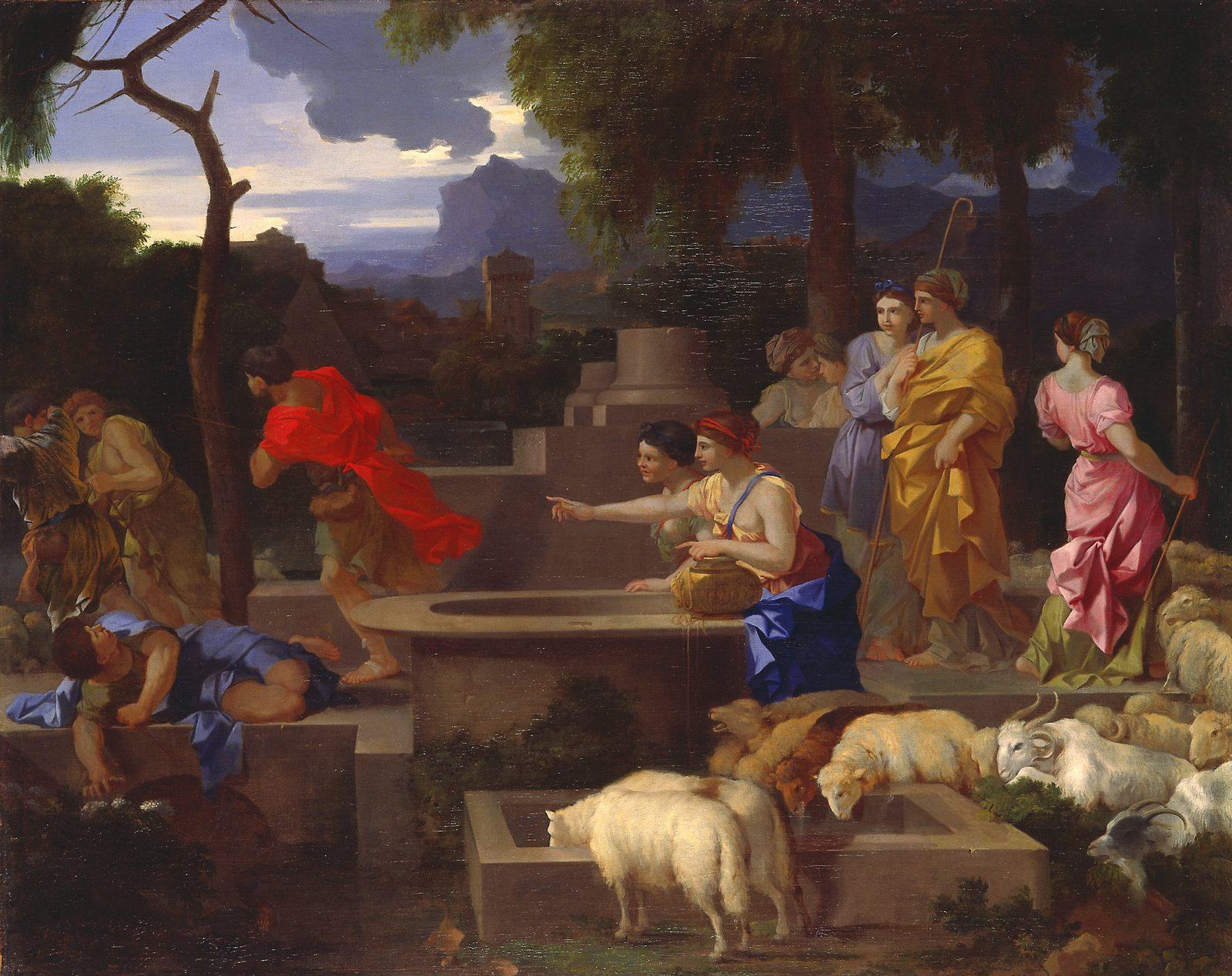
Sébastien Bourdon, Moses Defending the Daughters of Jethro, seventeenth century. Public domain.
Genesis 25 to Acts 7 · Place · Featured Study
Midian
Midian was a desert people descended from Abraham through his wife Keturah, and Moses lived among them for forty years before the exodus.
The sons of Midian were Ephah, Epher, Hanoch, Abida, and Eldaah. All these were descendants of Keturah.
- Today
- The S.W. plate: north-west Arabia
- Region
- The deserts east and south of Edom and Moab
- First named
- Genesis 25:2 “…bore him Zimran, Jokshan, Medan, Midian, Ishbak, and…”
- Last named
- Acts 7:29 “…fled to the land of Midian, where he…”
Moses was keeping the flock of Jethro, the priest of Midian, when God called to him from the bush.
Summary
Midian's people were traders, the kin of Moses' wife, and later foes of Israel.
- Ephah was one of Midian's sons, and Habakkuk 3:7 sets Cushan beside Midian.
- Jethro, the priest of Midian, blessed the LORD when Moses told him how Israel had been delivered from Egypt.
- A painted ware once called Midianite was made at Qurayyah in north-west Arabia.
- Isaiah names the day of Midian when he speaks of the broken yoke and the child given.
A Son of Abraham by Keturah
Genesis gives Midian five sons and sends the family away from Isaac to the land of the east.
But while he was still alive, Abraham gave gifts to the sons of his concubines and sent them away from his son Isaac to the land of the east.The gifts and the sending away explain why Keturah's sons are found in the deserts beyond Canaan.
Keturah's sons in JosephusAntiquities 1.15.1
Josephus, the Jewish historian, says in the Antiquities of the Jews that Abraham settled Keturah's sons and grandsons in colonies. In his account they took Troglodytis and Arabia the Happy as far as the Red Sea (1.15.1 in Whiston's numbering).
Midian on an Engraved Plate
The plate, signed S.W., letters the land east of Midian Part of the Desart Arabia.
The plate letters MIDIAN down the desert from below Zoar to Madyan on the eastern gulf, east of Edom and south of Moab.
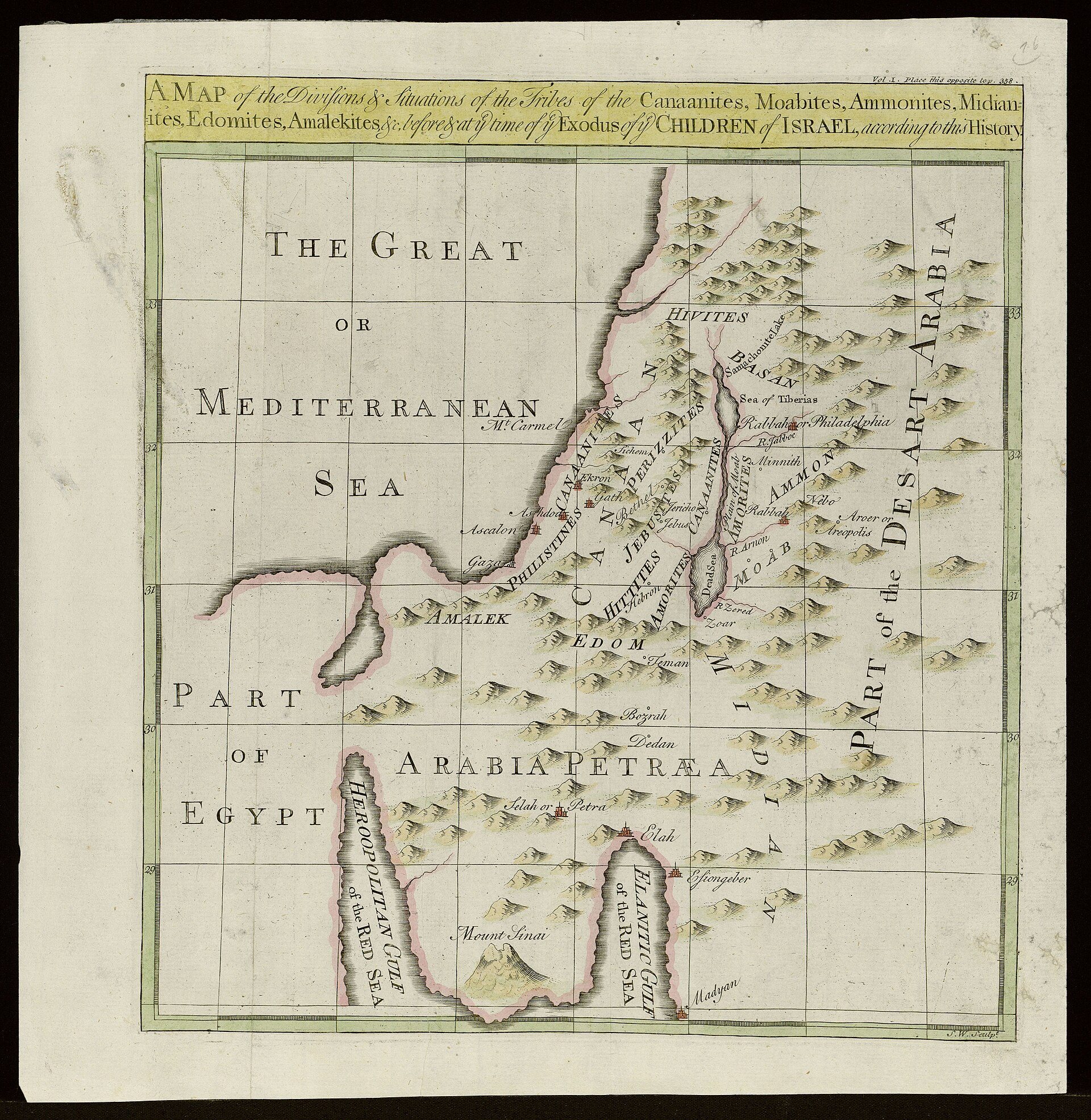
- Madyan, the plate's siteThe seven daughters of the priest of Midian came to draw water for their father's flock.Exodus 2:16
- Mount Sinai, the plate's siteMoses led Jethro's flock to Horeb, the mountain of God.Exodus 3:1
- Dedan, the plate's siteDedan was a grandson of Abraham and Keturah through Jokshan.Genesis 25:3
- MIDIAN, the plate's letteringMoses lived in the land of Midian as a foreigner and had two sons.Acts 7:29
- Moab, the plate's letteringThe Moabites called on the elders of Midian against Israel.Numbers 22:4
- Plain of Moab, as letteredIsrael brought the captives and plunder of Midian to the camp on the plains of Moab.Numbers 31:12
S.W., engraver, A Map of the Divisions and Situations of the Tribes of the Canaanites, Moabites, Ammonites, Midianites, Edomites, Amalekites, date not recorded, National Library of Israel, Eran Laor Cartographic Collection. Public domain, Wikimedia Commons File:S.W., A Map of the Divisions & Situations of the Tribes of Canaanites, Moabites, Ammonites, Midianites, Edomites, Amalekites & C (FL199992192 2369214).jpg.
Six points where the plate prints them, in its own spellings. The plate draws the peoples before and at the time of the Exodus, as its title says. The drawing is not to scale, and north is at the top, as the plate's lines of latitude show; the plate prints no scale and no north mark.
Kin, Guide and Enemy
Eleven meetings of Midian and Israel run from the sale of Joseph to a promise in Isaiah, each with the part Midian played.
Midian takes eight different parts in Israel's story, from traders to a land covered with its camels.
- Midianite traders sell Joseph in Egypt to Potiphar, an officer of PharaohTradersGenesis 37:36
- Moses settles in Midian and marries ZipporahRefugeExodus 2:21
- Jethro brings Moses' wife and sons to the camp at the mountain of GodKinExodus 18:5
- Moses asks Hobab, son of Reuel the Midianite, to be Israel's eyes in the wildernessAsked to guideNumbers 10:31
- The elders of Midian carry Moab's fees to Balaam, a diviner by the EuphratesEnemyNumbers 22:7
- Cozbi, daughter of a Midianite chief, is killed at PeorEnemyNumbers 25:15
- Israel kills the five kings of Midian and BalaamEnemyNumbers 31:8
- Midian holds Israel in its hand for seven yearsOppressorJudges 6:1
- Gideon's three hundred blow the rams' horns and the camp turns on itselfEnemyJudges 7:22
- Midian is subdued and the land rests forty yearsSubduedJudges 8:28
- Young camels of Midian and Ephah cover the land, and all from Sheba bring gold and frankincenseCamels in the landIsaiah 60:6
In the order of the books, from Genesis to Isaiah.
Israel kills the five kings of Midian and Balaam, Midian holds Israel in its hand for seven years, Gideon's three hundred blow the rams' horns and the camp turns on itself, Midian is subdued and the land rests forty years, Young camels of Midian and Ephah cover the land, and all from Sheba bring gold and frankincense
How many Midianites fellNumbers 31:7; Jamieson, Fausset and Brown
Then they waged war against Midian, as the LORD had commanded Moses, and they killed every male.Numbers reports every male killed, and yet Judges 6 finds Midian strong again.
Jamieson, Fausset and Brown, in their Commentary Critical and Explanatory (1871), judge that the destruction was partial. In their reading it reached those near the camp who had joined the plot at Peor. Many Midianites, they write, were away with their herds or had fled.
One Family, Many Names
Nine names in five books stand beside Midian in its own passages.
Each passage sets its name beside Midian in its own way: as a son, a parallel, an ally or another name.
| Name | What the passage does with it | Verse |
|---|---|---|
| Midianites | Names the people Israel was told to attack after Peor | Numbers 25:17 |
| Ishmaelites | Gives the name Ishmaelites to Gideon's Midianite enemies | Judges 8:24 |
| Ephah | Names Ephah as the first of the five sons of Midian | Genesis 25:4 |
| People of the east | Lists them beside Midian and the Amalekites whenever Israel planted its crops | Judges 6:3 |
| Cushan | Sets the tents of Cushan in parallel with the curtains of Midian | Habakkuk 3:7 |
| Reuel | Names the priest of Midian whose daughters Moses helped at the well | Exodus 2:18 |
| Jethro | Gives the priest of Midian a second name | Exodus 3:1 |
| Hobab | Names Hobab the son of Reuel the Midianite | Numbers 10:29 |
| Kenite | Calls Moses' father-in-law the Kenite, whose descendants went up with Judah | Judges 1:16 |
Jethro, Hobab, Kenite
Reuel, Jethro and HobabJudges 4:11; John Wesley
Now Heber the Kenite had moved away from the Kenites, the descendants of Hobab the father-in-law of Moses, and had pitched his tent by the great tree of Zaanannim, which was near Kedesh.Judges calls Hobab the father-in-law of Moses, where Numbers 10:29 calls him the son of Reuel.
“And therefore this Hobab is not Jethro, but his son, which may seem more probable, because Jethro was old and unfit to travel, and desirous, as may well be thought, to die in his own country, whither he returned, Exod. xviii, 27, but Hobab was young and fitter for these journeys, and therefore entreated by Moses to stay and bear them company.”
John Wesley · Explanatory Notes upon the Old Testament · on Numbers 10:29Evangelical
Camels, Tents and Herds
Judges pictures Midian as a host that moved with its tents, herds and camels.
For the Midianites came with their livestock and their tents like a great swarm of locusts. They and their camels were innumerable, and they entered the land to ravage it.This is the host Gideon faced, and its size explains why Israel hid in caves and strongholds in Judges 6:2.
The purple of the kings of MidianJudges 8:26
The weight of the gold earrings he had requested was 1,700 shekels, in addition to the crescent ornaments, the pendants, the purple garments of the kings of Midian, and the chains from the necks of their camels.Beside the earrings of the host, the spoil names the dress of a desert court: the kings' purple and their camels' chains.
The Painted Ware Once Called Midianite
The ware has carried two names, one for a people and one for a place.
Marta Luciani and seven colleagues analysed dozens of samples from a pottery kiln at Qurayyah and published the results in PLOS One in August 2026. They found that the bichrome painted ware was made there from the late Middle Bronze Age down to the fourth century BC. The same study traced vessels from the Hathor shrine at Timna, in the Arabah, to the kiln at Qurayyah.
B. Rothenberg and J. Glass published the ware in 1983 as The Midianite Pottery, in a volume on Midian, Moab and Edom. The study of the kiln names it Qurayyah Painted Ware, after the place it was made. That study names no people as the makers of the ware.
What the Text Leaves Unsaid
Numbers 31 burns Midian's cities and encampments and gives none of them a name.
Then they burned all the cities where the Midianites had lived, as well as all their encampments,No verse draws Midian's border either, so its extent is read from the places its people appear.
Where Jethro went homeExodus 18:27
Then Moses sent his father-in-law on his way, and Jethro returned to his own land.This verse gives his land no place name.
As in the Day of Midian
Isaiah twice recalls the defeat of Midian as the pattern of the LORD's deliverance.
For as in the day of Midian You have shattered the yoke of their burden, the bar across their shoulders, and the rod of their oppressor.Isaiah reaches back to Gideon for the one comparison he gives the broken yoke.
For unto us a child is born, unto us a son is given, and the government will be upon His shoulders. And He will be called Wonderful Counselor, Mighty God, Everlasting Father, Prince of Peace.Isaiah moves from the broken yoke to the One who will rule, and gives Him four titles.
The rock of OrebIsaiah 10:26
And the LORD of Hosts will brandish a whip against them, as when He struck Midian at the rock of Oreb. He will raise His staff over the sea, as He did in Egypt.Isaiah names the blow against Midian a second time and sets it beside the LORD's staff over the sea in Egypt.
Do to them as You did to MidianPsalm 83:9 to 11
Do to them as You did to Midian, as to Sisera and Jabin at the River Kishon, who perished at Endor and became like dung on the ground. Make their nobles like Oreb and Zeeb, and all their princes like Zebah and Zalmunna,The psalmist asks God to treat Israel's later enemies as He treated the princes and kings of Midian under Gideon.
Where Midian Lay and Where Israel's Worship Began
Josephus and the commentators place Midian's people, and Karl Budde asks where Israel's worship of the LORD began.
Now I know that the LORD is greater than all other gods, for He did this when they treated Israel with arrogance.”Jethro grounds his confession in what Moses has just told him of the deliverance.
A city on the Red SeaJosephus
Josephus writes in the Antiquities of the Jews that Moses came to "the city Midian, which lay upon the Red Sea" (2.11.1 in Whiston's numbering). Josephus names the city for Abraham's son by Keturah. The S.W. plate prints Madyan on the shore of the eastern gulf of the Red Sea.
Midianites near Sinai and near MoabJohn Wesley; Jamieson, Fausset and Brown
John Wesley, in his Explanatory Notes upon the Old Testament (1765), reads the Midianites near Sinai as a colony. In his reading the main body of the people lived near Moab. Jamieson, Fausset and Brown, in their Commentary Critical and Explanatory (1871), write that Jethro's headquarters are supposed to have been at Dahab-Madian on the Sinai coast. They add that tradition fixes another place in Wady Shuweib, east of the mountain of Moses.
A priest in MidianJohn Wesley
Wesley calls Jethro a worshipper of the true God. Wesley judges that Jethro probably offered the burnt offering of Exodus 18:12 himself, because the priesthood was not yet settled in Israel.
The LORD as the God of the KenitesKarl Budde
Karl Budde, in The Religion of Israel to the Exile (1899), argued that the LORD was first the God of the Kenites. Budde took the Kenites for the Midianite tribe of Moses' father-in-law. He rested the case on Exodus 18:12, where Jethro brings the offering and Aaron and the elders come to eat with him. Budde read Jethro as the priest of the LORD among the Kenites.
God also told Moses, “Say to the Israelites, ‘The LORD, the God of your fathers—the God of Abraham, the God of Isaac, and the God of Jacob—has sent me to you.’ This is My name forever, and this is how I am to be remembered in every generation.At the bush, before Moses returns to Jethro, the LORD gives His name as the God of Abraham, Isaac and Jacob, which bears on Budde's question.
Books to Read Next
Four works on Midian that a reader can open free, from Josephus to the study of the Qurayyah kiln.
Antiquities of the Jews
Flavius Josephus, translated by William Whiston · first century
In Books 1 and 2 Josephus settles Keturah's sons in Arabia and sets the city of Midian on the Red Sea.
READ IT FREE AT GUTENBERG →Commentary Critical and Explanatory on the Whole Bible
Robert Jamieson, A. R. Fausset and David Brown · 1871
Their notes on Exodus 2 and Numbers 31 give the supposed sites of Jethro's home and weigh the war against Midian.
READ IT FREE AT CCEL →The Religion of Israel to the Exile
Karl Budde · 1899
Lecture I sets out the case that Israel learned the LORD's worship from the Kenites.
READ IT FREE AT ARCHIVE.ORG →Creating a brand: Genesis, transformation and diffusion of Qurayyah Painted Ware
Marta Luciani and others, PLOS One · 2026
Its sections on the kiln and on Timna hold the evidence for where the ware was made.
READ IT FREE AT PLOS ONE →The King Isaiah Promised
Luke 1:32 to 33 gives Mary's Son the throne of His father David and a kingdom that will never end. The reader is asked to trust Him as the King whose government Isaiah 9 promised.
Sources
Scripture is the Berean Standard Bible.
- Flavius Josephus, Antiquities of the Jews, translated by William Whiston, 1.15.1 and 2.11.1 in Whiston's numbering.
- John Wesley, Explanatory Notes upon the Old Testament (1765), on Exodus 18:12, Numbers 10:29 and Numbers 22:4.
- Robert Jamieson, A. R. Fausset and David Brown, Commentary Critical and Explanatory on the Whole Bible (1871), on Exodus 2:15 and Numbers 31:7.
- Karl Budde, The Religion of Israel to the Exile (1899), Lecture I, pages 22 to 23.
- Marta Luciani and others, Creating a brand: Genesis, transformation and diffusion of Qurayyah Painted Ware, PLOS One (2026), the study of the kiln at Qurayyah.
- B. Rothenberg and J. Glass, The Midianite Pottery, in Midian, Moab and Edom (1983), Sheffield, JSOT Press, pages 65 to 124, the publication of the ware under the title The Midianite Pottery, cited from reference 14 of the 2026 study.
Keep Studying
People and groups10
Doctrines1