
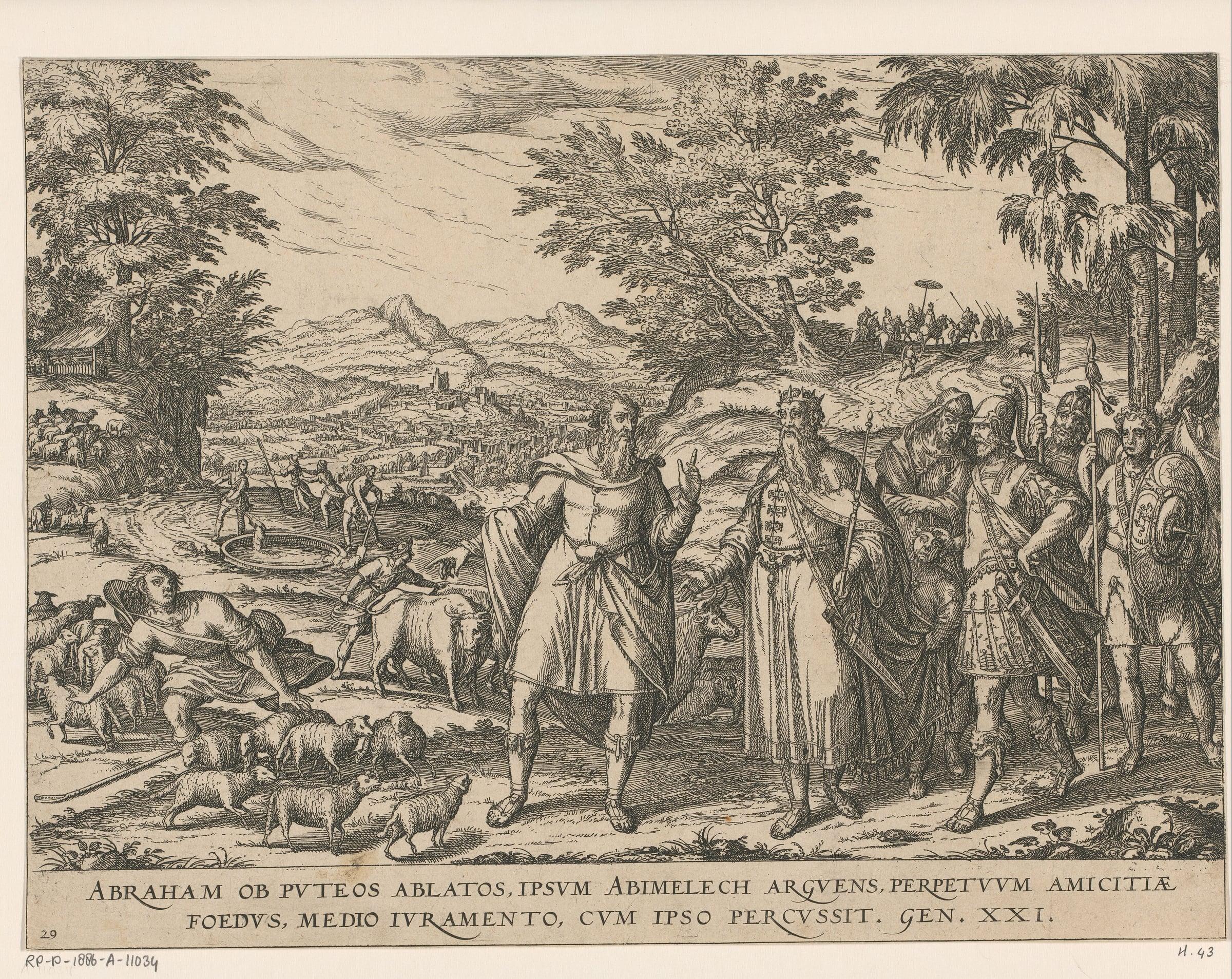
Attributed to Symon Novelanus, Bondgenootschap tussen Abraham en Abimelech, 1577 to 1627. CC0.
Judges 20:1 · Place · Featured Study
Beersheba
Beersheba was a cluster of wells in the Negev at the southern frontier of Israel's land.
Then all the Israelites from Dan to Beersheba and from the land of Gilead came out, and the congregation assembled as one man before the LORD at Mizpah.
- Today
- Tel Be'er Sheva, in the northern Negev of Israel
- Region
- The Negev of Judah
- First named
- Genesis 21:14 “…wandered in the Wilderness of Beersheba.”
- Last named
- Amos 8:14 “…surely as the way of Beersheba lives’—they will…”
The Latin under this engraving says Abraham rebuked Abimelech over the wells taken from him and struck a lasting treaty by an oath.
Summary
Beersheba is named in 33 verses, from Hagar's wandering in Genesis 21 to the warnings of Amos.
- Its name joins an oath sworn at a well with the number seven.
- For most of Israel's history the town marked the southern end of the land.
- Amos condemned the pilgrimages Israel made to its shrine.
The Well of the Oath
Genesis gives Beersheba its name twice, once under Abraham and once under Isaac.
This study asks where Beersheba stood and why Scripture uses it to mark the end of the land.
He replied, “You are to accept the seven ewe lambs from my hand as my witness that I dug this well.” So that place was called Beersheba, because it was there that the two of them swore an oath.This is the first naming of the place, under Abraham.
On that same day, Isaac’s servants came and told him about the well they had dug. “We have found water!” they told him. So he called it Shibah, and to this day the name of the city is Beersheba.This is the second naming, under Isaac.
Beersheba on Bartholomew's Plate
Bartholomew's plate covers the Negeb from Gaza to the Dead Sea.
Bartholomew sets Gerar west of Beersheba, on the side toward the coast.
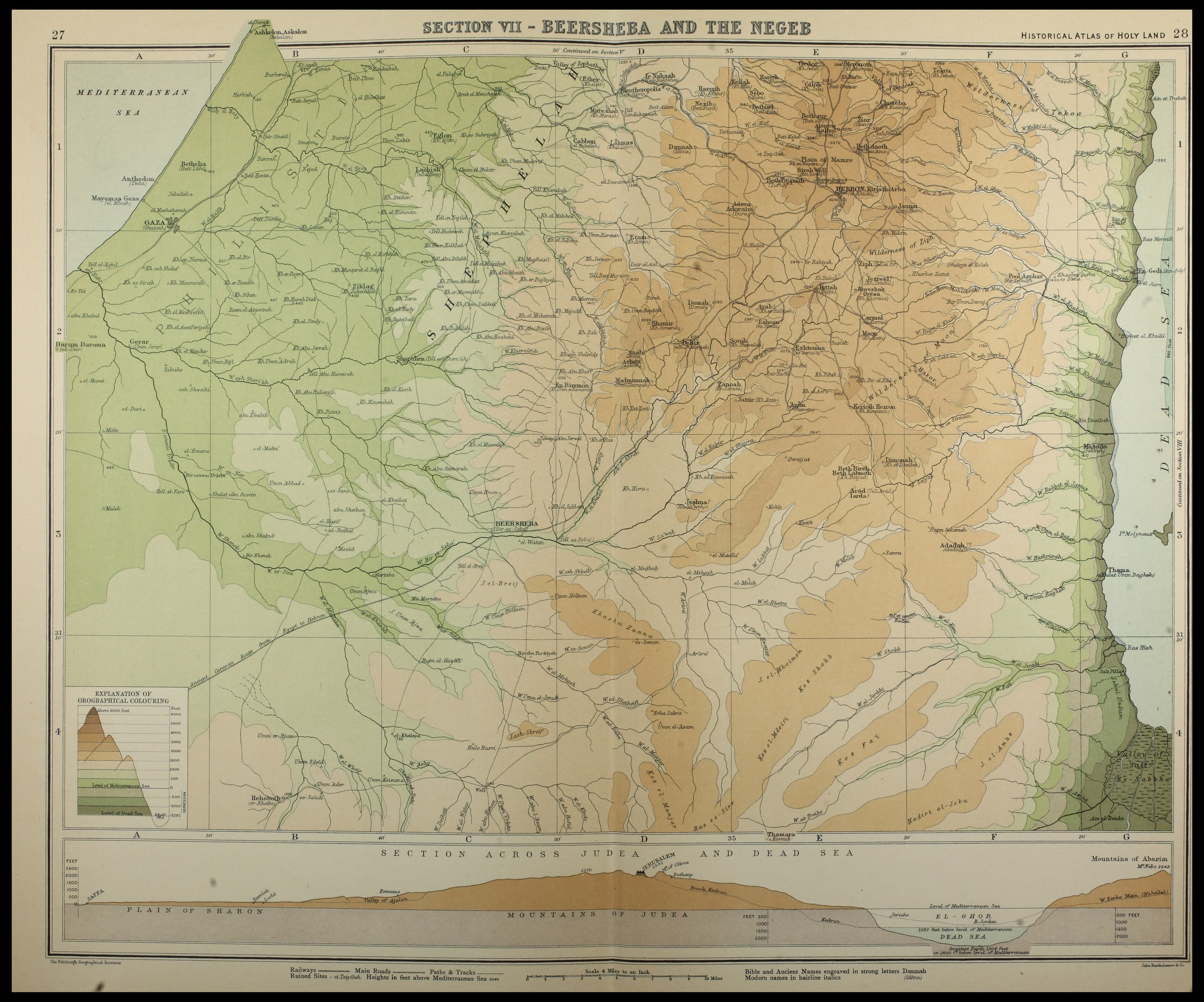
- GerarIsaac settled in Gerar, and from its valley he went up to Beersheba. Bartholomew's placing, proposed: he prints Gerar at Umm Jerar, the westernmost of the three points.Genesis 26:6
- BeershebaThe town Genesis 21 names. Bartholomew's placing: he prints the name at the wells of Bir es-Seba', the middle point.Genesis 21:31
- Tell es-Seba'Joshua 15:28 lists Beersheba among the towns of Judah. The plate prints this mound east of the wells under its modern name alone, the easternmost point.Joshua 15:28
John Bartholomew and Co., Section VII, Beersheba and the Negeb, Historical Atlas of the Holy Land, 1915. Public domain; National Library of Israel, Eran Laor Cartographic Collection; File:John Bartholomew & Co., Section VII - Beersheba and the Negeb (FL46962178 3907204).jpg.
Three numbered points, each where the plate prints the place, with north at the top. The plate is Section VII, Beersheba and the Negeb, of the Historical Atlas of the Holy Land, 1915. It sets Bible names in strong letters and modern names in hairline italics, and it prints a scale of miles.
Beersheba Through Scripture, in Order
Passages from Genesis to 1 Kings show the town as a home, a starting point and a seat of judges.
Three of the seven moments are departures from Beersheba.
- Genesis 21:14
- Hagar wanders with her son in the Wilderness of Beersheba
2After the mountain of the offering
- Genesis 22:19
- Abraham goes back to his servants and settles in Beersheba
- Genesis 28:10
- Jacob leaves Beersheba for Haran
- Genesis 46:1 to 5
- Israel offers sacrifices at Beersheba, and Jacob departs from there in Pharaoh's wagons
- Joshua 19:2
- Beersheba falls in Simeon's inheritance, inside the territory of Judah
- 1 Samuel 8:2
- Samuel's sons Joel and Abijah judge in Beersheba
- 1 Kings 19:3 to 4
- Elijah leaves his servant at Beersheba and goes a day's journey into the wilderness
In the order of the canon, each with its verse.
The study of Elijah tells his flight and the broom tree in full.
From Dan to Beersheba
The phrase joins Dan in the far north to Beersheba in the far south to name all Israel.
Seven verses run from Dan to Beersheba, and the two in Chronicles run from Beersheba to Dan.
- Judges 20:1The congregation assembles at MizpahJudges 20:1
- 1 Samuel 3:20All Israel knows Samuel as a prophet1 Samuel 3:20
- 2 Samuel 3:10Abner swears to set David's throne over Israel and Judah2 Samuel 3:10
- 2 Samuel 17:11Hushai counsels Absalom to gather all Israel2 Samuel 17:11
- 2 Samuel 24:2David sends Joab to register the troops2 Samuel 24:2
- 2 Samuel 24:15The plague falls on the people2 Samuel 24:15
- 1 Kings 4:25Judah and Israel dwell securely in Solomon's days1 Kings 4:25
- 1 Chronicles 21:2David orders the count, from Beersheba to Dan1 Chronicles 21:2
- 2 Chronicles 30:5Hezekiah's call to the Passover runs from Beersheba to Dan2 Chronicles 30:5
Every verse of the Berean text that joins the two towns in the phrase, in the order of the canon.
1 Kings 4:25, 1 Chronicles 21:2, 2 Chronicles 30:5
Albert Barnes, the American commentator, read the phrase in Judges 20:1 as a proverb for all Israel in the writer's day. In his reading it does not show that the Danites had already moved north as Judges 18 tells.
After the kingdom divided, the southern end held and the northern end moved. Josiah's reform runs from Geba to Beersheba (2 Kings 23:8). Jehoshaphat goes out from Beersheba to the hill country of Ephraim (2 Chronicles 19:4). The returned exiles settle from Beersheba to the Valley of Hinnom (Nehemiah 11:30).
The study of Dan sets out the northern end of the phrase.
Wells on the Open Desert
In 1897 the Scottish scholar George Adam Smith set Beersheba where settled farming came to an end.
Smith wrote The Historical Geography of the Holy Land. He judged that the land in practice ran from Dan to Beersheba, while its ideal border lay at the River of Egypt.
Smith found the frontier town to be a cluster of wells on the open desert. In his day there were seven wells there, and on the hills to the north lay ruins nearly three miles round.
The Mound of Tel Beersheba
UNESCO inscribed Tel Beer Sheba on the World Heritage List in 2005, with Megiddo and Hazor, as the Biblical Tels.
The listing names the three mounds for their remains of cities with biblical connections. It also names them for their Iron Age systems that gathered water underground for crowded towns.
The UNESCO listing gives the name Beersheba to the mound, which the old plate leaves under its modern name.
What the Text Leaves Unsaid
Genesis records Abraham's worship at Beersheba with no altar.
And Abraham planted a tamarisk tree in Beersheba, and there he called upon the name of the LORD, the Eternal God.This is the one act of worship Genesis records for Abraham at Beersheba.
So Isaac built an altar there and called on the name of the LORD, and he pitched his tent there. His servants also dug a well there.The first altar at Beersheba that Genesis records is Isaac's.
A Shrine the Prophet Forbade
Amos sets Beersheba beside Bethel and Gilgal as places Israel must stop seeking.
For this is what the LORD says to the house of Israel: “Seek Me and live! Do not seek Bethel or go to Gilgal; do not journey to Beersheba, for Gilgal will surely go into exile, and Bethel will come to nothing.Here Beersheba is one of three shrines Amos sets against the LORD Himself.
Those who swear by the guilt of Samaria and say, ‘As surely as your god lives, O Dan,’ or, ‘As surely as the way of Beersheba lives’—they will fall, never to rise again.”This verse ends the prophet's word on Beersheba with judgment.
Smith notes that Beersheba was still a sanctuary in the eighth century and drew worshippers even from the northern kingdom.
Voices on Beersheba
Origen and Barnes wrote on Isaac's altar, Elijah's flight and Samuel's sons at Beersheba.
Origen of Alexandria (died 253)
Origen of Alexandria, in his Homilies on Genesis, reads Isaac's altar and tent as a figure of the church.
“Isaac builds indeed an altar even now in the law and pitches his tent, but in the Gospels he does not pitch a tent but builds a house and establishes a foundation. For hear Wisdom saying of the church: ‘Wisdom,’ Scripture says, ‘has built herself a house and has set up seven columns.’”
Origen of Alexandria · Homilies on Genesis 14.2 · on Genesis 26:25Patristic
Albert Barnes (1798 to 1870)
Barnes gives the distance Elijah covered and a reason beyond Jezebel's threat for his flight.
“The rapid movement of the original is very striking. ‘And he saw (or, ‘feared,’ as some read), and he rose, and he went, etc.’ The fear and flight of Elijah are very remarkable. Jezebel’s threat alone, had not, in all probability, produced the extraordinary change but, partly, physical reaction from the over-excitement of the preceding day; and, partly, internal disquietude and doubt as to the wisdom of the course which he had adopted. Beer-sheba is about 95 miles from Jezreel, on the very borders of the desert et-Tih.”
Albert Barnes · Notes, Explanatory and Practical, on the Old and New Testaments (1832-1869) · on 1 Kings 19:3Evangelical
Barnes also accounts for a court of judges at the far south.
“The mention of Beer-sheba, on the extreme southern frontier of Judah, as the place where Samuel’s sons judged Israel is remarkable. It was probably due to the recovery of territory from the usurpation of the Philistines 1Sa 7:14.”
Albert Barnes · Notes, Explanatory and Practical, on the Old and New Testaments (1832-1869) · on 1 Samuel 8:2Evangelical
One Naming or Two
Readers differ on whether Genesis 21 and 26 tell one naming of Beersheba or two.
Isaac reopened the wells that had been dug in the days of his father Abraham, which the Philistines had stopped up after Abraham died. And he gave these wells the same names his father had given them.This verse is the ground of the first reading.
Isaac gave back his father's nameAdam Clarke, 1832
Two accounts of one originGeorge Adam Smith, 1897
Smith holds that Genesis 21 gives the founding of Beersheba to Abraham and Genesis 26 gives it to Isaac in very similar circumstances. In a note he assigns the two accounts to two documents.
The objection: the verse above has Isaac keep his father's names for the wells he reopened.
The Oath God Swore
On the mountain of the offering the LORD swore to Abraham by Himself (Genesis 22:16).
So when God wanted to make the unchanging nature of His purpose very clear to the heirs of the promise, He guaranteed it with an oath. Thus by two unchangeable things in which it is impossible for God to lie, we who have fled to take hold of the hope set before us may be strongly encouraged.Hebrews grounds the Christian's hope in the oath God swore to Abraham.
Sources
Scripture is the Berean Standard Bible.
- The Hebrew text tagged word by word with Strong's numbers.
- Jerome, Hebrew Questions on Genesis, on Genesis 21:30.
- Adam Clarke, Commentary on the Bible (1832), on Genesis 26:33.
- George Adam Smith, The Historical Geography of the Holy Land, fourth edition (London, 1897), pages 284 to 285.
- UNESCO World Heritage List, property 1108, Biblical Tels: Megiddo, Hazor, Beer Sheba (2005)
- Origen of Alexandria, Homilies on Genesis 14.2, on Genesis 26:25.
- Albert Barnes, Notes, Explanatory and Practical, on the Old and New Testaments (1832 to 1869), on Judges 20:1, 1 Samuel 8:2 and 1 Kings 19:3.
Keep Studying
Read it4
Studies6
People and groups7
Show the next 1 title
Doctrines1