
Place
Moriah
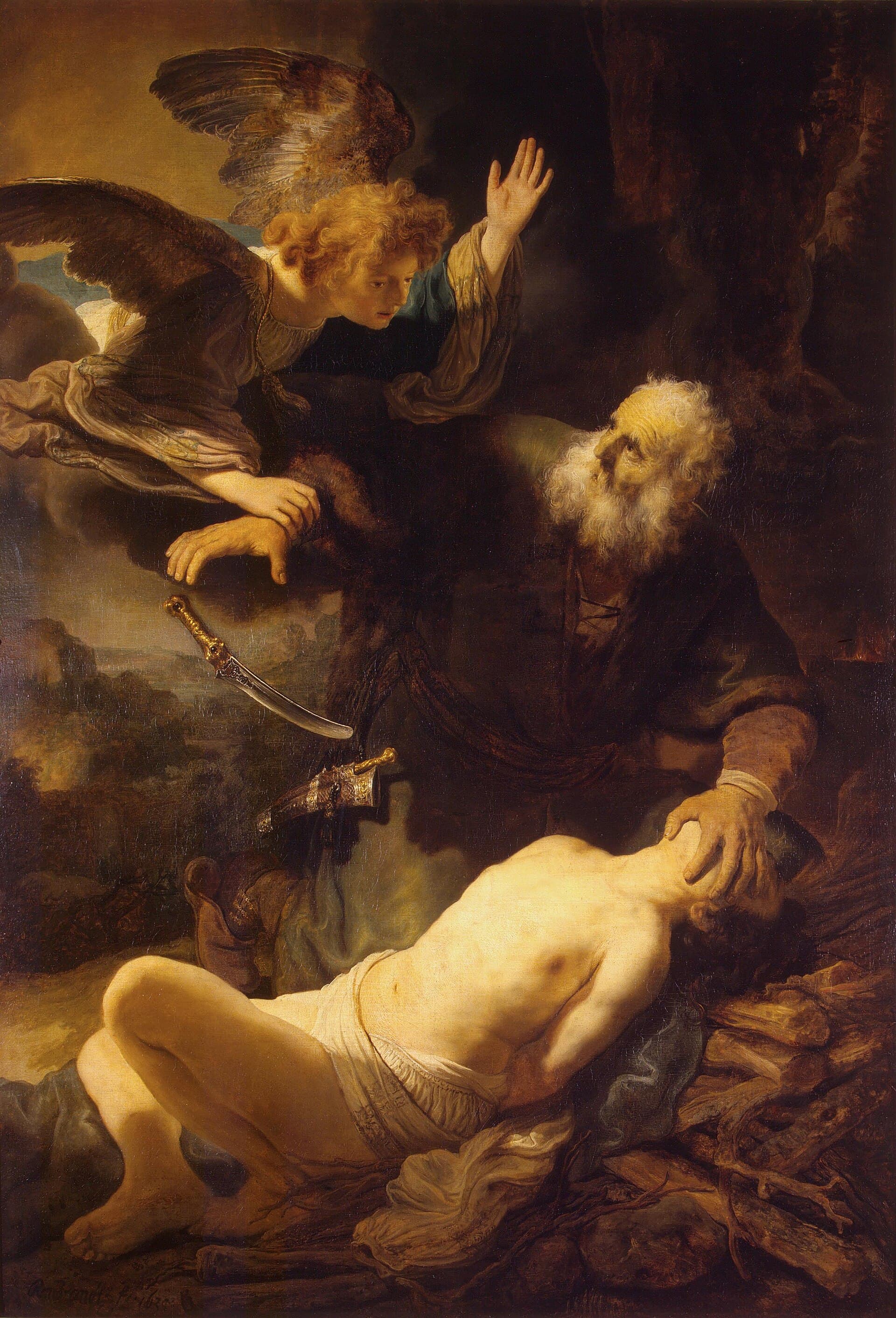
Rembrandt van Rijn, The Sacrifice of Isaac (1635), Hermitage Museum. Public domain, via Wikimedia Commons.
Summary
The mountain where Abraham bound Isaac and God provided the ram, where David bought Ornan’s threshing floor as the plague was halted, and where Solomon built the house of the LORD.
- Moriah is named twice in the whole Bible. Genesis 22:2 sends Abraham to the land of Moriah, and 2 Chronicles 3:1 says Solomon built the house of the LORD on Mount Moriah.
- The defining event is the binding of Isaac. Abraham's hand is stopped by a voice from heaven, and a ram caught in a thicket dies in the son's place.
- Abraham named the place The LORD Will Provide, and the saying became a proverb about the future: on the mountain of the LORD it will be provided.
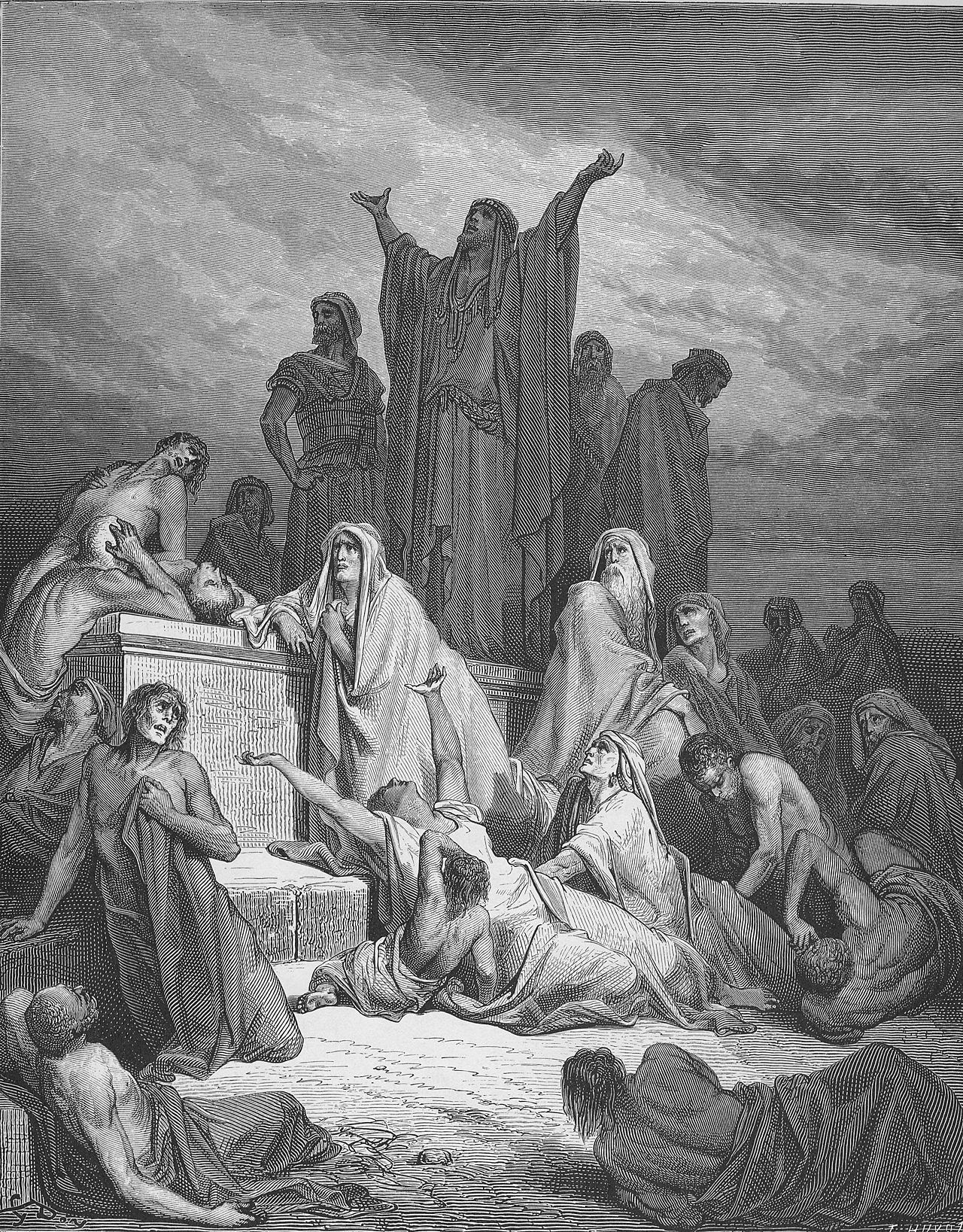
- David bought a threshing floor on this hill for the altar that halted a plague, and refused to take the ground for nothing. Solomon's temple was built on it.
- Genesis never gives Isaac's age. The word it uses for him is used of Joseph at seventeen and of Benjamin when he is a grown father, and Sarah's death in the next chapter puts a ceiling of thirty-seven on him.
On this page
In Scripture
- Verses
- 2
- Books
- 2
Near Moriah
- Mount of Olives1.1 km · 0.7 mi E
- Jerusalem2.3 km · 1.4 mi SW
- Nob2.5 km · 1.5 mi N
- Bethany2.6 km · 1.6 mi E
- Gibeah5.2 km · 3.2 mi N
- Bethlehem8.6 km · 5.3 mi S
Straight-line distances, computed from the gazetteer coordinates.
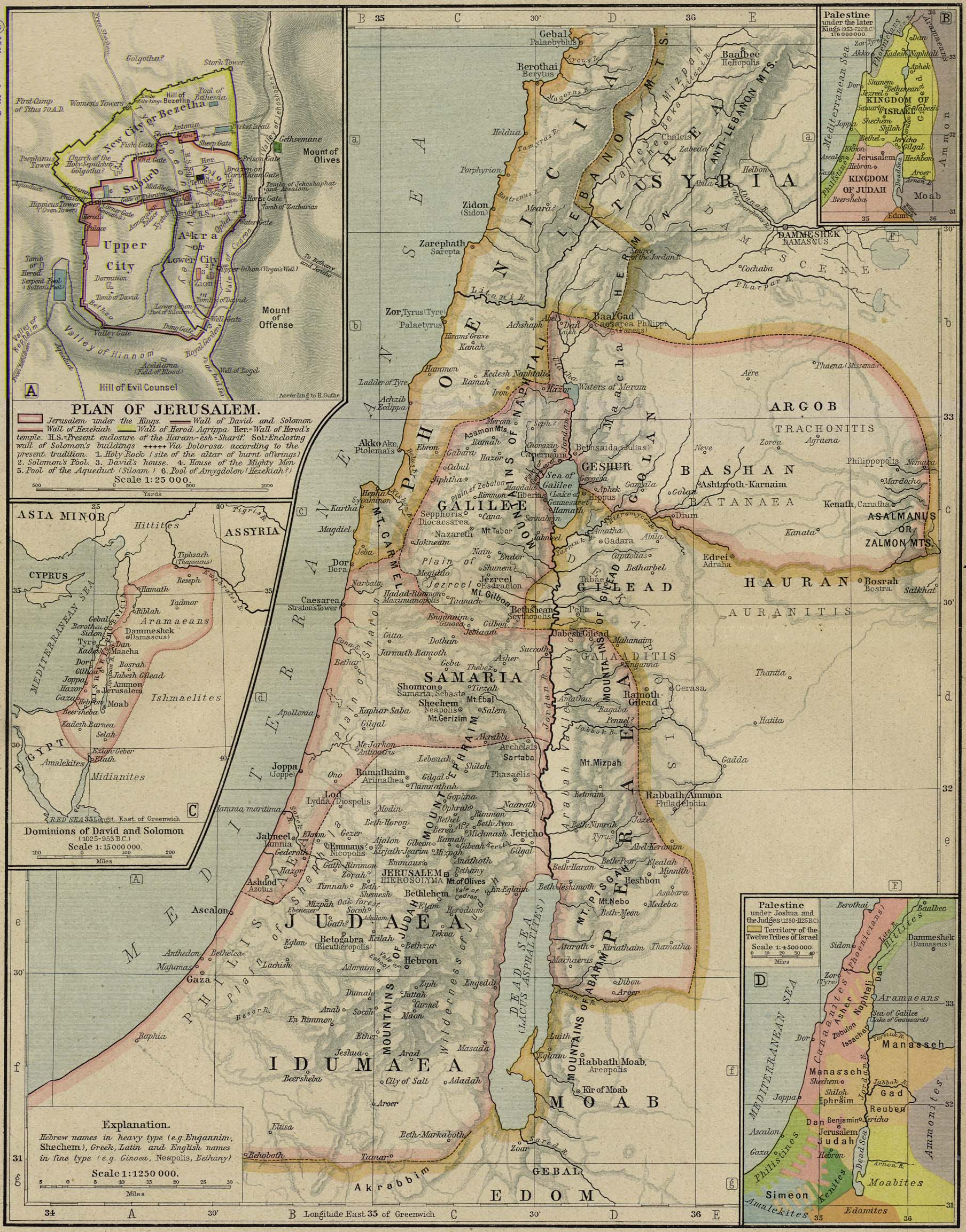
Where it is
the country around it
- Coordinates
- 31.7776° N, 35.2353° Efind it on the Atlas →
- Region
- Jerusalem
1 place the record names with Moriah, the farthest 2.3 km away
- Located: the gazetteer fixes one site
- ? Proposed: one candidate among several
- A dashed line ends at a place the gazetteer does not fix
Not located: The Temple, Golgotha. The gazetteer records no location for them, so they are not marked.
Why Moriah matters
What has been found
the evidence, and where it is disputed
The binding of Isaac
Genesis 22:1 to 22:19, three days from Beersheba to a mountain God chose
Read Genesis 22:1 to 22:19, three days from Beersheba to a mountain God chose
- The command, and a place not yet namedGenesis 22:2“Take your son,” God said, “your only son Isaac, whom you love, and go to the land of Moriah. Offer him there as a burnt offering on one of the mountains, which I will show you.”
- On the third day he sees itGenesis 22:4On the third day Abraham looked up and saw the place in the distance.
- We will return to youGenesis 22:5“Stay here with the donkey,” Abraham told his servants. “The boy and I will go over there to worship, and then we will return to you.”
- The son carries the woodGenesis 22:6Abraham took the wood for the burnt offering and placed it on his son Isaac. He himself carried the fire and the sacrificial knife, and the two of them walked on together.
- Where is the lamb?Genesis 22:7Then Isaac said to his father Abraham, “My father!” “Here I am, my son,” he replied. “The fire and the wood are here,” said Isaac, “but where is the lamb for the burnt offering?”
- God Himself will provideGenesis 22:8Abraham answered, “God Himself will provide the lamb for the burnt offering, my son.” And the two walked on together.
- The altar, and the bindingGenesis 22:9When they arrived at the place God had designated, Abraham built the altar there and arranged the wood. He bound his son Isaac and placed him on the altar, atop the wood.
- The hand is stoppedGenesis 22:12“Do not lay a hand on the boy or do anything to him,” said the angel, “for now I know that you fear God, since you have not withheld your only son from me.”
- A ram, in place of his sonGenesis 22:13Then Abraham looked up and saw behind him a ram in a thicket, caught by its horns. So he went and took the ram and offered it as a burnt offering in place of his son.
- The name that became a proverbGenesis 22:14And Abraham called that place The LORD Will Provide. So to this day it is said, “On the mountain of the LORD it will be provided.”
The chapter never gives Isaac's age and never says which mountain it was. It says the land of Moriah, one of the mountains, and three days of travel. Abraham tells the servants that he and the boy will both return, and Hebrews 11:19 says why he could say it.
The Binding of Isaac: the full studyWhat happened here, in order
in the order the canon tells it
- Melchizedek, priest-king of Salem, meets AbramGenesis 14:18Then Melchizedek king of Salem brought out bread and wine—since he was priest of God Most High—
- Abraham is sent to the land of MoriahGenesis 22:2“Take your son,” God said, “your only son Isaac, whom you love, and go to the land of Moriah. Offer him there as a burnt offering on one of the mountains, which I will show you.”
- A ram is offered in place of the sonGenesis 22:13Then Abraham looked up and saw behind him a ram in a thicket, caught by its horns. So he went and took the ram and offered it as a burnt offering in place of his son.
- The place is named, and the name becomes a proverbGenesis 22:14And Abraham called that place The LORD Will Provide. So to this day it is said, “On the mountain of the LORD it will be provided.”
- The law points Israel to one place God will chooseDeuteronomy 12:5Instead, you must seek the place the LORD your God will choose from among all your tribes to establish as a dwelling for His Name, and there you must go.
- Gad tells David to build an altar on the threshing floor2 Samuel 24:18And that day Gad came to David and said to him, “Go up and build an altar to the LORD on the threshing floor of Araunah the Jebusite.”
- David refuses to offer what costs him nothing2 Samuel 24:24“No,” replied the king, “I insist on paying a price, for I will not offer to the LORD my God burnt offerings that cost me nothing.” So David bought the threshing floor and the oxen for fifty shekels of silver.
- The altar is built and the plague is halted2 Samuel 24:25And there he built an altar to the LORD and offered burnt offerings and peace offerings. Then the LORD answered the prayers on behalf of the land, and the plague upon Israel was halted.
- The destroying angel stands over Jerusalem with a drawn sword1 Chronicles 21:16When David lifted up his eyes and saw the angel of the LORD standing between heaven and earth, with a drawn sword in his hand stretched out over Jerusalem, David and the elders, clothed in sackcloth, fell facedown.
- Fire from heaven answers on the altar of burnt offering1 Chronicles 21:26And there he built an altar to the LORD and offered burnt offerings and peace offerings. He called upon the LORD, who answered him with fire from heaven on the altar of burnt offering.
- David draws his conclusion about the ground1 Chronicles 22:1Then David said, “Here shall be the house of the LORD God, as well as the altar of burnt offering for Israel.”
- Solomon builds the house of the LORD on Mount Moriah2 Chronicles 3:1Then Solomon began to build the house of the LORD in Jerusalem on Mount Moriah, where the LORD had appeared to his father David. This was the place that David had prepared on the threshing floor of Ornan the Jebusite.
- Fire falls again on the same hill when the house is finished2 Chronicles 7:1When Solomon had finished praying, fire came down from heaven and consumed the burnt offering and the sacrifices, and the glory of the LORD filled the temple.
- The choosing of the place is sung as God's ownPsalms 132:13For the LORD has chosen Zion; He has desired it for His home:
- A Son carries His own wood out of the same cityJohn 19:17Carrying His own cross, He went out to The Place of the Skull, which in Hebrew is called Golgotha.
- Hebrews states what Abraham was reasoning on the way upHebrews 11:19Abraham reasoned that God could raise the dead, and in a sense, he did receive Isaac back from death.
Where it points
The voices
each quoted from the work named
If the Messiah is anywhere symbolized in the Old Testament, He is certainly to be seen upon Mount Moriah where the beloved Isaac, willingly bound and laid upon the altar, is a lively foreshadowing of the Well-Beloved of Heaven yielding His life as a ransom! We doubt not that one great intent of the whole transaction was to afford Abraham a clearer view of Christ's day.
Upon Mount Moriah, on or near that particular spot which had been named Jehovah-jireh, was the temple to be built. Abraham had there unsheathed the knife to slay his son. Wondrous type of the great Father offering up His Only-Begotten for the sins of men! The scene of that grand transaction was to be the center of worship for the chosen people. Where Abraham made the supreme sacrifice, there should His descendants present their offerings!
That Isaac carries on himself "the wood for the burnt offering" is a figure, because Christ also "himself carried his own cross," and yet to carry "the wood for the burnt offering" is the duty of a priest. He therefore becomes victim and priest.
4 more teachers on these versesAthanasius of Alexandria · Matthew Henry · Adam Clarke · John Bevere
Thus the sacrifice was not for the sake of Isaac but for that of Abraham, who was tested by being called upon to make this offering. And of course, God accepted his intentions, but he prevented him from slaying Isaac. The death of Isaac would not buy freedom for the world. No, that could be accomplished only by the death of our Savior, by whose stripes we are all healed.
Dr. Lightfoot observes that in the very place where Abraham, by a countermand from heaven, was stayed from slaying his son, this angel, by a like countermand, was stayed from destroying Jerusalem. It is for the sake of the great sacrifice that our forfeited lives are preserved from the destroying angel.
In Mount Moriah - Supposed to be the same place where Abraham was about to offer his son Isaac; so the Targum: “Solomon began to build the house of the sanctuary of the Lord at Jerusalem, in the place where Abraham had prayed and worshipped in the name of the Lord. This is the place of the earth where all generations shall worship the Lord. Here Abraham was about to offer his son Isaac for a burnt-offering; but he was snatched away by the Word of the Lord, and a ram placed in his stead.
How does the angel know that Abraham fears God? Because he obeyed instantly, when it didn't make sense, when it was painful, and with no promise of benefit, he went the distance.
Moriah in Scripture
2 verses name it, in 2 books
Open a book to read its mentions here. Text: Berean Standard Bible.
Old TestamentNew Testamentsegment width = share of mentions
Old Testament2 books · 2 mentions
Genesis1 mention
The account
Read the account as one telling
Common questions
Where is Mount Moriah?
Readers differ; the positions are named
Scripture uses the name twice. Genesis 22:2 sends Abraham to "the land of Moriah," and 2 Chronicles 3:1 says Solomon built the temple "on Mount Moriah," at Ornan's threshing floor in Jerusalem. On the strength of that second verse the traditional identification is the temple hill in Jerusalem, and Josephus states it outright in the first century, writing that Abraham went to the mountain upon which King David afterwards built the temple.
The Samaritan Pentateuch reads the name differently at Genesis 22:2, and the Samaritan tradition places the binding on Mount Gerizim above Shechem. Other readers weigh the three days of travel from Beersheba and look further afield. The tradition leads on this page and the objections are printed beside it.
What does the name Moriah mean?
Nobody knows for certain, and the honest answer names the options. The strongest clue sits inside the chapter itself: Genesis 22:14 turns twice on the verb ra'ah, to see, when Abraham names the place The LORD Will Provide and the proverb becomes "On the mountain of the LORD it will be provided."
Aquila translated the name as "the visible" and Symmachus as "the vision," both reported by Jerome. Onkelos rendered it "worship." Other proposals build it from the divine name Yah with a word for seeing, teaching or fearing, or read it as the land of the Amorites.
How old was Isaac when Abraham bound him?
Readers differ; the positions are named
Genesis never says. The word it uses for Isaac is na'ar, the same word used of Joseph when Genesis 37:2 has just told us he was seventeen, and of Benjamin when he is a grown father of children. In Genesis 22:5 the same word is used of Abraham's two servants in the same breath.
He carries the wood for a whole burnt offering up a mountain while his father, over a hundred years old, carries the fire and the knife. Sarah's death at 127 in the very next chapter puts a ceiling of thirty-seven on him. Josephus gives twenty-five, the common rabbinic reckoning gives thirty-seven, and the picture of a small boy rests on the English word rather than on the Hebrew.
Did Abraham really think he was going to lose Isaac?
He told the servants at the foot of the hill that he and the boy would worship and "then we will return to you" (Genesis 22:5). Hebrews states his reasoning in so many words: he "reasoned that God could raise the dead, and in a sense, he did receive Isaac back from death."
He was not hedging and he was not resigned. He had a promise that ran through this son, and he expected God to keep it on the far side of the knife.
Why did God ask for a human sacrifice at all?
The chapter opens by telling the reader what it is. Genesis 22:1 calls it a test, and it ends with the hand stopped and a ram dying in the son's place, which is the reverse of what the surrounding nations practised.
The law God later gave Israel forbids child sacrifice in the strongest terms, and the prophets treat it as the thing that most provoked Him. Athanasius put the theological point in AD 334: the death of Isaac would not buy freedom for the world.
Is the mountain of Genesis 22 the same hill the temple was built on?
Readers differ; the positions are named
That is what 2 Chronicles 3:1 says, and the whole later tradition, Jewish and Christian, follows it. The text also supplies a verbal link: the verb behind Abraham's naming in Genesis 22:14 is the same verb 2 Chronicles 3:1 uses for the place where the LORD appeared to David.
Jerome glossed Mount Moriah simply as the site of the temple. Jamieson, Fausset and Brown, writing in 1871, said the identification with a hill of Jerusalem was what was generally thought. The Samaritan reading and the objection from travel time are set out further up this page.
What has been dug up on the Temple Mount?
Readers differ; the positions are named
Almost nothing, and the reason is straightforward. Charles Warren surveyed Jerusalem for the Palestine Exploration Fund from 1867 to 1870 and was not permitted to excavate on the platform itself, so he sank shafts outside the walls and tunnelled to read the buried courses, publishing the results in the 1884 Warren Atlas.
Everything learned since has come the same way, from the outer walls, from below and beside them, and from displaced material. The platform has never been archaeologically excavated and no stone of Solomon's temple has been recovered. Where exactly the temple stood inside the enclosure is still argued by Leen Ritmeyer, by the followers of Asher Kaufman, and by a minority who put it off the platform entirely.
Why did David have to buy the threshing floor?
Araunah offered him the ground, the oxen and the wood for nothing, and David refused: "I will not offer to the LORD my God burnt offerings that cost me nothing." Adam Clarke drew out why it mattered. Had the offer been accepted it would have been Araunah's sacrifice rather than David's, and it was David who had sinned.
The two accounts give different figures, fifty shekels of silver in Samuel for the floor and the oxen, six hundred shekels of gold in Chronicles for the site. The usual harmonisation is that the smaller sum bought the floor and the larger bought the whole hill.
What is a threshing floor doing on top of a mountain?
That is exactly where threshing floors belong. Grain was beaten out and then thrown into the air so the wind could carry the chaff away, which needs a hard, level, exposed surface in a breeze, and a bare rock summit above a valley is the ideal place.
It also explains what Ornan was doing there when the angel appeared. 1 Chronicles 21:20 says he was threshing wheat, and his four sons hid themselves.
Notable art
3 verified pieces depicting Moriah
Sources cited
- OpenBible.info Bible Geocoding: Mount Moriahread 2026-08-20The coordinates on this page. Used under CC-BY with attribution to OpenBible.info.
- Berean Standard Bible (2023)Public domain. All Scripture text on this page, drawn from the site's own verse store.
- Flavius Josephus, Antiquities of the Jews 1.13.2 and Book 7, chapter 13Isaac's age given as twenty-five, and the mountain identified as the one where David afterwards built the temple. Whiston translation, public domain.
- Jubilees 17:15 to 18:16, about the second century BCThe Mastema frame, the Passover dating and the location on Mount Zion. A labeled study resource on this site and never Scripture.
- 4Q225, "Pseudo-Jubilees," Qumran Cave 4, first century BCThe earliest physical witness to the retelling of Genesis 22. Fragmentary, so only what survives is stated. A labeled study resource.
- Targum Onkelos and Targum Pseudo-Jonathan on Genesis 22, and the Targum on 2 Chronicles 3:1The Aramaic paraphrase tradition, named, dated and placed on this page. The Chronicles Targum is quoted here as Adam Clarke gives it.
- Genesis Rabbah 56, Palestinian midrash, roughly fifth century AD; Seder Olam Rabbah, attributed to Yose ben Halafta, second century ADThe thirty-seven-year reckoning, the ram's horn as the shofar, and the merit of the Aqedah. Reception history, never this site's confession, and the point where the reading parts from the New Testament is marked on the page.
- Mekhilta de-Rabbi Ishmael, halakhic midrash on Exodus, roughly third century ADThe blood of the Passover lamb tied to the blood of the Aqedah, the same connection Jubilees makes four centuries earlier.
- Origen, Homilies on Genesis 8.4 and 8.6, preached at Caesarea about AD 245Isaac as victim and priest, the promise at Genesis 22:8 read as future, and the third day. Public domain translation as held in the site's quote pool.
- Clement of Alexandria, The Instructor, Book 1, about AD 200Isaac as a type of the Lord, carrying the wood of his sacrifice. Public domain.
- Athanasius of Alexandria, Festal Letters 6, AD 334The death of Isaac would not buy freedom for the world. Public domain.
- Ambrose of Milan, On the Decease of His Brother Satyrus, Book 2, AD 378The father's hand and the ram shown in the thicket in the stead of the lad. Public domain.
- John Chrysostom, Homilies on Genesis 47.14, about AD 388; Augustine of Hippo, City of God 16.32, about AD 426The sheep offered in place of Isaac read beside the Lamb offered for the world, and the wood carried to the place of sacrifice. Public domain.
- Jerome, Hebrew Questions on Genesis, about AD 391 to 393Aquila's and Symmachus's renderings of the name, the gloss of Mount Moriah as the site of the temple, and the distances from Gerar and from Mamre. Public domain.
- Charles H. Spurgeon, The Metropolitan Tabernacle Pulpit, sermons 869 (1869), 1803 (1884) and 1808 (1884)The Gospel of Abraham's Sacrifice of Isaac, Jehovah-Jireh, and The Threshing Floor of Ornan. Public domain.
- Matthew Henry, Commentary on the Whole Bible (1710)John Lightfoot's observation that the angel was stayed on the ground where Abraham's hand was stayed. Public domain.
- Adam Clarke, Commentary on the Bible (1832)The Targum on 2 Chronicles 3:1, the reading of Genesis 22:8 as prophecy, and why David had to pay for the threshing floor. Public domain.
- Albert Barnes, Notes, Explanatory and Practical, on the Old and New Testaments (1832 to 1869)The four readings of the name Moriah, the Samaritan spelling, and the harmonisation of the two purchase prices. Public domain.
- John Gill, Exposition of the Old Testament (1748 to 1763)The reckoning of forty miles from Beersheba and two days of walking before the third day's sighting. Public domain.
- Robert Jamieson, A. R. Fausset and David Brown, Commentary Critical and Explanatory on the Whole Bible (1871)The identification generally thought in their day, Bartlett's note on the natural rock, and Barclay's note that the position of the temple within the enclosure was already disputed. Public domain.
- John Wesley, Explanatory Notes upon the Old Testament (1765) and upon the New Testament (1755)Isaac's carrying of the wood as a type, and the broader reading of Abraham's sight of Christ's day at John 8:56. Public domain.
- John Bevere, "The Test to Determine if You Really Fear God" (2021)In copyright, quoted at about thirty words with the work named, under the site's cite-only rule for modern authors.
- Charles Warren, Plans, Elevations, Sections, etc., Shewing the Results of the Excavations at Jerusalem, 1867-70 (London: Palestine Exploration Fund, 1884)The survey of 1867 to 1870, the shafts and tunnels outside the walls, and the limits of what could be recorded.
- Leen Ritmeyer, "Locating the Original Temple Mount," Biblical Archaeology Review 18:2 (1992), and The Quest: Revealing the Temple Mount in Jerusalem (Jerusalem: Carta, 2006)The central position on where the temple stood, and the majority reading.
- Asher S. Kaufman, "Where the Ancient Temple of Jerusalem Stood," Biblical Archaeology Review 9:2 (1983)The northern position, near the Dome of the Spirits.
- Ernest L. Martin, The Temples That Jerusalem Forgot (Portland: ASK Publications, 2000)The southern position, off the platform entirely. A minority reading, named as one.
- Samaritan Pentateuch, Genesis 22:2The variant reading behind the Samaritan identification of the site with Mount Gerizim, reported in Barnes's note and in the standard reference literature.
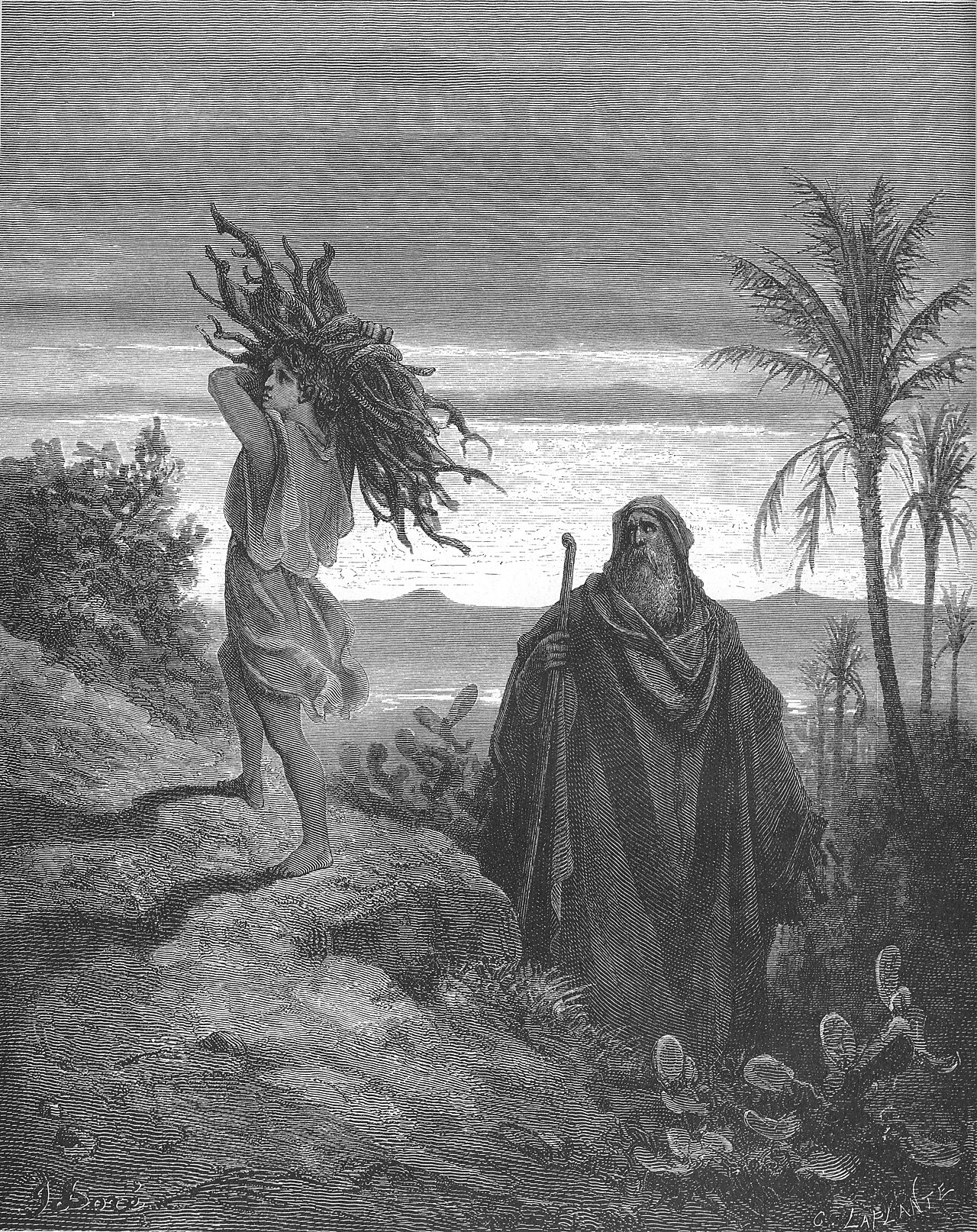
- Gustave Doré, La Sainte Bible (Tours: Alfred Mame et fils, 1866)The two engravings on this page, the testing of Abraham's faith and the plague of Jerusalem. Public domain.
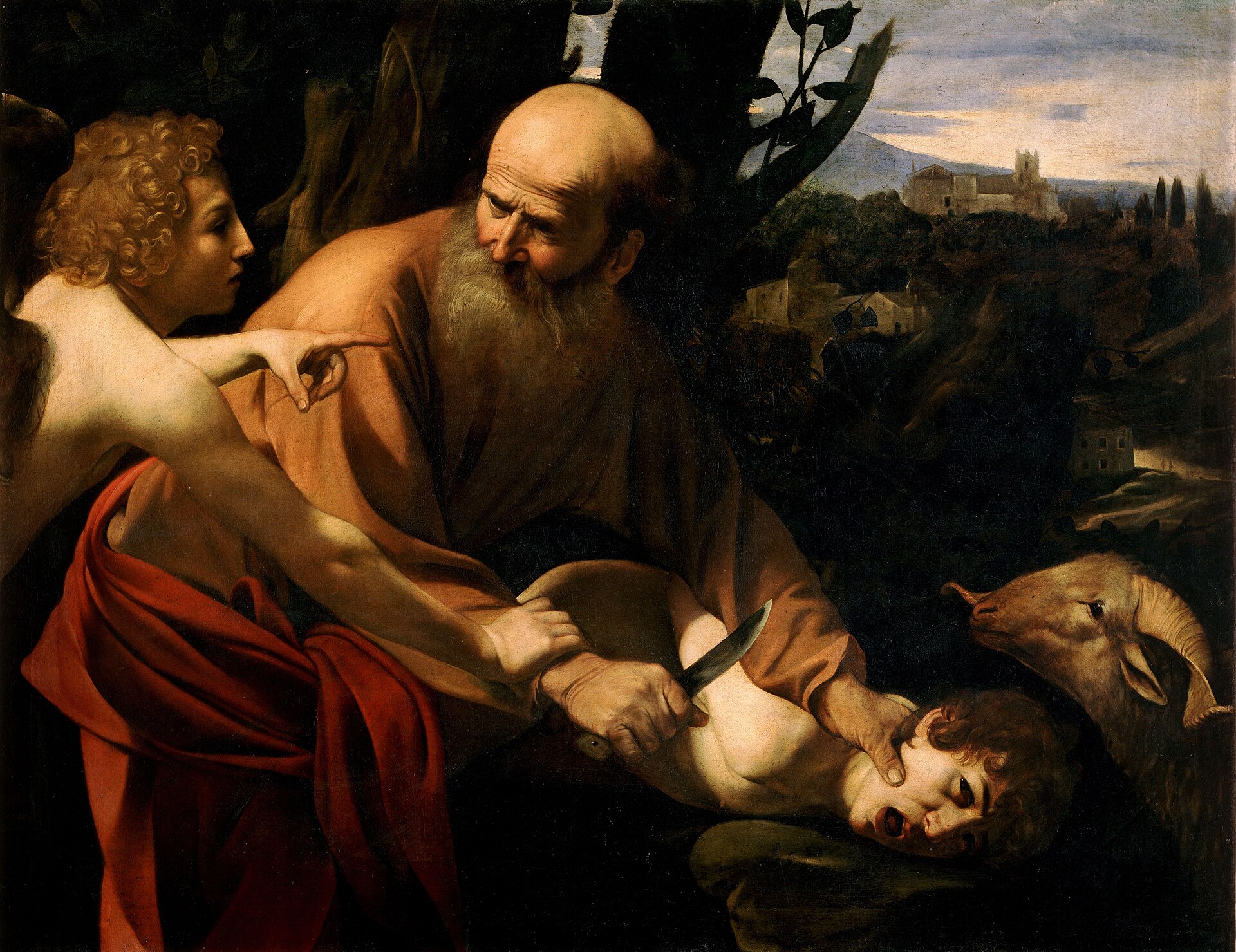
- Rembrandt van Rijn, The Sacrifice of Isaac (1635), Hermitage Museum; Michelangelo Merisi da Caravaggio, Sacrifice of Isaac (c. 1603), Uffizi Gallery, FlorenceThe two paintings on this page. Public domain, via Wikimedia Commons.
Keep studying
On this page
Studies17
Every page that names it1
Doorway2
Books that name it2
Lives that run through it1
Keep this page