
Place
Ur
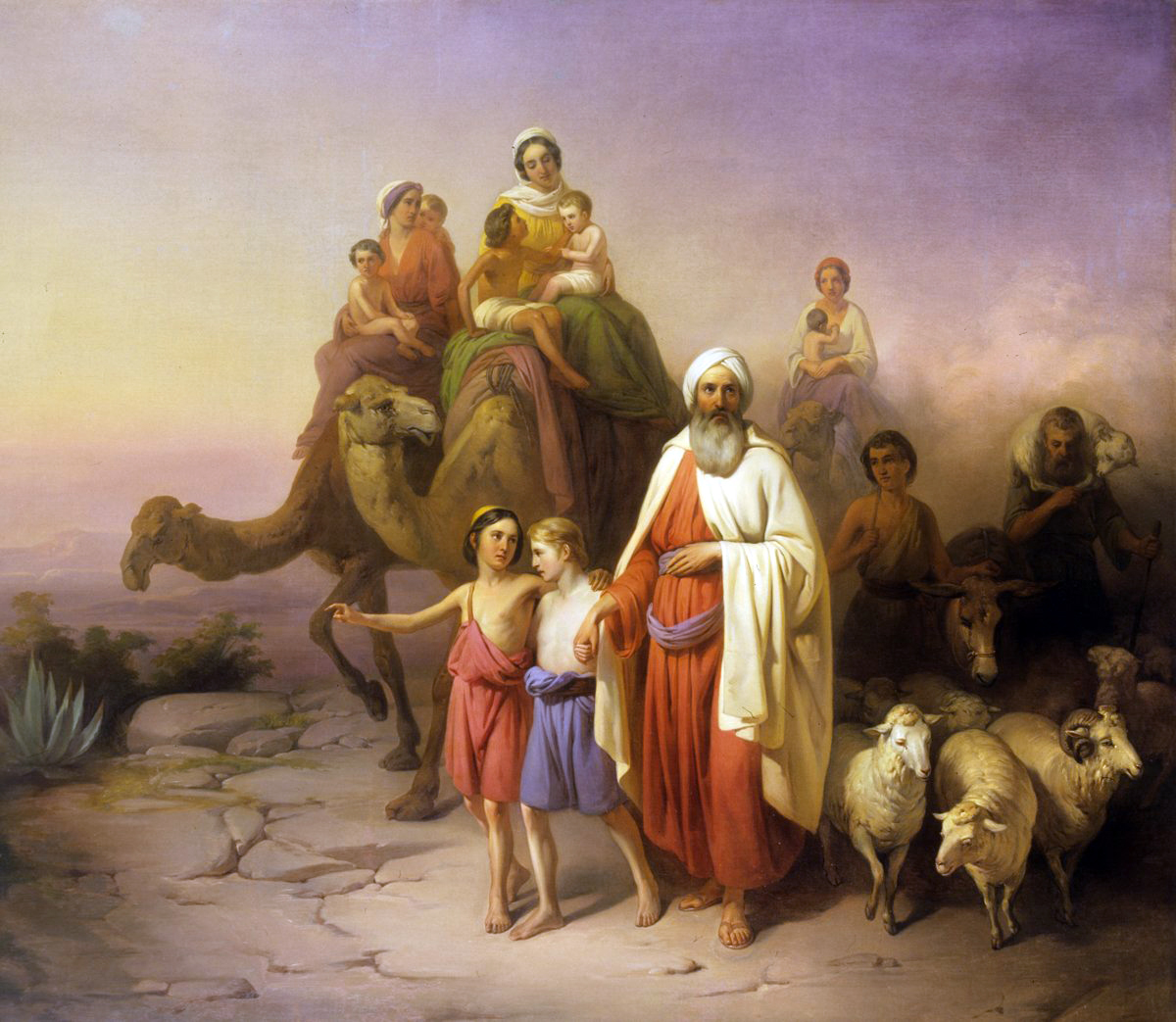
József Molnár, The March of Abraham, 1850. Public domain, via Wikimedia Commons.
Summary
The city of the moon god in southern Mesopotamia that Abram was called out of, the place Scripture names as Ur of the Chaldees and Stephen names as the land where the God of glory first appeared to him.
- Ur is the city God called Abram out of, and Scripture names it four times.
- Joshua 24:2 says Terah worshiped other gods, so the family God chose did not already know Him.
- At the covenant, God introduces Himself to Abram by what He did at Ur.
- Leonard Woolley dug the city from 1922 to 1934 and found a temple tower, a moon cult, a law code older than Hammurabi's and a royal graveyard full of gold.
- Where Ur stood is disputed. The southern mound of Tell el-Muqayyar is the majority reading, and a northern candidate near Şanlıurfa has real defenders.
On this page
In Scripture
- Verses
- 5
- Books
- 3
Where it is
the country around it
- Coordinates
- 30.9621° N, 46.1037° Eopen the Atlas →
- Region
- Southern Mesopotamia
- Located: the gazetteer fixes one site
Not located: Egypt, Canaan. The gazetteer records no location for them, so they are not marked.
Why Ur matters
What has been found
the evidence, and where it is disputed
The call of Abram out of Ur
Genesis 11:27 to 12:5, and the covenant that names the city
Read Genesis 11:27 to 12:5, and the covenant that names the city
- Terah's household, namedGenesis 11:27This is the account of Terah. Terah became the father of Abram, Nahor, and Haran. And Haran became the father of Lot.
- Haran dies in the cityGenesis 11:28During his father Terah’s lifetime, Haran died in his native land, in Ur of the Chaldeans.
- Sarai is barren, and the text says so before the promiseGenesis 11:30But Sarai was barren; she had no children.
- Terah takes the family out of Ur for CanaanGenesis 11:31And Terah took his son Abram, his grandson Lot son of Haran, and his daughter-in-law Sarai the wife of Abram, and they set out from Ur of the Chaldeans for the land of Canaan. But when they arrived in Haran, they settled there.
- The stop becomes a stay, and Terah diesGenesis 11:32Terah lived 205 years, and he died in Haran.
- The word to AbramGenesis 12:1Then the LORD said to Abram, “Leave your country, your kindred, and your father’s household, and go to the land I will show you.
- All the families of the earthGenesis 12:3I will bless those who bless you and curse those who curse you; and all the families of the earth will be blessed through you.”
- Abram goes, at seventy-fiveGenesis 12:4So Abram departed, as the LORD had directed him, and Lot went with him. Abram was seventy-five years old when he left Haran.
- God names the city when He makes the covenantGenesis 15:7The LORD also told him, “I am the LORD, who brought you out of Ur of the Chaldeans to give you this land to possess.”
- What faith looked like from the insideHebrews 11:8By faith Abraham, when called to go to a place he would later receive as his inheritance, obeyed and went, without knowing where he was going.
Genesis 12:1 gives the word after the family has already settled in Haran. Acts 7:2 says the God of glory appeared to Abraham in Mesopotamia before he lived in Haran, and Genesis 15:7 and Nehemiah 9:7 both say God brought him out of Ur. The readings of that difference are set out in the questions below.
The Abrahamic Covenant: the full studyWhat happened here, in order
in the order the canon tells it
- Abram and Nahor marry in UrGenesis 11:29And Abram and Nahor took wives for themselves. Abram’s wife was named Sarai, and Nahor’s wife was named Milcah; she was the daughter of Haran, who was the father of both Milcah and Iscah.
- The road out of Haran ends in CanaanGenesis 12:5And Abram took his wife Sarai, his nephew Lot, and all the possessions and people they had acquired in Haran, and set out for the land of Canaan. When they came to the land of Canaan,
- Abram believes God, one verse before Ur is namedGenesis 15:6Abram believed the LORD, and it was credited to him as righteousness.
- The man who left Ur is given a new nameGenesis 17:5No longer will you be called Abram, but your name will be Abraham, for I have made you a father of many nations.
- Abraham forbids taking Isaac back to the old countryGenesis 24:6Abraham replied, “Make sure that you do not take my son back there.
- Abraham calls God the One who brought him from his native landGenesis 24:7The LORD, the God of heaven, who brought me from my father’s house and my native land, who spoke to me and promised me on oath, saying, ‘To your offspring I will give this land’—He will send His angel before you so that you can take a wife for my son from there.
- The servant goes back to Nahor's town in Aram-naharaimGenesis 24:10Then the servant took ten of his master’s camels and departed with all manner of good things from his master in hand. And he set out for Nahor’s hometown in Aram-naharaim.
- Laban swears by a different god from Jacob'sGenesis 31:53May the God of Abraham and the God of Nahor, the God of their father, judge between us.” So Jacob swore by the Fear of his father Isaac.
- The LORD says Terah worshiped other godsJoshua 24:2And Joshua said to all the people, “This is what the LORD, the God of Israel, says: ‘Long ago your fathers, including Terah the father of Abraham and Nahor, lived beyond the Euphrates and worshiped other gods.
- But I took your father AbrahamJoshua 24:3But I took your father Abraham from beyond the Euphrates and led him through all the land of Canaan, and I multiplied his descendants. I gave him Isaac,
- Israel is told to cast the old gods asideJoshua 24:14Now, therefore, fear the LORD and serve Him in sincerity and truth; cast aside the gods your fathers served beyond the Euphrates and in Egypt, and serve the LORD.
- The returned exiles name Ur in prayerNehemiah 9:7You are the LORD, the God who chose Abram, who brought him out of Ur of the Chaldeans and gave him the name Abraham.
- Look to Abraham your father, who was but oneIsaiah 51:2Look to Abraham your father, and to Sarah who gave you birth. When I called him, he was but one; then I blessed him and multiplied him.
- Stephen puts the appearing in Mesopotamia, before HaranActs 7:2And Stephen declared: “Brothers and fathers, listen to me! The God of glory appeared to our father Abraham while he was still in Mesopotamia, before he lived in Haran,
- He left the land of the Chaldeans and settled in HaranActs 7:4So Abraham left the land of the Chaldeans and settled in Haran. After his father died, God brought him out of that place and into this land where you are now living.
- The city he was actually looking forHebrews 11:10For he was looking forward to the city with foundations, whose architect and builder is God.
Where it points
The voices
each quoted from the work named
I am the Lord that brought thee out of Ur of the Chaldees - Out of the fire of the Chaldees, so some: that is, from their idolatries; for the Chaldeans worshipped the fire. Or, from their persecutions. The Jewish writers have a tradition, that Abram was cast into a fiery furnace for refusing to worship idols, and was miraculously delivered.
Abraham’s family was originally an idolatrous one; afterwards some beams of light shone in upon the household, and they became worshippers of the true God; but there was much ignorance mingled with their worship, and at least occasionally their old idolatrous habits returned. The Lord who had always fixed on Abraham to be his chosen servant and the father of his chosen people upon earth, made Abraham leave the society of his friends and relatives, and go out of Ur of the Chaldees, and journey away to the land of Canaan,
It is not stated that Abraham himself was an idolater, though his fathers were. Jewish tradition asserts that Abraham while in Ur of the Chaldees was persecuted for his abhorrence of idolatry, and hence, was called away by God from his native land. The reference in the text to the original state of those who were the forefathers of the nation, is made to show that they were no better than others: God chose them not for their excellences but of His own mere motion.
4 more teachers on these versesJohn Chrysostom · Jamieson, Fausset & Brown · Matthew Henry · John Wesley
Is sacred Scripture inconsistent with itself? Not at all; rather, you need to understand from this that since the son was God-fearing, God appeared to him and called upon him to move there. His father Thara, though he happened to be a heathen, nevertheless for the affection he had for his son agreed to accompany him in his migration.
appeared unto our father Abraham before he dwelt in Charran, and said, &c.--Though this first call is not expressly recorded in Genesis, it is clearly implied in Ge 15:7 and Ne 9:7; and the Jewish writers speak the same language.
God's favour to him was distinguishing: "Thou didst choose him." His grace in him was powerful to bring him out of Ur of the Chaldees, and, in giving him the name of Abraham, he put honour upon him as his own and assured him that he should be the father of many nations. Look unto Abraham your father ( Isa. li. 2 ) and see free grace glorified in him.
He looked for a city which hath foundations - Whereas a tent has none. Whose builder and former is God - Of which God is the sole contriver, former, and finisher.
Ur in Scripture
5 verses name it, in 3 books
Open a book to read its mentions here. Text: Berean Standard Bible.
Old TestamentNew Testamentsegment width = share of mentions
Old Testament3 books · 5 mentions
Genesis3 mentions
- Genesis 11:28During his father Terah’s lifetime, Haran died in his native land, in Ur of the Chaldeans.
- Genesis 11:31And Terah took his son Abram, his grandson Lot son of Haran, and his daughter-in-law Sarai the wife of Abram, and they set out from Ur of the Chaldeans for the land of Canaan. But when they arrived in Haran, they settled there.
- Genesis 15:7The LORD also told him, “I am the LORD, who brought you out of Ur of the Chaldeans to give you this land to possess.”
1 Chronicles1 mention
The account
Read the account as one telling
Common questions
Where was Ur of the Chaldeans?
Readers differ; the positions are named
The majority identification is Tell el-Muqayyar in southern Iraq, the mound whose own foundation cylinders name the city of Ur. Alan Millard argued that case in Biblical Archaeology Review in 2001 while saying plainly that certainty is not available. Cyrus Gordon argued in 1958 that Abraham's Ur was a northern town near Harran, in the region of Urha, today Şanlıurfa, and Hershel Shanks put that case to a wide readership in 2000.
The text gives three constraints and no address: the family left Ur and reached Haran, Stephen says God appeared to Abraham in Mesopotamia before Haran, and the servant later goes back to Aram-naharaim in the north. The map pin on this page follows the majority reading.
Was Abraham's family really idol worshippers?
Readers differ; the positions are named
Joshua 24:2 is the LORD's own statement that Terah, the father of Abraham and Nahor, lived beyond the Euphrates and worshiped other gods, and Joshua 24:14 tells Israel to cast those gods aside seven generations later.
Scripture never says whether Abram himself served them before the call. Adam Clarke thought he probably did. Albert Barnes pointed out that the text does not state it, though his fathers did. Both readings stand on this page and neither is settled here.
Did God call Abraham in Ur or in Haran?
Readers differ; the positions are named
Genesis 12:1 gives the word after the family has already settled in Haran, while Acts 7:2 says the God of glory appeared to Abraham in Mesopotamia before he lived in Haran, and Genesis 15:7 and Nehemiah 9:7 both say God brought him out of Ur.
The oldest answer on this page is two calls. John Chrysostom, about 407, held that God appeared to Abram in Chaldea and that Terah went along out of affection for his son, and Adam Clarke set out the same two-call reading in 1832. Jamieson, Fausset and Brown put it in one line: the first call is not expressly recorded in Genesis but is clearly implied in Genesis 15:7 and Nehemiah 9:7. Others read one call, reported at Haran by Moses and dated earlier by Stephen.
Why does the Bible call it Ur of the Chaldeans if the Chaldeans came much later?
Readers differ; the positions are named
The Kaldu appear in Assyrian records in the early ninth century BC, in the annals of Ashurnasirpal II, more than a thousand years after any date proposed for Abraham. Three readings are held.
Some treat the phrase as a later note identifying the region for readers who would not know the bare name, the way a modern writer adds a country to a town, and Leonard Woolley took it that way. Some treat it as evidence that the text reached its present form in the first millennium. Alan Millard argued that it is not an anachronism at all, since the territory carried the name Kaldu from the early first millennium, regions there were named for the tribes in them, and no earlier general name for that region is known. A related conservative reading connects the name to Kesed, a son of Abraham's brother Nahor at Genesis 22:22, applied to the region in retrospect.
Was Abraham thrown into a fiery furnace?
Scripture does not say so. The story attaches to this verse because of a matter of spelling: the Hebrew city name and the Hebrew word for flame share their letters, and they are two different words. Jerome, writing about 420, records both the reading "the fire of the Chaldeans" and the legend the Hebrews relate about Abraham being thrown into the fire for refusing to worship it.
The fullest form is in Bereshit Rabbah 38:13, a Jewish midrash on Genesis compiled in the land of Israel around AD 400 to 500, where Nimrod casts Abraham into a furnace and Haran dies in it, which is that tradition's way of reading Genesis 11:28. An earlier Second Temple book, Jubilees 12, written in the second century BC, has Abram burn a house of idols and Haran die in the fire trying to save them. Both are named, dated and placed here as reception history rather than Scripture.
What did Woolley find at Ur, and did he find Noah's flood?
Readers differ; the positions are named
Leonard Woolley excavated Ur for the British Museum and the University of Pennsylvania Museum from 1922 to 1934 and cleared more than 1,800 graves, including the tomb of Puabi, the Great Death Pit, and the objects now known as the Standard of Ur and the Ram in a Thicket. In 1928 and 1929 he cut below the cemetery, found a bed of water-borne silt about three metres thick, and announced it as the flood of Genesis.
Flood deposits found at Kish, Shuruppak, Uruk and Nineveh turned out to sit at different stratigraphic levels, so they record different floods at different dates, and Woolley's silt does not run across the whole of Ur. Max Mallowan reviewed the question in Iraq in 1964 and held that a severe inundation lies behind the Mesopotamian flood traditions without sustaining Woolley's identification.
Can you visit Abraham's house at Ur?
There is a consolidated courtyard house at the site that visitors are shown under that name, and the label is modern. What Woolley excavated was a residential quarter of the period from about 1900 to 1700 BC, with lanes, two-storey brick houses, family chapels and burials beneath the floors.
That is genuinely the kind of house a family of Abraham's era in that city lived in. No inscription or object ties any house at Ur to Abraham or Terah, and no excavator has claimed one.
What did Ur worship, and why does that matter for the call?
The city's chief deity was Nanna, called Sin in Akkadian, the moon god, with his consort Ningal. The stepped temple tower that still stands was built for him by Ur-Nammu around 2100 BC, and the last Babylonian king, Nabonidus, restored it and installed his own daughter as its high priestess in 547 BC. Haran, where the family stopped, was the other great centre of the same moon cult, and Nabonidus rebuilt its temple too.
Scripture never names the gods Terah served, so this page holds the two facts side by side rather than combining them into a claim. Nehemiah's Levites praise the God who made the host of heaven, and one verse later they praise Him for bringing Abram out of Ur.
What is the city with foundations that Abraham was looking for?
Hebrews says Abraham lived in tents in the land of promise as a stranger, because he was looking forward to the city with foundations, whose architect and builder is God. John Wesley's note on the verse is one sentence: a tent has no foundations.
Hebrews then widens it, saying that these people acknowledged themselves strangers and exiles, that they had opportunity to go back to the country they left and did not take it, and that God has prepared a city for them. The man who walked away from a walled city with a tower spent his life waiting for a better one.
Notable art
1 verified piece depicting Ur
Sources cited
- OpenBible.info Bible Geocoding: Urread 2026-08-20The coordinates on this page. Used under CC-BY with attribution to OpenBible.info.
- C. Leonard Woolley, Ur of the Chaldees: A Record of Seven Years of Excavation (London: Ernest Benn, 1929)The popular account of the excavation, and the flood announcement.
- C. Leonard Woolley, Abraham: Recent Discoveries and Hebrew Origins (London: Faber and Faber, 1936)Woolley's own connection of the site to the patriarch.
- C. Leonard Woolley and others, Ur Excavations, ten volumes (British Museum and University of Pennsylvania Museum, 1927 to 1976), including volume II, The Royal Cemetery (1934)The final excavation reports.
- Ur of the Chaldees, the British Museum and Penn Museum digitisation of Woolley's field recordsThe excavation records and the season-by-season history.
- Metropolitan Museum of Art, "Ur: The Royal Graves"Summary essay on Puabi, the Great Death Pit and the cemetery finds.
- Cyrus H. Gordon, "Abraham and the Merchants of Ura," Journal of Near Eastern Studies 17 (1958)The northern identification, cited for the position it argues.
- Hershel Shanks, "Abraham's Ur: Is the Pope Going to the Wrong Place?", Biblical Archaeology Review 26:1 (2000)The northern case put to a wide readership.
- Alan R. Millard, "Where Was Abraham's Ur? The Case for the Babylonian City," Biblical Archaeology Review 27:3 (2001)The southern case, and the answer to Shanks.
- M. E. L. Mallowan, "Noah's Flood Reconsidered," Iraq 26 (1964)The reassessment of the Mesopotamian flood deposits.
- Samuel Noah Kramer and the Code of Ur-Nammu, the Nippur fragments of 1952 and the Ur tablets of 1965Summary and text of the oldest surviving law code.
- Hanspeter Schaudig, Die Inschriften Nabonids von Babylon und Kyros' des Grossen, AOAT 256 (Münster: Ugarit-Verlag, 2001)The Nabonidus corpus, including the Ur cylinders that name Belshazzar.
- C. J. Gadd, "The Harran Inscriptions of Nabonidus," Anatolian Studies 8 (1958)The Adad-guppi stele found by D. S. Rice in 1956, with the earlier copy published by H. Pognon in 1906.
- Encyclopaedia Iranica, "Chaldeans (Kaldu)"The first Assyrian attestation of the Chaldean tribes.
- Bereshit Rabbah 38:13, a Jewish midrash on Genesis compiled in the land of Israel around AD 400 to 500Named, dated and placed on this page as reception history.
- The Book of Jubilees 12, a Second Temple work of the second century BC, in R. H. Charles's translation (London: SPCK, 1917)Public domain. Named, dated and placed the same way.
- Jerome, Hebrew Questions on Genesis, c. AD 420Public domain. The earliest Christian witness on this page to the philology and to the Jewish legend.
- John Chrysostom, Homilies on Genesis, c. AD 407Public domain. The earliest voice on this page to state the two-call reading.
- Clement of Rome, First Letter to the Corinthians, chapter 10, c. AD 96Public domain. The earliest Christian reading of the call on this page.
- Charles H. Spurgeon, The New Park Street Pulpit, Sermon No. 261Public domain, CCEL edition, lightly modernized text.
- John Wesley, Explanatory Notes upon the Old Testament (1765) and Explanatory Notes upon the New Testament (1755)Public domain.
- Matthew Henry, Commentary on the Whole Bible (1710)Public domain.
- Adam Clarke, Commentary on the Bible (1832)Public domain.
- Albert Barnes, Notes, Explanatory and Practical, on the Old and New Testaments (1832 to 1869)Public domain.
- Jamieson, Fausset & Brown, Commentary Critical and Explanatory on the Whole Bible (1871)Public domain. Cited both for Acts 7 and for the northern identification it held in 1871.
- Flavius Josephus, Antiquities of the Jews, Book 1, chapters 6 and 7Cited at book and chapter level on Abraham's origins in Chaldea.
- József Molnár, The March of Abraham, 1850The hero painting on this page. Public domain, via Wikimedia Commons.
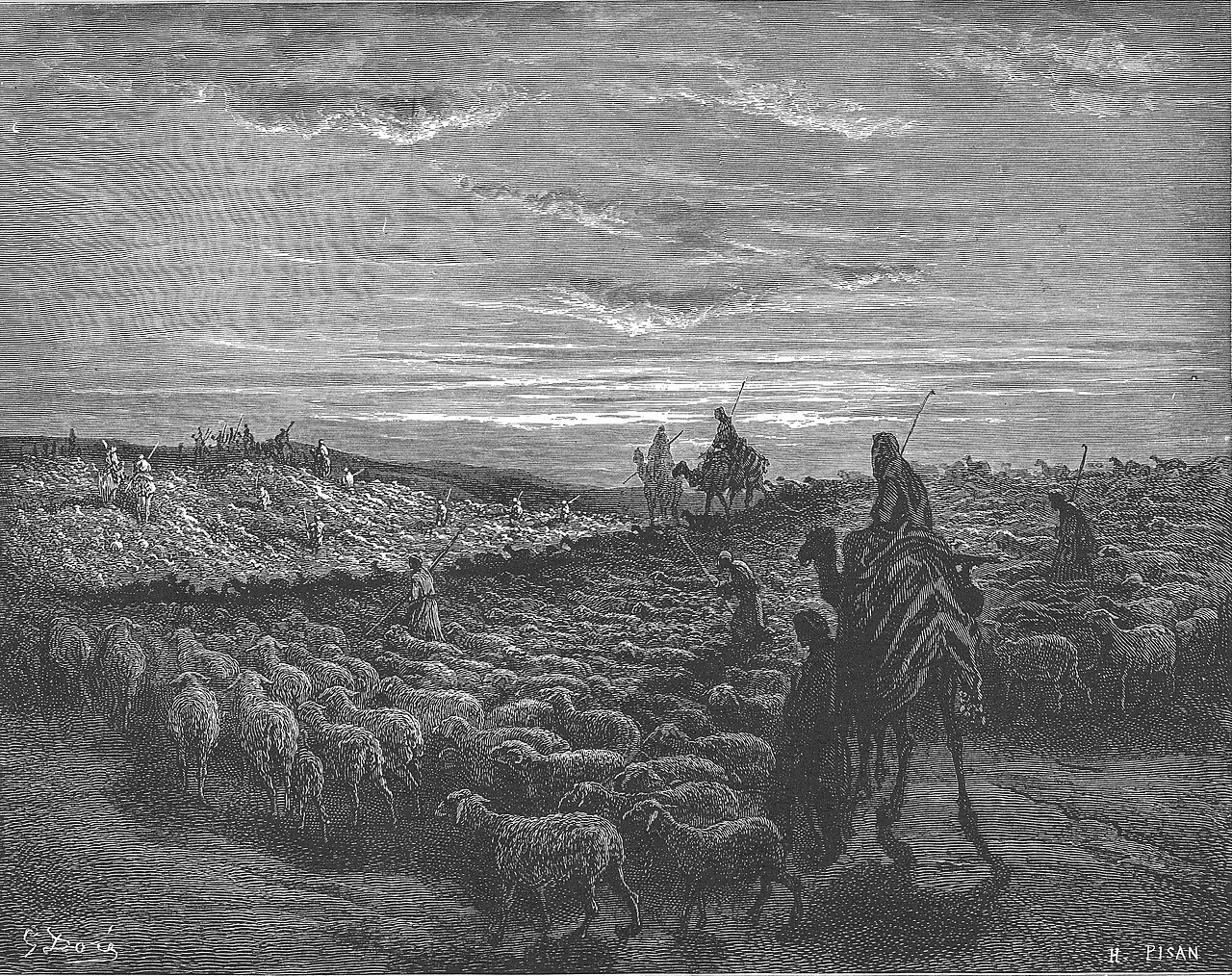
- Gustave Doré, La Sainte Bible (Tours: Alfred Mame et fils, 1866)Plate 11, the engraving on this page. Public domain.
- The Berean Standard BiblePublic domain since 2023. All Scripture quoted on this page.
Keep studying
On this page
Studies10
Books that name it3
Doorway2
Keep this page