
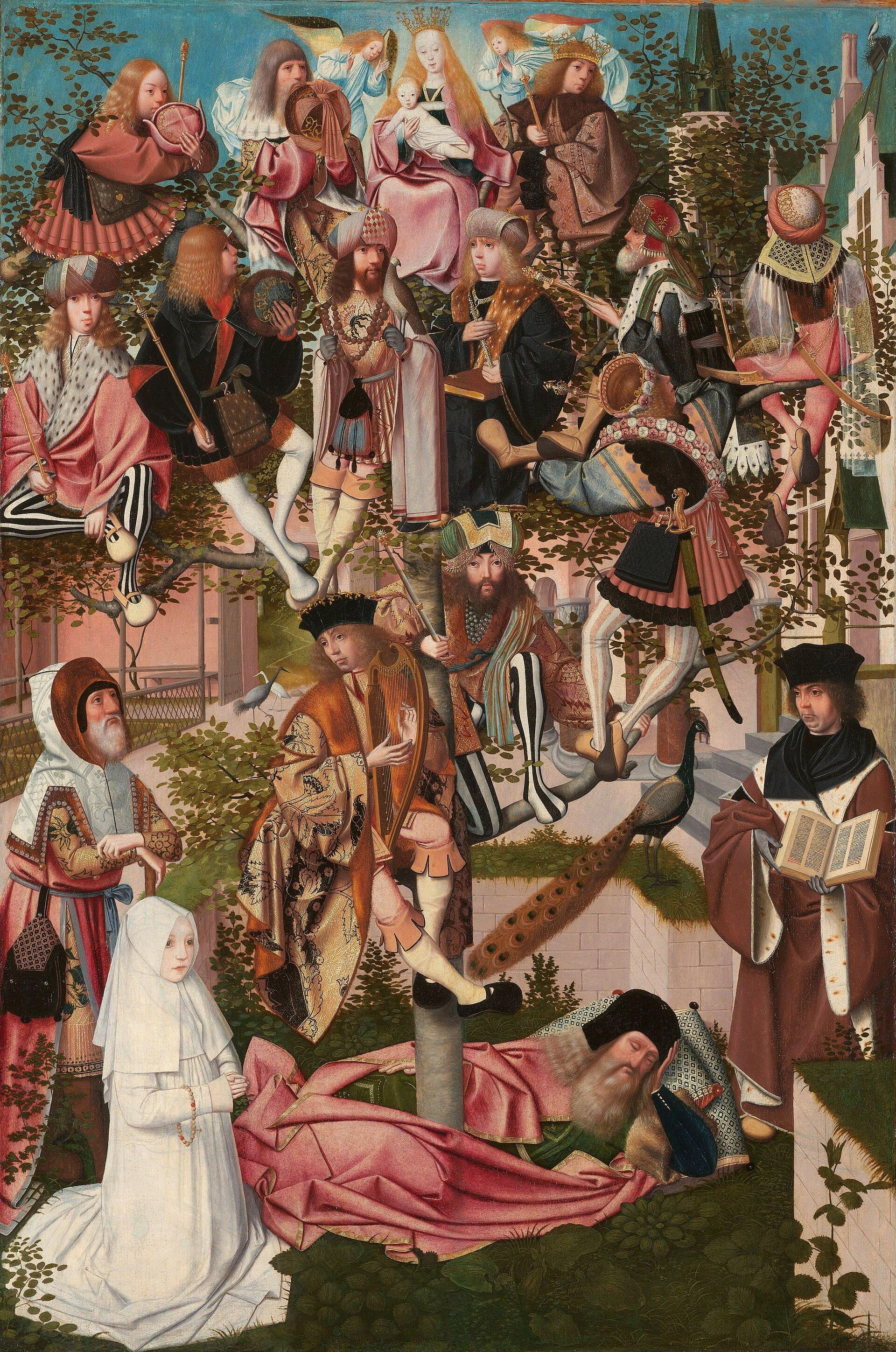
Circle of Geertgen tot Sint Jans, The Tree of Jesse, about 1500. Public domain.
Mark 12:35 to 37 · Subject · Featured Study
David's Son and David's Lord
Jesus asked His question in the temple courts in the last week before the cross.
The riddle turns on one line of a psalm of David.
David himself calls Him ‘Lord.’ So how can He be David’s son?” And the large crowd listened to Him with delight.
David himself calls Him ‘Lord.’ So how can He be David’s son?” And the large crowd listened to Him with delight.
- Books
- Mark, Psalms
- Hold in memory
- Mark 12:37, Psalm 110:1
Summary
The scribes taught that the Christ would be a son of David. Jesus pointed to a psalm in which David calls the Christ his Lord. He asked how both could be true.
- The psalm Jesus quoted is Psalm 110, where God tells David's Lord to sit at His right hand.
- Mark names David in seven verses, and six of them fall in chapters 10 to 12.
- Christian readers answered the riddle with Christ's two natures, or with His rising to God's right hand.
Whose Son Is the Christ?
The question follows a scribe's question about the greatest commandment (Mark 12:28 to 34).
While Jesus was teaching in the temple courts, He asked, “How can the scribes say that the Christ is the Son of David? Speaking by the Holy Spirit, David himself declared: ‘The Lord said to my Lord, “Sit at My right hand until I put Your enemies under Your feet.”’David speaks by the Holy Spirit, so Jesus treats his words as carrying God's authority.
Bartimaeus cried out to the Son of David at Jericho, and the crowd hailed the coming kingdom of our father David (Mark 10:47 and Mark 11:10).
J. C. Ryle set this question apart from the hard questions put to Jesus earlier in the chapter.
“We have seen in the former part of this chapter, how the enemies of our Lord endeavored to ‘catch Him in His words.’ We have seen how the Pharisees, the Sadducees, and the Scribes successively propounded to Him hard questions — questions we can hardly fail to observe more likely to minister strife than edification. The passage before us begins with a question of a very different character. Our Lord Himself propounds it. He asks His enemies about Christ and the meaning of Holy Scripture. Such questions are always truly profitable.”
J.C. Ryle · Expository Thoughts on the Gospels: Mark (lightly modernized text, Grace Gems edition) · on Mark 12:35 to 44Reformed Evangelical
The Argument in Four Steps
Jesus reasons from the words of David to a question He leaves open.
David calls the Christ his Lord, so the Christ must be more than David's son.
- What the text gives
- The Christ will come from the line of David.
- What the text gives
- Speaking by the Holy Spirit, David calls the one God addresses my Lord.
- What the text gives
- Jesus asks how the one David calls Lord can also be his son.
- What the text gives
- Peter says God has made Jesus both Lord and Christ.
The first three steps come from one scene in the temple, and the fourth comes after the resurrection.
Psalm 110:1 Across the New Testament
The Gospels, Acts and Hebrews quote the verse, and the letters echo its words.
Five books quote the verse once each, and seven books echo it in ten more passages.
| Passage | Who speaks | How the passage uses the verse |
|---|---|---|
| Quoted | ||
| Mark 12:36 | Jesus | Mark sets the riddle as the last question Jesus asks in the temple |
| Matthew 22:44 | Jesus | Jesus asks the Pharisees whose son the Christ is before He quotes the psalm |
| Luke 20:42 to 43 | Jesus | Luke names the book of Psalms as the place where David speaks these words |
| Acts 2:34 to 35 | Peter | Peter argues at Pentecost that the psalm cannot be about David himself |
| Hebrews 1:13 | The writer | The writer sets the Son above the angels, since no angel was ever invited to sit there |
| Echoed | ||
| Mark 14:62 | Jesus | Jesus gives His answer to the high priest at the night trial before the council |
| Romans 8:34 | Paul | Paul names the risen Christ at God's side as the one who pleads for believers |
| 1 Corinthians 15:25 | Paul | Paul takes up the psalm's enemies, who are made subject to Christ before the end |
| Ephesians 1:20 | Paul | Paul names the place at God's right hand as the seat God gave the raised Christ |
| Colossians 3:1 | Paul | Paul tells believers to set their minds on the place where Christ now is |
| Hebrews 1:3 | The writer | The writer places the Son's sitting down after He had made purification for sins |
| Hebrews 8:1 | The writer | The writer names the main point of his argument, a high priest enthroned in heaven |
| Hebrews 10:12 to 13 | The writer | The writer says that after one sacrifice the Priest now waits for His enemies to fall |
| Hebrews 12:2 | The writer | The writer gives the seat at God's throne to Jesus after He endured the cross |
| 1 Peter 3:22 | Peter | Peter speaks of angels, authorities and powers placed under the risen Christ |
Echoed, Mark 14:62, Romans 8:34, 1 Corinthians 15:25, Ephesians 1:20, Colossians 3:1, Hebrews 1:3, Hebrews 8:1 and 3 more
How Psalm 110 Was Read
Jewish and Christian teachers gave the psalm's Lord different names.
Justin Martyr, writing in the second century, said that the Jewish teachers of his day referred the psalm to King Hezekiah. Justin answered that the psalm could not fit him.
The Babylonian Talmud, at Nedarim 32b, reads the verse of Abraham. In the saying it gives in the name of Rabbi Yishmael, the priesthood passed from Melchizedek to Abraham.
John Wesley explained why the second word for Lord in the psalm suits the Messiah.
“The Hebrew word Adon is one of God's titles, signifying his power and authority over all things, and therefore is most fitly given to the Messiah, to whom God hath delegated all his power Matt. xxviii, 18.”
John Wesley · Explanatory Notes upon the Old Testament · on Psalm 110:1Evangelical
In Matthew's telling the Pharisees gave Jesus no answer, and from that day no one dared to question Him (Matthew 22:46).
The Words for Lord and for David
The psalm's first line holds two Hebrew words that the Greek of Mark gives as one.
יְהֹוָה Yehovah
6520 uses in the canon
The name of God, printed LORD in capitals in the first half of Psalm 110:1.
אָדוֹן adon
333 uses in the canon
Lord or master, a word for human rulers and for God, used of David's Lord.
κύριος kyrios
711 uses in the canon
Lord, the one Greek word Mark uses for both Hebrew words of the psalm.
Δαβίδ Dabid
59 uses in the canon
David, the king of Israel and the speaker of the psalm.
How Can He Be Both?
Readers from the fourth century to the eighteenth gave three answers to the riddle.
Son by birth, Lord as GodAugustine of Hippo, Harmony of the Gospels, Book 2, chapter 74; Thomas Aquinas, Commentary on Matthew; Matthew Henry, on Luke 20:42 to 44
“He spoke in the hearing of those whom he wished profitably to instruct on his authority, and to turn away from the teaching of the scribes, whose knowledge of Christ amounted then only to this, that he was made of the seed of David according to the flesh. They did not understand that he was God, and on that ground also the Lord even of David.”
Augustine of Hippo · Harmony of the Gospels 2.74 · on Mark 12:37Patristic
“If David then call him Lord, how is he his son? Therefore he is both Lord and son, because he is son according to the flesh, since he drew his origin from him, and Lord according to his divinity.”
Thomas Aquinas · Commentary on Matthew · on Matthew 22:45Patristic
Matthew Henry gave the same answer and joined it to Revelation 22:16, where Jesus calls Himself the Root and the Offspring of David.
The objection: Mark records the question without an answer, so the answer comes from later teaching and not from the scene (Mark 12:37).
Lord by His risingAugustine of Hippo, Explanations of the Psalms, Psalm 109 (110), 7; Theodoret of Cyrus, Dialogue 2
Augustine held that the flesh born of David's seed was so honoured that the son became David's Lord.
Theodoret held that the words sit at My right hand were spoken to Christ as man, after His ascension from earth.
The objection: David calls Him Lord in the psalm itself, long before the resurrection (Mark 12:36).
A question left for the hearersTheophylact of Ohrid, Commentary on Luke, on Luke 20:41; John Chrysostom, Homily 71 on Matthew
“Soon about to go to His sufferings, the Lord preaches about His Divinity, and not openly or with pride, but very humbly. For He asks them and, having brought them to perplexity, leaves it to them to draw the conclusion.”
Theophylact of Ohrid · Commentary on Luke · on Luke 20:41Patristic
John Chrysostom held that Jesus asked in order to lead His hearers on to confess Him as God.
The objection: the crowd listened with delight, yet Mark records no one who drew the conclusion (Mark 12:37).
At the Right Hand of Power
Jesus used the words of the psalm again when the high priest asked who He was.
But Jesus remained silent and made no reply. Again the high priest questioned Him, “Are You the Christ, the Son of the Blessed One?” “I am,” said Jesus, “and you will see the Son of Man sitting at the right hand of Power and coming with the clouds of heaven.”The answer joins Psalm 110:1 to the Son of Man of Daniel 7:13, and the council condemned Him for it (Mark 14:64).
Paul wrote that Jesus was a descendant of David according to the flesh and was declared the Son of God by His resurrection (Romans 1:3 to 4).
Sources
Scripture is the Berean Standard Bible.
- Theophylact of Ohrid, Commentary on Luke, on Luke 20:41.
- J. C. Ryle, Expository Thoughts on the Gospels: Mark (1857), on Mark 12:35 to 44.
- Justin Martyr, Dialogue with Trypho, chapter 83.
- Babylonian Talmud, Nedarim 32b, the William Davidson Edition in English.
- John Wesley, Explanatory Notes upon the Old Testament (1765), on Psalm 110:1.
- Augustine of Hippo, Harmony of the Gospels, Book 2, chapter 74; Explanations of the Psalms, Psalm 109 (110), 7.
- Thomas Aquinas, Commentary on Matthew, on Matthew 22:45.
- Matthew Henry, Commentary on the Whole Bible (1710), on Luke 20:42 to 44.
- Theodoret of Cyrus, Dialogue 2, on Acts 2:34 to 35.
- John Chrysostom, Homily 71 on the Gospel of Matthew, on Matthew 22:42.
- Strong's lexicon entries h3068, h113, g2962 and g1138, with their counts of uses.
Keep Studying
Read it5
People and groups6
Subjects1