
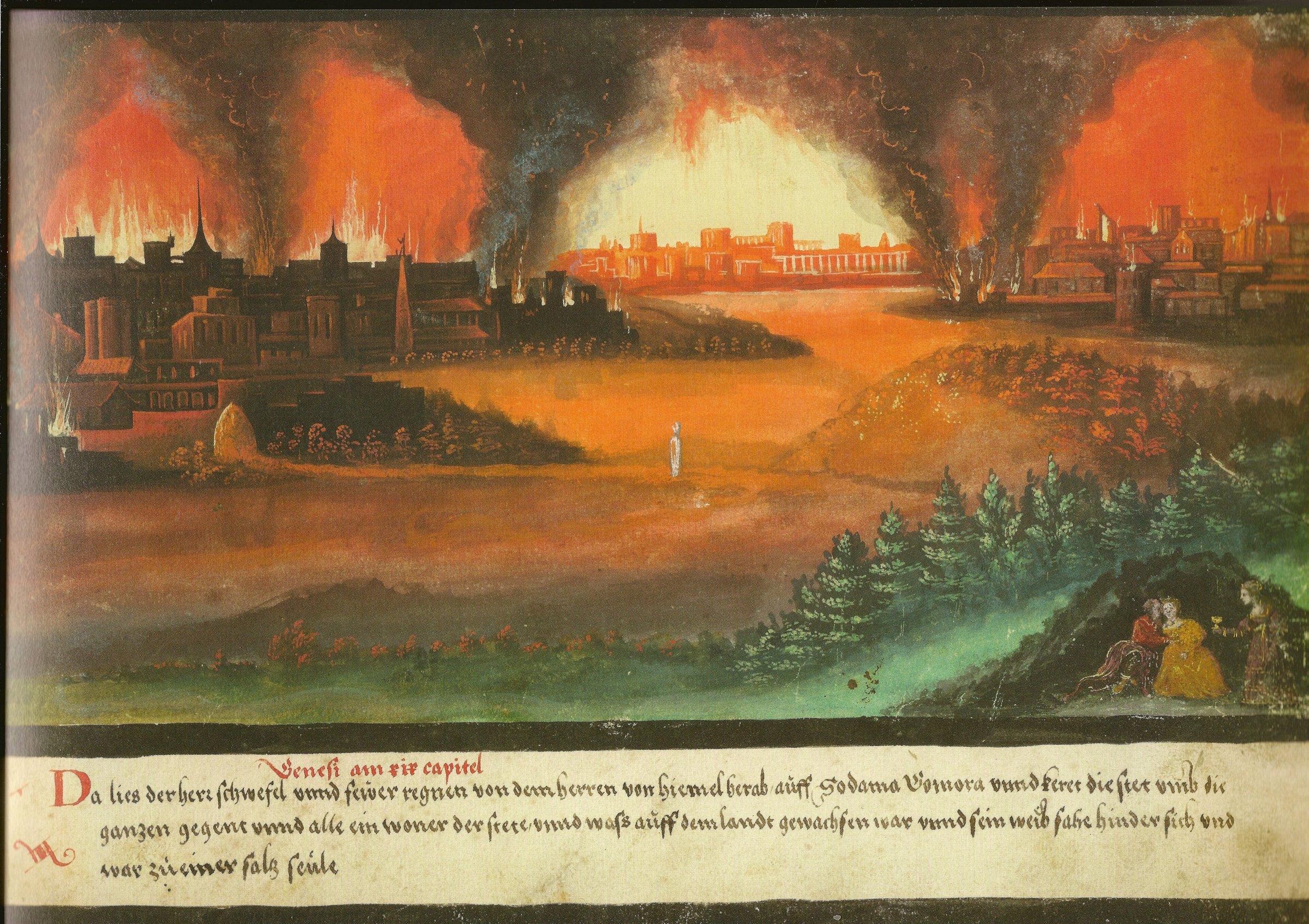
Unknown Augsburg artist, Sodom, about 1552. Public domain.
Genesis 19:15 to 26 · Person · Featured Study
Lot's Wife
Lot's wife is the woman of Genesis 19 who became a pillar of salt when she looked back toward Sodom.
Remember Lot’s wife!
- Died
- the morning Sodom burned
- Family
- husband: Lot; daughters: two, unnamed
- Places
- Sodom
- First named
- Genesis 19:15 “At daybreak the angels hurried Lot along, saying,…”
- Last named
- Luke 17:32 “Remember Lot’s wife!”
Scripture gives her no name and four verses.
Summary
Lot's wife lived in Sodom with Lot and their two daughters until the morning the city was destroyed. The family had settled there after Lot chose the well-watered plain of the Jordan. She left the city with them, and Genesis gives her end in one verse.
- Of the four who left Sodom, Genesis brings three to Zoar.
- Jesus named her as a warning for the day the Son of Man is revealed.
- Her grandsons were the fathers of the Moabites and the Ammonites.
Her Verses in Genesis
Genesis speaks of her in the angels' order, in the escape and at her end.
At daybreak the angels hurried Lot along, saying, “Get up! Take your wife and your two daughters who are here, or you will be swept away in the punishment of the city.” But when Lot hesitated, the men grabbed his hand and the hands of his wife and his two daughters. And they led them safely out of the city, because of the LORD’s compassion for them.She stands in the angels' order and is taken by the hand with the others.
As soon as the men had brought them out, one of them said, “Run for your lives! Do not look back, and do not stop anywhere on the plain! Flee to the mountains, or you will be swept away!”This is the command her look broke.
But Lot’s wife looked back, and she became a pillar of salt.Her end stands between the fire on the cities and Abraham's look the next morning.
Witnesses to the Pillar
Writers of the first centuries reported on the pillar, and a pilgrim was told where it had stood.
Josephus, Clement and Irenaeus wrote of the pillar as standing, and Egeria was told it was gone.
| Witness | Work | What the witness says |
|---|---|---|
| Josephus | Antiquities 1.11.4 | He had seen the pillar himself, and it remained in his day |
| Clement of Rome | Letter to the Corinthians 11 | She remains a pillar of salt to that day |
| Irenaeus | Against Heresies 4.31 | The pillar endures, a sign of the church left behind in the world as the salt of the earth |
| Egeria | The Pilgrimage | The bishop of Segor told her the pillar had not been seen for some years, and the Dead Sea covered the spot |
Her Household
Genesis speaks of her husband, her two daughters and her grandsons.
Her husband and daughters outlived her, and her daughters bore two sons.
| Person | Tie to her | After that morning |
|---|---|---|
| Lot | Her husband | Left Zoar for a cave in the mountains |
| Two daughters | Led out of Sodom with her | Bore sons to their father |
| Moab and Ben-ammi | Her grandsons | Named by their mothers at birth |
The Salt, the Pillar and Her Name
Commentators have asked how she became salt and what she was called.
How did she become salt?Bede; Keil and Delitzsch; Ellicott; the Pulpit Commentary
Bede held that it must be believed to have happened literally. Keil and Delitzsch thought she was killed by the fiery vapour and then crusted over with salt until she looked like a statue, as things near the Dead Sea are crusted still. Ellicott thought an earthquake threw up a mass of the rock salt that lies around the sea and closed her inside it.
The Pulpit Commentary judges a literal change not impossible but scarcely likely, and takes the same view as Keil and Delitzsch.
What was her name?Pirkei de-Rabbi Eliezer 25; Genesis Rabbah 51:5
Pirkei de-Rabbi Eliezer, a Jewish retelling of the Torah that Sefaria dates between 630 and 1030, calls her Edith. John Gill reports the names Adith and Irith from Jewish writers.
Genesis Rabbah, a midrash on Genesis from about 400, says she sinned through salt on the night the angels came. She went to her neighbours to ask for salt for her guests, so that the city would learn of them.
Why Jesus Named Her
Jesus set her between a command about possessions and a saying about losing one's life.
On that day, let no one on the housetop come down to retrieve his possessions. Likewise, let no one in the field return for anything he has left behind.The verse before her name forbids going back for anything left behind.
Whoever tries to save his life will lose it, but whoever loses his life will preserve it.The verse after it states the loss she stands for.
Then Jesus declared, “No one who puts his hand to the plow and then looks back is fit for the kingdom of God.”Jesus applies the same warning to a disciple's following.
Voices on Lot's Wife
Six teachers from the third century to the eighteenth preached and wrote on her.
Clement of Alexandria (died 215)
The Stromata Book 2
Clement of Alexandria asks what her choice was and finds a lesson in the salt.
“For God looks closely at the actual inner purpose, as when Lot's wife was the only one to turn of her own free will toward the wickedness of the world. He left her insensible, giving her the likeness of a pillar of salt and leaving her without the power of forward movement, a statue, yet not one without a useful message but one intended to season and salt the person capable of spiritual perception.”
on Genesis 19:26Patristic
Origen of Alexandria (died 253)
HOMILIES ON GENESIS 5.2
Origen weighs her fault against her punishment.
“But let us return to Lot, who, fleeing the destruction of Sodom with his wife and daughters after he had received the command from the angels to not look back, was proceeding to Zoar. But his wife became negligent of the command. ‘She looked back’; she violated the imposed law; ‘she became a little statue of salt.’ Do we think there was so much evil in this transgression, that the woman, because she looked behind her, incurred the destruction that she appeared to be fleeing by divine favor?”
on Genesis 19:26Patristic
Ambrose of Milan (died 397)
Commentary on Luke
Ambrose of Milan draws a rule for the Christian life from her.
“For this reason, the Lord says, ‘Remember Lot's wife,’ who because she looked back, lost the function of her own nature. Satan and Sodom are behind. Flee excess and shun extravagance. Know that not everyone can flee to the mountain. Remember that the one who did not return to his old pursuits, as if to Sodom, escaped because he came to the mountain. She, who was weaker since she looked back, could not come to the mountain. She remained, although her husband's help supported her.”
on Luke 17:32Patristic
Augustine of Hippo (died 430)
Catena Aurea by Aquinas
Augustine gives the reading the medieval church kept.
“Lot's wife represents those who in time of trouble look back and turn aside from the hope of the divine promise, and hence she was made a pillar of salt as a warning to men not to do likewise, and to season as it were their hearts, lest they become corrupt.”
on Luke 17:32Patristic
Cyril of Alexandria (died 444)
COMMENTARY ON LUKE, HOMILY 118
Cyril of Alexandria preached her to his hearers as the example Jesus chose.
“It is our duty to maintain our religious exertions without wavering and to persevere in them with undaunted wills or else we may suffer the kind of fate that befell the woman at Sodom. We take her as an example because he says, ‘Remember Lot's wife. For when she was rescued from Sodom, but would afterward have returned, she became a pillar of salt.’ That means she became foolish and stonelike.”
on Luke 17:32Patristic
Matthew Henry (1662 to 1714)
Commentary on the Whole Bible
Matthew Henry carries the reading into English Protestant commentary.
“As by the example of Sodom the wicked are warned to turn from their wickedness, so by the example of Lot's wife the righteous are warned not to turn from their righteousness. The sin of Lot's wife: She looked back from behind him. This seemed a small thing, but we are sure, by the punishment of it, that it was a great sin, and exceedingly sinful.”
on Genesis 19:26Puritan
Why Did She Look Back?
Genesis gives the look and not its reason, and readers have given four.
She broke a plain commandThe Cambridge Bible; Origen
The Cambridge Bible says she failed to trust with her whole heart or to obey. Origen's homily, quoted among the voices, reads her the same way.
The objection: this reading leaves open why a single look was judged so heavily.
Her heart was in Sodom with her goodsJohn Wesley; Adam Clarke; Jamieson, Fausset and Brown
Wesley thought she probably longed for her house and goods and was loath to leave them, and he took Luke 17:31 to 32 as Christ naming that as her sin. Clarke on Luke thought she turned back to carry some of her goods away, and Jamieson, Fausset and Brown read her look as a heart still in Sodom.
The objection: Genesis 19:26 names no goods, and the tie to possessions is drawn from Luke.
She doubted the warningClement of Rome; the Wisdom of Solomon
Clement of Rome wrote that she was of a different mind from her husband. She stands, he says, as a sign that the double-minded who distrust the power of God bring judgment on themselves. The Wisdom of Solomon, a book of the Apocrypha, calls the pillar a monument of an unbelieving soul.
The objection: Genesis records no word or thought of hers.
She looked back for her daughtersPirkei de-Rabbi Eliezer 25; Philoxenus of Mabbug
Pirkei de-Rabbi Eliezer says her pity was stirred for her daughters who were married in Sodom, and she looked back to see whether they were following. Philoxenus of Mabbug wrote in his Discourses that love of her kinsfolk and the cries of those she loved made her turn.
The objection: Genesis names only the two daughters who left the city with her.
A Warning to the Rescued
Her end stands in Scripture as a warning to those already brought out of danger, and the letter to the Hebrews sets a hope against it.
But we are not of those who shrink back and are destroyed, but of those who have faith and preserve their souls.It names the faith that holds on to the end.
Brothers, I do not consider myself yet to have taken hold of it. But one thing I do: Forgetting what is behind and straining toward what is ahead, I press on toward the goal to win the prize of God’s heavenly calling in Christ Jesus.Paul sets the forward look of faith against the backward one.
Sources
Scripture is the Berean Standard Bible.
- Keil and Delitzsch, Biblical Commentary on the Old Testament; Ellicott's Commentary for English Readers; the Pulpit Commentary; the Cambridge Bible for Schools and Colleges; Benson's Commentary; John Gill, Exposition of the Old Testament; each on Genesis 19:26.
- Clement of Alexandria, Stromata 2; Origen, Homilies on Genesis 5.2; Augustine in the Catena Aurea on Luke 17:32; Cyril of Alexandria, Commentary on Luke, homily 118; Matthew Henry, Commentary on the Whole Bible, on Genesis 19:26; Bede, Commentary on Genesis, on 19:26; John Wesley, Explanatory Notes upon the Old Testament, on 19:26; Adam Clarke, Commentary on the Bible, on Luke 17:32; Jamieson, Fausset and Brown on Luke 17:32; Ambrose, Commentary on Luke, on 17:32; Philoxenus of Mabbug, Discourse 9.
- Flavius Josephus, Antiquities of the Jews 1.11.4, translated by William Whiston.
- Clement of Rome, First Letter to the Corinthians 11, Ante-Nicene Fathers.
- Irenaeus, Against Heresies 4.31.1 and 4.31.3, Ante-Nicene Fathers.
- The Wisdom of Solomon 10:7, King James Version Apocrypha.
- The Pilgrimage of Etheria, translated by M. L. McClure and C. L. Feltoe (SPCK, 1919)
- Pirkei de-Rabbi Eliezer 25, translated by Gerald Friedlander (London, 1916), public domain.
- Genesis Rabbah 51:5, The Sefaria Midrash Rabbah (2022), CC-BY.
Keep Studying
Places1
Doctrines1
Go further15