
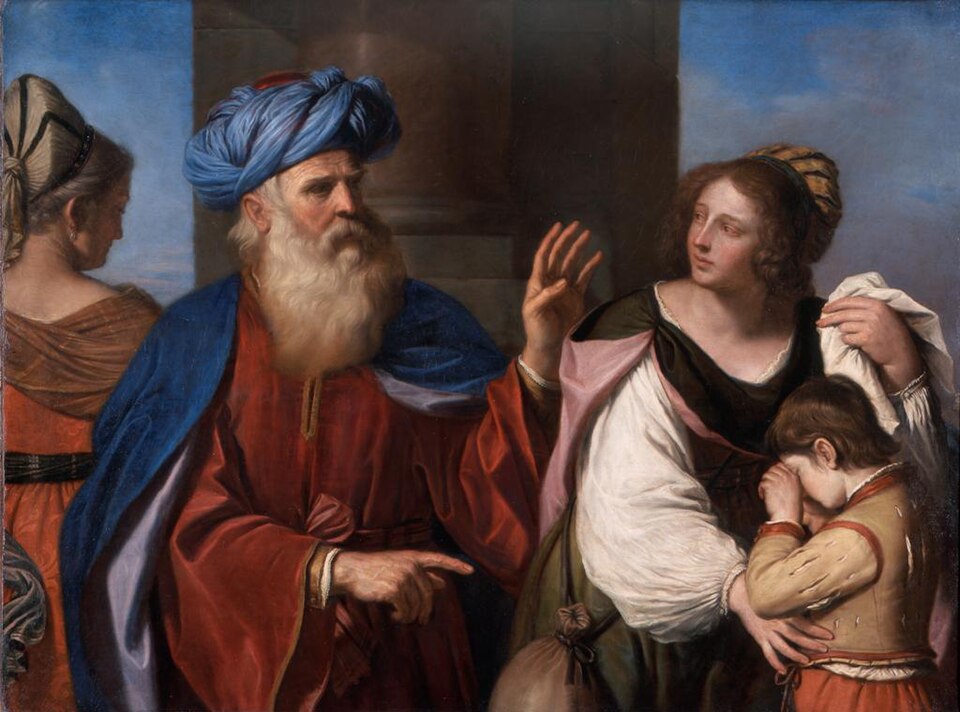
Galatians 4:21-31 · Featured Study
Hagar and Sarah: the Allegory
Paul takes the oldest family story in Genesis and says of it, “which things contain an allegory.” Two mothers stand for two covenants: Sinai bearing children unto bondage, and the free Jerusalem above, our mother. This page walks the allegory in the text’s own order, the two sons, the two covenants, the barren woman’s song from Isaiah, the persecution note, and the command from Genesis 21. It also says plainly what the allegory never teaches: it is an argument about law and promise, not a verdict that God has discarded Israel.
Summary
Paul reads the story of Abraham's two sons as an allegory of two covenants: Sinai, which bears children unto bondage, and the Jerusalem above, which is free and is our mother. The argument is aimed at teachers pressing Galatian believers back under the law, and it ends where Genesis ends, the inheritance belongs to the children of promise.
- Paul himself names the method: "which things contain an allegory" (4:24); the history stays history, and carries a second meaning
- The two covenants are the contrast, law-bondage against promise-freedom, not one people against another
- Isaiah 54:1 gives the free city her song: the barren woman ends with more children than the married one (4:27)
- As Ishmael persecuted Isaac, "so also it is now": the pressure on the Galatians repeats the old pattern (4:29)
- The same apostle wrote Romans 11: God did not cast off his people, and his gifts and calling are not repented of
Do Ye Not Hear the Law?
4:21-23: the challenge, and the two sons
“Tell me, ye that desire to be under the law, do ye not hear the law?” Galatians 4:21
“For it is written, that Abraham had two sons, one by the handmaid, and one by the freewoman.” Galatians 4:22
“Howbeit the son by the handmaid is born after the flesh; but the son by the freewoman is born through promise.” Galatians 4:23
Paul turns the Judaizing argument against itself. The teachers troubling Galatia held up the law; Paul answers, then hear the law, and takes them to Genesis. Abraham had two sons. Ishmael was born to Hagar, Sarah’s Egyptian handmaid, by an ordinary human plan to force the promise (Genesis 16). Isaac was born to Sarah in her old age, against nature, because God had promised him (Genesis 21). One birth ran on human effort. The other ran on God’s word alone. That difference, effort against promise, is the hinge of everything that follows.
“It should be noted that the Law mentioned here refers to the history of Genesis ... the entire narrative of Abraham and his wives and children, referred to as the Law”
Jerome · Commentary on Galatians, 386Latin Father
Gal 4:21
The Genesis story underneath, brieflyGenesis 16 and 21
Sarah, childless for decades after the promise of Genesis 12, gave her handmaid Hagar to Abraham so the household might have an heir by custom. Ishmael was born, and the household fractured. Fourteen years later God kept his word directly: Sarah bore Isaac. At Isaac's weaning feast the tension broke, and Sarah demanded that the handmaid and her son be sent away, the very words Paul quotes in 4:30. Scripture treats Hagar herself with honor: God saw her in the wilderness, named her son, and made him a great nation. Her own page carries her story in full at /featured/hagar.
Two Women, Two Covenants
4:24-25: "these women are two covenants"
“Which things contain an allegory: for these women are two covenants; one from mount Sinai, bearing children unto bondage, which is Hagar.” Galatians 4:24
“Now this Hagar is mount Sinai in Arabia and answereth to the Jerusalem that now is: for she is in bondage with her children.” Galatians 4:25
Paul says what he is doing before he does it. The women stand for covenants. Hagar answers to Sinai, the covenant of law, and to “the Jerusalem that now is,” the city as it stood in Paul’s day, holding to law-keeping as the way of righteousness. Anyone seeking to be justified by that covenant is born, so to speak, into the handmaid’s position: serving for an inheritance that service can never earn. The point is aimed at the Judaizers’ program, not at Hagar, and not at the Jewish people. The women are figures; the covenants are the subject.
“Which things are an allegory - An allegory is a figurative speech, wherein one thing is expressed, and another intended. For those two sons are types of the two covenants. One covenant is that given from Mount Sinai, which beareth children to bondage - That is, all who are under this, the Jewish covenant, are in bondage.”
John Wesley · Explanatory Notes upon the New Testament, 1755Evangelical
Gal 4:24
“The former, Agar, represented that which was given from mount Sinai, and which gendereth to bondage, which, though it was a dispensation of grace, yet, in comparison of the gospel state, was a dispensation of bondage, and became more so to the Jews, through their mistake of the design of it, and expecting to be justified by the works of it.”
Matthew Henry · Commentary on the Whole Bible, 1710Puritan
Gal 4:24
“Or ‘are allegorized’: so Sarah and Hagar were allegorized by Philo the Jew (p), before they were by the apostle. Sarah he makes to signify virtue, and Hagar the whole circle of arts and sciences, which are, or should be, an handmaid to virtue”
John Gill · Exposition of the New Testament, 1746-1748Particular Baptist
Gal 4:24
Why Hagar 'is' Mount Sinai: an old geographical noteJFB, carrying Chrysostom
The tightest knot in the passage is 4:25: how is Hagar mount Sinai? One old and simple answer, running back to Chrysostom, is linguistic: the Arabians of the Sinai region called the mountain by a name that sounds as Hagar's. Whether or not that etymology decides the verse, the logic of the allegory does not depend on it. Sinai sits in Arabia, outside the land of promise, as Hagar and her son were sent outside the household of promise.
“Translate, ‘For this word, Hagar, is (imports) Mount Sinai in Arabia (that is, among the Arabians--in the Arabian tongue).’ So CHRYSOSTOM explains. Haraut, the traveller, says that to this day the Arabians call Sinai, ‘Hadschar,’ that is, Hagar, meaning a rock or stone.”
Jamieson, Fausset & Brown · Commentary Critical and Explanatory on the Whole Bible, 1871Reformed
Gal 4:25
The Jerusalem That Is Above
4:26-27: the free city, and the barren woman's song
“But the Jerusalem that is above is free, which is our mother.” Galatians 4:26
“For it is written, Rejoice, thou barren that bearest not; Break forth and cry, thou that travailest not: For more are the children of the desolate than of her that hath the husband.” Galatians 4:27
The second covenant has a city too, and it is not below but above. Paul seals the point with Isaiah 54:1, the song sung to barren Zion straight after the suffering servant of Isaiah 53. Sarah was the barren woman of Genesis, laughing at the promise she could not carry; Isaiah’s Zion is barren the same way, desolate beyond hope of children. Both are told to rejoice before the children come, because the children come by promise, and the desolate woman ends with more of them than the married one. Paul reads the church of Jew and Gentile together as that overflow.
“The object of the apostle in introducing it here seems to be to prove that the Gentiles as well as the Jews would partake of the privileges connected with the heavenly Jerusalem. He had in the previous verse spoken of the Jerusalem from above as the common mother of all, true Christians, whether by birth Jews or Gentiles.”
Albert Barnes · Notes, Explanatory and Practical, on the Old and New Testaments, 1832-1869Presbyterian
Gal 4:27
Children of Promise
4:28-29: "as Isaac was," and the old persecution repeated
“Now we, brethren, as Isaac was, are children of promise.” Galatians 4:28
“But as then he that was born after the flesh persecuted him that was born after the Spirit, so also it is now.” Galatians 4:29
The believer’s birth certificate reads like Isaac’s: born through promise, by God’s power, not by human effort. And the old household tension repeats. Genesis 21:9 shows Ishmael at Isaac’s weaning feast, and Paul, following the way his people had long read that scene, names it persecution. “So also it is now”: the flesh-born way of religion was pressing hard on the promise-born churches of Galatia, demanding they earn what they had been given. Paul is describing the pressure his converts were under from the law-party, the same pressure the Antioch confrontation exposed one chapter earlier.
“The persecution here referred to, was the injurious treatment which Isaac received from Ishmael, or the opposition which subsisted between them.”
Albert Barnes · Notes, Explanatory and Practical, on the Old and New Testaments, 1832-1869Presbyterian
Gal 4:29
Cast Out the Handmaid
4:30-31: the scripture's own verdict, and the conclusion
“Howbeit what saith the scripture? Cast out the handmaid and her son: for the son of the handmaid shall not inherit with the son of the freewoman.” Galatians 4:30
The words are Sarah’s, from Genesis 21:10, and God himself told Abraham to heed them (Genesis 21:12). In the allegory they become the verdict on the two covenants as ways of inheritance: law and promise cannot share the estate. A Galatian believer taking up circumcision to secure his standing was choosing the covenant that cannot inherit.
Genesis 21:10 (BSB)
“and she said to Abraham, Expel the slave woman and her son, for the slave woman’s son will never share in the inheritance with my son Isaac!” Genesis 21:10
The source text, quoted in the reader’s own Bible. Genesis 21 carries the whole scene, including God’s care for Hagar and Ishmael in the wilderness after they left.
“Nevertheless, what saith the Scripture?.... This is a Talmudic form of citing Scriptures, and answers to מאי קראה, ‘what says the Scriptures (e)?’ the passage referred to is Gen 21:10 and which are the words of Sarah to Abraham; but inasmuch as she spake them under divine inspiration, and they were approved of and confirmed by God, as appears from Gen 21:12 they are ascribed to God speaking in the Scripture”
John Gill · Exposition of the New Testament, 1746-1748Particular Baptist
Gal 4:30
“Ge 21:10, 12, where Sarah's words are, ‘shall not be heir with my son, even with Isaac.’ But what was there said literally, is here by inspiration expressed in its allegorical spiritual import, applying to the New Testament believer, who is antitypically ‘the son of the free woman.’ In Joh 8:35, 36, Jesus refers to this.”
Jamieson, Fausset & Brown · Commentary Critical and Explanatory on the Whole Bible, 1871Reformed
Gal 4:30
“Wherefore, brethren, we are not children of a handmaid, but of the freewoman.” Galatians 4:31
The conclusion lands on identity. The believer’s mother is the free city; his standing rests on promise, not performance. The next verse, 5:1, turns the identity into a command: stand fast in the freedom Christ set us free for.
“Are not children of the bondwoman - Have nothing to do with the servile Mosaic dispensation. But of the free - Being free from the curse and the bond of that law, and from the power of sin and Satan.”
John Wesley · Explanatory Notes upon the New Testament, 1755Evangelical
Gal 4:31
Not a Verdict on Israel
what the allegory argues, and what it never says
This passage has a long and painful reception history. From the early centuries onward, some readers turned Paul’s covenant allegory into a verdict on the Jewish people themselves: the church as the new Isaac, Israel as the cast-out Ishmael, the synagogue disinherited. That reading appears in real and honored authors, and this site names it as history. It does not teach it, because Paul does not teach it.
Read the argument in its own frame. Paul’s targets are the Judaizing teachers of Galatia, men pressing Gentile believers to take up law-keeping as the ground of their standing with God. The contrast is between two covenants as ways of inheritance, law-bondage against promise-freedom. It is not a contrast between two peoples. Paul himself was an Israelite and never stopped saying so, and the same apostle, in the same body of letters, answered this exact question directly.
Romans 11:1 (BSB)
“I ask then, did God reject His people? Certainly not! I am an Israelite myself, a descendant of Abraham, from the tribe of Benjamin.” Romans 11:1
“For the gifts and the calling of God are not repented of.” Romans 11:29
The standing promise, in the same apostle’s hand. Whatever the Hagar allegory teaches, it cannot teach what Romans 11 denies.
Why God Is Not Finished with Israel
The Romans 11 case in full: the remnant, the hardening in part, and the promise that all Israel shall be saved.
The full study →Israel and the Olive Tree
Paul’s own picture for Jew and Gentile in one plant: wild branches grafted in, natural branches never beyond regrafting.
The full study →The Word Paul Chose
allegoreo: one thing spoken, another intended
Galatians 4:24 carries the only New Testament use of this Greek verb. Paul does not deny the history; Abraham, Hagar, Sarah, and the two boys were real, and the letter treats them as real. He says the recorded history also speaks figuratively, the way a type speaks. Gill’s note above shows the method was already at home in first-century Jewish reading: Philo of Alexandria had allegorized these same two women a generation before Paul wrote.
“Allegory, from αλλος, another, and αγορεω, or αγορευω, to speak, signifies a thing that is a representative of another, where the literal sense is the representative of a spiritual meaning”
Adam Clarke · Commentary on the Bible, 1832Methodist
Gal 4:24
The Voices
with the work named
Commentary on Galatians (c. 386) · public domain
Reads "the law" in 4:21 as the Genesis narrative itself: the whole story of Abraham, his wives, and his sons.
Explanatory Notes upon the New Testament (1755) · public domain
Defines the allegory plainly: the two sons are types of the two covenants, and Sinai's children are born to bondage.
Commentary on the Whole Bible (1710) · public domain
Guards the balance: Sinai was a dispensation of grace, and became bondage through mistaking its design.
Exposition of the New Testament (1746-1748) · public domain
Notes that Philo allegorized Sarah and Hagar before Paul did, and that 4:30 cites Genesis 21:10 by the rabbis' own formula.
Commentary Critical and Explanatory on the Whole Bible (1871) · public domain
Carries Chrysostom's note that the Arabians called Sinai by Hagar's name, and points 4:30 forward to John 8:35-36.
Notes, Explanatory and Practical, on the Old and New Testaments (1832-1869) · public domain
Reads the Isaiah 54:1 quotation as proof that Gentiles as well as Jews share the heavenly Jerusalem.
Commentary on the Bible (1832) · public domain
Unpacks the Greek word allegoria itself: one thing spoken, another intended.
Marcus Brown's own commentary leads above all; within a tier, all voices are equal. No modern (living-copyright) roster voice appears in the site's quote pool for this chapter; the relevance gate is honored by carrying none rather than reaching for one.
Word studies
The Hebrew and Greek under this study, each word in its own room.
Keep Studying
On this page