
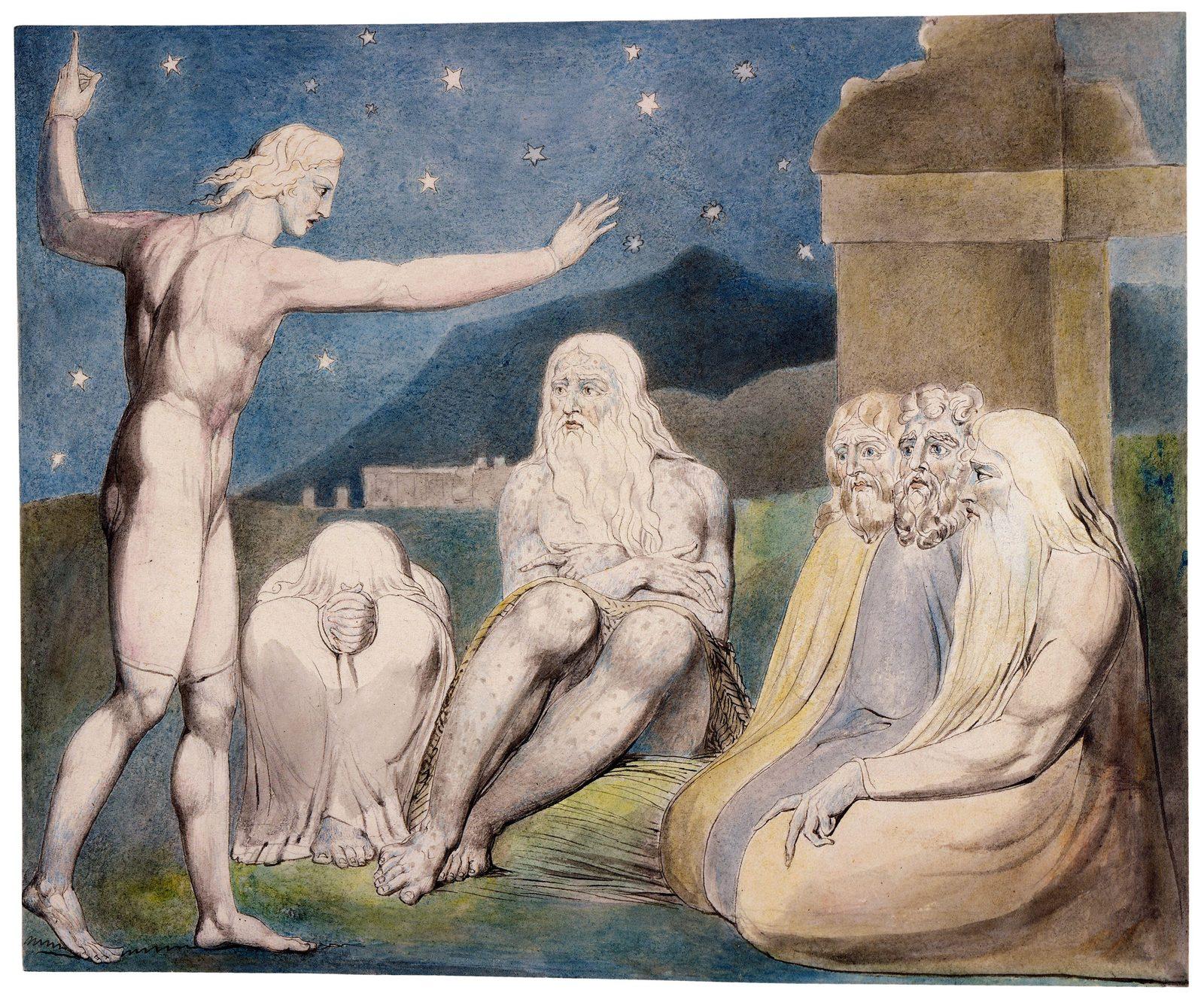
William Blake, The Wrath of Elihu, 1805 to 1806. Public domain.
Job 32 to 37 · Person · Featured Study
Elihu
Elihu son of Barachel the Buzite was a young man who spoke to Job and his three friends after they had stopped answering one another.
This kindled the anger of Elihu son of Barachel the Buzite, of the family of Ram. He burned with anger against Job for justifying himself rather than God,
Elihu spoke for six chapters, and the book records no reply to him.
Summary
Elihu speaks four times in Job 32 to 37. He holds that God is just in all He does.
- Barachel is the only father of a speaker that the book names.
- Eusebius reports that Aristeas called him the son of Barachiel the Zobite.
- An ancestor of Samuel bore the same name (1 Samuel 1:1).
Where Elihu Stands in Scripture
Elihu enters the book in its thirty-second chapter.
His Four Speeches
Each speech opens with a line naming Elihu as the speaker (Job 32:6, Job 34:1, Job 35:1 and Job 36:1).
Elihu moves from his right to speak, to God's justice, to God's greatness in the storm.
- FirstJob 32:6 to 33:33Age does not make a man wise, and God speaks to a man again and againJob 32:6
- SecondJob 34:1 to 34:37Far be it from God to do wrong, and Job speaks without knowledgeJob 34:1
- ThirdJob 35:1 to 35:16A man's sin or righteousness reaches other men, and God receives nothing from itJob 35:1
- FourthJob 36:1 to 37:24God is mighty and teaches the afflicted, and His voice thunders in the stormJob 36:1
Each speech stands with the verse that opens it.
Young Among the Old
Elihu claimed the right to speak from the breath of the Almighty, though he was young.
But there is a spirit in a man, the breath of the Almighty, that gives him understanding.Elihu answers the custom that the old speak first.
Adam Clarke notes that among the peoples of the East a young man did not speak before his elders on a disputed matter. Elihu also says he is full of words and that his spirit compels him to speak (Job 32:18).
His Name and His Line
Commentators read his name and his father's name as words of faith.
Albert Barnes reads Elihu as God is he, and Barachel as God blesses.
Barnes adds that nothing certain is known of Ram, and that the Targum, the old Aramaic paraphrase of the Hebrew, renders of the family of Ram as of the race of Abraham.
The Circle of Elihu
His father and his forebear stand in his line, and Job and the three friends stand before him.
Elihu's line runs back to Buz, and his hearers are the four older men.
| Person | Generation | Tie to Elihu |
|---|---|---|
| Buz | 1 | The forebear whose name his people bore |
| Barachel the Buzite | 2 | His father |
| Job | The man he answered | |
| Eliphaz, Bildad and Zophar | The older men he answered |
The Places of His People
Scripture gives the name Buz to a son of Nahor and to a people of Arabia.
The name of Elihu's people stands in the family of Nahor and among the peoples of Arabia.
| Where Buz stands | What Scripture tells of it |
|---|---|
| The family of Nahor | Buz is the brother of Uz, the firstborn of Nahor, Abraham's brother. |
| The peoples of Arabia | Jeremiah sets Buz beside Dedan and Tema. |
Who Was Elihu?
Rabbis and commentators have given four answers about who Elihu was.
Was Elihu Balaam, or Isaac?The Jerusalem Talmud, Sotah 5:6; John Gill
In the Jerusalem Talmud, Rabbi Aqiba reads Elihu as Balaam, who came to curse Israel and blessed them. Rabbi Eleazar ben Azariah answers that Elihu is Isaac, the son whom God blessed, of the family of Abram.
John Gill rejects the identification with Balaam, since Elihu lived before Balaam.
Was Elihu a prophet to the nations, or the author of the book?The Babylonian Talmud, Bava Batra 15b; Jamieson, Fausset and Brown
The Babylonian Talmud counts Elihu among seven prophets who prophesied to the nations of the world. It reads the family of Ram as the family of Abraham, to show that Elihu was a Jew.
Jamieson, Fausset and Brown report that John Lightfoot took the full account of Elihu's descent as a sign that Elihu wrote the book. They answer that he was simply less known than the three friends.
Left Out of the Verdict
The LORD's verdict names three men.
So Eliphaz the Temanite, Bildad the Shuhite, and Zophar the Naamathite went and did as the LORD had told them; and the LORD accepted Job’s request.Elihu stands outside the sacrifice the LORD required.
God Speaks in One Way and in Another
Elihu answered Job's complaint that God gives no answer.
For God speaks in one way and in another, yet no one notices.It opens his answer to Job's charge in Job 33:13 that God answers nothing.
Elihu names two ways God speaks: a dream in the night that turns a man from pride (Job 33:15 to 18), and pain on his bed (Job 33:19). He then speaks of a messenger, one mediator in a thousand, who finds a ransom for the man (Job 33:23 to 24).
God rescues the afflicted by their affliction and opens their ears in oppression.His fourth speech returns to the same teaching.
Voices on Elihu
Matthew Henry wrote on the warnings of Job 33:14.
Matthew Henry (1662 to 1714)
Commentary on the Whole Bible
Henry read the warnings Elihu describes as the patience of God, who sends one warning after another.
“This he does once, yea, twice, that is, again and again; when one warning is neglected he gives another, not willing that any should perish. Precept must be upon precept, and line upon line; it is so, that sinners may be left inexcusable.”
on Job 33:14Puritan
A True Voice, or a Proud One?
Readers judge Elihu's speeches in three ways.
A wise and good manMatthew Poole; John Gill; Jamieson, Fausset and Brown
Poole holds that his speech shows him to be both a wise and a good man. Gill calls him a holy good man, as all his discourses show, and Jamieson, Fausset and Brown say he was mainly to solve the problem of the book.
The objection: Matthew Henry's Concise Commentary holds that Elihu silenced Job without bringing him to own his guilt before God.
A proud or an evil speakerGregory the Great; the Testament of Job
Gregory the Great holds that Elihu stands for the sound faith of proud men placed within the church, and passes over his words quickly. The Testament of Job, a retelling of Job outside the Bible, calls him the evil one who will have no remembrance among the living.
The objection: Poole reads his speech as the mark of a wise and good man.
A man who misread JobJohn Chrysostom
Chrysostom holds that Elihu thought Job claimed to be more righteous than God. He answers that Job only held God responsible for his afflictions, and that the charge was Elihu's own reading.
The objection: Wesley holds that Job took more care to keep his own innocence than God's glory.
Elihu's Last Words
Elihu ends on the greatness of God in the storm.
Therefore, men fear Him, for He is not partial to the wise in heart.”His last line names the fear of God as the answer to God's greatness.
Sources
Scripture is the Berean Standard Bible.
- Strong's Hebrew lexicon, h453, h938 and h1292, with the index of every use.
- Albert Barnes, Notes (1832 to 1869); Matthew Poole, Annotations; John Gill, Exposition; Jamieson, Fausset and Brown, Commentary (1871); the Cambridge Bible for Schools and Colleges; the Pulpit Commentary, each on Job 32:2.
- Adam Clarke, Commentary (1832), on Job 32:6; John Wesley, Explanatory Notes (1765), on Job 32:2; Gregory the Great, Morals on the Book of Job, Book XXIII, on Job 32:2 and 32:6; John Chrysostom, Commentary on Job, on Job 32:2 to 3.
- Matthew Henry, Commentary on the Whole Bible (1710), on Job 33:14.
- Matthew Henry's Concise Commentary, on Job 38:1 to 3.
- Eusebius, Preparation for the Gospel, Book 9, chapter 25, translated by E. H. Gifford (1903)
- The Jerusalem Talmud, Sotah 5:6, translated by Heinrich Guggenheimer.
- The Babylonian Talmud, Bava Batra 15b, the William Davidson translation.
- The Testament of Job, the English text at the Wesley Center Online.
Keep Studying
Studies6