
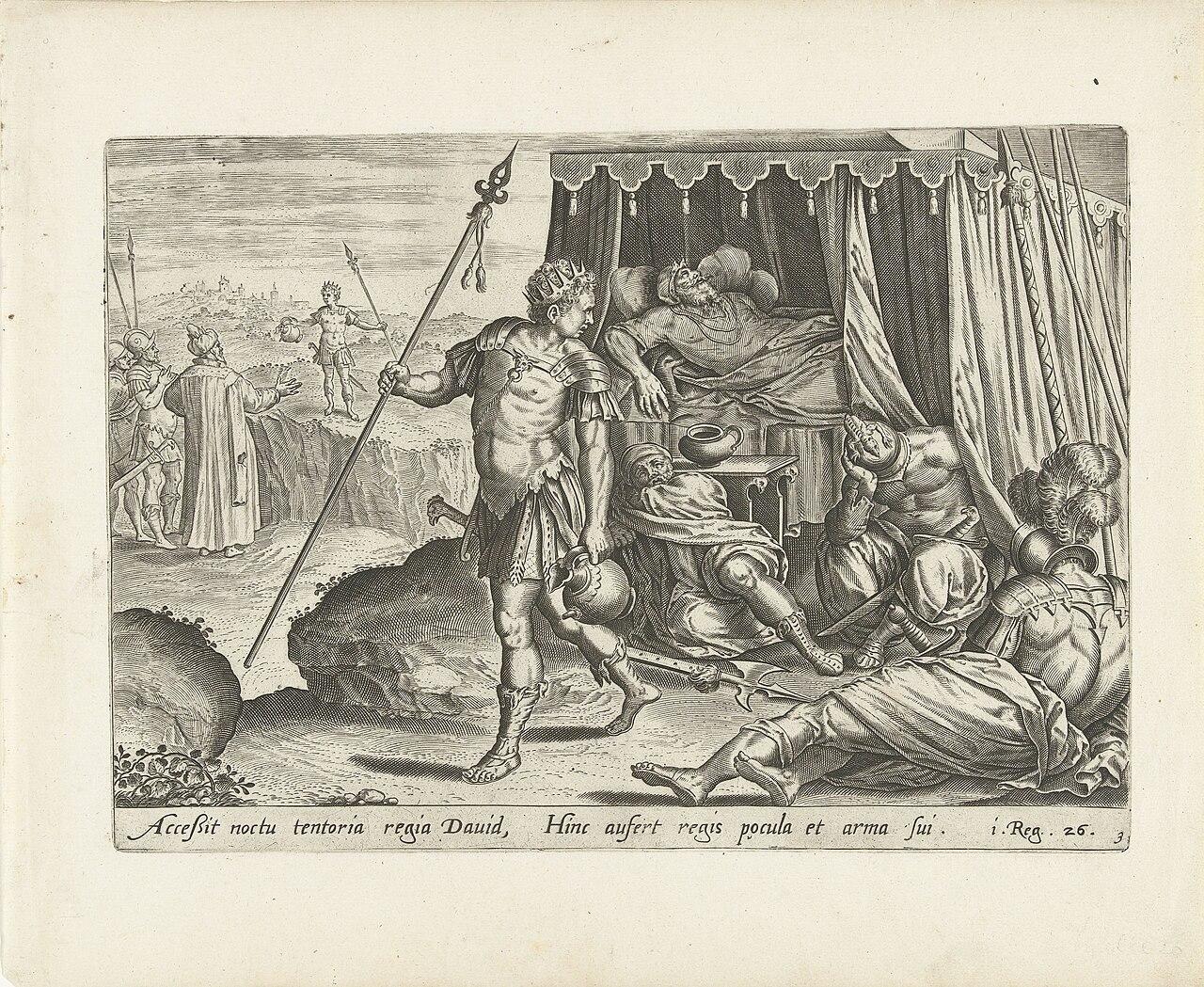
After Ambrosius Francken the Elder, David Spares the Life of Saul, 1585. Public domain.
1 Samuel 24 and 26 · Subject · Featured Study
The LORD's Anointed, and the Hand That Must Not Be Stretched Out
In 1 Samuel 24 and 26 David twice had Saul in his power and spared him. In 2 Samuel 1 he judged the man who said he had killed Saul.
So David’s men said to him, “This is the day about which the LORD said to you, ‘Behold, I will deliver your enemy into your hand, that you may do with him as you wish.’” Then David crept up secretly and cut off a corner of Saul’s robe.
- Books
- 1 Samuel, 2 Samuel
- Hold in memory
- 1 Samuel 26:9, Romans 12:19
Saul hunted David in the wilderness, and twice the king lay within reach of David's hand.
Summary
The words the LORD's anointed stand in ten verses of the Berean text. Six of those verses stand in two chapters of 1 Samuel.
- At En-gedi David cut off the corner of Saul's robe, and his conscience struck him for it.
- In the camp at night he took the king's spear and water jug and left him asleep.
- He put to death the Amalekite who said he had killed Saul.
- In Psalm 105:15 God calls the patriarchs His anointed ones, and readers differ on how far David's rule reaches.
The Cave and the Camp
1 Samuel 24 and 26 tell how David twice held Saul's life in his hand.
Saul led three thousand chosen men to the Rocks of the Wild Goats near En-gedi. He went into a cave to relieve himself, where David and his men were hiding.
So he said to his men, “The LORD forbid that I should do such a thing to my master, the LORD’s anointed. May I never lift my hand against him, since he is the LORD’s anointed.”David gives his reason twice in one verse: Saul is the LORD's anointed.
Later the men of Ziph told Saul where David was, and Saul came again with three thousand men. At night David and Abishai went down into the camp and found the king asleep with his spear stuck in the ground by his head.
But David said to Abishai, “Do not destroy him, for who can lift a hand against the LORD’s anointed and be guiltless?”Abishai asked leave to strike once, and this is David's answer.
But the LORD forbid that I should stretch out my hand against the LORD’s anointed. Instead, take the spear and water jug by his head, and let us go.”The spear and the jug are taken as proof, and the king's life is left.
Four Times David Answered Harm to the King
Four scenes of 1 and 2 Samuel, each with who spoke or acted against the king and what David did.
David refused to strike Saul twice, judged the man who said he killed him, and spared the man who cursed David.
- The cave at En-gediDavid's menHe cut off the corner of Saul's robe and would not touch the king.1 Samuel 24:4 to 7
- Saul's camp at nightAbishaiHe took the spear and the water jug and left the king asleep.1 Samuel 26:7 to 12
- Ziklag, after GilboaThe Amalekite who said he killed SaulHe sentenced the man on his own report of the deed.2 Samuel 1:13 to 16
- The Jordan, after AbsalomAbishai, asking death for Shimei, who had cursed DavidHe swore to Shimei that he would not die that day.2 Samuel 19:21 to 23
A table in story order: the place, the person, and the reply, each with its verse.
Why did David's heart strike him over a piece of cloth?1 Samuel 24:5, with the word kanaph
Afterward, David’s conscience was stricken because he had cut off the corner of Saul’s robe.The text records David's remorse and gives no reason for it beyond the deed.
The word for the corner of the robe is kanaph, which the lexicon of James Strong gives as an edge or extremity. It stands four times in 1 Samuel 24, in verses 4, 5 and 11.
What the Text Says and What Is Often Said
What Psalm 105:15 says, and how it differs from 1 Samuel.
Psalm 105:15 is the other place where God speaks of His anointed ones. There the words are God's rebuke to kings on behalf of Abraham, Isaac and Jacob, who were few in number and strangers in the land.
“Do not touch My anointed ones! Do no harm to My prophets!”The anointed ones and the prophets of this verse are the patriarchs of verses 9 and 10.
Now return the man’s wife, for he is a prophet; he will pray for you and you will live. But if you do not restore her, be aware that you will surely die—you and all who belong to you.”Abraham is the first man the Bible calls a prophet, and the words are spoken to a king.
John Gill, on Psalm 105:15, says the patriarchs were anointed ones though not anointed with material oil. In 1 Samuel the title belongs to a king who has been anointed with oil. The hand forbidden is a hand raised to kill him.
Two Anointed Men in One Kingdom
David had been anointed king while Saul still reigned.
So Samuel took the horn of oil and anointed him in the presence of his brothers, and the Spirit of the LORD rushed upon David from that day forward. Then Samuel set out and went to Ramah.David was anointed years before he took the throne.
After the Spirit of the LORD had departed from Saul, a spirit of distress from the LORD began to torment him.The next verse turns to Saul, from whom the Spirit had departed.
Jonathan told David that he would be king and that Saul knew it. After the cave Saul said the same to David's face.
Now I know for sure that you will be king, and that the kingdom of Israel will be established in your hands.The king who is hunting David says that David will reign.
The Amalekite's report in 2 Samuel 1 differs from 1 Samuel 31, where Saul falls on his own sword. David judged the man by what he said he had done.
Then Saul said to his armor-bearer, “Draw your sword and run it through me, or these uncircumcised men will come and run me through and torture me!” But his armor-bearer was terrified and refused to do it. So Saul took his own sword and fell on it.The narrator's account differs from the Amalekite's.
For David had said to the Amalekite, “Your blood be on your own head because your own mouth has testified against you, saying, ‘I killed the LORD’s anointed.’”David's sentence rests on the man's own mouth.
1 Samuel 24:20, 1 Samuel 31:4, 2 Samuel 1:16
Every Verse of the LORD's Anointed, Book by Book
The ten verses fall in three books: 1 Samuel, 2 Samuel and Lamentations.
Six of the ten verses are David's words in 1 Samuel 24 and 26.
| Where | Speaker | Spoken to | What it records |
|---|---|---|---|
| 1 Samuel (6 verses) | |||
| Inside the cave | David | His men | David says it twice in one breath to the men in the cave. |
| Outside the cave | David | Saul | David repeats his oath to Saul himself outside the cave. |
| Answering Abishai's request | David | Abishai | David asks Abishai who could lift a hand against the king and be guiltless. |
| Beside the sleeping king | David | Abishai | David takes the spear and the water jug instead of the king's life. |
| The hilltop across the valley | David | Abner | David turns the phrase against Abner, who failed to guard the king. |
| The last words to Saul | David | Saul | David leaves his reward to the LORD in his last words to Saul. |
| 2 Samuel (3 verses) | |||
| Ziklag, after Gilboa | David | The Amalekite | David asks the Amalekite why he was not afraid. |
| The sentence at Ziklag | David | The Amalekite | David passes sentence on the man's own words. |
| The Jordan, after Absalom | Abishai | David | Abishai uses the phrase of David himself, against Shimei. |
| Lamentations (1 verse) | |||
| Jerusalem's fall | The poet of Lamentations | The reader | Jerusalem mourns its captured king under the same title. |
The last words to Saul, 2 Samuel (3 verses), Ziklag, after Gilboa, The sentence at Ziklag, The Jordan, after Absalom, Lamentations (1 verse), Jerusalem's fall
The Words of the Hand and the Oil
Three Hebrew words of these chapters, from the lexicon of James Strong, and the count of mashiach by book.
mashiach (Hebrew, H4899)
Anointed, the word of the phrase the LORD's anointed; it stands in nine verses of 1 Samuel 24, 26 and 2 Samuel 1.
shalach (Hebrew, H7971)
To send or stretch out; with yad, the hand, it is the stretching out of the hand against the king.
naqah (Hebrew, H5352)
To be clean or guiltless, the word of David's question to Abishai.
The lexicon in full1 figure
Mashiach stands 12 times in 1 Samuel and 10 times in the Psalms.
The ten counts as a table
| Book | Uses |
|---|---|
| 1 Samuel | 12 |
| Psalms | 10 |
| 2 Samuel | 6 |
| Leviticus | 4 |
| Daniel | 2 |
| 1 Chronicles | 1 |
| 2 Chronicles | 1 |
| Isaiah | 1 |
| Lamentations | 1 |
| Habakkuk | 1 |
A bar chart of the word mashiach, anointed, by book, in the Hebrew Bible.
What the Text Leaves Unsaid
Two questions the chapters leave open.
What David's Restraint Teaches
David left the king's end to the LORD, and the New Testament asks the same of believers.
David added, “As surely as the LORD lives, the LORD Himself will strike him down; either his day will come and he will die, or he will go into battle and perish.David names three ends for Saul, and none of them is by his own hand.
May the LORD judge between you and me, and may the LORD take vengeance on you, but my hand will never be against you.David asks the LORD to judge between them and to avenge him.
Paul gives the same rule to the church in Rome, and Peter finds it kept in full by Christ.
Do not avenge yourselves, beloved, but leave room for God’s wrath. For it is written: “Vengeance is Mine; I will repay, says the Lord.”Vengeance is left to God.
When they heaped abuse on Him, He did not retaliate; when He suffered, He made no threats, but entrusted Himself to Him who judges justly.Peter sets Christ before His accusers as the pattern for His people.
Romans 12:19, 1 Peter 2:23
Three Voices on the Spared King
Voices from the fourth century to the nineteenth.
Ambrose of Milan (died 397)
Ambrose of Milan, in his book on the duties of the clergy, praises the deed and the loyalty it taught.
“What a virtuous action that was, when David wished rather to spare the king his enemy, though he could have injured him! How useful, too, it was, for it helped him when he succeeded to the throne. For all learned to be faithful to their king and not to seize the kingdom but to fear and reverence him. Thus what is virtuous was preferred to what was useful, and then usefulness followed on what was virtuous.”
Ambrose of Milan · On the Duties of the Clergy 3.9.60 · on 1 Samuel 24:6 to 7Patristic
Matthew Henry (1662 to 1714)
Matthew Henry judges David's sentence on the Amalekite.
“And his lying to David, if indeed it was a lie, was highly criminal, and proved, as sooner or later that sin will prove, lying against his own head. He did honourably and well.”
Matthew Henry · Commentary on the Whole Bible · on 2 Samuel 1:14Puritan
Jamieson, Fausset & Brown (1802 to 1910)
Jamieson, Fausset and Brown say David chose to wait for the LORD's judgment on Saul.
“Besides, he was the sovereign; Though God had rejected him from the kingdom, it was in every way the best and most dutiful course, instead of precipitating his fall by imbruing their hands in his blood and thereby contracting the guilt of a great crime, to wait the awards of that retributive providence which sooner or later would take him off by some sudden and mortal blow.”
Jamieson, Fausset & Brown · Commentary Critical and Explanatory on the Whole Bible · on 1 Samuel 26:8 to 12Reformed
Where Readers of David's Rule Differ
Two positions on David's rule, each with its holders and an objection.
Subjects must obey even a wicked kingThe Homily against Rebellion; James VI and I · Church of England and royalist
The Church of England's Homily against Disobedience and Wilful Rebellion of 1570 argues from David's dealing with Saul that a subject may not lay hands on his prince, though the prince seeks his death. James VI of Scotland, in The Trew Law of Free Monarchies of 1598, reaches the same rule from Samuel's warning in 1 Samuel 8.
The objection is Samuel Rutherford's in Lex, Rex of 1644. He answers that David spoke of stretching out his hand against the person of King Saul, and that no one in the three kingdoms had attempted violence to the king's person.
David kept a personal rule, and the people kept their rightsSamuel Rutherford · Scottish Presbyterian
Rutherford takes up 1 Samuel 24 and 26 in Question 31 of Lex, Rex, which asks whether self-defence against unjust violence is lawful. He holds that it was unlawful for David to kill the Lord's anointed, as it is unlawful to kill a man made in the image of God, except in case of necessity.
The royalist objection is 1 Samuel 26:9, which names no exception.
Books to Read Next
Four works on David and Saul, each free to read.
Commentary on the Whole Bible
Matthew Henry · 1710
Henry gives David's two reasons at the camp and weighs the sentence on the Amalekite.
Read it at the Christian Classics Ethereal LibraryOn the Duties of the Clergy
Ambrose of Milan · 391
Book 3 sets David's mercy to Saul among the deeds where virtue led and profit followed.
Read it at the Christian Classics Ethereal LibraryLex, Rex
Samuel Rutherford · 1644
Rutherford answers the argument from David and Saul in his case for the people's rights.
Read it at the Internet ArchiveThe Trew Law of Free Monarchies
James VI and I · 1598
The king's own case for obedience, argued from Samuel's warning in 1 Samuel 8.
Read it at the Constitution SocietyThe King Who Waited
David held the throne by promise and would not take it by the sword.
The LORD's Anointed One of Psalm 2 suffered the hand of kings and rulers, as the church in Acts 4 prayed. The reader is asked to leave judgment with God.
Sources
Scripture is the Berean Standard Bible.
- The Berean text searched for the LORD’s anointed, His anointed, My anointed and Your anointed.
- STEP Bible TBESH lexicon and TAHOT word index, Tyndale House, CC BY 4.0.
- Ambrose of Milan, On the Duties of the Clergy 3.9.60.
- Matthew Henry, Commentary on the Whole Bible, 1710, on 1 Samuel 26:9.
- Jamieson, Fausset and Brown, Commentary Critical and Explanatory on the Whole Bible, 1871, on 1 Samuel 26:8 to 12.
- Matthew Henry, Commentary on the Whole Bible, 1710, on 2 Samuel 1:14.
- John Gill, Exposition of the Old Testament, on Psalm 105:15.
- Adam Clarke, Commentary on the Bible, 1832, on Psalm 105:15.
- James VI and I, The Trew Law of Free Monarchies, 1598.
- An Homily against Disobedience and Wilful Rebellion, 1570, the Second Book of Homilies.
- Samuel Rutherford, Lex, Rex, 1644, Questions 31 and 32, Edinburgh reprint by Robert Ogle and Oliver and Boyd.
Keep Studying
Read it4