
.jpg?width=1600)
Patriarch
Adam
First Man, Father of Humanity · Creation · Beginning of time
The Creation of Adam, Michelangelo
Summary
Adam was the first man, created by God from the dust of the ground and animated by divine breath. He was placed in Eden as its keeper, named all animals, received Eve as his wife, but brought sin and death upon humanity through his disobedience.
- Adam is the first man. God formed him from the dust of the ground, breathed life into him, and put him in a garden with work to do and one command to keep.
- Genesis 3:6 puts him beside his wife for the whole conversation with the serpent, and he says nothing until God asks him a question.
- The sentence at Genesis 3:17 names his fault exactly: he listened to his wife's voice and ate from the tree he had been commanded not to eat from.
- The first promise of a deliverer is spoken over the serpent while he listens, and four verses later he names his wife Eve, the mother of all the living.
- He lived nine hundred and thirty years and died. Luke traces the family line of Jesus back through him, and Paul sets him opposite Christ as one of the two men the whole race stands in.
On this page
Start here
So God created man in His own image; in the image of God He created him; male and female He created them.
Genesis 1:27→- 6 key events in order
- 21 verses name Adam, across 10 books
In Scripture
- Verses
- 21
- Books
- 10
Adam
- Role
- First Man, Father of Humanity
- Era
- Creation
- Dates
- Beginning of time
- Tribe
- None (first human)
- Spouse
- Eve
- Children
- Cain, Abel, Seth
The life in order
in the order the canon tells it
- Made in the image of God, male and femaleGenesis 1:27So God created man in His own image; in the image of God He created him; male and female He created them.
- Formed from the dust, and given the breath of lifeGenesis 2:7Then the LORD God formed man from the dust of the ground and breathed the breath of life into his nostrils, and the man became a living being.
- Put in the garden to cultivate it and keep itGenesis 2:15Then the LORD God took the man and placed him in the Garden of Eden to cultivate and keep it.
- The one command, with the sentence attached to itGenesis 2:17but you must not eat from the tree of the knowledge of good and evil; for in the day that you eat of it, you will surely die.”
- He names every creature, and no helper is found for himGenesis 2:20The man gave names to all the livestock, to the birds of the air, and to every beast of the field. But for Adam no suitable helper was found.
- The first recorded human words, and they are about herGenesis 2:23And the man said: “This is now bone of my bones and flesh of my flesh; she shall be called ‘woman,’ for out of man she was taken.”
- He is with her when she eats, and he eatsGenesis 3:6When the woman saw that the tree was good for food and pleasing to the eyes, and that it was desirable for obtaining wisdom, she took the fruit and ate it. She also gave some to her husband who was with her, and he ate it.
- He hides, and says whyGenesis 3:10“I heard Your voice in the garden,” he replied, “and I was afraid because I was naked; so I hid myself.”
- He blames the woman, and the God who gave herGenesis 3:12And the man answered, “The woman whom You gave me, she gave me fruit from the tree, and I ate it.”
- The promise of a deliverer, spoken in his hearingGenesis 3:15And I will put enmity between you and the woman, and between your seed and her seed. He will crush your head, and you will strike his heel.”
- The sentence names his fault exactlyGenesis 3:17And to Adam He said: “Because you have listened to the voice of your wife and have eaten from the tree of which I commanded you not to eat, cursed is the ground because of you; through toil you will eat of it all the days of your life.
- He names his wife Eve, the mother of all the livingGenesis 3:20And Adam named his wife Eve, because she would be the mother of all the living.
- God makes garments of skin and clothes themGenesis 3:21And the LORD God made garments of skin for Adam and his wife, and He clothed them.
- Sent out to work the ground he was taken fromGenesis 3:23Therefore the LORD God banished him from the Garden of Eden to work the ground from which he had been taken.
- Cain is bornGenesis 4:1And Adam had relations with his wife Eve, and she conceived and gave birth to Cain. “With the help of the LORD I have brought forth a man,” she said.
- Seth, and Eve counts him with the word from the promiseGenesis 4:25And Adam again had relations with his wife, and she gave birth to a son and named him Seth, saying, “God has granted me another seed in place of Abel, since Cain killed him.”
- At a hundred and thirty he fathers a son in his own likenessGenesis 5:3When Adam was 130 years old, he had a son in his own likeness, after his own image; and he named him Seth.
- Nine hundred and thirty years, and then he diedGenesis 5:5So Adam lived a total of 930 years, and then he died.
- The family line of Jesus is traced back through himLuke 3:38the son of Enosh, the son of Seth, the son of Adam, the son of God.
- Paul names him a pattern of the One to comeRomans 5:14Nevertheless, death reigned from Adam until Moses, even over those who did not sin in the way that Adam transgressed. He is a pattern of the One to come.
Why Adam matters
Adam is the first man. God formed him out of the ground, breathed the breath of life into him, and put him in a garden with work to do and one command to keep. Almost everything else in his life follows from what he did with that command. The work came before there was any curse on work. Genesis 2:15 puts him in the garden to cultivate it and keep it. Then God brings him every living creature to name, and whatever he called each one, that was its name. The parade ends in a finding rather than a triumph: for the man himself, no suitable helper was found. So God put him into a deep sleep, took part of his side, and made a woman. His first recorded words in the Bible are about her, and they are poetry: bone of my bones and flesh of my flesh. Jesus quotes the next verse when He teaches on marriage, and Paul quotes it when he writes about Christ and the church. Genesis 3 is the chapter he is known for. The serpent speaks to the woman, misquotes God, and then contradicts Him outright. Four words in Genesis 3:6 decide how the whole scene reads: she gave some to her husband "who was with her." Adam had the command from God's own mouth, before she existed, and he stood there and said nothing. When God asks him a direct question he answers with two deflections in one clause: "The woman whom You gave me, she gave me fruit from the tree." The last four words are the only confession in it. The sentence God passes on him names his fault precisely. He listened to his wife's voice and ate from the tree he had been commanded not to eat from. The order of the chapter is the mercy. God speaks to the serpent first, and the promise of a deliverer lands there, before either sentence is passed. Adam hears it. Four verses later, with death named over him twice, he names his wife Eve because she would be the mother of all the living. Then God makes garments of skin, clothes them both, and sends him out to work the ground he came from. He fathered Cain, Abel and Seth and other sons and daughters, lived nine hundred and thirty years, and died. His is the first death of a man that Scripture records. Luke traces the family line of Jesus back through him and calls him the son of God. Paul sets him opposite Christ as one of the two men the whole race stands in, and that argument needs both of them to have lived.
Biography
Adam stands as the singular beginning of human history, the first man created directly by God from the dust of the ground and animated by the divine breath. His creation marked the culmination of God's creative work, and he was placed in the Garden of Eden as its keeper and guardian. In Eden, Adam enjoyed unbroken fellowship with God, walking with Him in the cool of the day. He was given dominion over all creation and the task of naming every living creature—a profound responsibility that demonstrated his God-given authority and intelligence. When God declared that it was not good for Adam to be alone, He created Eve from Adam's side, establishing the institution of marriage. Adam's greatest failure came when he ate the forbidden fruit from the tree of the knowledge of good and evil. Though Eve was deceived by the serpent, Adam sinned with full knowledge, bringing death and corruption upon himself and all his descendants. This act of rebellion necessitated expulsion from Eden and separation from the tree of life. Yet even in judgment, God provided hope. The protoevangelium in Genesis 3:15 promised that Eve's seed would crush the serpent's head. Adam lived 930 years, fathering Seth and other children, watching civilization develop, and witnessing the spread of both godliness through Seth's line and wickedness through Cain's.
So God created man in His own image; in the image of God He created him; male and female He created them.
God created man in his own image
The garden, the command, and the eating
Genesis 3, in the order it happens
- The serpent's question, put to the womanGenesis 3:1Now the serpent was more crafty than any beast of the field that the LORD God had made. And he said to the woman, “Did God really say, ‘You must not eat from any tree in the garden?’”
- The flat contradiction, and the offerGenesis 3:4-5“You will not surely die,” the serpent told her. “For God knows that in the day you eat of it, your eyes will be opened and you will be like God, knowing good and evil.”
- She takes it, and her husband is standing thereGenesis 3:6When the woman saw that the tree was good for food and pleasing to the eyes, and that it was desirable for obtaining wisdom, she took the fruit and ate it. She also gave some to her husband who was with her, and he ate it.
- Their eyes open, and they sew fig leavesGenesis 3:7And the eyes of both of them were opened, and they knew that they were naked; so they sewed together fig leaves and made coverings for themselves.
- God comes and calls: Where are you?Genesis 3:9But the LORD God called out to the man, “Where are you?”
- He answers with two deflections and one confessionGenesis 3:12And the man answered, “The woman whom You gave me, she gave me fruit from the tree, and I ate it.”
- The promise lands inside the curse on the serpentGenesis 3:15And I will put enmity between you and the woman, and between your seed and her seed. He will crush your head, and you will strike his heel.”
- The sentence, and the exact ground of itGenesis 3:17And to Adam He said: “Because you have listened to the voice of your wife and have eaten from the tree of which I commanded you not to eat, cursed is the ground because of you; through toil you will eat of it all the days of your life.
- He names his wife Eve, and God clothes themGenesis 3:20-21And Adam named his wife Eve, because she would be the mother of all the living. And the LORD God made garments of skin for Adam and his wife, and He clothed them.
- Sent out to the ground he came from, the way back guardedGenesis 3:23-24Therefore the LORD God banished him from the Garden of Eden to work the ground from which he had been taken. So He drove out the man and stationed cherubim on the east side of the Garden of Eden, along with a whirling sword of flame to guard the way to the tree of life.
Genesis 3 never names an apple, never names a species, and never calls the serpent Satan. It calls him more crafty than any beast of the field that the LORD God had made, and the identification with the devil is made in the New Testament, at Revelation 12:9 and 20:2. At 3:15 the one who crushes the head is singular and masculine in the Hebrew. Jerome noted in Hebrew Questions on Genesis, in the late fourth century, that the Latin of his own day read otherwise and that the Hebrew has "He will crush your head."
The Fall: the full studyKey events
- 1Created from dustGenesis 2:7→
God formed Adam from the ground and breathed life into him
Read the verse here
Genesis 2:7Then the LORD God formed man from the dust of the ground and breathed the breath of life into his nostrils, and the man became a living being.
- 2Placed in EdenGenesis 2:8-15→
God placed Adam in the garden to work and keep it
Read the verse here
Genesis 2:8-15And the LORD God planted a garden in Eden, in the east, where He placed the man He had formed.
- 3Named the animalsGenesis 2:19-20→
Adam named every living creature, exercising dominion
Read the verse here
Genesis 2:19-20And out of the ground the LORD God formed every beast of the field and every bird of the air, and He brought them to the man to see what he would name each one. And whatever the man called each living creature, that was its name.
- 4Eve createdGenesis 2:21-23→
God made Eve from Adam's rib as his helper
Read the verse here
Genesis 2:21-23So the LORD God caused the man to fall into a deep sleep, and while he slept, He took one of the man’s ribs and closed up the area with flesh.
- 5The FallGenesis 3:6-7→
Adam ate the forbidden fruit, bringing sin into humanity
Read the verse here
Genesis 3:6-7When the woman saw that the tree was good for food and pleasing to the eyes, and that it was desirable for obtaining wisdom, she took the fruit and ate it. She also gave some to her husband who was with her, and he ate it.
- 6Expelled from EdenGenesis 3:22-24→
God drove Adam and Eve out of the garden
Read the verse here
Genesis 3:22-24Then the LORD God said, “Behold, the man has become like one of Us, knowing good and evil. And now, lest he reach out his hand and take also from the tree of life, and eat, and live forever...”
More key verses
Text: Berean Standard Bible.
“Then the LORD God formed man from the dust of the ground and breathed the breath of life into his nostrils, and the man became a living being.”
“Therefore, just as sin entered the world through one man, and death through sin, so also death was passed on to all men, because all sinned.”
What they got right, and what they got wrong
Strengths
Original righteousness before the Fall, intellectual capacity to name all animals, given dominion over creation
Weaknesses
Yielded to temptation despite knowing God's command, failed to protect Eve from the serpent, blamed Eve when confronted by God
Lessons
Obedience to God's commands is essential. Sin has far-reaching consequences. Even in judgment, God provides hope. We are created for relationship with God.
Spiritual significance
Adam demonstrates both humanity's original dignity as God's image-bearers and our fallen condition through sin. His story establishes that all humans are accountable to God and need redemption from sin's curse.
How Adam points to Jesus
Romans 5:14 does the work in one clause. Adam "is a pattern of the One to come." That is not the church reading a type back into Genesis. It is Paul naming Adam a type in the middle of his own argument, and Romans 5:12-21 is built on the parallel. 1 Corinthians 15 finishes it with titles: the first man Adam and the last Adam, the first man of the dust of the earth and the second man from heaven. This site's study of that pairing takes the two chapters as facing panels. The parallel is lopsided on purpose, and it is lopsided in the direction of grace. Paul presses the point five times with "how much more." Augustine put the same thing in one sentence in a letter written in the early fifth century: Adam is the type of Christ but in reverse, because the good done by Christ to the regenerated is greater than the harm done by Adam to his descendants. John Wesley, writing in 1755, gave the plainest English for what the two men have in common: as Adam was a public person, who acted in the stead of all mankind, so was Christ. The oldest Christian reading of Genesis 2:21 runs from the deep sleep to the cross. Tertullian, writing in Carthage in the early third century, read Adam's sleep as a figure of the death of Christ and the church as taken from the wound in His side. Jerome made the same move about AD 400, from the Latin verb at 2:22, which is "built" rather than "made": we have heard about the first Adam, let us come now to the second Adam and see how the church is made from his side. Augustine gave it its fullest form in City of God about AD 426, and he added the guard that keeps it honest: "Therefore woman is as much the creation of God as man is." These are readings offered by named men, and Genesis does not make the claim about itself. Genesis 3:15 is spoken over the serpent while Adam listens, and the rest of the Bible follows it. Irenaeus, writing in Gaul in the later second century, read it of Christ crushing the head of the one who had led us away captive in Adam, and he pressed the parallel down to the material: Adam was formed from untilled ground and Christ was born of a virgin, so that the same formation should be summed up. Charles Spurgeon preached the verse in 1876 as the first gospel sermon ever delivered upon the surface of this earth. The question Paul answers at Romans 5:12 was already being asked in Jewish writing outside the New Testament. 2 Esdras, a Jewish apocalypse whose central chapters are commonly dated to the late first century AD and which this site carries as a labeled study resource rather than Scripture, puts it as a cry: "O thou Adam, what hast thou done? for though it was thou that sinned, thou art not fallen alone, but we all that come of thee." Paul reaches the same conclusion and then answers it with a second man. The last door Adam went out of is the one the Bible ends by opening. Genesis 3:24 stations cherubim and a whirling sword of flame to guard the way to the tree of life. Revelation 2:7 promises the one who overcomes the right to eat from that tree in the Paradise of God, and Revelation 22 puts it back in the middle of the city, with leaves for the healing of the nations and no curse left. Ephrem the Syrian said it in one line in the fourth century: "Blessed is he who was pierced and so removed the sword from the entry to paradise."
As the first Adam brought death through sin, Christ the 'last Adam' brings life through righteousness (Romans 5:12-21, 1 Corinthians 15:45). Adam's headship over fallen humanity is contrasted with Christ's headship over redeemed humanity.
The voices
each quoted from the work named
This same language was not used for (the creation) of other things. The command was simple when light was created; God said, "let there be light." Heaven was also made without deliberation.… These, though, were before (the creation of) humans. For humans, there was deliberation. He did not say, as he did when creating other things, "Let there be a human." See how worthy you are! Your origins are not in an imperative. Instead, God deliberated about the best way to bring to life a creation worthy of honor.
Then, as is quite common in cases of pride, he does not accuse himself of having consented to the woman but pushes the fault off upon the woman. Thus, as if out of a cleverness the poor fellow had conceived, he cunningly tried to attribute his sinning to God himself. For he did not just say, "the woman gave to me," but added on, "the woman you gave to me." Nothing is as characteristic of sinners as to want to attribute to God everything for which they are accused. This arises from that vein of pride. For man sinned in wishing to be like God, that is, to be free from his dominion, as God is free from all dominion, since he is the Lord of all.
THIS IS THE FIRST gospel sermon that was ever delivered upon the surface of this earth. It was memorable discourse indeed, with Jehovah himself for the preacher, and the whole human race and the prince of darkness for the audience. It must be worthy of our heartiest attention. Is it not remarkable that this great gospel promise should have been delivered so soon after the transgression?
4 more teachers on these versesJohn Wesley · Augustine of Hippo · Ephrem the Syrian
He might justly have chased him out of the world, Job xviii, 18, but he only chased him out of the garden: he might justly have cast him down to hell, as the angels that sinned were, when they were shut out from the heavenly paradise, 2 Pet. ii, 4, but man was only sent to till the ground out of which he was taken. He was only sent to a place of toil, not to a place of torment.
So, too, we must believe that Adam transgressed the law of God, not because he was deceived into believing that the lie was true but because in obedience to a social compulsion he yielded to Eve, as husband to wife, as the only man in the world to the only woman. It was not without reason that the apostle wrote, "Adam was not deceived, but the woman was deceived." He means, no doubt, that Eve accepted the serpent's word as true, whereas Adam refused to be separated from his partner even in a union of sin. This does not imply that he was on that account any less guilty, since he sinned knowingly and deliberately.
He himself made the heavens, and by descending from thence showed himself to us as the Lord. Christ was not the second man in order of time; but in this respect, that as Adam was a public person, who acted in the stead of all mankind, so was Christ. As Adam was the first general representative of men, Christ was the second and the last.
Blessed is he who was pierced and so removed the sword from the entry to paradise.
Adam in Scripture
Open a book to read its mentions here. Text: Berean Standard Bible. Names repeat in Scripture, so some of these verses may speak of another person called Adam. The two marks are drawn from the chapters this page's own references stand in.
Old TestamentNew Testamentsegment width = share of mentions
Old Testament5 books · 14 mentions
Genesis10 mentions
- Genesis 2:20The man gave names to all the livestock, to the birds of the air, and to every beast of the field. But for Adam no suitable helper was found.
- Genesis 3:17And to Adam He said: “Because you have listened to the voice of your wife and have eaten from the tree of which I commanded you not to eat, cursed is the ground because of you; through toil you will eat of it all the days of your life.
- Genesis 3:20And Adam named his wife Eve, because she would be the mother of all the living.
- Genesis 3:21And the LORD God made garments of skin for Adam and his wife, and He clothed them.
- Genesis 4:1And Adam had relations with his wife Eve, and she conceived and gave birth to Cain. “With the help of the LORD I have brought forth a man,” she said.
5 further mentions in Genesis, read them in the book.
Joshua1 mention
1 Chronicles1 mention
Job1 mention
New Testament5 books · 7 mentions
Luke1 mention
Romans1 mention
1 Corinthians2 mentions
1 Timothy2 mentions
Common questions
Was Adam a real man, or a picture of humanity?
This site's tradition holds that he was a real man, and the reason is the New Testament rather than sentiment about Genesis. Luke 3:38 puts him at the end of a list of named fathers and sons. Jude 14 counts generations from him. Paul argues from the order of his creation at 1 Timothy 2:13 and from the manner of his sin at 2:14. Romans 5 and 1 Corinthians 15 set him opposite Christ as one of the two men the whole race stands in, and that argument needs two men.
Other readings are held by serious people and are given here as they give them. C. John Collins, in Did Adam and Eve Really Exist?, and Hugh Ross hold a real, individual Adam and a real fall on an old earth. William Lane Craig, in In Quest of the Historical Adam (Eerdmans, 2021), reads Genesis 1 through 11 as a genre that is literarily mythic but refers to real people, and places Adam far earlier than young-earth chronology allows. John H. Walton, in The Lost World of Adam and Eve (IVP, 2015), reads Adam and Eve as historical individuals who also work as literary archetypes for all humanity. Dennis Lamoureux, Francis Collins and the BioLogos Foundation hold that God created through evolutionary processes and that Genesis 1 through 3 teaches theological truth in the idiom of its own culture. This site's tradition does not hold the last of these, because it removes the second of the two men Paul's argument runs through.
Does this page take a position on the six days and the age of the earth?
Readers differ; the positions are named
No. Six literal days is a widely held belief on this site rather than a claim the site presses, and the wording the creation pages already carry stands here too. The days of Genesis 1 are marked by "evening and morning" and a counted number, and the Fourth Commandment grounds Israel's literal week in the creation week (Exod 20:11). Read together with the genealogies (ch. 5, 11), many readers take this to a young earth, a widely held reading, not a conclusion this site presses on the reader. Others hold the day-age reading (each day a long era) or the framework reading (the days a literary structure of forming and filling).
On why the account was given, Marcus Brown, in his own words:
"the book was written by moses to the jews in the exodus and its purpose was to teach them about YHWH, not explain every little detail and be a perfect account, or else there would have been much more included"
The day-length readings are worked out in full on the creation week page. This page carries the framing and stays with the man.
Was Adam with Eve when she ate?
Yes, according to the text. Genesis 3:6 says she "also gave some to her husband who was with her, and he ate it." He was there for the serpent's question at 3:1, for her answer, for the flat contradiction at 3:4 and for the offer at 3:5.
He had also received the command directly at 2:16-17, before she existed, and Genesis 3:17 grounds his sentence on his having listened to her voice and eaten. The picture of Adam arriving afterwards to find it already done comes from the retellings and the paintings, not from the verse.
Did Adam die the day he ate?
Readers differ; the positions are named
Genesis 2:17 says "in the day that you eat of it, you will surely die," and Genesis 5:5 says he lived nine hundred and thirty years. Three readings are old and each has its holders.
The mortality reading: he became mortal that day. Jerome, in Hebrew Questions on Genesis in the late fourth century, reports Symmachus rendering the Hebrew "you shall be mortal" and calls it the better rendering. Cosmas Indicopleustes reasons the same way in the sixth century, from the fact that Adam did not fall down dead.
The death-in-stages reading: the first death is the soul's separation from God, which happened that day, and the body's death followed. Augustine sets it out in City of God 13.12, and Ambrose reads the doubled Hebrew verb, "die the death," along the same line.
The plain-wording reading: Bede, in his commentary on Genesis, refuses the softer rendering outright. He did not say, if you eat, you shall be mortal, but on whichever day, he said, you eat from it, you shall surely die. This page names the three and chooses none.
Why does Paul say Adam was not deceived?
1 Timothy 2:14 sets the two cases apart: the woman was deceived, Adam was not. Genesis backs the distinction. Eve says at 3:13 that the serpent deceived her. Adam never says he was deceived, only that she gave and he ate, and 3:17 holds him to a command he had heard from God Himself.
The tradition has read this as the heavier charge against him rather than the lighter one. Augustine states it in City of God 14.11: Adam refused to be separated from his partner even in a union of sin, and "this does not imply that he was on that account any less guilty, since he sinned knowingly and deliberately."
The charge at 2:14 is a charge against Adam and stays there. On the making of the woman four chapters earlier, Adam Clarke read the Hebrew of Genesis 2:18 in 1832 as ruling out a ranking in either direction: she was to be "a perfect resemblance of the man, possessing neither inferiority nor superiority, but being in all things like and equal to himself."
Was the fruit an apple?
The text does not say. Genesis 2:9 names the tree by what it does rather than by what it is, and Genesis 3:6 calls the fruit good for food, pleasing to the eyes and desirable for obtaining wisdom. No species is named anywhere in the chapter.
The apple came into Western art through Latin, where one word covers both an apple and an evil, and the painters fixed it in place. Many famous paintings of the scene put an apple in the frame, and that is where the picture in most readers' heads comes from. 1 Enoch, a Second Temple work this site carries as a labeled study resource rather than Scripture, calls it "the tree of wisdom" at 32:6 and names no fruit either.
Is the serpent of Genesis 3 called Satan?
Not in Genesis 3. The chapter calls him "more crafty than any beast of the field that the LORD God had made" and says nothing else about who he is. The identification with the devil is the New Testament's own, at Revelation 12:9 and Revelation 20:2, and it is read back into the garden from there.
It was made in Jewish writing before that. The Wisdom of Solomon, a Greek work from Alexandria commonly dated to the first century BC or the early first century AD and carried here as a labeled study resource, is one of the earliest surviving texts to say it: "Nevertheless through envy of the devil came death into the world: and they that do hold of his side do find it."
What were the garments of skin?
Readers differ; the positions are named
Genesis 3:21 states two acts and stops. God made garments of skin, and God clothed them. The verse does not narrate a killing, does not use the word sacrifice and does not mention an altar. Their own covering had been fig leaves at 3:7, and it did not survive one conversation.
The first-sacrifice reading: John Wesley (1765) says the beasts were slain before their eyes to show them what death is, hedges his next step with "probably 'tis supposed they were slain for sacrifice," and lands on "the first thing that died was a sacrifice, or Christ in a figure." Adam Clarke (1832) argues it from Genesis 4, where Cain and Abel already know how to bring an offering, and Jamieson, Fausset and Brown (1871) read the verse the same way.
The mortality reading: Origen, in the third century, takes the skins as "a symbol of the mortality that he received," and Gregory of Nyssa reads them as the animal nature humanity put on. Both readings are given with their holders, and the verse says what it says.
Is Hosea 6:7 about Adam?
Readers differ; the positions are named
The Hebrew phrase can be read "like Adam" or "like men," and the same phrase stands at Job 31:33. The Berean Standard Bible renders both "like Adam."
For the personal reading: Albert Barnes draws the parallel out at length, Adam breaking the covenant in the garden God gave him and Israel breaking it in the land God gave her. Adam Clarke agrees, and dismisses the alternative in four words, "the other is scarcely so," which is a judgment rather than an argument.
Against it: Jamieson, Fausset and Brown answer that Scripture does not elsewhere use the word covenant of Adam's relation to God, and read the phrase as "like men," meaning as lightly as men break everyday agreements with each other. The page gives both and settles nothing.
Does Jewish tradition say anything about Adam's original size?
Genesis does not describe Adam's stature. The Babylonian Talmud, at Sanhedrin 38b, preserves a rabbinic teaching that the first man spanned the whole world, from one end to the other, reading it out of Deuteronomy 4:32's phrase "from the one end of heaven unto the other." The same passage reads Psalm 139:5, "you have laid your hand upon me," as God's hand cutting him down to ordinary size once he sinned. This is a rabbinic reading of two other verses, dated to the Babylonian Talmud's completion between about AD 500 and 600, not a claim Genesis itself makes.
Notable art
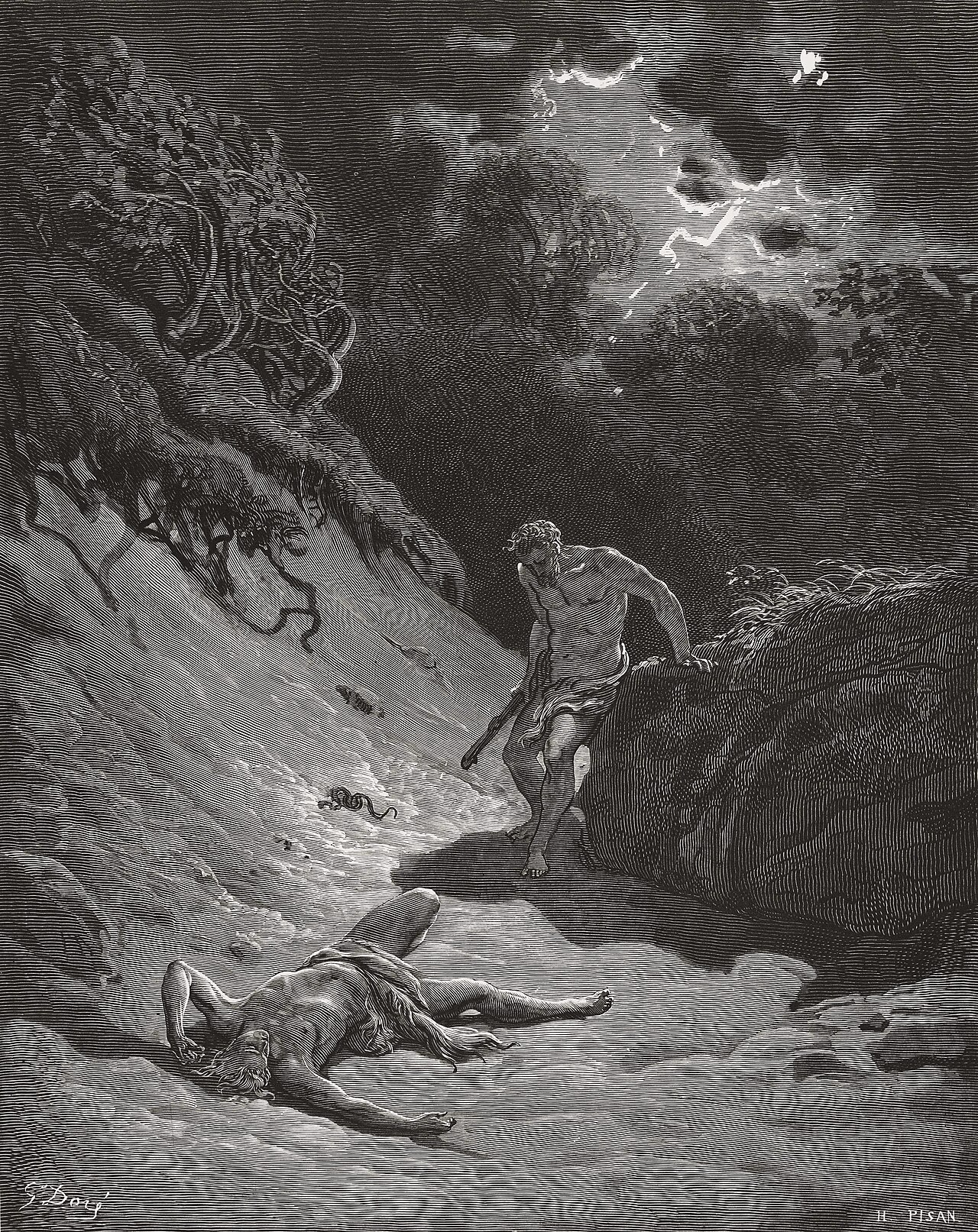
5 verified pieces depicting Adam
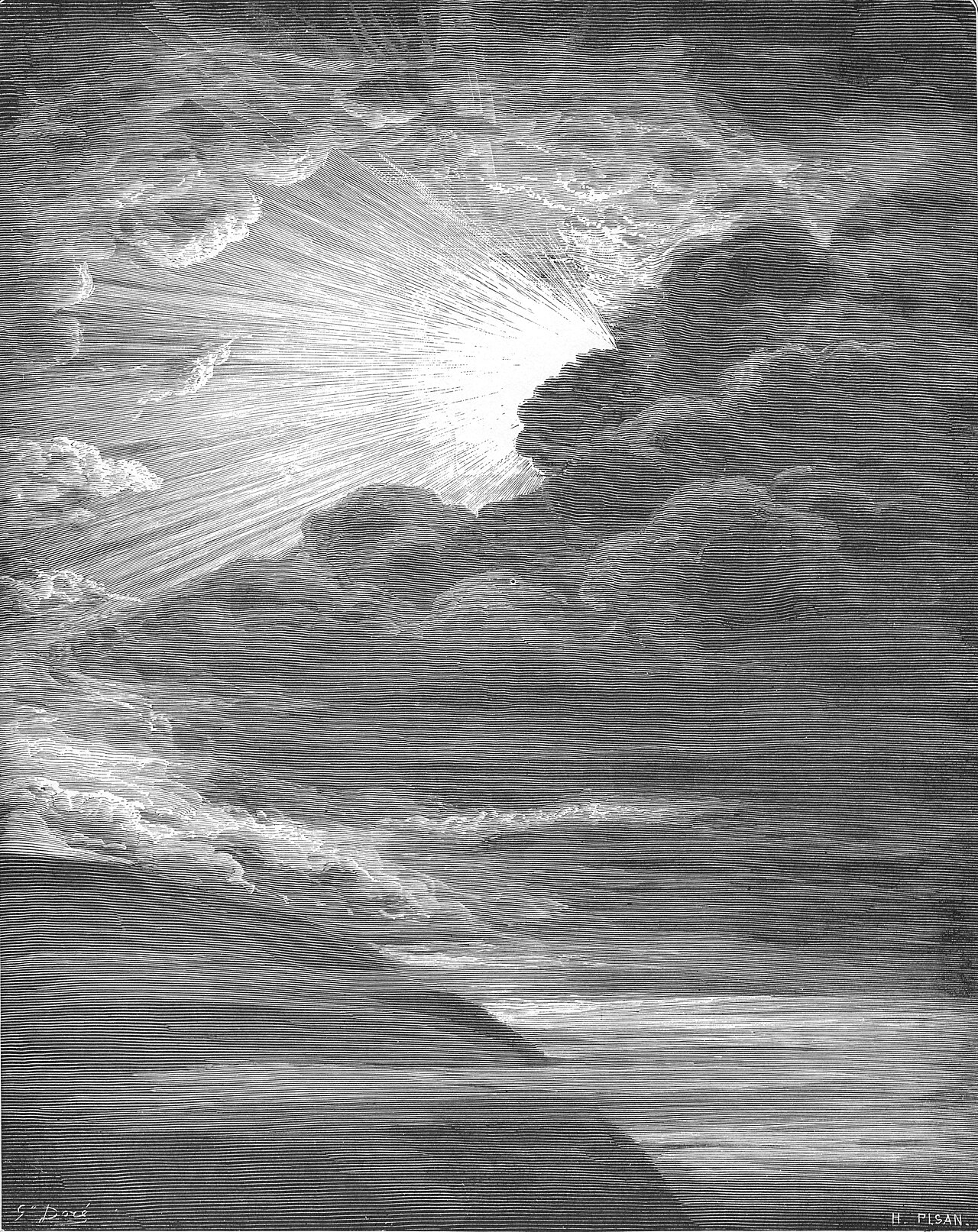
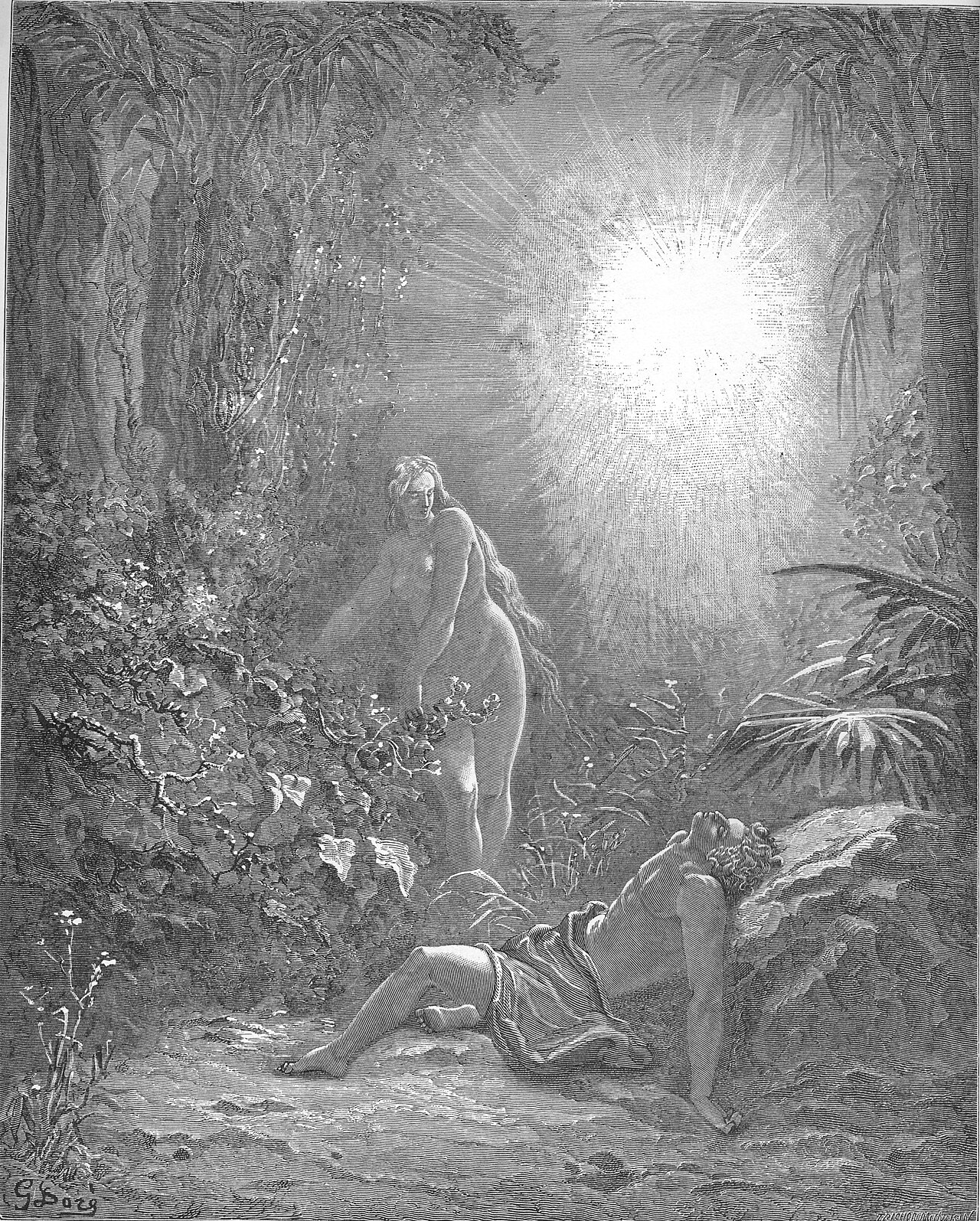
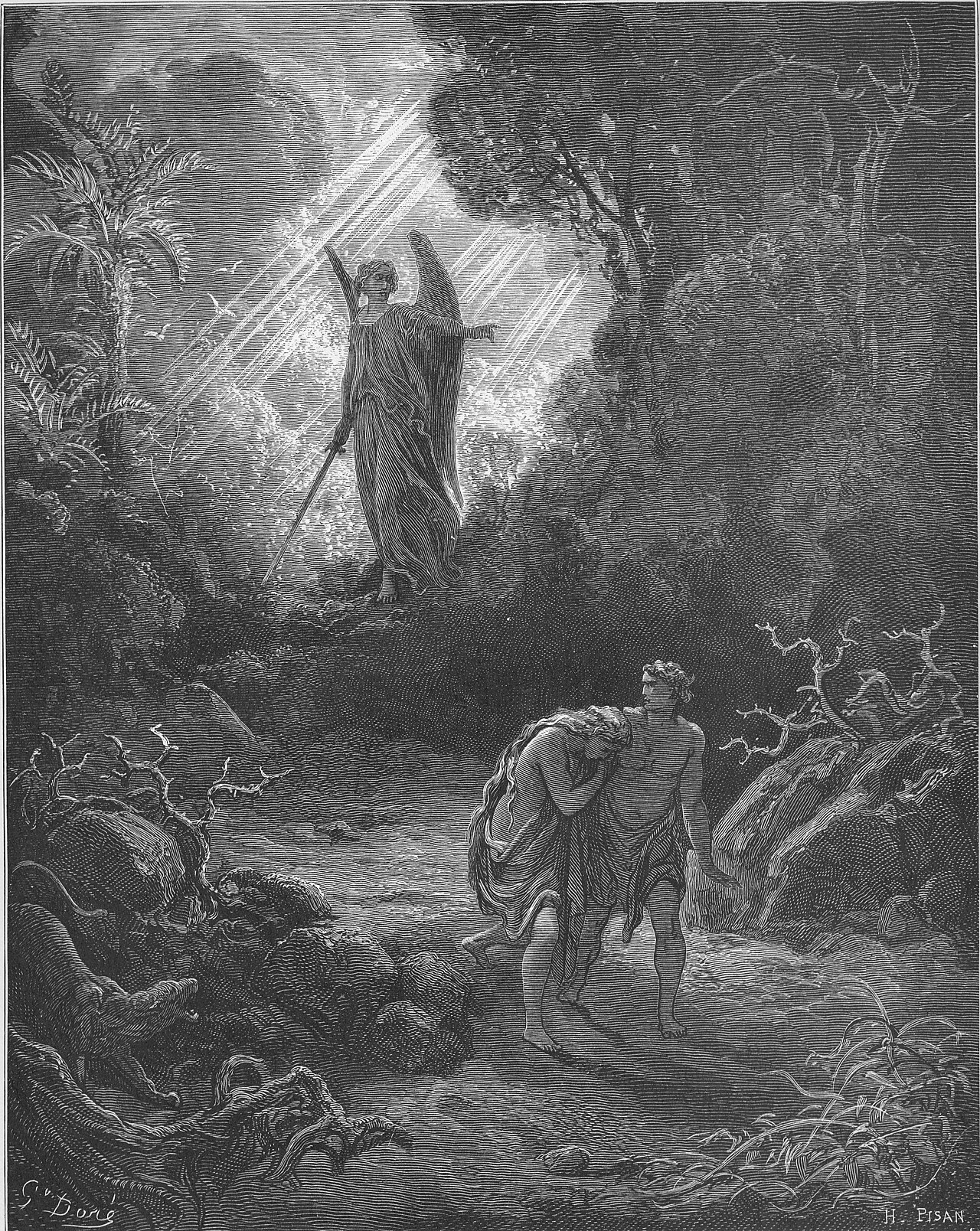
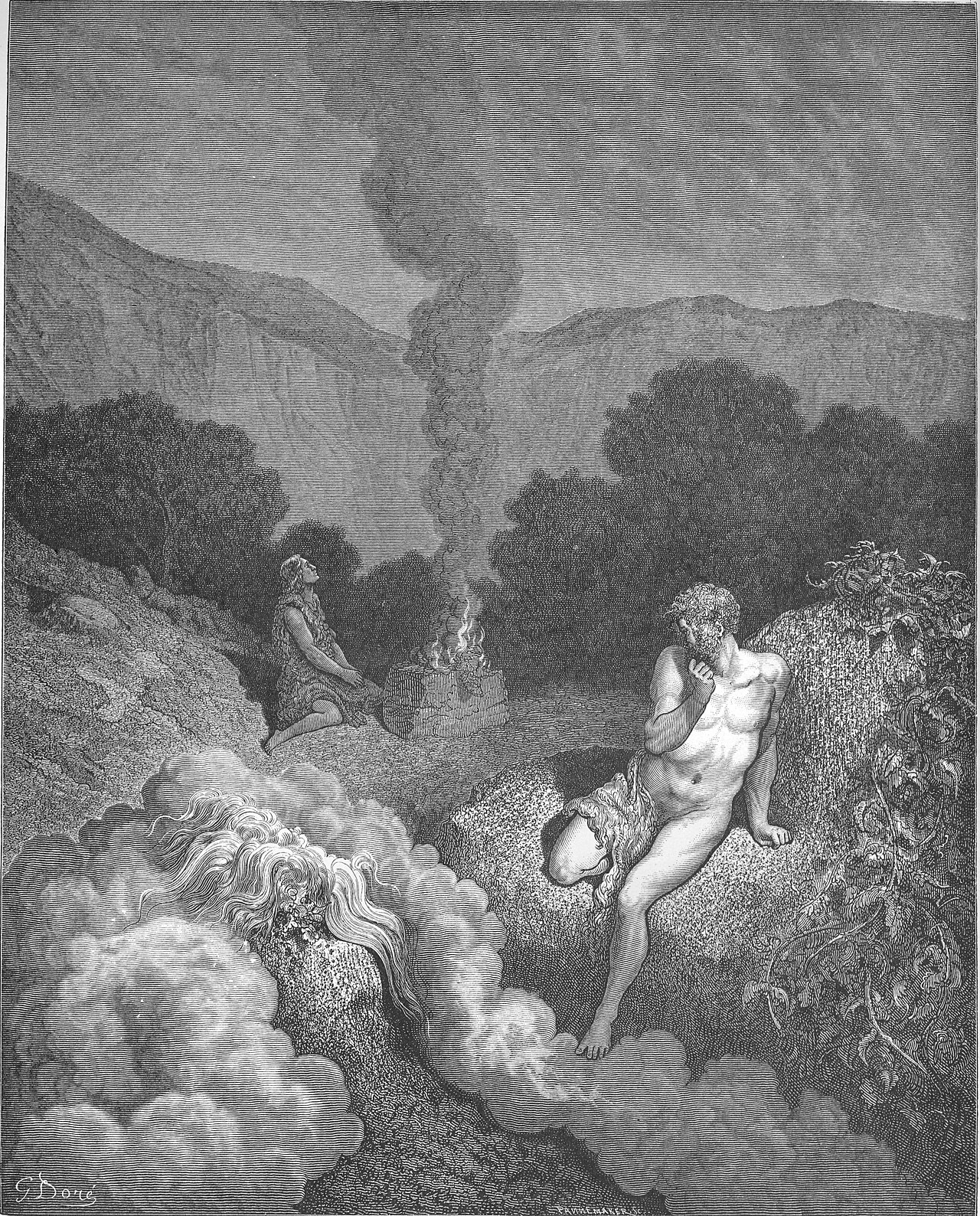
Sources cited
- Berean Standard BibleThe Scripture quoted on this page, byte for byte. Public domain since 2023.
- King James Version with Apocrypha, standardized 1769 text, eBible.org USFX editionThe text of 2 Esdras and the Wisdom of Solomon quoted here. Labeled study resources rather than Scripture. Public domain.
- 1 Enoch, translated by R. H. Charles (SPCK, 1917)The tree of wisdom at 1 Enoch 32:6, named in the question about the fruit. A labeled study resource, not canon. Public domain.
- The early Christian writers cited on this page, in the Ante-Nicene and Nicene and Post-Nicene FathersGregory of Nyssa, Irenaeus, Tertullian, Origen, Jerome, Ambrose, Augustine, Cosmas Indicopleustes, Ephrem the Syrian and Bede. Where a date is printed it is the date of the work and not the author's death year.
- John Wesley, Explanatory Notes upon the Old Testament (1765) and upon the New Testament (1755)Quoted on Genesis 3:24 and 1 Corinthians 15:47, and cited on Genesis 3:21. Public domain.
- Adam Clarke, Commentary on the Bible (1832)Cited on Genesis 2:18, Genesis 3:21 and Hosea 6:7. Public domain.
- Jamieson, Fausset & Brown, Commentary Critical and Explanatory on the Whole Bible (1871)Cited on Genesis 3:21 and on Hosea 6:7, where they argue against the personal reading. Public domain.
- Albert Barnes, Notes, Explanatory and Practical, on the Old and New Testaments (1832-1869)Cited on Hosea 6:7 for the personal reading of the phrase. Public domain.
- Charles H. Spurgeon, The Metropolitan Tabernacle Pulpit, Sermon No. 1326The sermon on Genesis 3:15 quoted here. Public domain, CCEL edition.
- Gustave Doré, La Sainte Bible (Tours: Alfred Mame et fils, 1866)The five engravings on this page. Public domain.
- C. John Collins, Did Adam and Eve Really Exist?The old-earth historical Adam, named with its holders in the first question.
- William Lane Craig, In Quest of the Historical Adam (Eerdmans, 2021)The mytho-historical reading, named with its holder in the first question.
- John H. Walton, The Lost World of Adam and Eve (IVP, 2015)The archetypal reading, named with its holder in the first question.
- The BioLogos FoundationThe evolutionary-creation reading, given in the first question as its holders give it.
- Creation week, on this siteThe day-length readings and the founder's framing of what Genesis was written to do, carried here in the same words.
- The two Adams, on this siteRomans 5:12-21 and 1 Corinthians 15 as facing panels. This page gives the type in short and sends the reader there.
- Sefaria, Babylonian Talmud, Sanhedrin 38bThe teaching that Adam originally spanned the world and was diminished after his sin, read from Deuteronomy 4:32 and Psalm 139:5. Confirmed by search in the 2026-09-02 session 7 re-verification; the Talmud reached its present form between about AD 500 and 600.
Keep studying
On this page
Studies9
On this person
Trails1
Every page that names them1
Books10
Show the next 4 titles
Doorway1
Keep this page