

2 Maccabees 7 · Featured Study · A Labeled Study Resource, Not Canon
The Seven Brothers and Their Mother
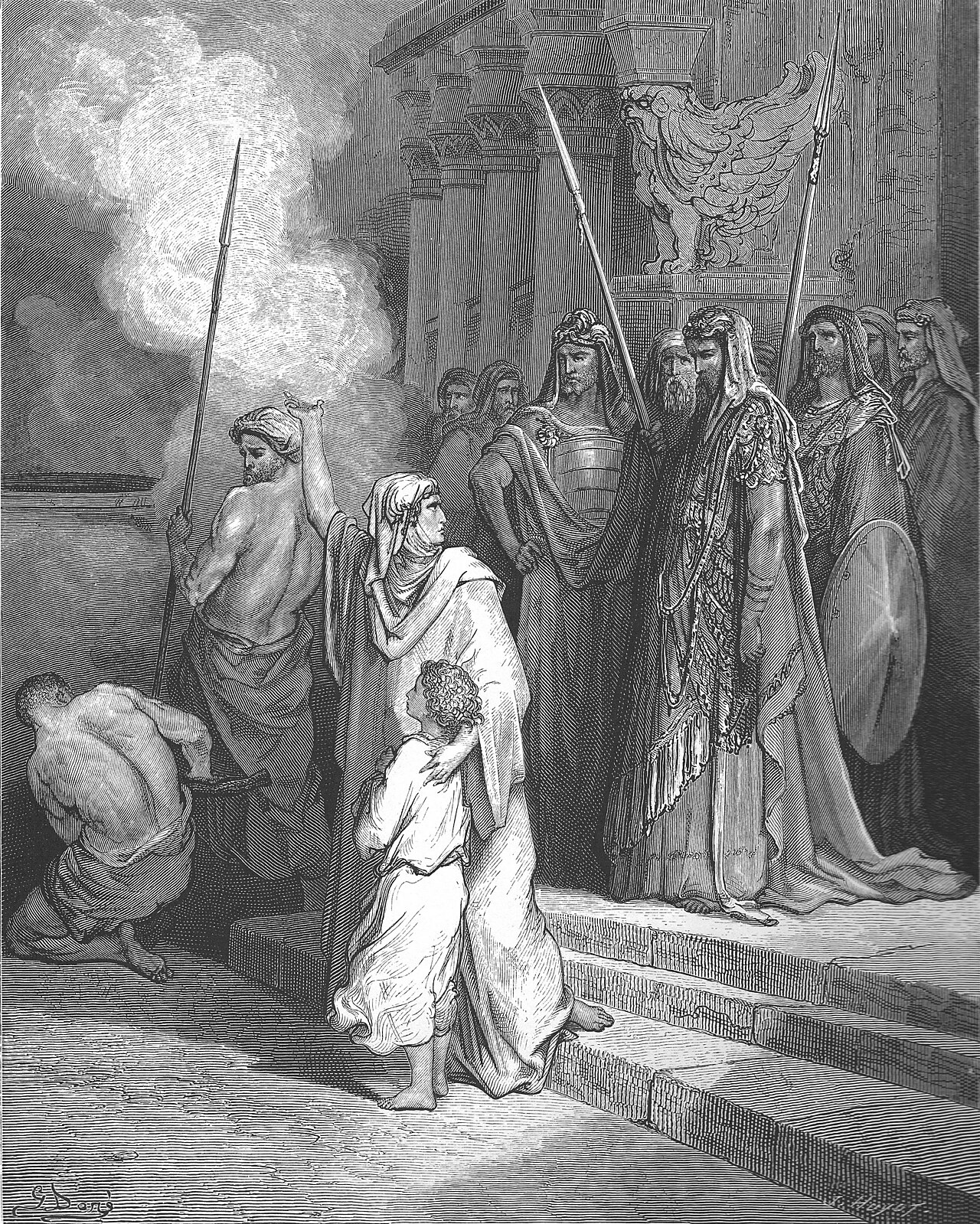
Antiochus’s torturers worked through a family one son at a time, oldest to youngest, while their mother watched — and every son they killed answered the king with the same unbroken confession: the King of the world shall raise us up. Not vague immortality; resurrection — bodies given back “of his own mercy” by the Creator who made all things “of things that were not.” It is the era’s most vivid witness that, more than a century before the empty tomb, ordinary Jewish believers were dying rather than sin, because they were certain death would not keep them. Hebrews remembers them. Jesus stepped into a Judaism their faith had helped to shape. This page tells their story whole, and follows their hope to the morning that proved it.
Gustave Doré, The Courage of a Mother, 1866. Public domain.
Summary
Seven brothers and their mother are tortured to death one at a time under Antiochus, each confessing that the King of the world will raise them up. This page tells their story, connects it to Hebrews 11:35's better resurrection, and follows their hope to Christ's own resurrection.
- Each brother confesses bodily resurrection hope as he is put to death, recorded in 2 Maccabees 7
- The mother's speech states that God made heaven and earth of things that were not, an early statement of creation from nothing
- Commentator Harold Attridge judges that Hebrews 11:35's tortured ones who refused deliverance for a better resurrection alludes to these martyrs
- The church commemorated the Holy Maccabean Martyrs with a feast day from its early centuries, East and West alike
- 2 Maccabees remains a labeled study resource, and the page points their hope toward Christ as the firstfruits of the resurrection
Seven Deaths, One Confession
the resurrection statements of 2 Maccabees 7, verbatim
The chapter opens without ceremony: “seven brethren with their mother were taken, and compelled by the king against the law to taste swine’s flesh, and were tormented with scourges and whips” (7:1). What follows is seven refusals and seven executions — and out of the horror, the clearest ladder of resurrection faith in all the literature between the Testaments:
the second brother
“Thou like a fury takest us out of this present life, but the King of the world shall raise us up, who have died for his laws, unto everlasting life.”
2 Macc 7:9(KJV Apocrypha) — a labeled study resource, not canon
the fourth brother
“It is good, being put to death by men, to look for hope from God to be raised up again by him: as for thee, thou shalt have no resurrection to life.”
2 Macc 7:14(KJV Apocrypha) — a labeled study resource, not canon
the mother, to her sons
“But doubtless the Creator of the world, who formed the generation of man… will also of his own mercy give you breath and life again, as ye now regard not your own selves for his laws’ sake.”
2 Macc 7:23(KJV Apocrypha) — a labeled study resource, not canon
the mother, to her last son
“Fear not this tormentor, but, being worthy of thy brethren, take thy death that I may receive thee again in mercy with thy brethren.”
2 Macc 7:29(KJV Apocrypha) — a labeled study resource, not canon
And inside the mother’s speech, almost in passing, one of the most consequential sentences of the era: God made heaven and earth “of things that were not”(7:28) — the classic early statement of creation from nothing. The logic is her comfort: the God who made bodies out of nothing can certainly give them back.
- 7 + 1martyrs in one chapter
- 7:9“shall raise us up”
- 7:28made “of things that were not”
- Heb 11:35“a better resurrection”
The Epistle That Remembers Them
Hebrews 11:35: the hall of faith's unnamed martyrs
“Women received back their dead, raised to life again. Others were tortured and refused their release, so that they might gain a better resurrection.” Hebrews 11:35 (BSB)
The verse’s first half is Elijah’s and Elisha’s widows — mothers whose sons came back to this life. The second half is a different company: tortured, offered release, refusing it, for a resurrection betterthan resuscitation. The standard judgment of the commentators (Attridge, Hermeneia, at 11:35) is that this points to the martyrs of 2 Maccabees 6–7 — the combination of refused deliverance, torture, and superior-resurrection hope matches them and no one else in the era’s literature. The hall of faith, in other words, keeps a niche for this family — unnamed, but unmistakable.
Their memory never faded: the church commemorated the “Holy Maccabean Martyrs” from its early centuries, East and West alike: one of the few figures from the Apocrypha with a feast day on ancient calendars.
The Firstfruits
where their hope was headed all along
The brothers’ faith did not come from nowhere — the canon had already sounded it: “many of them that sleep in the dust of the earth shall awake” (Dan 12:2); “Thy dead shall live” (Isa 26:19). And it did not go nowhere. By the Gospels, resurrection is the burning public question — Pharisees affirming, Sadducees denying, Jesus adjudicating (Matt 22:23–33). What chapter 7’s martyrs staked their bodies on, God answered in a garden tomb:
“But Christ has indeed been raised from the dead, the firstfruits of those who have fallen asleep.” 1 Corinthians 15:20 (BSB)
2 Maccabees remains a labeled study resource, and the Bible remains the sixty-six books. But when the church reads this chapter, it recognizes its own family likeness: people who would rather die than deny, because they knew the King of the world — and the King of the world, in the fullness of time, walked out of a grave to prove such faith is not wasted, ever.
The Voices on the Martyrs
with the work named
The Epistle to the Hebrews (Hermeneia; Fortress Press, 1989)
The standard critical commentary on Hebrews: attests that 11:35's tortured ones who refused deliverance for “a better resurrection” alludes to the martyrs of 2 Maccabees 6–7, the judgment this page rests on.
Introducing the Apocrypha: Message, Context, and Significance (Baker Academic, 2002)
On 2 Maccabees' theology: its explicit bodily-resurrection hope and its creation-from-nothing statement (7:28) as landmark witnesses to beliefs the Gospels find already in place.
An Introduction to the Apocrypha (Oxford University Press, 1957)
The standard scholarly account of 2 Maccabees' composition and reception: including the martyrs' long liturgical afterlife in both East and West.
The Apocrypha and Pseudepigrapha of the Old Testament, vol. I (Oxford, 1913)
The standard critical edition: 2 Maccabees with introduction and per-chapter notes.
Marcus Brown's own commentary leads above all; within a tier, all voices are equal.
Read the Great Books
the works this study is built on
2 Maccabees 6–7
c. 124–100 BC: a labeled study resource, not canon
Eleazar, then the seven and their mother: the martyrdom chapters whole, in MannaFest’s own reader.
READ IT →Daniel 12 & Hebrews 11
Scripture: read them in MannaFest’s own reader
The canon’s own resurrection dawn, and the hall of faith that keeps the martyrs’ unnamed niche.
READ IT →The Apocrypha and Pseudepigrapha of the Old Testament, vol. I
R. H. Charles, ed. · 1913
The standard critical edition: 2 Maccabees with introduction and notes.
READ IT FREE →Keep studying
Read it5