
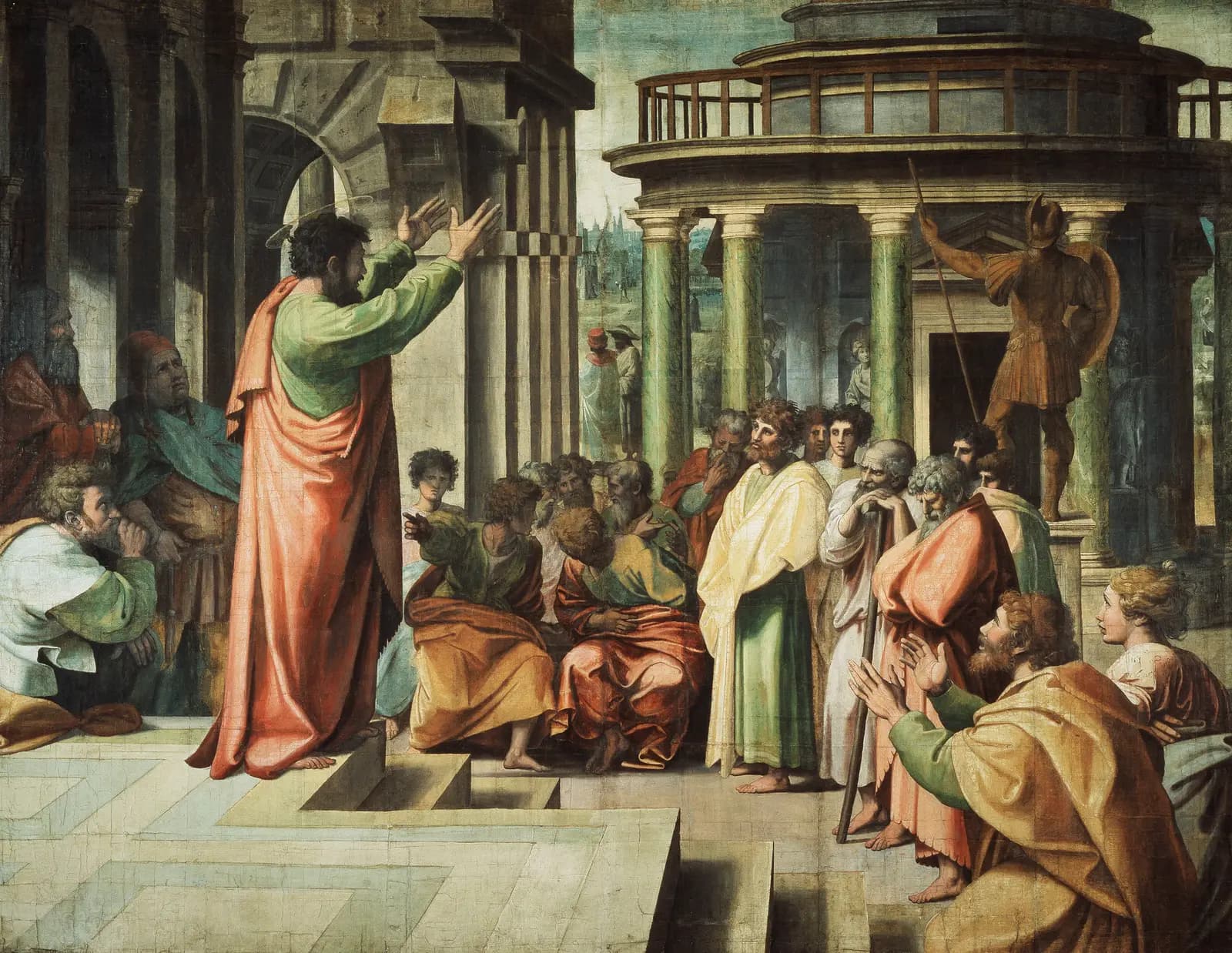
St Paul Preaching at Athens, Raphael, about 1515 to 1516, Royal Collection. Public domain.
New Testament · Book 52 of 66
1 Thessalonians
1 Thessalonians is Paul's letter to the young church in Thessalonica, written soon after he had to leave them. He thanks God for their faith, urges them to live holy lives, and teaches about the Lord's return.
1 Thessalonians is Paul's letter to the young church in Thessalonica, written soon after he had to leave them. He thanks God for their faith, urges them to live holy lives, and teaches about the Lord's return.
What is 1 Thessalonians about?
1 Thessalonians is a letter from Paul, Silvanus and Timothy to a young church Paul had to leave after a short stay. He gives thanks that the believers turned to God from idols (1:9) and now wait for his Son from heaven. He recalls how the missionaries lived among them and rejoices at the good news Timothy brought back. Then he answers a grief: believers who have died will rise first when the Lord comes, and the living will be caught up with them. The letter closes on the day of the Lord and the life of a church that stays awake for it.
All 5 chapters
Every chapter of the book, in one grid. Each cell opens that chapter.
- You turned to GodChapters 1 to 3
- The dead in ChristChapter 4
- The day of the LordChapter 5
The colour is the movement of the letter the chapter stands in, and every cell opens that chapter's Study level.
Who wrote it, where, when, for whom, and why?
The letter opens with three names, Paul, Silvanus and Timothy, writing to the church of the Thessalonians (1:1). Paul speaks alone where he tells of trying again and again to come (2:18) and of sending to learn about their faith (3:5), and at the close he charges the church before the Lord to have the letter read to all the brothers (5:27). Acts names Silas and Timothy with Paul in Berea and has both rejoin him at Corinth (Acts 17:14, 18:5).
I charge you before the Lord to have this letter read to all the brothers.
1 Thessalonians 5:27, Berean Standard Bible.
The letter names Philippi, where the missionaries suffered before they came (2:2), Thessalonica, Macedonia and Achaia (1:7 to 8), and Athens, where Paul stayed on alone (3:1). Acts gives the same road: Philippi, Thessalonica, Berea, Athens and then Corinth (Acts 17:1, 17:10, 17:15, 18:1).
Paul writes just after Timothy has returned from Thessalonica (3:6), a short time after he was torn away from the church (2:17). Acts places that return at Corinth (Acts 18:5), where Paul stayed a year and six months and stood before Gallio, proconsul of Achaia (Acts 18:11 to 12). The letter dates itself by these events and by the weeks since the founding.
The church had turned to God from idols (1:9) and suffered from its own countrymen as the churches in Judea had (2:14). Acts says some of the Jews in the synagogue were persuaded, with a great many God-fearing Greeks and a number of leading women (Acts 17:4).
Paul tried again and again to return, and Satan obstructed him (2:18). He sent Timothy so that none would be shaken by their trials (3:3), and he writes to supply what is lacking in their faith (3:10), to teach them about those who sleep in death so that they will not grieve without hope (4:13), and to remind them about the times and the seasons (5:1).
Sources. 1 Thessalonians 1:1, 1:7 to 9, 2:2, 2:14, 2:17 to 18, 3:1 to 6, 3:10, 4:13, 5:1, 5:27; Acts 17:1 to 15; Acts 18:1 to 12. Every verse is read in the Berean Standard Bible.
How is 1 Thessalonians arranged, and what is it for?
The three movements the letter falls into, then what it teaches and what it was written to do.
- You turned to GodChapters 1 to 3, 43 verses, the turn at 1:9
Thanks for a church that received the word in affliction, Paul's conduct among them, and Timothy's good news.
- The dead in ChristChapter 4, 18 verses, the turn at 4:14
The walk that pleases God, then the hope for believers who have died.
- The day of the LordChapter 5, 28 verses, the turn at 5:9
The day that comes like a thief, the sons of the day, and the short commands for church life.
The theme
The letter is about a young church that turned to God, serves him and waits for his Son. Its faith works, its love labors and its hope endures under suffering, and Paul gives thanks for all three. The hope is the thread through the whole: the Son who delivers from the coming wrath, the dead who will rise first, and the living who will be caught up to be with the Lord. Holiness in the body, love for the brothers, quiet work and watchfulness are how a church lives while it waits.
The purpose
Paul was driven from Thessalonica after a short stay, and Satan obstructed his return (2:18). He writes to a church under pressure to strengthen its faith, to answer what was said about the missionaries, and to supply what was lacking. He teaches the grieving that their dead will share in the coming, tells the watchful how to live before the day of the Lord, and asks that the letter be read to every believer.
Every chapter comes to rest on the coming of the Lord
- 1Chapter 1, 10 verses; the coming at 1:10
“to await His Son from heaven” (1:10)
The church waits for the Son, the deliverer from the coming wrath.
- 2Chapter 2, 20 verses; the coming at 2:19
“in the presence of our Lord Jesus at His coming” (2:19)
The church itself is Paul's joy and crown when the Lord comes.
- 3Chapter 3, 13 verses; the coming at 3:13
“at the coming of our Lord Jesus with all His saints” (3:13)
Hearts established blameless when he comes with his saints.
- 4Chapter 4, 18 verses; the coming at 4:16 to 17
“And so we will always be with the Lord” (4:16 to 17)
The dead rise, the living are caught up, and all are with the Lord.
- 5Chapter 5, 28 verses; the coming at 5:23
“kept blameless at the coming” (5:23)
The whole person, spirit, soul and body, kept for that day.
You turned to God, chapters 1 to 3
What the text says in these 43 verses, and the pages they open on.
Paul, Silvanus and Timothy give thanks for a church whose faith works, whose love labors and whose hope endures (1:3). The gospel came to Thessalonica in power and in the Holy Spirit, and the believers welcomed it with joy in great suffering, until the report of them went out through Macedonia and Achaia (1:5 to 8). Paul then recalls how the missionaries lived in the city: bold after their treatment at Philippi, gentle as a nursing mother, working night and day to be a burden to no one, and urging each believer as a father urges his children (2:1 to 12). The believers received the message as the word of God and suffered from their own countrymen as the churches in Judea had (2:13 to 16). Torn away and hindered from returning, Paul sent Timothy from Athens, and Timothy has come back with good news of their faith and love (3:1 to 6). The movement ends with a prayer that the Lord will establish their hearts blameless at his coming (3:11 to 13).
For they themselves report what kind of welcome you gave us, and how you turned to God from idols to serve the living and true God
- Study
1 Thessalonians 1faith, love and hope, and a church known through Macedonia and AchaiaShow the summary and 2 pagesShow summary, 2 pagesHide the summary
Paul, Silvanus, and Timothy greet the church of the Thessalonians. Paul gives thanks for their work of faith, labour of love, and patience of hope. The gospel came not in word only, but in power and in the Holy Ghost. You turned to God from idols to serve the living and true God, and to wait for his Son from heaven, even Jesus, which delivered us from the wrath to come. Their faith is sounded forth throughout Macedonia and Achaia. Calvin reads the chapter as the apostolic template for Christian growth observable to neighbours.
On this chapter (2)
- The second coming
The coming of the Lord, through the whole Bible.
- 1 Thessalonians 1:9
The verse on its own page, with the commentators on it by era.
- The second coming
- Study
1 Thessalonians 2how the missionaries lived among them, and the word received as God'sShow the summary and 4 pagesShow summary, 4 pagesHide the summary
Paul rehearses the ministry among them. Entrance in boldness after Philippi's shameful treatment, words not of flattery, not of covetousness. Gentle among them as a nurse cherishes her children; then as a father. You are witnesses, how holily and justly and unblameably we behaved ourselves. Paul was taken from them for a short time in presence but not in heart. Satan hindered his return. You are our glory and joy. JFB reads the chapter as the apostle's own pastoral autobiography. One of the New Testament's tenderest.
On this chapter (4)
- Why God is not finished with Israel
The promises to Israel that stand.
- What does 2:14 to 16 say, and how is wrath has come upon them read?
Answered under Where do readers disagree, lower on this page, with each reading and who holds it.
- How do the three Sabbaths of Acts 17:2 stand beside the longer stay the letter implies?
Answered under Where do readers disagree, lower on this page, with each reading and who holds it.
- 1 Thessalonians 2:13
The verse on its own page, with the commentators on it by era.
- Why God is not finished with Israel
- Study
1 Thessalonians 3Timothy sent from Athens and back with good news, and the prayerShow the summary and 2 pagesShow summary, 2 pagesHide the summary
No longer able to forbear, Paul sent Timothy to establish them, that none should be moved by afflictions. Timothy has returned with good news of their faith and charity. Now we live, if you stand firm in the Lord. What thanks can we render to God for you, for all the joy with which we rejoice before God? Paul prays night and day that he may see their face, and perfect that which is lacking in their faith. May the Lord increase their love. Henry reads the chapter as the gospel's relational economy.
On this chapter (2)
- Is this the earliest letter of Paul?
Answered under Where do readers disagree, lower on this page, with each reading and who holds it.
- 1 Thessalonians 3:13
The verse on its own page, with the commentators on it by era.
- Is this the earliest letter of Paul?
The road of the mission, and Timothy's errand
- 1Philippi
Beaten and jailed, the missionaries leave for the next city.
In the letter, 2:2, and in Acts 16:12
- 2Thessalonica
The gospel preached and the church founded.
In the letter, 1:5, and in Acts 17:1
- 3Berea
Sent away by night, they preach in the synagogue there.
In Acts 17:10
- 4Athens
Paul waits alone and sends Timothy back north.
In the letter, 3:1, and in Acts 17:15
- 5Corinth
Paul stays and works; the letter is written after Timothy arrives.
In Acts 18:1
- Timothy, step 1Sent from Athens to Thessalonica (3:1 to 2)
- Timothy, step 2Back to Paul with good news (3:6)
- Timothy, step 3Arrives at Corinth from Macedonia (Acts 18:5)
Characters (5)
Who the text names. A name with a page carries its door.
- Paul
The first of the three senders, who speaks alone when he tried again and again to come (2:18).
- Silvanus
The second sender, the companion Acts calls Silas (1:1).
- Timothy
Sent from Athens to strengthen the church, and back with good news (3:2, 3:6).
- The believers of Thessalonica
An example to all the believers in Macedonia and Achaia (1:7).
Show the next 1
- Those who hindered
The opponents who drove the missionaries out and hindered their preaching to the Gentiles (2:15 to 16).
Places (5)
Where the chapters stand.
- Thessalonica
The city of the church the letter is written to (1:1).
- Philippi
Where the missionaries suffered before they came (2:2).
- Macedonia and Achaia
The two provinces the report of the church reached (1:7 to 8).
- Athens
Where Paul stayed on alone and sent Timothy north (3:1).
Show the next 1
- Judea
Home of the churches whose suffering the Thessalonians shared (2:14).
Themes (4)
What these chapters raise, each on its own page where one stands.
- The word received
The message accepted as the word of God, now at work in those who believe (2:13).
- The labor of love
Faith that works, love that labors, and hope that endures (1:3).
- The church
A church in God the Father and the Lord Jesus Christ (1:1).
- The coming of the Lord
The Son awaited from heaven, named at the close of each chapter (1:10).
Where these chapters take up the Old Testament (2)each marked as a quotation or an allusion, with the evidence
- Probable allusion2:16 with Genesis 15:16
In the fourth generation your descendants will return here, for the iniquity of the Amorites is not yet complete.” (Genesis 15:16)
The opponents heap up their sins to full capacity, as the LORD told Abram the iniquity of the Amorites would be filled before judgment.Held by Robert Jamieson, A. R. Fausset and David Brown, Commentary Critical and Explanatory on the Whole Bible, on 2:16, who set the full measure beside Genesis 15:16 and Matthew 23:32. - Probable allusion3:13 with Zechariah 14:5
You will flee by My mountain valley, for it will extend to Azal. You will flee as you fled from the earthquake in the days of Uzziah king of Judah. Then the LORD my God will come, and all the holy ones with Him. (Zechariah 14:5)
The Lord Jesus comes with all his saints, as Zechariah saw the LORD come with all the holy ones.The Treasury of Scripture Knowledge pairs the two verses, and both name the coming with all the holy ones in the same order.
Acts tells the founding of the church these chapters remember: three Sabbaths in the synagogue, the uproar, and the night departure to Berea. Read Acts 17.
The dead in Christ, chapter 4
What the text says in these 18 verses, and the pages they open on.
Chapter 4 opens the teaching half of the letter. Paul reminds the church how to live in a way that pleases God: holy in the body and honest with a brother, because God calls his people to holiness and gives them his Holy Spirit (4:1 to 8). They already love one another, and he asks them to do so more, to live quietly and to work with their own hands (4:9 to 12). Then he answers a grief. Some in the church had died, and Paul writes so that the living will not grieve like those without hope (4:13). Because Jesus died and rose again, God will bring with him those who have fallen asleep (4:14). The Lord himself will descend, the dead in Christ will rise first, and the living will be caught up together with them to meet the Lord and be with him always (4:16 to 17). Paul tells the church to encourage one another with these words (4:18).
For since we believe that Jesus died and rose again, we also believe that God will bring with Jesus those who have fallen asleep in Him.
- Study
1 Thessalonians 4holiness and the quiet life, then the dead in Christ rising firstShow the summary and 5 pagesShow summary, 5 pagesHide the summary
Paul exhorts them to abound more and more in pleasing God. This is the will of God, even your sanctification, that you abstain from fornication. Study to be quiet, and to do your own business. Concerning them which are asleep. Sorrow not as others who have no hope. The Lord himself shall descend from heaven with a shout, with the voice of the archangel, and with the trump of God; the dead in Christ shall rise first. Then we which are alive and remain shall be caught up together with them in the clouds, to meet the Lord in the air. Calvin reads the chapter as the early church's hope sharpened.
On this chapter (5)
- The rapture
The four readings of when the catching up falls.
- Sanctification
God's will that his people be holy.
- What does caught up mean in 4:17, and where does it stand against the tribulation?
Answered under Where do readers disagree, lower on this page, with each reading and who holds it.
- What is the vessel of 4:4, the body or a wife?
Answered under Where do readers disagree, lower on this page, with each reading and who holds it.
- 1 Thessalonians 4:17
The verse on its own page, with the commentators on it by era.
- The rapture
The order Paul gives in 4:14 to 17
- 1Jesus died and rose
- 2The Lord descends
- 3The call of God
“with a loud command, with the voice of an archangel, and with the trumpet of God” (4:16)
- 4The dead rise first
- 5The living caught up
“caught up together with them in the clouds to meet the Lord in the air” (4:17)
- 6Always with the Lord
Characters (3)
Who the text names. A name with a page carries its door.
- The dead in Christ
Believers who have fallen asleep, who will rise first (4:16).
- The living who remain
Caught up together with them to meet the Lord (4:17).
- The archangel
Whose voice sounds when the Lord descends (4:16).
Places (2)
Where the chapters stand.
- Macedonia
Where the church already shows its love to all the brothers (4:10).
- The clouds and the air
Where the living meet the Lord (4:17).
Themes (4)
What these chapters raise, each on its own page where one stands.
- Sanctification
God's will that his people be holy in the body (4:3).
- The hope for the dead
Grief with hope, because Jesus died and rose again (4:13 to 14).
- The rapture
Caught up together to meet the Lord in the air (4:17).
- The two resurrections
The dead in Christ rising first (4:16).
Where these chapters take up the Old Testament (2)each marked as a quotation or an allusion, with the evidence
- Probable allusion4:7 with Leviticus 11:44
For I am the LORD your God; consecrate yourselves, therefore, and be holy, because I am holy. You must not defile yourselves by any creature that crawls along the ground. (Leviticus 11:44)
God calls his people to holiness, as the law called Israel to be holy because the LORD is holy.The Treasury of Scripture Knowledge pairs the two verses; Paul grounds the call in God himself as Leviticus does. - Probable allusion4:13 with Daniel 12:2
And many who sleep in the dust of the earth will awake, some to everlasting life, but others to shame and everlasting contempt. (Daniel 12:2)
The dead are those who sleep, and they will rise, as Daniel saw those who sleep in the dust awake.The Treasury of Scripture Knowledge pairs the two verses; both speak of the dead as asleep and of a waking to come.
Jesus names the loud trumpet call and the gathering of his elect when the Son of Man comes on the clouds. Read Matthew 24:30 to 31.
The day of the Lord, chapter 5
What the text says in these 28 verses, and the pages they open on.
Paul turns from the coming to its timing. The church knows that the day of the Lord will come like a thief in the night, and sudden destruction will fall on those who say peace and security (5:1 to 3). The believers are sons of the light and of the day, so they are to stay awake and sober, wearing faith and love as a breastplate and the hope of salvation as a helmet (5:4 to 8). God appointed them to salvation through Christ, who died for them so that, awake or asleep, they will live together with him (5:9 to 10). Short commands follow for the life of the church: honor those who lead, live at peace, rejoice, pray, give thanks, keep the Spirit's fire and test every prophecy (5:12 to 22). Paul prays that God will keep them whole, spirit, soul and body, until the coming, and charges that the letter be read to all the brothers (5:23 to 27).
For God has not appointed us to suffer wrath, but to obtain salvation through our Lord Jesus Christ.
- Study
1 Thessalonians 5the thief in the night, the sons of the day, and the closing commandsShow the summary and 4 pagesShow summary, 4 pagesHide the summary
Of the times and the seasons you have no need that I write. The day of the Lord comes like a thief in the night. You, brothers, are not in darkness. You are all the children of light and of the day. Watch and be sober. Comfort yourselves together, and edify one another. Know them which labour among you. Warn them that are unruly, comfort the feebleminded, support the weak. Rejoice evermore; pray without ceasing; in every thing give thanks. Quench not the Spirit; despise not prophesyings. Prove all things. Wesley reads the closing as the compact catechism for a waiting church.
On this chapter (4)
- The day of the Lord
The day the prophets named, and what Paul says of it.
- Prophecy as a gift today
Keep the Spirit's fire, and test what is spoken.
- Does 5:23 teach three parts in man or two?
Answered under Where do readers disagree, lower on this page, with each reading and who holds it.
- 1 Thessalonians 5:23
The verse on its own page, with the commentators on it by era.
- The day of the Lord
Night and day, then 17 commands
Night“we do not belong to the night or to the darkness” (5:5)
Day“you are all sons of the light and sons of the day” (5:5)
Asleep“let us not sleep as the others do” (5:6)
Awake“let us remain awake and sober” (5:6)
Drunk“those who get drunk, get drunk at night” (5:7)
Sober“since we belong to the day, let us be sober” (5:8)
Wrath“not appointed us to suffer wrath” (5:9)
Salvation“to obtain salvation” (5:9)
The commands of 5:12 to 22 (17)
- 1“acknowledge those who work diligently among you” (5:12)
- 2“hold them in highest regard” (5:13)
- 3“Live in peace with one another” (5:13)
- 4“admonish the unruly” (5:14)
- 5“encourage the fainthearted” (5:14)
- 6“help the weak” (5:14)
- 7“be patient with everyone” (5:14)
- 8“no one repays evil for evil” (5:15)
- 9“Always pursue what is good” (5:15)
- 10“Rejoice at all times” (5:16)
- 11“Pray without ceasing” (5:17)
- 12“Give thanks in every circumstance” (5:18)
- 13“Do not extinguish the Spirit” (5:19)
- 14“Do not treat prophecies with contempt” (5:20)
- 15“test all things” (5:21)
- 16“Hold fast to what is good” (5:21)
- 17“Abstain from every form of evil” (5:22)
Characters (3)
Who the text names. A name with a page carries its door.
- Those who labor among you
The leaders the church is to hold in highest regard (5:12 to 13).
- The unruly, the fainthearted, the weak
Each named with what the church owes them (5:14).
- The brothers
Greeted with a holy kiss, and all to hear the letter read (5:26 to 27).
Places (1)
Where the chapters stand.
- Thessalonica
The church charged to have the letter read to all (5:27).
Themes (4)
What these chapters raise, each on its own page where one stands.
- The day of the Lord
The day that comes like a thief in the night (5:2).
- Watchfulness
Awake and sober, as sons of the day (5:6).
- Prophecy as a gift today
Keep the Spirit's fire, and test what is spoken (5:19 to 21).
- Grieving and quenching the Spirit
The command to keep the Spirit's fire burning (5:19).
Where these chapters take up the Old Testament (1)each marked as a quotation or an allusion, with the evidence
- Probable allusion5:8 with Isaiah 59:17
He put on righteousness like a breastplate, and the helmet of salvation on His head; He put on garments of vengeance and wrapped Himself in a cloak of zeal. (Isaiah 59:17)
The believer puts on a breastplate and the helmet of salvation, the armor Isaiah gives to the LORD himself.The Treasury of Scripture Knowledge pairs the two verses, and both name the breastplate and the helmet of salvation.
Jesus tells his disciples to keep watch because the Son of Man comes at an unexpected hour, like a thief. Read Matthew 24:42 to 44.
- Author
- Paul, with Silvanus and Timothy (1:1)
- Date
- c. AD 50–51, from Corinth
- Audience
- The young church at Thessalonica, recently planted (Acts 17)
Where do readers disagree?
One list: the readings with their holders, and what the evidence does not settle.
What does caught up mean in 4:17, and where does it stand against the tribulation?
The Rapture, the four readings in full→- Before the tribulation. Held by John F. Walvoord, The Rapture Question (1957). This is the reading of this site's own tradition, which is premillennial.
- At the middle of the seven years. Held by Gleason L. Archer, in The Rapture: Pre-, Mid-, or Post-Tribulational (1984).
- Before the wrath, after the great tribulation. Held by Marvin Rosenthal, The Pre-Wrath Rapture of the Church (1990).
- At the one coming, after the tribulation. Held by George Eldon Ladd, The Blessed Hope (1956). John Chrysostom, Homily 8 on 1 Thessalonians, reads the meeting as the welcome a city gives its arriving king.
What the evidence does not settle: The passage gives the order of the events (4:16 to 17); where the catching up falls against the tribulation is settled by how other passages are joined to it.
The argument in full
Before the tribulation. God has appointed his people to salvation and away from wrath (5:9), Jesus delivers from the coming wrath (1:10), and 4:13 to 18 is given as comfort, so the catching up comes before the time of wrath begins.
At the middle of the seven years. The trumpet of 4:16 is read with the last trumpet of 1 Corinthians 15:52 and the seventh trumpet of Revelation 11, which sounds at the middle of the week.
Before the wrath, after the great tribulation. The wrath of 5:9 is God's own, and it begins on the day of the Lord, after the signs in the sun and moon that follow the great tribulation (Matthew 24:29).
At the one coming, after the tribulation. The word for meeting the Lord at 4:17 was used of citizens going out to welcome an arriving king and escort him back to the city, so the living meet the Lord as he comes and return with him.
What does 2:14 to 16 say, and how is wrath has come upon them read?
Why God Is Not Finished With Israel→- Paul names the particular persecutors. Held by Jeffrey A. D. Weima, 1-2 Thessalonians, Baker Exegetical Commentary on the New Testament (2014).
- The wrath is spoken as already certain. Held by John Wesley, Explanatory Notes upon the New Testament, on 2:16, who reads the vengeance as having overtaken the persecutors and soon to be completed.
- The passage was added by a later hand. Held by Birger A. Pearson, 1 Thessalonians 2:13 to 16: A Deutero-Pauline Interpolation, Harvard Theological Review 64 (1971).
What the evidence does not settle: Which event, if any, Paul means by the wrath that has come. This site reads the verses as Paul's word on the particular men who persecuted the churches, and sets beside them his settled word that his people are loved on account of the patriarchs and that God's gifts and call are irrevocable (Romans 11:28 to 29).
The argument in full
Paul names the particular persecutors. The comparison runs countryman to countryman: Gentile believers suffered from Gentiles, and the Jewish churches of Judea, held up as the model, suffered from their own people. Paul, a Jew, names the men who drove him from city to city.
The wrath is spoken as already certain. Greek can state a coming judgment as done, and the measure filled up recalls the iniquity of the Amorites in Genesis 15:16.
The passage was added by a later hand. The tone and the finality of 2:16 are read as fitting the years after the fall of Jerusalem in AD 70. Every manuscript carries the verses, and F. F. Bruce, 1 and 2 Thessalonians (1982), defends them as Paul's.
Is this the earliest letter of Paul?
- The earliest letter that survives. Held by Abraham J. Malherbe, The Letters to the Thessalonians, Anchor Bible (2000).
- Galatians came first. Held by F. F. Bruce, The Epistle to the Galatians, New International Greek Testament Commentary (1982).
- 2 Thessalonians came first. Held by Charles A. Wanamaker, The Epistles to the Thessalonians, New International Greek Testament Commentary (1990).
What the evidence does not settle: The date of Galatians and the order of the two letters to Thessalonica, since each letter is dated by the events it names, such as Timothy's return (3:6).
The argument in full
The earliest letter that survives. The letter was written from Corinth soon after Timothy's return (3:6, Acts 18:5), and Gallio's year in Achaia fixes that stay near AD 50 to 51.
Galatians came first. Galatians is read as written before the council of Acts 15, which would place it a year or two before this letter.
2 Thessalonians came first. The persecution in 2 Thessalonians reads as present, and 2 Thessalonians 3:17 sounds like a first letter setting the mark for those to come.
How do the three Sabbaths of Acts 17:2 stand beside the longer stay the letter implies?
- Paul stayed longer than three weeks. Held by Adam Clarke, Commentary on the Bible, on 2:9, who says Paul spent much more time at Thessalonica than is generally supposed.
- Work through the week, preaching on the Sabbath. Held by Albert Barnes, Notes, Explanatory and Practical, 1832 to 1869, on 2:9.
What the evidence does not settle: How long the stay ran after the synagogue phase: Acts counts three Sabbaths in the synagogue (Acts 17:2), and the letter speaks of work night and day (2:9).
The argument in full
Paul stayed longer than three weeks. Paul worked night and day through a steady ministry (2:9), and the Philippians sent help to him in Thessalonica more than once (Philippians 4:16).
Work through the week, preaching on the Sabbath. Paul labored at his trade through the week and preached on the Sabbath, so the Sabbaths Acts counts mark the synagogue preaching inside the stay.
What is the vessel of 4:4, the body or a wife?
Sanctification→- A man's own body. Held by Theophylact of Ohrid in his Commentary on 1 Thessalonians, on 4:4, and by Albert Barnes, Notes, Explanatory and Practical, 1832 to 1869, on 4:4.
- A man's wife. Held by Thomas Aquinas in his Commentary on 1 Thessalonians, on 4:4, and by John Wesley, Explanatory Notes upon the New Testament, on 4:4.
What the evidence does not settle: Which the word means here; John Gill, Exposition of the New Testament (1746 to 1748), says on 4:4 that it is hard to determine, and the practical charge to holiness stands either way.
The argument in full
A man's own body. Paul calls the body an earthen vessel (2 Corinthians 4:7), and the paragraph is about purity in the body throughout.
A man's wife. Peter calls the wife the weaker vessel (1 Peter 3:7), Jewish usage called a wife a vessel, and the verb fits taking a wife in holiness.
Does 5:23 teach three parts in man or two?
- Three: spirit, soul and body. Held by Franz Delitzsch, A System of Biblical Psychology (1855), and read in the three words by Irenaeus, Against Heresies, Book 5.
- Two, with the whole person named. Held by Charles Hodge, Systematic Theology (1872).
What the evidence does not settle: Whether Paul lists parts or piles up words for the whole; the prayer itself asks that the whole person be kept blameless.
The argument in full
Three: spirit, soul and body. Paul names three and prays that each be kept, and Hebrews 4:12 divides soul from spirit.
Two, with the whole person named. Scripture elsewhere names body and soul, or body and spirit, as the whole man, so the three words of 5:23 gather the whole person in one prayer.
The Text and the Spade
- The politarch inscriptions of Macedonia1st century BC to 2nd century AD; the best known block was taken from the Vardar Gate at Thessalonica in 1876 and is now in the British Museum
Acts 17:6 says the mob dragged Jason and others 'before the city officials', and the Greek word Luke uses there is politarch. Critics once cited the title as a magistracy Luke had invented. Something like seventy inscriptions from Macedonia have since turned up using it, several from Thessalonica itself, and the Vardar Gate block lists the politarchs by name. Luke used the correct local title for a free Macedonian city, which is a small thing that says something about the quality of his reporting.
- The Gallio inscription at Delphithe letter of Claudius it copies belongs to AD 51 or 52; the fragments were published by Émile Bourguet in 1905
Four fragments of a stone at Delphi carry a letter of the emperor Claudius that names Lucius Junius Gallio as proconsul of Achaia and is dated by the emperor's twenty-sixth acclamation. Acts 18:12 has Paul brought before Gallio at Corinth, and provincial governors of that rank served one year. The inscription therefore puts Paul in Corinth in AD 51 or thereabouts, and since 1 Thessalonians was written from Corinth after Timothy's return (3:6, Acts 18:5), it dates this letter to AD 50 or 51. It is the single firmest date in the whole Pauline chronology.
- The Via Egnatia through Thessalonicabuilt from 146 BC onward; milestones and paved stretches survive across northern Greece
The great Roman road from the Adriatic to Byzantium ran straight through Thessalonica, and Acts 17:1 traces the mission along it: 'When they had passed through Amphipolis and Apollonia, they came to Thessalonica' (Acts 17:1). Those are staging posts on the Egnatian Way at roughly a day's travel apart. The road also explains 1:8, 'For not only did the message of the Lord ring out from you to Macedonia and Achaia' (1:8), since a church planted on the main highway of the northern empire could be heard about in Achaia within weeks.
- The cults of Roman Thessalonicathe sanctuaries in use through the 1st century AD
Excavation in the city has produced evidence of an Egyptian sanctuary serving Serapis and Isis, of the local mystery deity Cabirus, and of honors paid to Rome and the emperor, including coins that give divine titles to the imperial house. That is the setting behind 1:9, where the converts 'turned to God from idols to serve the living and true God' (1:9). It also sharpens Acts 17:7, where the charge against the missionaries was that they were 'defying Caesar’s decrees, saying that there is another king, named Jesus' (Acts 17:7). In a city with that much invested in imperial favor, announcing another king was a civic problem before it was a religious one.
The pages 1 Thessalonians opens on
Studies35
- The Rapture
- The Second Coming
- The Day of the Lord
- Sanctification
- Why God Is Not Finished With Israel
- Prophecy as a Gift Today
Show the next 6 titles
Words6
Books beside it5
Sources for this page
The painting in the band is St Paul Preaching at Athens, Raphael, about 1515 to 1516, Royal Collection. Public domain. The movements, the chapter entries, the figures and the Context are read off the text of 1 Thessalonians and Acts 16 to 18. The works behind the readings under Where do readers disagree are John Chrysostom, Homilies on 1 Thessalonians; Theophylact of Ohrid, Commentary on 1 Thessalonians; Thomas Aquinas, Commentary on 1 Thessalonians; Irenaeus, Against Heresies; John Gill, Exposition of the New Testament (1746 to 1748); John Wesley, Explanatory Notes upon the New Testament (1755); Adam Clarke, Commentary on the Bible (1832); Albert Barnes, Notes, Explanatory and Practical (1832 to 1869); Robert Jamieson, A. R. Fausset and David Brown, Commentary Critical and Explanatory on the Whole Bible (1871); Franz Delitzsch, A System of Biblical Psychology (1855); Charles Hodge, Systematic Theology (1872); George Eldon Ladd, The Blessed Hope (1956); John F. Walvoord, The Rapture Question (1957); Birger A. Pearson in the Harvard Theological Review 64 (1971); F. F. Bruce, 1 and 2 Thessalonians (1982) and The Epistle to the Galatians (1982); Gleason L. Archer in The Rapture: Pre-, Mid-, or Post-Tribulational (1984); Charles A. Wanamaker, The Epistles to the Thessalonians (1990); Marvin Rosenthal, The Pre-Wrath Rapture of the Church (1990); Abraham J. Malherbe, The Letters to the Thessalonians (2000); and Jeffrey A. D. Weima, 1-2 Thessalonians (2014). The Old Testament pairs are those of the Treasury of Scripture Knowledge held in the store. Every verse quoted on this page is the Berean Standard Bible, read from the store.