
Galatia
Summary
The region and Roman province of central Asia Minor to whose churches Paul wrote his most urgent letter, whether to the ethnic north or to the provincial south of Acts 13 and 14.
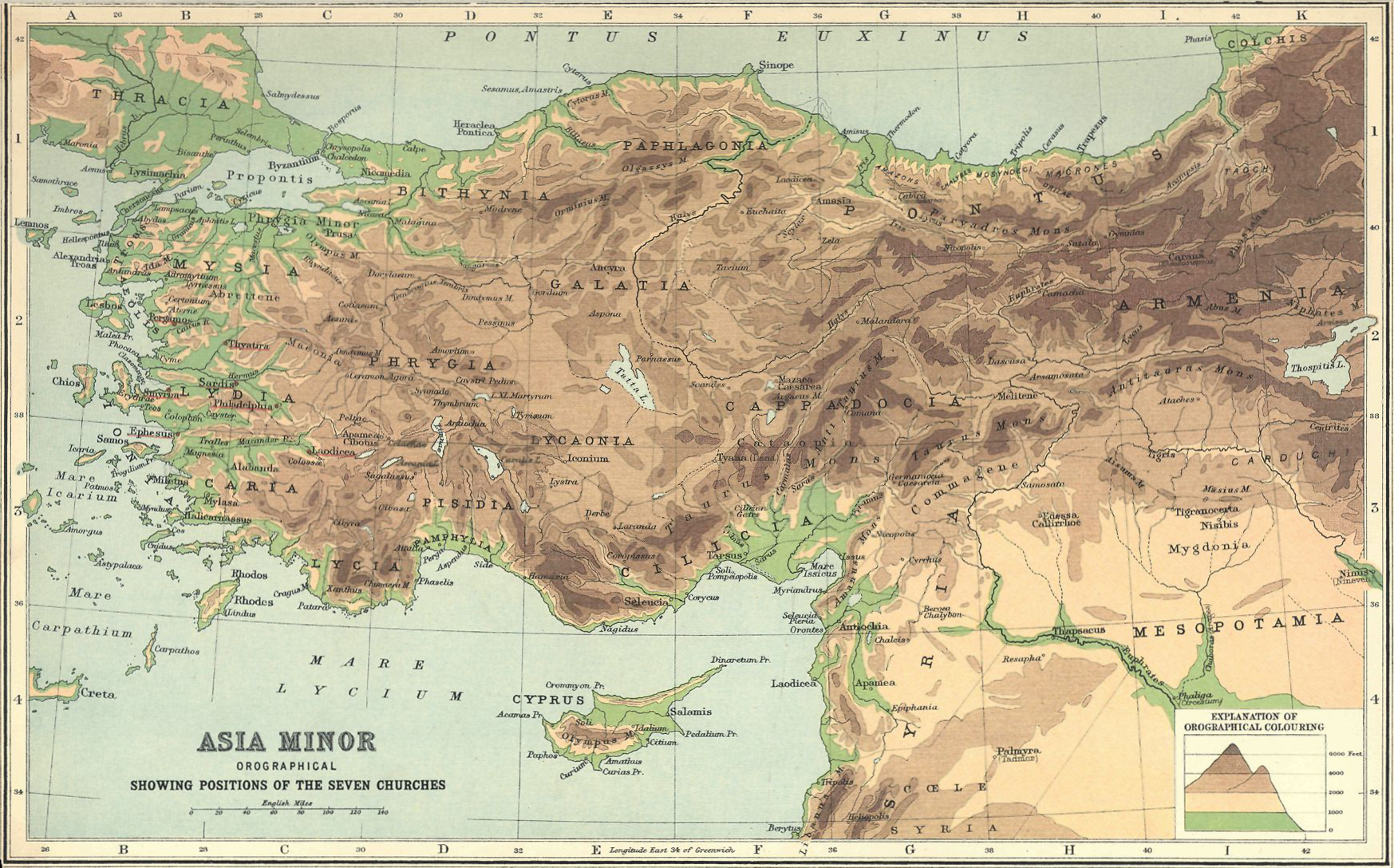
- Galatia was a region and a Roman province in central Asia Minor, never a single city, spanning both an old ethnic Gaulish north and a southern stretch that reached the cities of Acts 13 and 14.
- On the first missionary journey Paul and Barnabas preached through Pisidian Antioch, Iconium, Lystra and Derbe, and were driven out of more than one of them.
- At Lystra a crowd tried to worship them as gods after a healing, then a mob from Antioch and Iconium stoned Paul and left him for dead.
- Paul's letter to the Galatians answers a crisis over the law with unusual heat, reminding them how eagerly they had first received him despite an illness.
- Later New Testament writers keep naming Galatia: its churches gave to the Jerusalem collection, Crescens went there, and Peter addressed his letter partly to its exiles.
On this page
In Scripture
- Verses
- 6
- Books
- 5
Where it is
- Region
- Central Asia Minor
- Kind of place
- Region
Why Galatia matters
The first missionary journey through Galatia
Acts 13:14 to 14:23, in the order it happens
Read Acts 13:14 to 14:23, in the order it happens
- Paul and Barnabas reach Pisidian AntiochActs 13:14And from Perga, they traveled inland to Pisidian Antioch, where they entered the synagogue on the Sabbath and sat down.
- Turning to the GentilesActs 13:46Then Paul and Barnabas answered them boldly: “It was necessary to speak the word of God to you first. But since you reject it and do not consider yourselves worthy of eternal life, we now turn to the Gentiles.
- Driven out, they shake the dust off their feetActs 13:51So they shook the dust off their feet in protest against them and went to Iconium.
- At Lystra, a man lame from birth is healedActs 14:10In a loud voice Paul called out, “Stand up on your feet!” And the man jumped up and began to walk.
- The crowd tries to worship them as godsActs 14:11When the crowds saw what Paul had done, they lifted up their voices in the Lycaonian language: “The gods have come down to us in human form!”
- Paul and Barnabas insist they are only menActs 14:15“Men, why are you doing this? We too are only men, human like you. We are bringing you good news that you should turn from these worthless things to the living God, who made heaven and earth and sea and everything in them.
- Paul is stoned and dragged out of the cityActs 14:19Then some Jews arrived from Antioch and Iconium and won over the crowds. They stoned Paul and dragged him outside the city, presuming he was dead.
- Elders appointed in every church on the way homeActs 14:23Paul and Barnabas appointed elders for them in each church, praying and fasting as they entrusted them to the Lord, in whom they had believed.
What happened here, in order
in the order the canon tells it
- At Iconium, a great number believeActs 14:1At Iconium, Paul and Barnabas went as usual into the Jewish synagogue, where they spoke so well that a great number of Jews and Greeks believed.
- A man crippled from birth sits at LystraActs 14:8In Lystra there sat a man crippled in his feet, who was lame from birth and had never walked.
- Derbe reached, then the road retracedActs 14:21They preached the gospel to that city and made many disciples. Then they returned to Lystra, Iconium, and Antioch,
- Paul passes through Phrygia and Galatia on the second journeyActs 16:6After the Holy Spirit had prevented them from speaking the word in the province of Asia, they traveled through the region of Phrygia and Galatia.
- Paul strengthens the disciples of Galatia on the third journeyActs 18:23After Paul had spent some time in Antioch, he traveled from place to place throughout the region of Galatia and Phrygia, strengthening all the disciples.
- The letter addressed to the churches of GalatiaGalatians 1:2and all the brothers with me, To the churches of Galatia:
- Who has bewitched you?Galatians 3:1O foolish Galatians! Who has bewitched you? Before your very eyes Jesus Christ was clearly portrayed as crucified.
- An illness first brought Paul to preach among themGalatians 4:13You know that it was because of an illness that I first preached the gospel to you.
- You would have torn out your eyes for meGalatians 4:15What then has become of your blessing? For I can testify that, if it were possible, you would have torn out your eyes and given them to me.
- The collection modeled on Galatia's churches1 Corinthians 16:1Now about the collection for the saints, you are to do as I directed the churches of Galatia:
- Crescens has gone to Galatia2 Timothy 4:10because Demas, in his love of this world, has deserted me and gone to Thessalonica. Crescens has gone to Galatia, and Titus to Dalmatia.
- Peter addresses the exiles scattered through Galatia1 Peter 1:1Peter, an apostle of Jesus Christ, To the elect who are exiles of the Dispersion throughout Pontus, Galatia, Cappadocia, Asia, and Bithynia, chosen
The voices
each quoted from the work named
And all the brethren which are with me - It is very likely that this refers to those who were his assistants in preaching the Gospel, and not to any private members of the Church. Churches of Galatia - Galatia was a region or province of Asia Minor; there was neither city nor town of this name. See the preface. But as, in this province, St. Paul had planted several Churches, he directs the epistle to the whole of them; for it seems they were all pretty nearly in the same state, and needed the same instructions.
WITH very great enthusiasm the Galatians received the Gospel when Paul preached it to them. They seem to have been a very warm-hearted but fickle people and Paul found to his great grief that while he was away from them, certain false teachers came in and turned them aside from the Gospel which he had delivered to them. He spoke out very plainly about the matter. In this verse he uses very strong terms, while he says to them—"O foolish Galatians, who has bewitched you, that you should not obey the truth?"
Here he shows perplexity and amazement, and desires to learn of themselves the reason of their change. Who, says he, hath deceived you, and caused a difference in your disposition towards me? Are ye not the same who attended and ministered to me, counting me more precious than your own eyes? what then has happened? whence this dislike? whence this suspicion? Is it because I have told you the truth? You ought on this very account to pay me increased honor and attention; instead of which "I am become your enemy, because I tell you the truth,"-for I can find no other reason but this. Observe too what humbleness of mind appears in his defence of himself; he proves not by his conduct to them, but by theirs to him that his language could not possibly have proceeded from unkind feeling. For he says not; How is it supposable that one, who has been scourged and driven about, and ill-treated a thousand things for your sakes, should now have schemes against you? But he argues from what they had reason to boast of, saying, How can one who has been honored by you, and received as an Angel, repay you by conduct the very opposite?
1 more teacher on these versesAdam Clarke
They came to Antioch in Pisidia - This place is mentioned thus to distinguish it from Antioch in Syria, with which it had nothing in common but the name. There were several cities and towns in various districts of these countries called Antioch: some have reckoned up not less than twelve. Pisidia, in which this was situated, was a province of Asia Minor, near to Pamphylia, having Phrygia on the north, and Pamphylia on the south.
Galatia in Scripture
6 verses name it, in 5 books
Open a book to read its mentions here. Text: Berean Standard Bible.
Old TestamentNew Testamentsegment width = share of mentions
New Testament5 books · 6 mentions
Acts2 mentions
- Acts 16:6After the Holy Spirit had prevented them from speaking the word in the province of Asia, they traveled through the region of Phrygia and Galatia.
- Acts 18:23After Paul had spent some time in Antioch, he traveled from place to place throughout the region of Galatia and Phrygia, strengthening all the disciples.
1 Corinthians1 mention
Galatians1 mention
2 Timothy1 mention
Common questions
Was Galatia a city, or something else?
Galatia was never a city. It was a region of central Asia Minor, named for the Gauls who settled its northern part centuries before Paul, and later a Roman province built on top of that region and reaching further south than the old ethnic territory did.
Adam Clarke's note on Galatians 1:2 states the point plainly: there was neither city nor town of this name, and Paul's letter addresses every church he had planted across the whole province rather than one congregation in one town.
What happened to Paul and Barnabas at Lystra?
Paul healed a man who had been lame from birth, and the watching crowd concluded that the gods themselves had come down in human form. They called Barnabas Zeus and Paul Hermes, and the local priest of Zeus prepared to offer sacrifice to them.
Paul and Barnabas tore their own clothes in protest and rushed into the crowd insisting they were only men. Days later, in the same city, a mob stirred up by Jews from Antioch and Iconium stoned Paul and left him for dead outside the walls, and he got up and went back into the city before leaving the next day for Derbe.
Why does Paul call the Galatians foolish, and is that harsh?
Paul's question, "who has bewitched you," comes after he reminds them how eagerly they had first received him, as though he were an angel of God or Christ Jesus Himself, despite an illness that first brought him to preach among them. The rebuke reads as grief over a real relationship rather than cold argument.
John Chrysostom's homily on the letter reads Paul's tone this way directly: Paul argues not from what he has suffered for them, but from what they once did for him, asking how people who once honored him as an angel could now turn against the very message that first won them.
Does "Galatia" in Paul's letters mean the same churches Acts 13 and 14 describe?
Readers differ; the positions are named
This is a real geography question, and this site's own sources do not settle it with named holders on each side. Galatia named both an old ethnic region in the north, around Ancyra, Pessinus and Tavium, and a larger Roman province that also took in the southern cities of the first journey: Pisidian Antioch, Iconium, Lystra and Derbe.
The question has long-named holders on each side. J.B. Lightfoot argued Paul wrote to the old ethnic region in the north, the North Galatia theory; W.M. Ramsay, drawing on his own survey of central Asia Minor, argued Paul wrote to the southern cities of the first journey, the South Galatia theory. Jamieson, Fausset and Brown's note on Acts 16:6 reads the churches of Galatia named in Galatians and 1 Corinthians as founded on the first journey, which points toward the southern cities. This page states the geography plainly rather than adjudicating between the two.
What was the illness that first brought Paul to preach in Galatia?
Readers differ; the positions are named
Paul says only that it was because of an illness that he first preached the gospel to them, and that despite it they did not despise or reject him. He does not name the illness anywhere in the letter.
His remark that they would have torn out their own eyes and given them to him has led some readers to guess at an eye ailment, but this is inference from that one line rather than something the text states. This page names what Galatians 4:13-15 actually says and does not assign a diagnosis beyond it.
Sources cited
- Berean Standard Bible (2023)Every verse quoted on this page, from the site's own verse store. Public domain.
- Adam Clarke, Commentary on the Bible (1832)Acts 13:14, the two Antiochs distinguished; Galatians 1:2, Galatia as a region and not a city. Public domain.
- Albert Barnes, Notes, Explanatory and Practical, on the Old and New Testaments (1832-1869)Acts 16:6, the Gaulish settlement of Galatia, referenced in why_it_matters. Public domain.
- Jamieson, Fausset & Brown, Commentary Critical and Explanatory on the Whole Bible (1871)Acts 16:6, reading the churches of Galatia as founded on the first journey, referenced in the common questions. Public domain.
- John Chrysostom, Homily on Galatians 4 (407)Galatians 4:15, Paul's tone read as grief rather than argument. Public domain.
- Charles Spurgeon, The Metropolitan Tabernacle Pulpit, Sermon No. 1546, "Men Bewitched" (1880)Galatians 3:1. Public domain, CCEL edition.
- Catholic Encyclopedia (1913), "Epistle to the Galatians"Names Lightfoot as chief holder of the North Galatia theory and Ramsay of the South Galatia theory, used in the common_questions entry on the geography question. Public domain.
- Textual Variants: 1 & 2 Timothy, Philemon (bible.ovu.edu, citing UBS4)2 Timothy 4:10, the Gaul/Galatia manuscript variant and the UBS4 "B" rating for Galatia, referenced in why_it_matters.
Keep studying
On this page
Studies4
Books that name it5
Lives that run through it1
Doorway2
Keep this page