
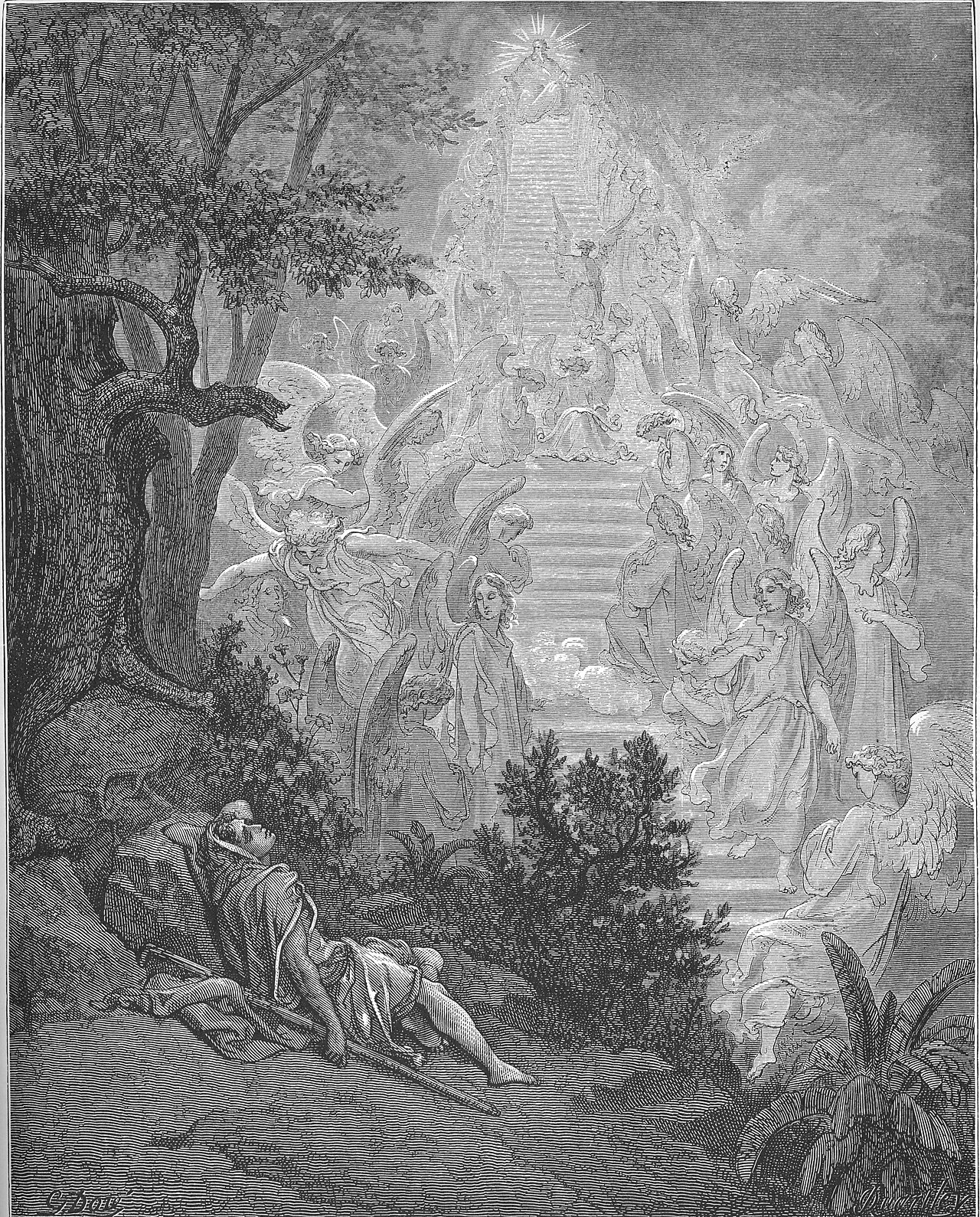
Patriarch
Jacob
Israel, Prince with God · Patriarchal · c. 2006-1859 BC
Gustave Doré, La Sainte Bible (Tours: Alfred Mame et fils, 1866). Public domain, via Wikimedia Commons.
Summary
Jacob was a supplanter transformed by grace into Israel, prince with God. His twelve sons became the twelve tribes of Israel, and despite his deceptions, God chose him to carry the covenant promises.
- Jacob bought his brother's birthright for a bowl of stew and then took his blessing by lying to a blind father.
- God met him on the first night of his flight, at Bethel, and promised him land, descendants and company on the road without asking anything in return.
- Twenty years under Laban paid him back in his own coin: he was given the wrong sister in the dark, as he had passed himself off as the wrong brother in the dark.
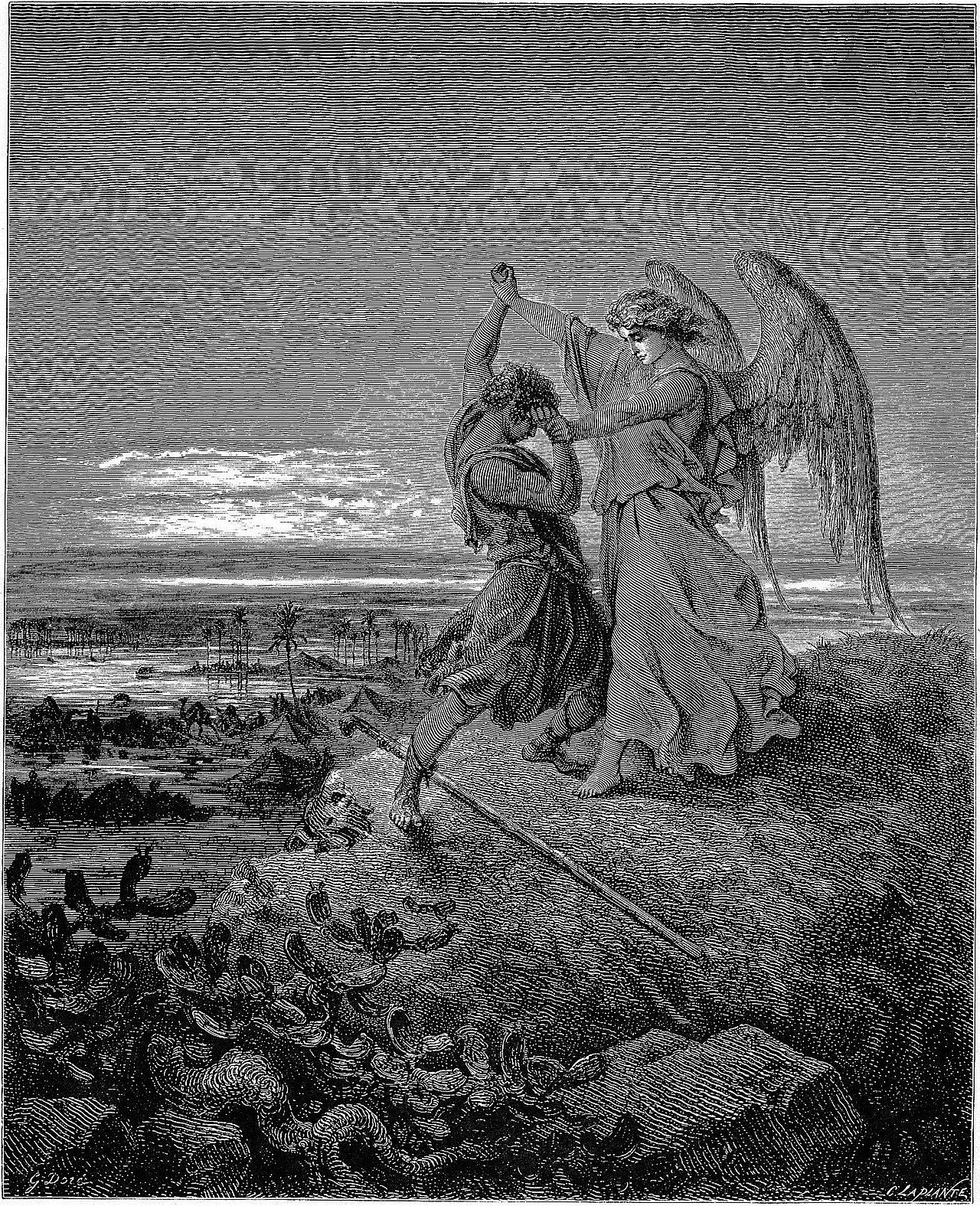
- A man wrestled him at the ford of the Jabbok, struck his hip out of joint, and named him Israel. He limped for the rest of his life.
- His twelve sons became the twelve tribes, and his blessing over Judah in Genesis 49:10 is the verse the scepter and Shiloh question turns on.
On this page
Start here
Look, I am with you, and I will watch over you wherever you go, and I will bring you back to this land. For I will not leave you until I have done what I have promised you.”
Genesis 28:15→- 6 key events in order
- 375 verses name Jacob, across 29 books
In Scripture
- Verses
- 375
- Books
- 29
Jacob
- Role
- Israel, Prince with God
- Era
- Patriarchal
- Dates
- c. 2006-1859 BC
- Tribe
- Hebrew
- Father
- Isaac
- Mother
- Rebekah
- Spouse
- Leah, Rachel
- Children
- Reuben, Simeon, Levi, Judah…
The life in order
in the order the canon tells it
- Two nations in the womb, and the older will serve the youngerGenesis 25:23and He declared to her: “Two nations are in your womb, and two peoples from within you will be separated; one people will be stronger than the other, and the older will serve the younger.”
- Born second, holding his brother's heelGenesis 25:26After this, his brother came out grasping Esau’s heel; so he was named Jacob. And Isaac was sixty years old when the twins were born.
- Esau swears, and sells him the birthrightGenesis 25:33“Swear to me first,” Jacob said. So Esau swore to Jacob and sold him the birthright.
- Isaac learns the blessing was taken by deceitGenesis 27:35But Isaac replied, “Your brother came deceitfully and took your blessing.”
- Esau resolves to kill him, and he runs for HaranGenesis 27:41Esau held a grudge against Jacob because of the blessing his father had given him. And Esau said in his heart, “The days of mourning for my father are at hand; then I will kill my brother Jacob.”
- Laban gives him Leah in the darkGenesis 29:25When morning came, there was Leah! “What have you done to me?” Jacob said to Laban. “Wasn’t it for Rachel that I served you? Why have you deceived me?”
- Leah bears Judah, and the line to Christ runs through herGenesis 29:35And once more she conceived and gave birth to a son and said, “This time I will praise the LORD.” So she named him Judah. Then Leah stopped having children.
- Rachel bears JosephGenesis 30:24She named him Joseph, and said, “May the LORD add to me another son.”
- Twenty years served, and wages changed ten timesGenesis 31:41Thus for twenty years I have served in your household—fourteen years for your two daughters and six years for your flocks—and you have changed my wages ten times!
- Left alone at the ford, a man wrestles him until daybreakGenesis 32:24So Jacob was left all alone, and there a man wrestled with him until daybreak.
- Peniel: the name Israel, and a hip out of jointGenesis 32:28Then the man said, “Your name will no longer be Jacob, but Israel, because you have struggled with God and with men, and you have prevailed.”
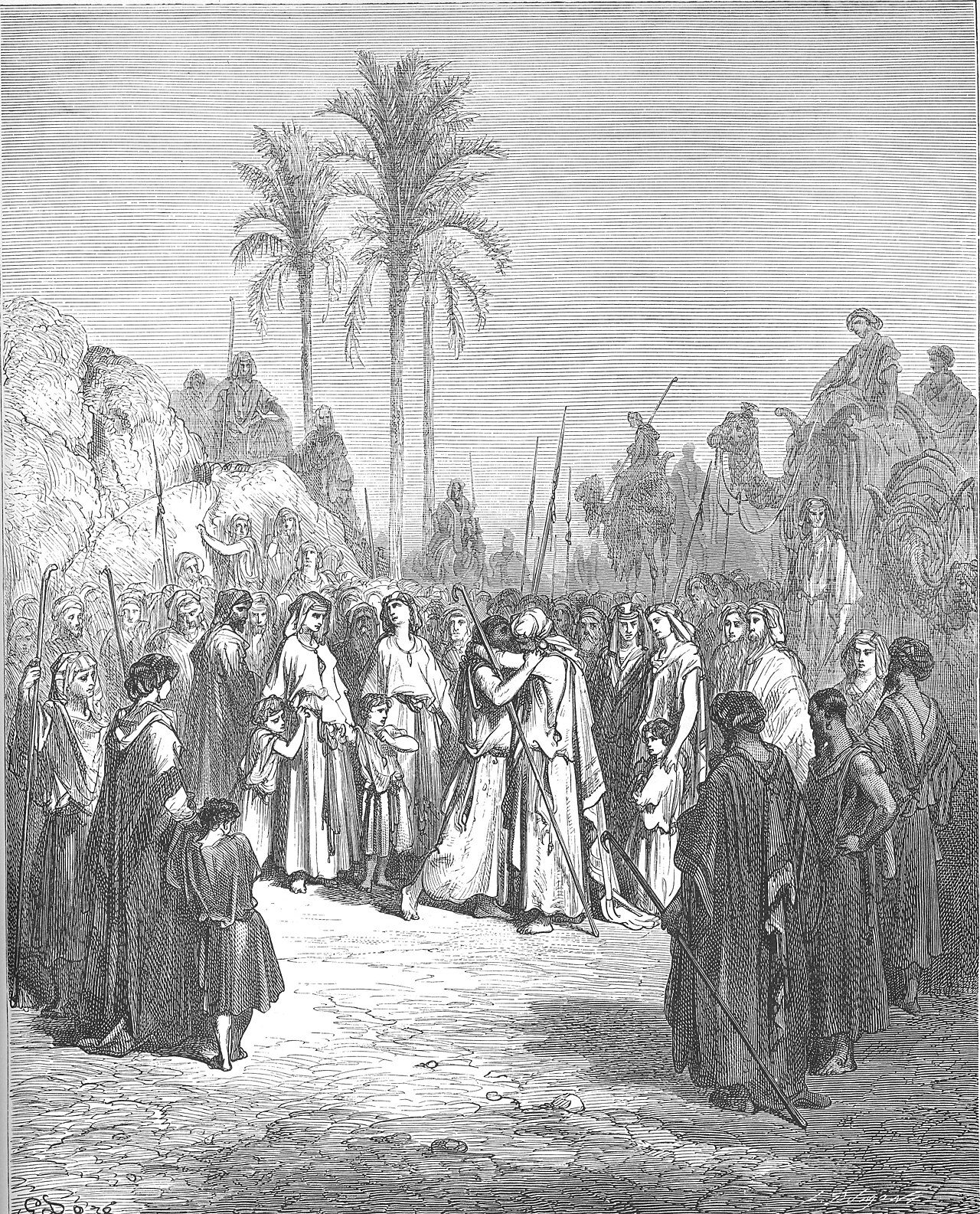
- Esau runs to meet him, and they both weepGenesis 33:4Esau, however, ran to him and embraced him, threw his arms around his neck, and kissed him. And they both wept.
- Simeon and Levi kill the men of Shechem after Dinah is rapedGenesis 34:25Three days later, while they were still in pain, two of Jacob’s sons (Dinah’s brothers Simeon and Levi) took their swords, went into the unsuspecting city, and slaughtered every male.
- Rachel dies on the road to EphrathGenesis 35:19So Rachel died and was buried on the way to Ephrath (that is, Bethlehem).
- He mourns Joseph and refuses to be comfortedGenesis 37:34Then Jacob tore his clothes, put sackcloth around his waist, and mourned for his son many days.
- Joseph is alive, and he will go to see himGenesis 45:28“Enough!” declared Israel. “My son Joseph is still alive! I will go to see him before I die.”
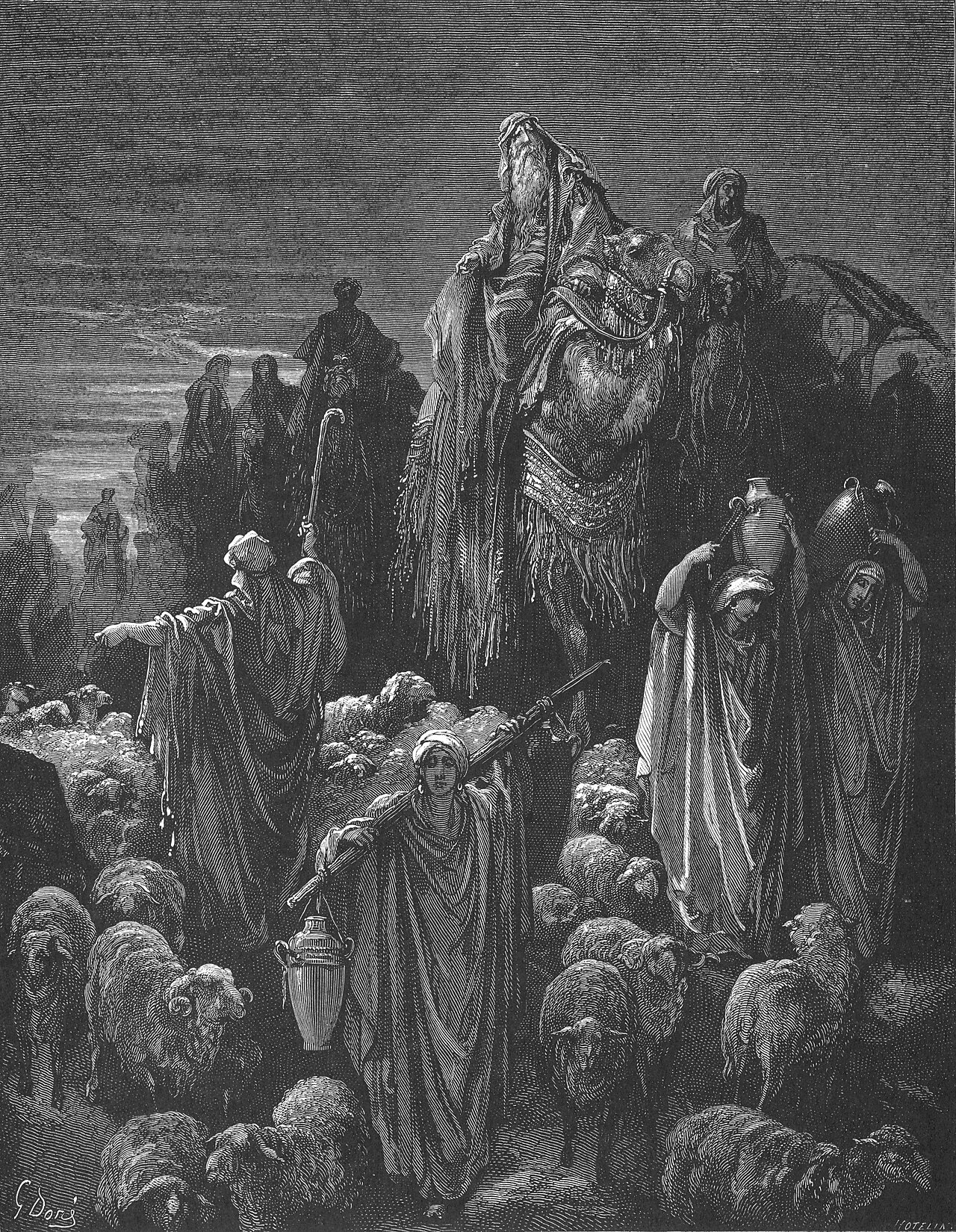
- He tells Pharaoh his years were few and hardGenesis 47:9“My travels have lasted 130 years,” Jacob replied. “My years have been few and hard, and they have not matched the years of the travels of my fathers.”
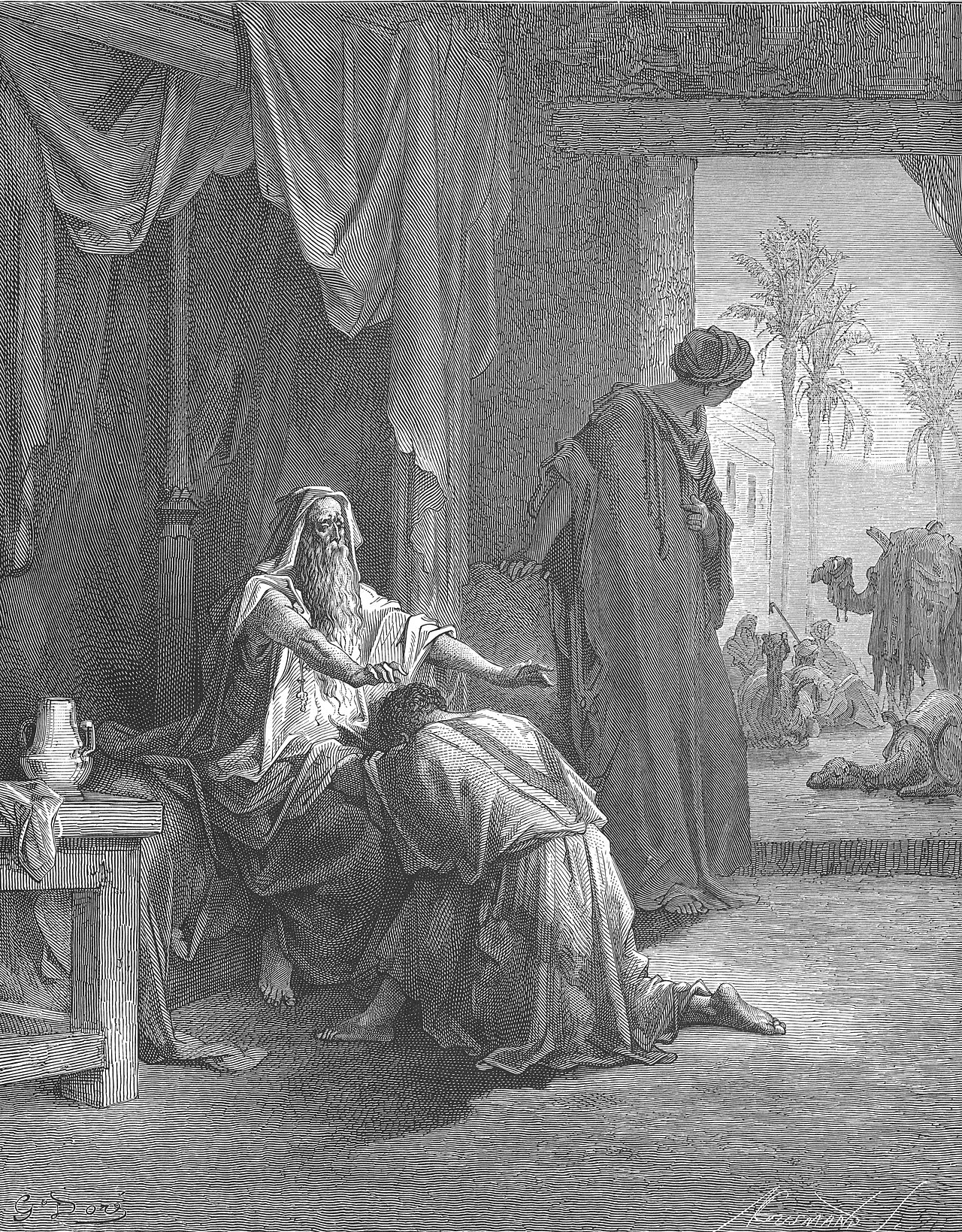
- He crosses his hands over Joseph's two sonsGenesis 48:14But Israel stretched out his right hand and put it on the head of Ephraim, the younger; and crossing his hands, he put his left on Manasseh’s head, although Manasseh was the firstborn.
- The scepter stays with Judah until Shiloh comesGenesis 49:10The scepter will not depart from Judah, nor the staff from between his feet, until Shiloh comes and the allegiance of the nations is his.
- Carried out of Egypt and buried in the cave at MachpelahGenesis 50:13They carried him to the land of Canaan and buried him in the cave at Machpelah in the field near Mamre, which Abraham had purchased from Ephron the Hittite as a burial site.
Why Jacob matters
Jacob is Isaac's younger twin and Abraham's grandson. He was born holding his brother's heel, and his name says so. He bought that brother's birthright for a bowl of stew, and years later he took the blessing meant for him by dressing in his clothes and lying to a father who could no longer see. Then he ran. On the first night of the run he stopped because the sun had set, put a stone under his head, and dreamed of a ladder standing on the earth with its top reaching heaven. God stood at the top and spoke first, and nothing He said was a condition. Jacob woke and said the LORD was in that place and he had not known it. He spent twenty years in Haran working for an uncle who cheated him the way he had cheated. On the wedding night Laban gave him Leah, the older sister, after he had passed himself off as the older brother in the dark. Rachel came a week later, and the second seven years were worked after the marriage rather than before it. He fathered eleven sons and a daughter in that house, and came home rich and afraid of his brother. On the night before he faced Esau, a man wrestled him until daybreak and struck his hip out of joint. Jacob would not let go until he was blessed, and the man gave him the name Israel. He crossed into the rest of his life limping. Genesis 34 is told plainly here because Genesis tells it plainly. His daughter Dinah went out to visit the women of the land, and Shechem son of Hamor took her by force. Her brothers Simeon and Levi answered with a trap, killed every man in the city and looted it. Jacob heard about his daughter and said nothing until his sons came home, and what he said to them afterwards was about the danger to himself. Genesis records no word from Dinah and never says what became of her, and that silence is left as silence here. The rest is loss and mercy in turns. Rachel died on the road to Bethlehem. Joseph was taken from him by a lie his own sons told with a garment and the blood of an animal, which is what he had used on his father. Twenty-two years later he found Joseph alive in Egypt, and he died there at 147 after blessing twelve sons and two grandsons. His body was carried back to the cave at Machpelah and buried with Abraham, Sarah, Isaac, Rebekah and Leah. His new name became the name of a nation. God introduces Himself to Moses at the burning bush as the God of Abraham, the God of Isaac and the God of Jacob, and Jesus quotes that sentence to prove that the dead are raised. The name Israel is still Israel's, and the New Testament never takes it off them.
Biography
Jacob, whose name means "heel-grabber" or "supplanter," was born grasping his twin brother Esau's heel. His life would be marked by struggle, deception, and ultimately transformation by divine grace. Even before birth, Jacob was chosen by God over his older brother Esau. Yet rather than trusting God's promise, Jacob schemed to obtain the blessing. He exploited Esau's hunger to purchase the birthright, then deceived his blind father to steal the blessing intended for Esau. Fleeing his brother's murderous rage, Jacob had his first direct encounter with God at Bethel, where he dreamed of a ladder reaching to heaven with angels ascending and descending. Jacob's years with Laban in Haran were marked by his own deception being repaid. Working seven years for Rachel, he was tricked into marrying Leah first. He labored another seven years for Rachel, then six more for flocks. During these years, his twelve sons were born—the future tribes of Israel. The transforming moment came at the Jabbok River as Jacob returned to face Esau. A mysterious man wrestled with him all night. When Jacob refused to let go without a blessing, the man touched his hip, dislocating it, and renamed him Israel—"one who struggles with God." Jacob declared, "I have seen God face to face, and yet my life has been preserved." The remainder of Jacob's life involved the loss of Rachel in childbirth, the supposed death of Joseph, years of famine, and finally reunion with Joseph in Egypt. He died at 147, blessing his sons with prophetic words, including the messianic promise that the scepter would not depart from Judah.
Look, I am with you, and I will watch over you wherever you go, and I will bring you back to this land. For I will not leave you until I have done what I have promised you.”
God's promise to be with Jacob
Bethel: the ladder
Genesis 28:10-22, in the order it happens
- He leaves Beersheba on the runGenesis 28:10Meanwhile Jacob left Beersheba and set out for Haran.
- The sun sets, and a stone becomes his pillowGenesis 28:11On reaching a certain place, he spent the night there because the sun had set. And taking one of the stones from that place, he put it under his head and lay down to sleep.
- The ladder, and the angels going up and downGenesis 28:12And Jacob had a dream about a ladder that rested on the earth with its top reaching up to heaven, and God’s angels were going up and down the ladder.
- God stands at the top and speaks firstGenesis 28:13And there at the top the LORD was standing and saying, “I am the LORD, the God of your father Abraham and the God of Isaac. I will give you and your descendants the land on which you now lie.
- All the families of the earth will be blessedGenesis 28:14Your descendants will be like the dust of the earth, and you will spread out to the west and east and north and south. All the families of the earth will be blessed through you and your offspring.
- I am with you, and I will bring you backGenesis 28:15Look, I am with you, and I will watch over you wherever you go, and I will bring you back to this land. For I will not leave you until I have done what I have promised you.”
- He wakes and says he did not knowGenesis 28:16When Jacob woke up, he thought, “Surely the LORD is in this place, and I was unaware of it.”
- The house of God and the gate of heavenGenesis 28:17And he was afraid and said, “How awesome is this place! This is none other than the house of God; this is the gate of heaven!”
- He sets the stone up, pours oil on it, and names the placeGenesis 28:18-19Early the next morning, Jacob took the stone that he had placed under his head, and he set it up as a pillar. He poured oil on top of it, and he called that place Bethel, though previously the city had been named Luz.
- The vow, made after the promise and not before itGenesis 28:20-22Then Jacob made a vow, saying, “If God will be with me and watch over me on this journey, and if He will provide me with food to eat and clothes to wear, so that I may return safely to my father’s house, then the LORD will be my God. And this stone I have set up as a pillar will be God’s house, and of all that You give me I will surely give You a tenth.”
God speaks first, and He asks nothing. The promise runs from the first word of 28:13 to the last word of 28:15 with no condition attached, and only after it ends does Jacob make his vow. Jamieson, Fausset and Brown read his "if" as "since" for that reason. The Hebrew word for the ladder occurs once in the whole Old Testament, which is why English versions give it as ladder, staircase and ramp, and nothing in the passage turns on which is right. The place itself has its own page on this site.
Jacob's ladder: the full studyKey events
- 1Born grasping Esau's heelGenesis 25:24-26→
Jacob was born holding his twin's heel
Read the verse here
Genesis 25:24-26When her time came to give birth, there were indeed twins in her womb.
- 2Purchased birthrightGenesis 25:29-34→
Jacob bought Esau's birthright for stew
Read the verse here
Genesis 25:29-34One day, while Jacob was cooking some stew, Esau came in from the field and was famished.
- 3Stole blessingGenesis 27:1-29→
Jacob deceived Isaac to receive Esau's blessing
Read the verse here
Genesis 27:1-29When Isaac was old and his eyes were so weak that he could no longer see, he called his older son Esau and said to him, “My son.” “Here I am,” Esau replied.
- 4Ladder dream at BethelGenesis 28:10-22→
God appeared in a dream with promises
Read the verse here
Genesis 28:10-22Meanwhile Jacob left Beersheba and set out for Haran.
- 5Wrestled with GodGenesis 32:22-32→
Jacob wrestled and was renamed Israel
Read the verse here
Genesis 32:22-32During the night Jacob got up and took his two wives, his two maidservants, and his eleven sons, and crossed the ford of the Jabbok.
- 6Blessed his sonsGenesis 49:1-28→
Jacob prophesied over his twelve sons
Read the verse here
Genesis 49:1-28Then Jacob called for his sons and said, “Gather around so that I can tell you what will happen to you in the days to come:
More key verses
Text: Berean Standard Bible.
Then the man said, “Your name will no longer be Jacob, but Israel, because you have struggled with God and with men, and you have prevailed.”
“By faith Jacob, when he was dying, blessed each of Joseph’s sons and worshiped as he leaned on the top of his staff.”
What they got right, and what they got wrong
Strengths
Valued spiritual blessing, persevered through hardship, eventually trusted God, deep love for Rachel and Joseph
Weaknesses
Deceptive and manipulative, showed favoritism among sons, fearful when facing Esau
Lessons
God's purposes cannot be thwarted by human schemes. Deception reaps deception. Transformation comes through encountering God. Perseverance in seeking God brings blessing.
Spiritual significance
Jacob demonstrates that God's purposes prevail despite human manipulation, and that transformation comes through wrestling with God. His twelve sons become the nation of Israel.
How Jacob points to Jesus
The strongest ground on this page is a sentence of the Lord's own. Nathanael is called "a true Israelite, in whom there is no deceit", which is the one thing Jacob was not, and Jesus answers his confession with a line built straight out of Genesis 28:12: "you will all see heaven open and the angels of God ascending and descending on the Son of Man." The traffic Jacob watched between heaven and earth now moves on a person. What the Lord does not say is that He is the ladder, and this page does not put words in His mouth that He did not use. Matthew Henry states the connection as plainly as any English writer: all the intercourse between heaven and earth is by this ladder, and Christ is the way. Augustine of Hippo drew the two scenes together in the fifth century. If Jacob, who was named Israel, saw the ladder, and Nathanael was an Israelite indeed, then there was a fitness in the Lord telling him Jacob's dream. Jerome in the fourth century, Cyril of Alexandria in the fifth and Bede in the eighth read the stone Jacob anointed as Christ the rejected cornerstone. Each of those is a reading of its own century rather than a claim the text makes, and Augustine's own warning belongs beside it: when Jacob poured oil on the stone he set up a sign and not an object of worship. Genesis calls the figure at the ford a man, and Jacob names the place for having seen God face to face and living. Hosea calls the same figure God in one line and the angel in the next. On those two texts this site's tradition reads him as the Angel of the LORD, the figure met at the burning bush and in the furnace, and Adam Clarke and John Wesley both state that reading in their own words. Other readings take him as a created angel, and they are named here without disparagement. At the end of his life Jacob called the one who redeemed him from all harm the angel, using the Hebrew word for a kinsman who buys back what a relative has lost, which is the word Ruth 4 uses of Boaz. His name outlived him inside a sentence God speaks about Himself. At the burning bush God tells Moses He is the God of Abraham, the God of Isaac and the God of Jacob, and Jesus quotes that sentence back to the Sadducees to prove the resurrection: "He is not the God of the dead, but of the living." Hebrews names his faith at one point only, and it is the last one, blessing Joseph's sons while leaning on the top of his staff, dying in a land he had been promised and did not own. John Damascene read the crossed hands of that blessing as a sign of the cross in the eighth century, and that is his reading rather than the text's claim. "Jacob I loved, but Esau I hated" is spoken in Malachi of two nations, Israel restored after exile and Edom left in ruin, and Paul quotes it in Romans 9 inside an argument about whose call decides the line of promise. Adam Clarke says flatly that there is not a word there about the eternal state of either man, and John Wesley says the same. What Paul means by election is a real question, and it is argued at full strength on the study page rather than settled here or on the page for Edom. Jacob's new name became the name of a people, and Scripture never takes it off them. Paul spends Romans 9 to 11 in grief over his own kinsmen and ends by saying that God has not rejected the people He foreknew. Tertullian put the same thing in one line in the third century: it is fitting for the Christian to rejoice, and not to grieve, at the restoration of Israel. Every reading on this page that carries Jacob forward into Christ is offered as a reading, and not one of them is the church standing in Israel's place.
Jacob's ladder is fulfilled in Christ, the true connection between heaven and earth (John 1:51). Jacob's wrestling prefigures perseverance in prayer until blessing comes.
The voices
each quoted from the work named
All the intercourse between heaven and earth, since the fall, is by this ladder. Christ is the way; all God's favours come to us, and all our services go to him, by Christ. If God dwell with us, and we with him, it is by Christ.
Jacob vowed a vow--His words are not to be considered as implying a doubt, far less as stating the condition or terms on which he would dedicate himself to God. Let "if" be changed into "since," and the language will appear a proper expression of Jacob's faith--an evidence of his having truly embraced the promise.
And there wrestled a man with him - This was doubtless the Lord Jesus Christ, who, among the patriarchs, assumed that human form, which in the fullness of time he really took of a woman, and in which he dwelt thirty-three years among men. He is here styled an angel, because he was μεγαλης βουλης Αγγελος, (see the Septuagint, Isa 9:7), the Messenger of the great counsel or design to redeem fallen man from death, and bring him to eternal glory; see Gen 16:7.
4 more teachers on these versesJohn Wesley · Adam Clarke · Charles Spurgeon · Augustine of Hippo
The angel - Called ver. 3, God; and ver. 5, Jehovah, Lord of hosts. He was no created angel, but the Messiah; eternal God by nature and essence, angel by office, and voluntary undertaking. He wept - He prayed with tears from a sense of his own unworthiness, and with earnestness for the mercy he desired.
On the subject of loving Jacob and hating Esau, see the notes on Genesis 27 (note), and Rom 9:13 (note). Let it be remembered, 1. That there is not a word spoken here concerning the eternal state of either Jacob or Esau. 2. That what is spoken concerns merely their earthly possessions. And, 3. That it does not concern the two brothers at all, but the posterity of each.
JACOB'S character was far from faultless, but equally removed from despicable. He possessed great strength of character and force of judgment, but this became somewhat of a snare to him, so that he did not always move through life with the childlike repose of Isaac, or the royal serenity of Abraham, but was, at times, crafty and critical like his relatives on his mother's side. Yet I object to that depreciation of Jacob's character which is so common in certain quarters because he used the means, as well as prayed. Our God is the God of Abraham, of Isaac, and of Jacob—and, very frequently, He is called the God of Israel—and even the God of Jacob. "He is not ashamed to be called their God." And if He is not ashamed to be called Jacob's God, no fellow Believer has any right to be ashamed of Jacob!
Because that Israelite, in whom there is no deceit; look to Jacob in whom there is no deceit; and recall from where he speaks, a stone at his head, vision in a dream, ladders from earth to heaven, descending and ascending; and see what the Lord says to the Israelite without deceit: you will see heaven opened: Hear, Nathanael without deceit, what Jacob without deceit saw: you will see heaven opened, and angels ascending and descending; to whom? to the Son of Man.
Jacob in Scripture
Open a book to read its mentions here. Text: Berean Standard Bible. Names repeat in Scripture, so some of these verses may speak of another person called Jacob. The two marks are drawn from the chapters this page's own references stand in.
Old TestamentNew Testamentsegment width = share of mentions
Old Testament22 books · 350 mentions
Genesis190 mentions
- Genesis 25:26After this, his brother came out grasping Esau’s heel; so he was named Jacob. And Isaac was sixty years old when the twins were born.
- Genesis 25:27When the boys grew up, Esau became a skillful hunter, a man of the field, while Jacob was a quiet man who stayed at home.
- Genesis 25:28Because Isaac had a taste for wild game, he loved Esau; but Rebekah loved Jacob.
- Genesis 25:29One day, while Jacob was cooking some stew, Esau came in from the field and was famished.
- Genesis 25:30He said to Jacob, “Let me eat some of that red stew, for I am famished.” (That is why he was also called Edom.)
185 further mentions in Genesis, read them in the book.
Exodus11 mentions
- Exodus 1:1These are the names of the sons of Israel who went to Egypt with Jacob, each with his family:
- Exodus 1:5The descendants of Jacob numbered seventy in all, including Joseph, who was already in Egypt.
- Exodus 2:24So God heard their groaning, and He remembered His covenant with Abraham, Isaac, and Jacob.
- Exodus 3:6Then He said, “I am the God of your father, the God of Abraham, the God of Isaac, and the God of Jacob.” At this, Moses hid his face, for he was afraid to look at God.
- Exodus 3:15God also told Moses, “Say to the Israelites, ‘The LORD, the God of your fathers—the God of Abraham, the God of Isaac, and the God of Jacob—has sent me to you.’ This is My name forever, and this is how I am to be remembered in every generation.
6 further mentions in Exodus, read them in the book.
Leviticus1 mention
Numbers8 mentions
- Numbers 23:7And Balaam lifted up an oracle, saying: “Balak brought me from Aram, the king of Moab from the mountains of the east. ‘Come,’ he said, ‘put a curse on Jacob for me; come and denounce Israel!’
- Numbers 23:10Who can count the dust of Jacob or number even a fourth of Israel? Let me die the death of the righteous; let my end be like theirs!”
- Numbers 23:21He considers no disaster for Jacob; He sees no trouble for Israel. The LORD their God is with them, and the shout of the King is among them.
- Numbers 23:23For there is no spell against Jacob and no divination against Israel. It will now be said of Jacob and Israel, ‘What great things God has done!’
- Numbers 24:5How lovely are your tents, O Jacob, your dwellings, O Israel!
3 further mentions in Numbers, read them in the book.
Deuteronomy11 mentions
- Deuteronomy 1:8See, I have placed the land before you. Enter and possess the land that the LORD swore He would give to your fathers Abraham, Isaac, and Jacob, and to their descendants after them.”
- Deuteronomy 6:10And when the LORD your God brings you into the land He swore to your fathers, to Abraham, Isaac, and Jacob, that He would give you—a land with great and splendid cities that you did not build,
- Deuteronomy 9:5It is not because of your righteousness or uprightness of heart that you are going in to possess their land, but it is because of their wickedness that the LORD your God is driving out these nations before you, to keep the promise He swore to your fathers, to Abraham, Isaac, and Jacob.
- Deuteronomy 9:27Remember Your servants Abraham, Isaac, and Jacob. Overlook the stubbornness of this people and the wickedness of their sin.
- Deuteronomy 29:13and so that He may establish you today as His people, and He may be your God as He promised you and as He swore to your fathers, to Abraham, Isaac, and Jacob.
6 further mentions in Deuteronomy, read them in the book.
Joshua2 mentions
- Joshua 24:4and to Isaac I gave Jacob and Esau. I gave Esau Mount Seir to possess, but Jacob and his sons went down to Egypt.
- Joshua 24:32And the bones of Joseph, which the Israelites had brought up out of Egypt, were buried at Shechem in the plot of land that Jacob had purchased from the sons of Hamor, Shechem’s father, for a hundred pieces of silver. So it became an inheritance for Joseph’s descendants.
1 Samuel1 mention
2 Samuel1 mention
1 Kings1 mention
2 Kings2 mentions
- 2 Kings 13:23But the LORD was gracious to Israel and had compassion on them, and He turned toward them because of His covenant with Abraham, Isaac, and Jacob. And to this day, the LORD has been unwilling to destroy them or cast them from His presence.
- 2 Kings 17:34To this day they are still practicing their former customs. None of them worship the LORD or observe the statutes, ordinances, laws, and commandments that the LORD gave the descendants of Jacob, whom He named Israel.
1 Chronicles2 mentions
Psalms34 mentions
- Psalms 14:7Oh, that the salvation of Israel would come from Zion! When the LORD restores His captive people, let Jacob rejoice, let Israel be glad!
- Psalms 20:1May the LORD answer you in the day of trouble; may the name of the God of Jacob protect you.
- Psalms 22:23You who fear the LORD, praise Him! All descendants of Jacob, honor Him! All offspring of Israel, revere Him!
- Psalms 24:6Such is the generation of those who seek Him, who seek Your face, O God of Jacob. Selah
- Psalms 44:4You are my King, O God, who ordains victories for Jacob.
29 further mentions in Psalms, read them in the book.
Isaiah40 mentions
- Isaiah 2:3And many peoples will come and say: “Come, let us go up to the mountain of the LORD, to the house of the God of Jacob. He will teach us His ways so that we may walk in His paths.” For the law will go forth from Zion, and the word of the LORD from Jerusalem.
- Isaiah 2:5Come, O house of Jacob, let us walk in the light of the LORD.
- Isaiah 2:6For You have abandoned Your people, the house of Jacob, because they are filled with influences from the east; they are soothsayers like the Philistines; they strike hands with the children of foreigners.
- Isaiah 8:17I will wait for the LORD, who is hiding His face from the house of Jacob. I will put my trust in Him.
- Isaiah 9:8The Lord has sent a message against Jacob, and it has fallen upon Israel.
35 further mentions in Isaiah, read them in the book.
Jeremiah13 mentions
- Jeremiah 2:4Hear the word of the LORD, O house of Jacob, and all you families of the house of Israel.
- Jeremiah 5:20Declare this in the house of Jacob and proclaim it in Judah:
- Jeremiah 10:16The Portion of Jacob is not like these, for He is the Maker of all things, and Israel is the tribe of His inheritance—the LORD of Hosts is His name.
- Jeremiah 10:25Pour out Your wrath on the nations that do not acknowledge You, and on the families that do not call on Your name. For they have devoured Jacob; they have consumed him and finished him off; they have devastated his homeland.
- Jeremiah 30:7How awful that day will be! None will be like it! It is the time of Jacob’s distress, but he will be saved out of it.
8 further mentions in Jeremiah, read them in the book.
Lamentations3 mentions
- Lamentations 1:17Zion stretches out her hands, but there is no one to comfort her. The LORD has decreed against Jacob that his neighbors become his foes. Jerusalem has become an unclean thing among them.
- Lamentations 2:2Without pity the Lord has swallowed up all the dwellings of Jacob. In His wrath He has demolished the fortified cities of the Daughter of Judah. He brought to the ground and defiled her kingdom and its princes.
- Lamentations 2:3In fierce anger He has cut off every horn of Israel and withdrawn His right hand at the approach of the enemy. He has burned in Jacob like a flaming fire that consumes everything around it.
Ezekiel4 mentions
- Ezekiel 20:5and tell them that this is what the Lord GOD says: On the day I chose Israel, I swore an oath to the descendants of the house of Jacob and made Myself known to them in the land of Egypt. With an uplifted hand I said to them, ‘I am the LORD your God.’
- Ezekiel 28:25This is what the Lord GOD says: ‘When I gather the house of Israel from the peoples among whom they have been scattered, I will show Myself holy among them in the sight of the nations. Then they will dwell in their own land, which I have given to My servant Jacob.
- Ezekiel 37:25They will live in the land that I gave to My servant Jacob, where your fathers lived. They will live there forever with their children and grandchildren, and My servant David will be their prince forever.
- Ezekiel 39:25Therefore this is what the Lord GOD says: Now I will restore Jacob from captivity and will have compassion on the whole house of Israel, and I will be jealous for My holy name.
Hosea3 mentions
- Hosea 10:11Ephraim is a well-trained heifer that loves to thresh; but I will place a yoke on her fair neck. I will harness Ephraim, Judah will plow, and Jacob will break the hard ground.
- Hosea 12:2The LORD also brings a charge against Judah. He will punish Jacob according to his ways and repay him according to his deeds.
- Hosea 12:12Jacob fled to the land of Aram and Israel worked for a wife—for a wife he tended sheep.
Amos6 mentions
- Amos 3:13Hear and testify against the house of Jacob, declares the Lord GOD, the God of Hosts.
- Amos 6:8The Lord GOD has sworn by Himself—the LORD, the God of Hosts, has declared: “I abhor Jacob’s pride and detest his citadels, so I will deliver up the city and everything in it.”
- Amos 7:2And when the locusts had eaten every green plant in the land, I said, “Lord GOD, please forgive! How will Jacob survive, since he is so small?”
- Amos 7:5Then I said, “Lord GOD, please stop! How will Jacob survive, since he is so small?”
- Amos 8:7The LORD has sworn by the Pride of Jacob: “I will never forget any of their deeds.
1 further mention in Amos, read them in the book.
Obadiah3 mentions
- Obadiah 1:10Because of the violence against your brother Jacob, you will be covered with shame and cut off forever.
- Obadiah 1:17But on Mount Zion there will be deliverance, and it will be holy, and the house of Jacob will reclaim their possession.
- Obadiah 1:18Then the house of Jacob will be a blazing fire, and the house of Joseph a burning flame; but the house of Esau will be stubble—Jacob will set it ablaze and consume it. Therefore no survivor will remain from the house of Esau.” For the LORD has spoken.
Micah10 mentions
- Micah 1:5All this is for the transgression of Jacob and the sins of the house of Israel. What is the transgression of Jacob? Is it not Samaria? And what is the high place of Judah? Is it not Jerusalem?
- Micah 2:7Should it be said, O house of Jacob, “Is the Spirit of the LORD impatient? Are these the things He does?” Do not My words bring good to him who walks uprightly?
- Micah 2:12I will surely gather all of you, O Jacob; I will collect the remnant of Israel. I will bring them together like sheep in a pen, like a flock in the midst of its pasture—a noisy throng.
- Micah 3:1Then I said: “Hear now, O leaders of Jacob, you rulers of the house of Israel. Should you not know justice?
- Micah 3:8As for me, however, I am filled with power by the Spirit of the LORD, with justice and courage, to declare to Jacob his transgression and to Israel his sin.
5 further mentions in Micah, read them in the book.
Nahum1 mention
Malachi3 mentions
- Malachi 1:2“I have loved you,” says the LORD. But you ask, “How have You loved us?” “Was not Esau Jacob’s brother?” declares the LORD. “Yet Jacob I have loved,
- Malachi 2:12As for the man who does this, may the LORD cut off from the tents of Jacob everyone who is awake and aware—even if he brings an offering to the LORD of Hosts.
- Malachi 3:6“Because I, the LORD, do not change, you descendants of Jacob have not been destroyed.
New Testament7 books · 25 mentions
Matthew5 mentions
- Matthew 1:2Abraham was the father of Isaac, Isaac the father of Jacob, and Jacob the father of Judah and his brothers.
- Matthew 1:15Eliud was the father of Eleazar, Eleazar the father of Matthan, Matthan the father of Jacob,
- Matthew 1:16and Jacob the father of Joseph, the husband of Mary, of whom was born Jesus, who is called Christ.
- Matthew 8:11I say to you that many will come from the east and the west to share the banquet with Abraham, Isaac, and Jacob in the kingdom of heaven.
- Matthew 22:32‘I am the God of Abraham, the God of Isaac, and the God of Jacob’? He is not the God of the dead, but of the living.”
Mark1 mention
Luke4 mentions
- Luke 1:33and He will reign over the house of Jacob forever. His kingdom will never end!”
- Luke 3:34the son of Jacob, the son of Isaac, the son of Abraham, the son of Terah, the son of Nahor,
- Luke 13:28There will be weeping and gnashing of teeth when you see Abraham, Isaac, Jacob, and all the prophets in the kingdom of God, but you yourselves are thrown out.
- Luke 20:37Even Moses demonstrates that the dead are raised, in the passage about the burning bush. For he calls the Lord ‘the God of Abraham, the God of Isaac, and the God of Jacob.’
John3 mentions
- John 4:5So He came to a town of Samaria called Sychar, near the plot of ground that Jacob had given to his son Joseph.
- John 4:6Since Jacob’s well was there, Jesus, weary from His journey, sat down by the well. It was about the sixth hour.
- John 4:12Are You greater than our father Jacob, who gave us this well and drank from it himself, as did his sons and his livestock?”
Acts7 mentions
- Acts 3:13The God of Abraham, Isaac, and Jacob, the God of our fathers, has glorified His servant Jesus. You handed Him over and rejected Him before Pilate, even though he had decided to release Him.
- Acts 7:8Then God gave Abraham the covenant of circumcision, and Abraham became the father of Isaac and circumcised him on the eighth day. And Isaac became the father of Jacob, and Jacob of the twelve patriarchs.
- Acts 7:12When Jacob heard that there was grain in Egypt, he sent our fathers on their first visit.
- Acts 7:14Then Joseph sent for his father Jacob and all his relatives, seventy-five in all.
- Acts 7:15So Jacob went down to Egypt, where he and our fathers died.
2 further mentions in Acts, read them in the book.
Romans2 mentions
Hebrews3 mentions
- Hebrews 11:9By faith he dwelt in the promised land as a stranger in a foreign country. He lived in tents, as did Isaac and Jacob, who were heirs with him of the same promise.
- Hebrews 11:20By faith Isaac blessed Jacob and Esau concerning the future.
- Hebrews 11:21By faith Jacob, when he was dying, blessed each of Joseph’s sons and worshiped as he leaned on the top of his staff.
Common questions
Did Jacob steal the birthright, or buy it?
He bought the birthright and then stole the blessing. They are two different things taken on two different days. Genesis 25:31-33 is a bargain Esau agrees to and swears to, and the chapter's closing verdict falls on Esau for despising it, which is the verdict Hebrews 12:16 repeats.
Genesis 27 is a separate act years later, and Isaac names it deceit in his own mouth. Adam Clarke sets the birthright out as four things, authority in the family, a double portion, the father's benediction and the priestly office, and treats the blessing as a separate matter with its own content. The common retelling collapses the two into one theft. The text does not.
Was Jacob's ladder a ladder?
Readers differ; the positions are named
The Hebrew word occurs once in the whole Old Testament, at Genesis 28:12, which leaves translators with no second occurrence to compare it against. English versions have given it as ladder, staircase and ramp.
Jamieson, Fausset and Brown note that the same term was used of a flight of steps cut into rock. Nothing in the passage turns on the answer, because what the dream shows is traffic between heaven and earth rather than the shape of the thing it moves on.
Who wrestled with Jacob at the Jabbok?
Readers differ; the positions are named
Genesis calls him a man, and then Jacob names the place Peniel because he had seen God face to face and lived. Hosea 12:3-4 calls the same figure God in one line and the angel in the next.
This site's tradition reads him as the Angel of the LORD, the figure met at the burning bush and in the furnace, and Adam Clarke and John Wesley both state that reading in the site's own quote pool. Other readings take him as a created angel. Both are named here, and neither is disparaged.
What does the name Israel mean?
Readers differ; the positions are named
Genesis 32:28 gives its own reason inside the verse, "because you have struggled with God and with men, and you have prevailed", which points to the Hebrew verb meaning to prevail. That is the derivation behind the older English rendering, prince with God.
Chrysostom and Augustine both read the name instead as seeing God, from a different derivation, and tie it to Jacob's own words at 32:30. Adam Clarke lays both out at length. This page gives both and does not choose, because the verse supplies the first and the argument for the second is made from the Hebrew.
What does Genesis blame him for, and what does it credit him with?
It calls the fraud of chapter 27 what it is. Isaac says his brother came deceitfully and took the blessing, and Esau says he has been cheated twice. Genesis puts the parents' favoritism on the record before either boy is grown, and then records Jacob doing the same thing to his own sons, with his brothers' hatred following in the very next verse.
Genesis never records him confessing any of it, and it never records God rebuking him for it. What it records instead is Laban handing him the older sister in the dark after he had passed himself off as the older brother in the dark, and his own sons deceiving him with a garment and animal blood, which is what he had used on his father.
What the text credits him with is that he wanted the covenant and would not let go of it. "I will not let you go unless you bless me" is his sentence at the ford, and Hosea says how he held on: he wept and sought God's favor. Hebrews names his faith at one point only, the blessing he gave while he was dying.
What does "Jacob I loved, but Esau I hated" mean?
Readers differ; the positions are named
In both places it appears the immediate sense is national and covenantal. The oracle to Rebekah speaks of two nations before either twin is born, and Malachi 1:2-3 sets Israel's restoration after exile against Edom's continuing ruin. Paul quotes the line in Romans 9:13 inside an argument about whose call decides the line of promise.
Adam Clarke states flatly that there is not a word here about the eternal state of either man, and John Wesley says the same of Paul's use of it. Whether Paul's argument reaches beyond the two nations to individual election is a real question, and the comparative-national reading and the Reformed individual-election reading are both held at full strength on the study page rather than settled here.
Does "until Shiloh comes" in Genesis 49:10 point to Jesus?
Readers differ; the positions are named
The Hebrew word in Genesis 49:10 is spelled the same as the town's name, and four readings of it are held. The Messianic reading takes it as a title of the coming one, and it is the reading of the Targums, of the Babylonian Talmud at Sanhedrin 98b, of Rashi in the eleventh century, of Justin Martyr and Irenaeus in the second, and of Wesley, of Jamieson, Fausset and Brown, and of Spurgeon, who preached a whole sermon under the title in 1874. The tribute reading repoints the consonants as shai lo, tribute to him, which fits the second half of the verse. The relative reading takes the word as until he comes to whom it belongs, which is how the Septuagint, the Syriac and the Latin fathers understood it. The place-name reading takes it as the town in Ephraim and ties it to the assembly of Joshua 18:1.
Where the readings part from Christ, this page says so at the point of contact. The Targums, the Talmud and Rashi read the verse as pointing to a Messiah still awaited rather than to Jesus of Nazareth, and that difference is stated plainly and without disparagement. This site teaches that Jesus of Nazareth is the Messiah, and it says so without mocking the tradition that reads the verse otherwise.
Why does Scripture keep calling him Jacob after God renamed him?
Because it does, and this page reports it rather than tidying it. The name is given at the ford in Genesis 32:28 and given again by God at Bethel in Genesis 35:10, and Genesis then uses both, sometimes in the same paragraph. At Genesis 46:2 God calls him "Jacob, Jacob" in a sentence that begins with Israel setting out.
Charles Spurgeon read the two names as the weakness and the strength of the same man. Nothing in the text says the old name was withdrawn.
How many years passed between Joseph being sold and Jacob's reunion with him?
About twenty-two years, though Genesis states no single number for it. Joseph is seventeen when his brothers sell him in Genesis 37:2. He is thirty when Pharaoh raises him up in Genesis 41:46. Genesis 41:53 names seven years of abundance after that, and Genesis 45:6 has Joseph telling his brothers the famine has run two years with five still to come. Thirty minus seventeen is thirteen, and thirteen plus seven plus two comes to twenty-two.
Where is Jacob buried?
In the cave at Machpelah near Mamre, with Abraham, Sarah, Isaac, Rebekah and Leah, as he instructed at Genesis 49:29-31 and as Genesis 50:13 records. The funeral procession carried him out of Egypt and back into a land his family did not yet own except for one field and one cave.
Joseph's bones went somewhere else, to the field at Shechem that Jacob had bought. Stephen's summary in Acts 7:16 compresses the two purchases into one sentence, and this page states what each text says rather than harmonising them into a third account.
Notable art
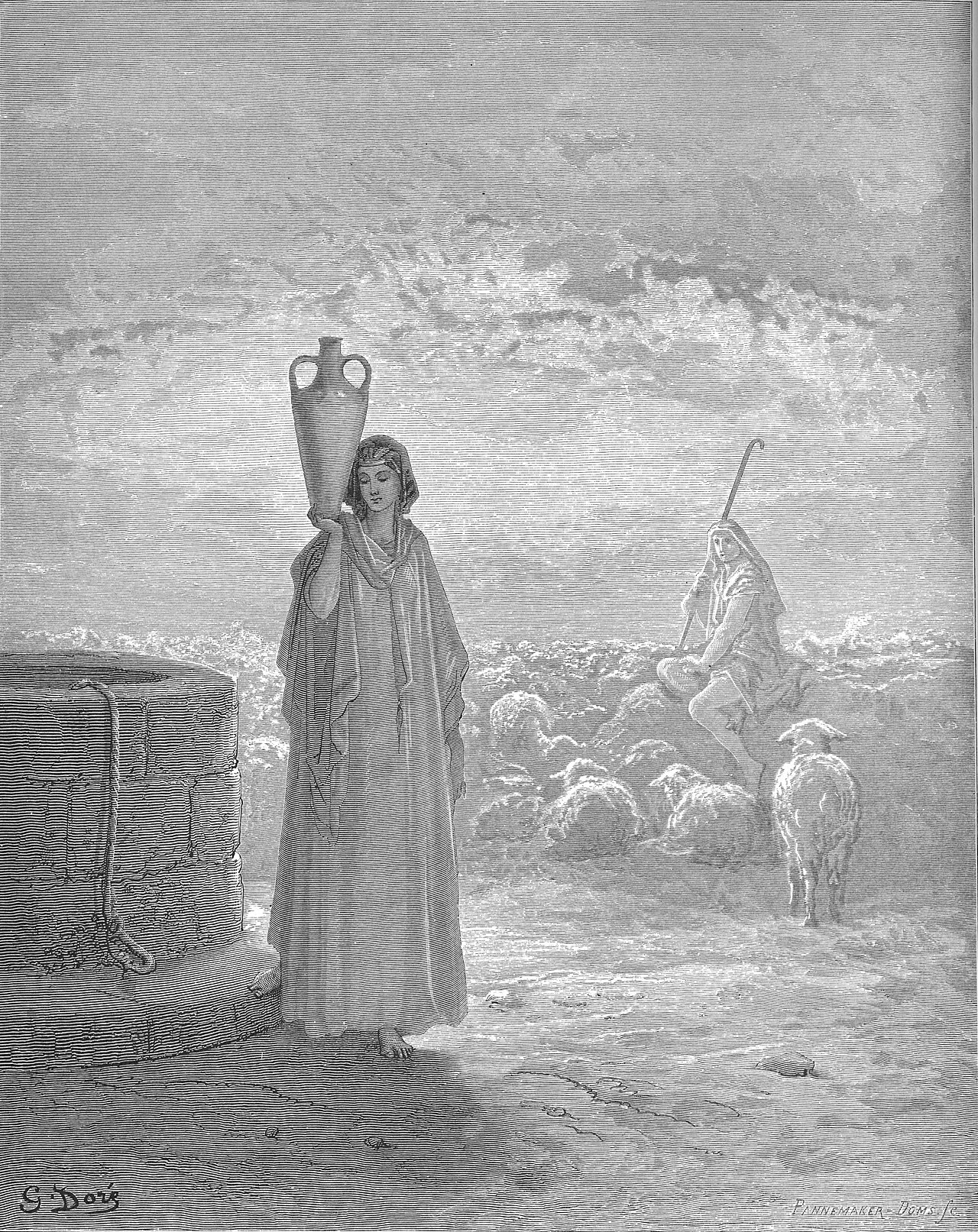
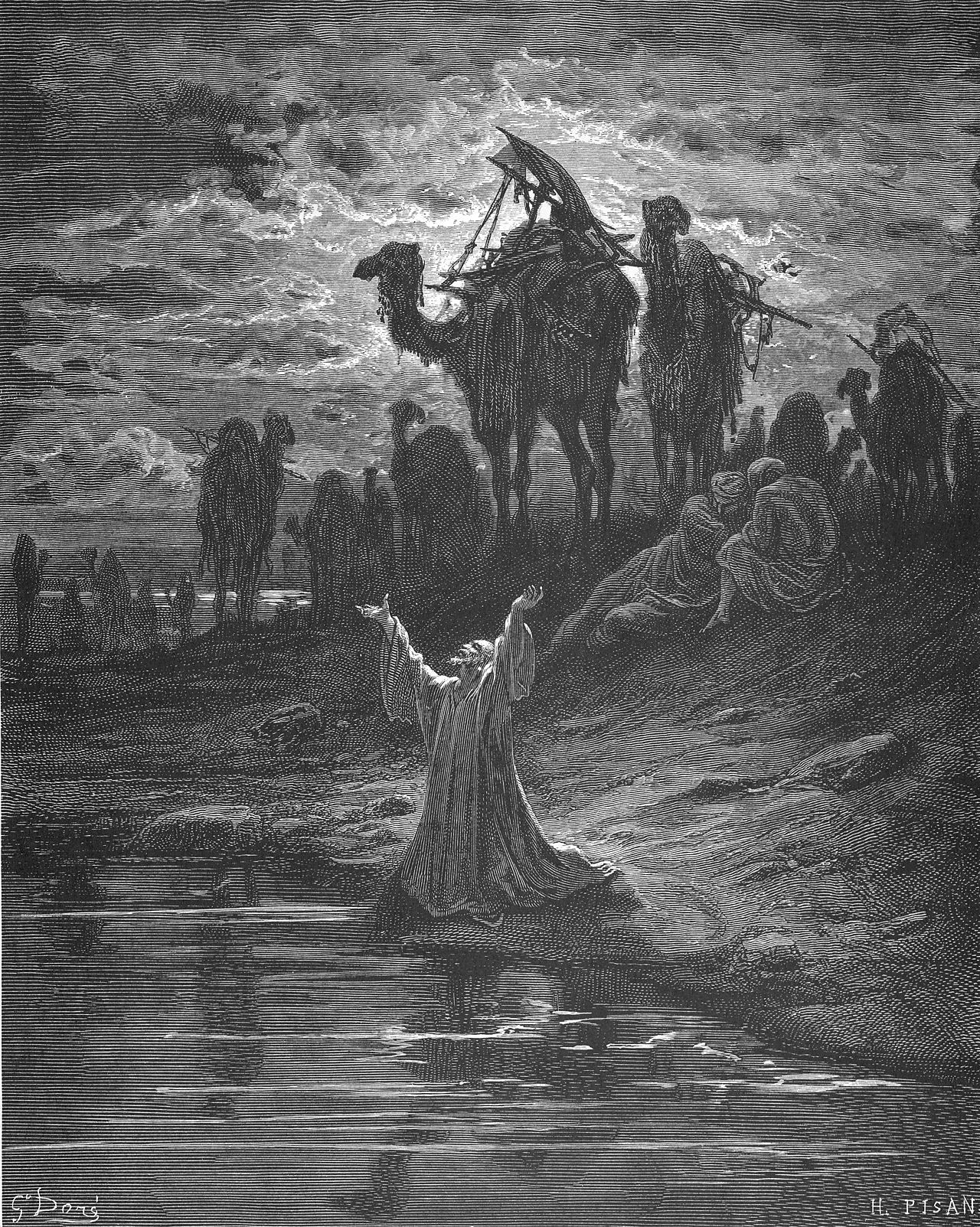
6 verified pieces depicting Jacob
Sources cited
- Berean Standard BibleThe Scripture quoted on this page, byte for byte. Public domain since 2023.
- Matthew Henry, Commentary on the Whole Bible (1710)Quoted on Genesis 28:12 for the ladder and the way to the Father. Public domain.
- Adam Clarke, Commentary on the Bible (1832)Quoted on Genesis 32:24 and on Malachi 1:3, and cited for the four parts of the birthright at Genesis 25:31, for the two derivations of the name Israel, and for his refusal to excuse the lie at Genesis 27:19. Public domain.
- Jamieson, Fausset & Brown, Commentary Critical and Explanatory on the Whole Bible (1871)Quoted on Genesis 28:20 for reading the vow's "if" as "since", and cited on the Hebrew word for the ladder and among the holders of the Messianic reading of Genesis 49:10. Public domain.
- John Wesley, Explanatory Notes upon the Old Testament (1765) and upon the New Testament (1755)Quoted on Hosea 12:4, and cited on Romans 9:13 for the reading that the passage does not concern the eternal state of either man. Public domain.
- Charles H. Spurgeon, The Metropolitan Tabernacle Pulpit, Sermon No. 1787: “Humility, the Friend of Prayer”Quoted on Genesis 32:10 for his assessment of Jacob's character. The sermon is named by number and title and no preaching year is printed, because the year stored with these sermons is the volume's publication date. Public domain, CCEL edition.
- Augustine of Hippo, Sermon 89.5, and the extracts from his Tractates on the Gospel of John in the Catena AureaQuoted and cited for the link he draws between Jacob's dream and the Lord's word to Nathanael, and for his warning that the anointed stone was a sign and not an object of worship. Placed by century, because the year stored with these texts is the author's death year. Public domain in translation.
- Jerome, Cyril of Alexandria, Bede and John Damascene, in the Nicene and Post-Nicene Fathers and the later Latin and Greek collectionsCited for the reading of the anointed stone as Christ the cornerstone, and for the eighth-century reading of the crossed hands as the cross. Each is placed by the century of the work rather than by a printed date. Public domain in translation.
- Tertullian, On ModestyCited for the third-century line that the Christian should rejoice, and not grieve, at the restoration of Israel. Public domain in translation.
- The Aramaic Targums, the Babylonian Talmud at Sanhedrin 98b, and Rashi on Genesis 49:10Named here as the holders of the Messianic reading of the word Shiloh, in the same terms this site's page for Shiloh already uses. No edition of the tractate or of Rashi was opened for this page, so nothing is quoted from them and no wording beyond the naming is given.
- Gustave Doré, La Sainte Bible (Tours: Alfred Mame et fils, 1866)The seven engravings on this page, the largest run of plates Doré gave any one person in Genesis. Public domain, via Wikimedia Commons.
- Sefaria, Sanhedrin 98bConfirms the school of Rabbi Sheila's teaching that Shiloh is a name of the Messiah, drawn from Genesis 49:10. Named in the Shiloh question.
- Justin Martyr, First Apology 32, and Dialogue with Trypho 52-54, and Irenaeus of Lyons, Against Heresies 4.10.2Confirms the second-century application of Genesis 49:10 to Christ named in the Shiloh question. Public domain translation.
Keep studying
On this page
Studies15
On this person
On this passage
- Rachel and Leah: Genesis 29-35
- The Resurrection and the Sadducees
- The Idol Who Ate Nothing
- The Land Covenant
- The Burning Bush: the Name Revealed
- The Woman at the Well: John 4
- The Flight to Egypt: Matthew 2
- Joseph, Genesis 37-50
- Luke (the Savior of All)
- Deuteronomy: the Study Guide
- Rebekah: Genesis 24-27
- Moses in the Bulrushes: Exodus 2
Trails1
Books27
Doorway1
Keep this page