
Lamentations 2:2
in Lamentations 2Without pity the Lord has swallowed up all the dwellings of Jacob. In His wrath He has demolished the fortified cities of the Daughter of Judah. He brought to the ground and defiled her kingdom and its princes.
BSB
The same verse in ASV and KJV ▾
ASV
The Lord hath swallowed up all the habitations of Jacob, and hath not pitied: He hath thrown down in his wrath the strongholds of the daughter of Judah; He hath brought them down to the ground; he hath profaned the kingdom and the princes thereof.
KJV
The Lord hath swallowed up all the habitations of Jacob, and hath not pitied: he hath thrown down in his wrath the strong holds of the daughter of Judah; he hath brought them down to the ground: he hath polluted the kingdom and the princes thereof.
⋯
This verse in Lamentations 2
Commentary
8 notes on this verseThe Lord hath swallowed up - It is a strange figure when thus applied: but Jehovah is here represented as having swallowed down Jerusalem and all the cities and fortifications in the land: that is, he has permitted them to be destroyed. See Lam 2:6.
This site's exposition
How the Lord has covered the Daughter of Zion with the cloud of His anger
on Lamentations 2:1-3
Lamentations 2 is a twenty-two verse acrostic, and it names who stood behind the enemy. The Lord is the subject of its opening verbs: He “has abandoned His footstool in the day of His anger”. The footstool is the ark's resting place in 1 Chronicles 28:2 and Psalm 99:5.
This site's exposition
Without pity the Lord has swallowed up
The verb swallowed up returns twice in 2:5, and in 2:16 the enemy boasts of the same deed. Albert Barnes reads the dwellings as the shepherds' homes in the open country, lost as in an earthquake, beside the walled cities. To defile the kingdom is to make the holy common.
The record, by era
The Medieval Church1 voice
Those events occurring around destruction are viewed here in particular. First, are lamented those events conjoined to the destruction, second, those events following. Onward in Verse 13 such is expressed: "What can I say for you, to what compare you, O daughter of Jerusalem?" etc. …
The Puritans and the Awakening3 voices
He has given up their glory, which was looked upon as sacred (that is a character we give to majesty), to be trampled upon and profaned; and no marvel that the king and the priest, whose characters were always deemed venerable and inviolable, are despised by every body, when God has, in the indignation of his anger, despised the king and the priest,
), both the cities and the country houses; they are burnt, or otherwise destroyed, so totally ruined that they seem to have been swallowed up, and no remains left of them.
quarantine:debris (2026-07-29) — leading-punctuation+unbalanced-parens
The Lord hath swallowed up all the habitations of Jacob, and hath not pitied,....
The Nineteenth Century1 voice
A commentator
Albert Barnes1798–1870
Notes, Explanatory and Practical, on the Old and New Testaments (1832-1869)
proposed
Habitations - The dwellings of the shepherds in the pastures Jer 49:19. These are described as swallowed up by an earthquake, while the storm itself throws down the fortified cities of Judah. Polluted - i. e. profaned it, made common or unclean what before was holy.
How the passage was read
What the Jewish commentators add
On the verses either side of this one
How can it be that…cast a gloom. Bring darkness, 1 Alternatively, ‘has raised up to the clouds.’ (Ibn Ezra) as Scripture states, “the heavens had become darkened with clouds.” 2 I Melochim:45.
This section is reception history: how the passage was read and kept in the Jewish tradition. Where a reading parts from an essential of the Christian faith, the section says so at that point.
Texts and citation data: Sefaria; each excerpt follows its version’s licence. 2 further sources are cited on this chapter that carry no English text this site may quote or only restate the verse.
The words behind it
18 Hebrew wordsEvery Hebrew word of this verse in the order it stands, with what it means and the door to its own study. The last column counts the times a word stands in the whole Bible: the rarer the word, the more the places it appears belong together.
| Hebrew | Sound | Meaning | Word study | In the Bible |
|---|---|---|---|---|
| בִּלַּ֨ע | bila' | he has swallowed up | H1104 → | 49 times |
| אֲדֹנָ֜י | ʾadonai | [the] Lord | H136 → | 440 times |
| וְלֹ֣א | lo' | and not | H3808 → | 5168 times |
| חָמַ֗ל | chamal | he has spared | H2550 → | 41 times |
| אֵ֚ת | ʾet | <obj.> | H853 → | 10935 times |
| כָּל־ | kol- | all | H3605 → | 5413 times |
| נְא֣וֹת | neot | [the] settlements of | H4999 → | |
| יַעֲקֹ֔ב | yaako | Jacob | H3290 → | 350 times |
| הָרַ֧ס | haras | he has torn down | H2040 → | |
| בְּעֶבְרָת֛וֹ | beevrato | in wrath his | H5678 → | |
| מִבְצְרֵ֥י | mivtzerei | [the] fortifications of | H4013 → | |
| בַת־ | vat- | [the] daughter of | H1323 → | 588 times |
| יְהוּדָ֖ה | yehudah | Judah | H3063 → | 819 times |
| הִגִּ֣יעַ | higia' | he has made [them] touch | H5060 → | 150 times |
| לָאָ֑רֶץ | laaretz | <to> the ground | H776 → | 2504 times |
| חִלֵּ֥ל | chilel | he has profaned | H2490 → | |
| מַמְלָכָ֖ה | mamlakhah | [the] kingdom | H4467 → | |
| וְשָׂרֶֽיהָ׃ ס | vesareiha | and princes its | H8269 → | 421 times |
בִּלַּ֨עhe has swallowed up
bila'H1104 →49 times
אֲדֹנָ֜י[the] Lord
ʾadonaiH136 →440 times
וְלֹ֣אand not
lo'H3808 →5168 times
חָמַ֗לhe has spared
chamalH2550 →41 times
אֵ֚ת<obj.>
ʾetH853 →10935 times
כָּל־all
kol-H3605 →5413 times
נְא֣וֹת[the] settlements of
neotH4999 →
יַעֲקֹ֔בJacob
yaakoH3290 →350 times
הָרַ֧סhe has torn down
harasH2040 →
בְּעֶבְרָת֛וֹin wrath his
beevratoH5678 →
מִבְצְרֵ֥י[the] fortifications of
mivtzereiH4013 →
בַת־[the] daughter of
vat-H1323 →588 times
יְהוּדָ֖הJudah
yehudahH3063 →819 times
הִגִּ֣יעַhe has made [them] touch
higia'H5060 →150 times
לָאָ֑רֶץ<to> the ground
laaretzH776 →2504 times
חִלֵּ֥לhe has profaned
chilelH2490 →
מַמְלָכָ֖ה[the] kingdom
mamlakhahH4467 →
וְשָׂרֶֽיהָ׃ סand princes its
vesareihaH8269 →421 times
A shaded row is a word that stands 400 times or fewer in the Bible.
The walk
8 stopsEach card is a verse this one points to, and under it the verses that one points to in turn. Where several paths arrive at the same place, that place is listed first: the text keeps returning to it.
Through
Psalms 21:9You will place them in a fiery furnace at the time of Your appearing. In His wrath the LORD will engulf them, and the fire will consume them.
it leads to
- Malachi 4:1
“For behold, the day is coming, burning like a furnace, when all the arrogant and every evildoer will be stubble; the day is coming when I will set them ablaze,” says the LORD of…
- Psalms 50:3
Our God approaches and will not be silent! Consuming fire precedes Him, and a tempest rages around Him.
- Psalms 18:8
Smoke rose from His nostrils, and consuming fire came from His mouth; glowing coals blazed forth.
- 2 Thessalonians 1:8
in blazing fire, inflicting vengeance on those who do not know God and do not obey the gospel of our Lord Jesus.
- Nahum 1:6
Who can withstand His indignation? Who can endure His burning anger? His wrath is poured out like fire; even rocks are shattered before Him.
- Malachi 4:1
Through
Lamentations 2:17The LORD has done what He planned; He has accomplished His decree, which He ordained in days of old; He has overthrown you without pity. He has let the enemy gloat over you and…
it leads to
- Ezekiel 5:11
Therefore as surely as I live, declares the Lord GOD, because you have defiled My sanctuary with all your detestable idols and abominations, I Myself will withdraw My favor; I will not look upon…
- Ezekiel 5:11
Through
Lamentations 3:43You have covered Yourself in anger and pursued us; You have killed without pity.
it leads to
- Lamentations 2:17
The LORD has done what He planned; He has accomplished His decree, which He ordained in days of old; He has overthrown you without pity. He has let the enemy gloat over you and…
- Lamentations 2:21
Both young and old lie together in the dust of the streets. My young men and maidens have fallen by the sword. You have slain them in the day of Your anger; You have…
- Lamentations 2:17
Where this verse is studied
About Lamentations
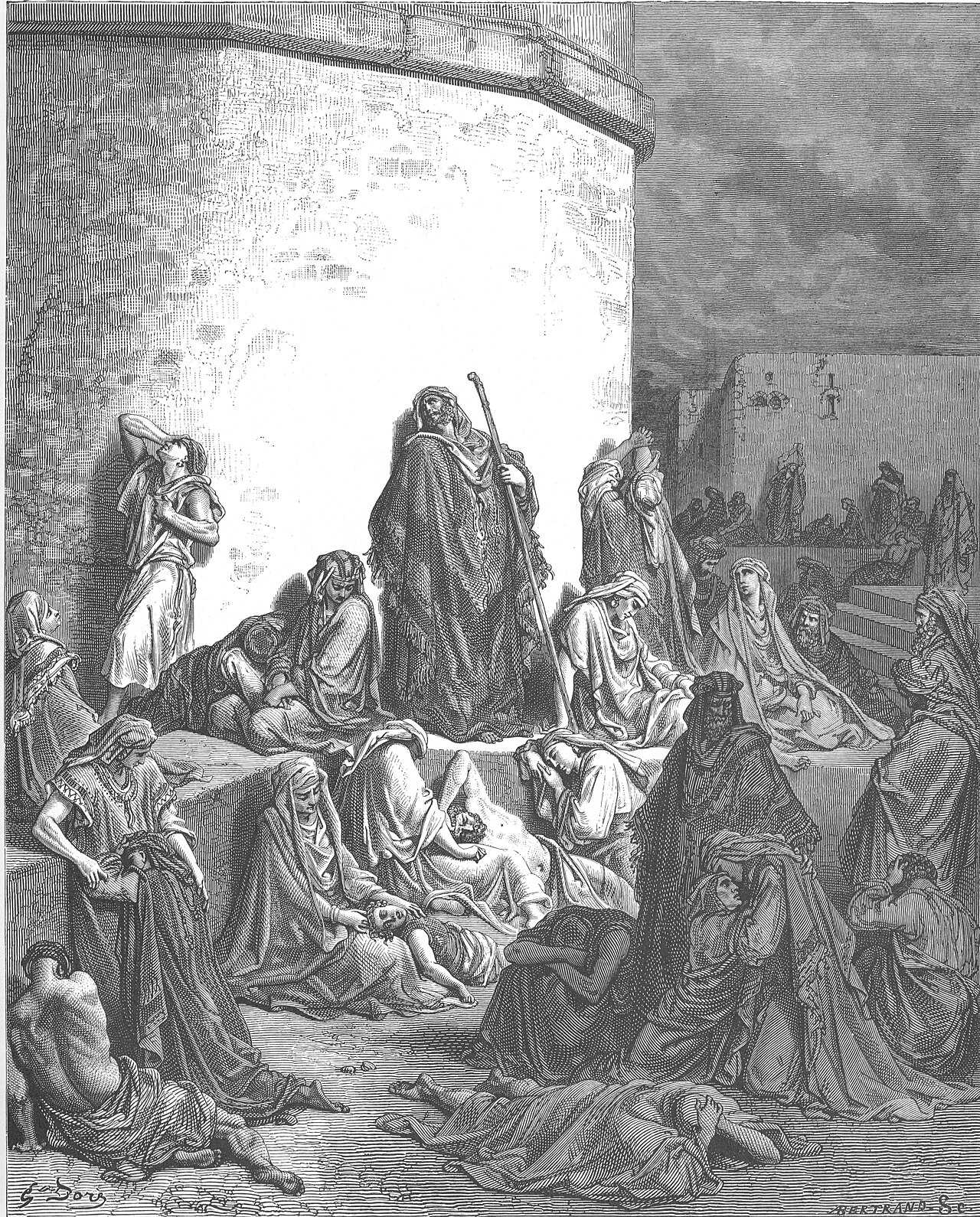
Who and where
2 names in this verse with a page on the site.
This page draws on Adam Clarke, Commentary on the Bible; Albert Barnes, Notes, Explanatory and Practical, on the Old and New Testaments (1832-1869); Carl Friedrich Keil, Lamentations; John Gill, Exposition of the Old Testament (1748-1763); Matthew Henry, Commentary on the Whole Bible and Thomas Aquinas, Commentary on Lamentations.