
Place
Peniel
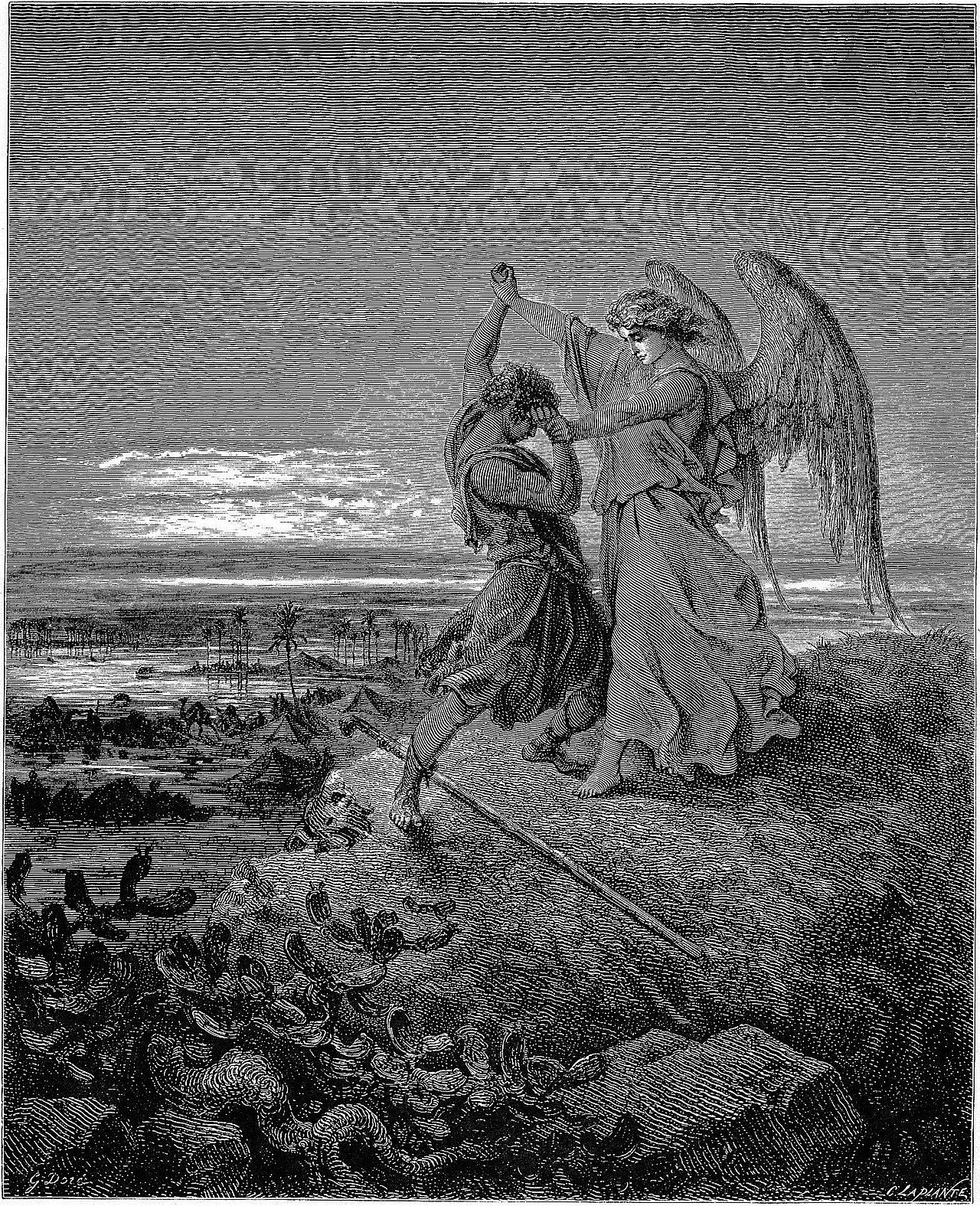
Gustave Doré, La Sainte Bible (Tours: Alfred Mame et fils, 1866). Public domain.
Summary
The ford of the Jabbok where Jacob wrestled God 'face to face' (Gen 32:30).
- At the ford of the Jabbok, alone in the night, Jacob wrestled with a man until daybreak.
- The man struck Jacob's hip and renamed him Israel, "because you have struggled with God and with men, and you have prevailed."
- Jacob named the place Peniel, "for I have seen God face to face, and yet my life was spared."
- This site's own tradition reads the wrestler as the Angel of the LORD, a pre-incarnate appearance of Christ, consistent with its reading of the Angel elsewhere in Scripture.
- Penuel returns later in Gideon's pursuit of Midian, in Jeroboam's building projects, and in Hosea's own reading of the wrestling.
On this page
In Scripture
- Verses
- 1
- Books
- 1
Near Peniel
- The Jordan River19 km · 12 mi NW
- Ammon33 km · 21 mi SE
- Sychar37 km · 23 mi W
- Gilgal40 km · 25 mi SW
- Shechem40 km · 25 mi W
- Mount Gerizim41 km · 25 mi W
Straight-line distances, computed from the gazetteer coordinates.
Where it is
the country around it
- Coordinates
- 32.1844° N, 35.7029° Efind it on the Atlas →
- Region
- Transjordan (the Jabbok)
1 place the record names with Peniel, the farthest 40 km away
- Located: the gazetteer fixes one site
- Placed: the point stands for an area, or is rounded
- A dashed line ends at a place the gazetteer does not fix
Why Peniel matters
What has been found
the evidence, and where it is disputed
Jacob wrestles at the Jabbok
Genesis 32:22-32, in the order it happens
Read Genesis 32:22-32, in the order it happens
- Jacob crosses the ford of the JabbokGenesis 32:22During the night Jacob got up and took his two wives, his two maidservants, and his eleven sons, and crossed the ford of the Jabbok.
- Left alone, a man wrestles with himGenesis 32:24So Jacob was left all alone, and there a man wrestled with him until daybreak.
- The hip is struckGenesis 32:25When the man saw that he could not overpower Jacob, he struck the socket of Jacob’s hip and dislocated it as they wrestled.
- "I will not let you go unless you bless me"Genesis 32:26Then the man said, “Let me go, for it is daybreak.” But Jacob replied, “I will not let you go unless you bless me.”
- Renamed IsraelGenesis 32:28Then the man said, “Your name will no longer be Jacob, but Israel, because you have struggled with God and with men, and you have prevailed.”
- "I have seen God face to face"Genesis 32:30So Jacob named the place Peniel, saying, “Indeed, I have seen God face to face, and yet my life was spared.”
- The sun rises as he passes by, limpingGenesis 32:31The sun rose above him as he passed by Penuel, and he was limping because of his hip.
Who Jacob wrestled is the question the page keeps returning to. This site's own tradition, set out at /featured/christophany, reads the wrestler as the Angel of the LORD, the same figure met at the bush and in the furnace. Hosea 12:3-4 calls him both "God" and "the angel" in the same breath, the clearest identification Scripture makes of its own scene.
Jacob Wrestles the Angel: the full studyWhat happened here, in order
in the order the canon tells it
- Gideon asks bread at Penuel and is refusedJudges 8:8From there he went up to Penuel and asked the same from them, but the men of Penuel gave the same response as the men of Succoth.
- Gideon threatens the towerJudges 8:9So Gideon told the men of Penuel, “When I return in triumph, I will tear down this tower!”
- The tower of Penuel fallsJudges 8:17He also pulled down the tower of Penuel and killed the men of the city.
- Jeroboam builds Penuel1 Kings 12:25Then Jeroboam built Shechem in the hill country of Ephraim and lived there. And from there he went out and built Penuel.
- Hosea reads the wrestling into Israel's own nameHosea 12:3In the womb he grasped his brother’s heel, and in his vigor he wrestled with God.
- Hosea names the wrestler both God and the angelHosea 12:4Yes, he struggled with the angel and prevailed; he wept and sought His favor; he found Him at Bethel and spoke with Him there—
Peniel in Scripture
1 verse names it, in 1 book
Open a book to read its mentions here. Text: Berean Standard Bible.
Old Testament1 book · 1 mention
The account
Read the account as one telling
Common questions
Who was the man Jacob wrestled with at the Jabbok?
Readers differ; the positions are named
Genesis calls him simply "a man," but Jacob himself names the place Peniel because he says he saw God face to face, and Hosea 12:3-4 later calls the same figure both God and the angel in the same two verses. This site reads the wrestler as the Angel of the LORD, a pre-incarnate appearance of Christ, the same tradition it carries at the bush and in the fire with Shadrach, Meshach and Abednego. Other readings, including a created angel sent to test Jacob, are named respectfully on the full study.
Why does Jacob's name change to Israel, and what does the name mean?
The man tells Jacob his name will no longer be Jacob but Israel, giving the reason directly: he has struggled with God and with men, and he has prevailed. The name carries that struggle inside it, and it becomes the name of the whole people descended from him.
Why does Jacob ask the man's name and not receive it?
Jacob asks directly, and the man answers with a question of his own, "Why do you ask my name?," and blesses him without ever giving it. Scripture does not explain the refusal. What Jacob receives instead is the new name for himself and the name he gives the place, Peniel, the face of God.
Why do the Israelites not eat the hip tendon, per Genesis 32:32?
The text ties the practice directly to this night: the tendon at the socket of Jacob's hip was struck as they wrestled, and Israel remembers that wound by leaving that tendon out of what they eat, to this day the text was written.
What happens at Penuel later, in Gideon's story and in Jeroboam's reign?
Gideon, exhausted and still pursuing two Midianite kings, asked the men of Penuel for bread as he had asked Succoth, and they refused him the same way. He kept his word after his victory and tore down the town's tower, killing its men. Generations later, after the kingdom split, Jeroboam rebuilt Penuel as one of his own building projects, alongside Shechem.
Sources cited
- OpenBible.info Bible Geocoding: Penielread 2026-08-20The coordinates on this page. Used under CC-BY with attribution to OpenBible.info.
- Berean Standard BiblePublic domain since 2023. All Scripture quoted on this page, from the site's own verse store.
- Gustave Doré, La Sainte Bible (Tours: Alfred Mame et fils, 1866)The engraving on this page. Public domain.
- Wikipedia, "Penuel"The Tulul adh-Dhahab candidate site and the disputed identification, added in re-verification session 7. The primary survey report was not fetched this session, so the encyclopedia is cited directly rather than a source not itself verified.
Keep studying
On this page
Keep this page