

Bel and the Dragon · Featured Study · A Labeled Study Resource, Not Canon
The Idol Who Ate Nothing
The king of Babylon has an argument for his god, and it is empirical: Bel eats. Twelve measures of flour, forty sheep, six vessels of wine — gone every night. What god could be more alive? Daniel’s reply begins with a smile and ends with the ancient world’s first recorded detective sting: ashes sifted silently across the temple floor at sealed doors — and in the morning, footprints. Men, women, and children, padding nightly through a hidden door to eat the god’s dinner. Bel and the Dragon is apologetic satire — the era laughing idolatry out of the room with evidence — and its method is startlingly close to this site’s own: don’t argue; look at the floor. This page walks the case, and lands where the prophets landed long before the tale was told.
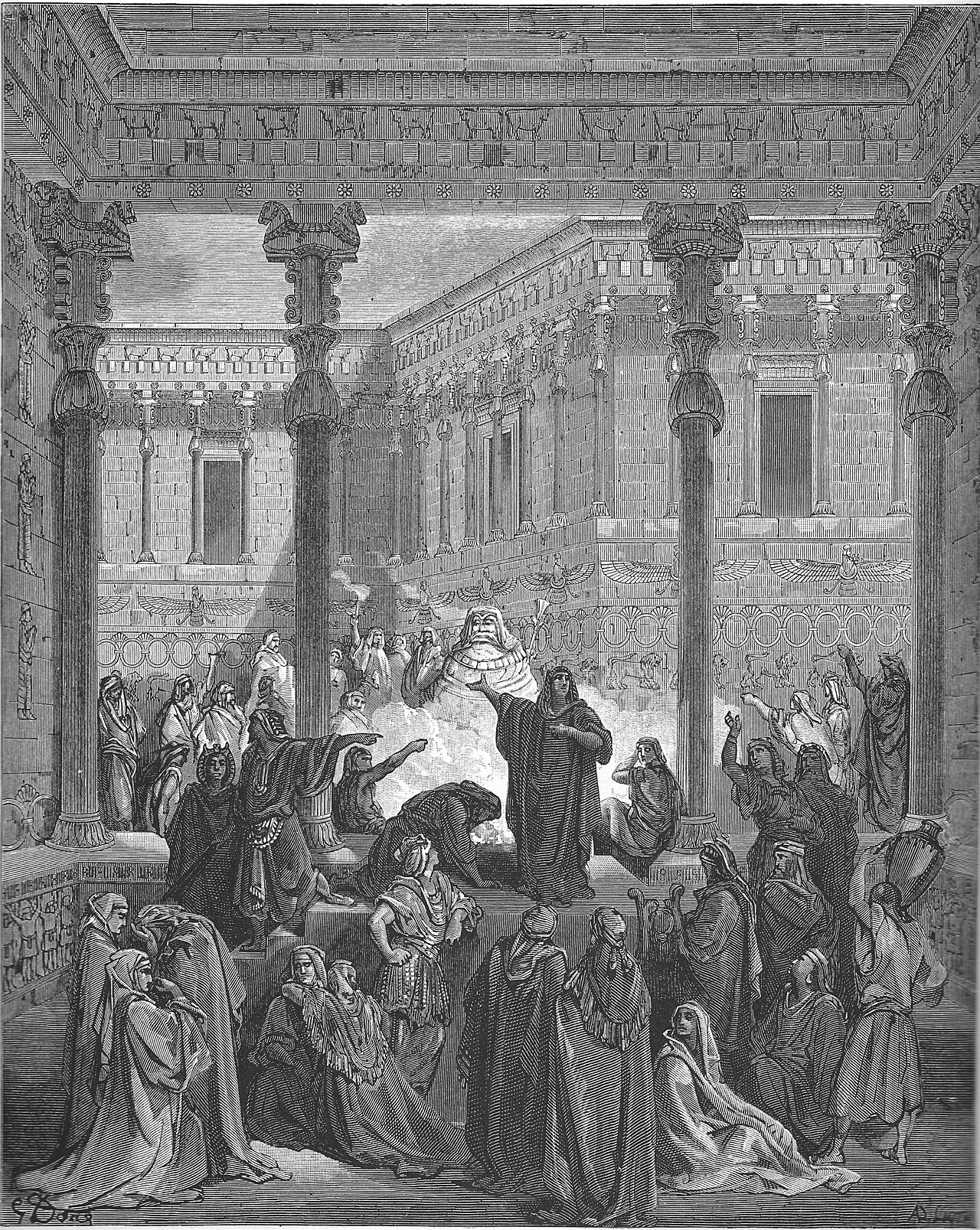
Gustave Doré, Daniel Confounds the Priests of Bel, 1866. Public domain.
Summary
Daniel proves the idol Bel is not alive by sifting ashes across the sealed temple floor and finding the priests' footprints in the morning, since they had been sneaking in nightly to eat the offered food themselves. The tale is satire against idolatry, and Isaiah had already said the same thing centuries earlier.
- The king's proof that Bel is a living god is that Bel eats twelve measures of flour, forty sheep, and six vessels of wine every night
- Daniel's ash trap on the pavement reveals footprints of men, women, and children entering through a hidden door
- The sequel has Daniel kill a living dragon the people worship by feeding it cakes that make it burst
- Isaiah 46:1 and Psalm 115 already mocked idols that must be carried, fed, or defended by their own priests
The Sting
the case in four moves: the quoted lines verbatim
1 · THE CLAIM
“Thinkest thou not that Bel is a living God? seest thou not how much he eateth and drinketh every day?” (v. 6): the king's whole theology is a food bill.
2 · THE CONFESSION OF FAITH
“I may not worship idols made with hands, but the living God, who hath created the heaven and the earth, and hath sovereignty over all flesh.” (v. 5)
3 · THE TRAP
Daniel has ashes sifted across the temple pavement after the food is laid out and the doors sealed. The priests come by night through their hidden door, with their wives and children, and eat it all: as every night.
4 · THE REVEAL
“Behold now the pavement, and mark well whose footsteps are these. And the king said, I see the footsteps of men, women, and children.” (vv. 19–20)
The sequel doubles the satire: shown a great dragon that undeniably eats, Daniel feeds it cakes of pitch, fat, and hair — “and so the dragon burst in sunder: and Daniel said, Lo, these are the gods ye worship” (v. 27). One god exposed because he could not eat; the other because he did. The tale’s logic is ruthless: whatever can be starved or fed to death is not God.
- v. 5“but the living God”: the creed
- ashesthe ancient world's first sting
- 2 godsone starved, one burst
- Isa 46:1the prophets said it first
The Prophets Said It First
the tale's whole argument, already in the canon
“Bel crouches; Nebo cowers. Their idols weigh down beasts and cattle… unable to relieve the burden; but they themselves go into captivity.” Isaiah 46:1–2 (BSB)
The very god by name: Bel, a load on a donkey, centuries before the tale was written. And the Psalmist had already drawn the satire’s sharpest line: “Their idols are silver and gold, The work of men’s hands… They that make them shall be like unto them; Yea, every one that trusteth in them” (Ps 115:4, 8). The addition invents nothing; it dramatizes the canon’s standing verdict on every god that must be carried, fed, or defended by its priests. That is why the church could enjoy this tale for two millennia while keeping it exactly where this site keeps it: beside the canon, never in it.
The God Who Feeds
the inversion the gospel completes
Every idol in this tale is defined by what it consumes: flour, sheep, wine, and finally the offerings of the credulous. The living God of Daniel’s creed (v. 5) stands at the opposite pole, and the gospel drives the inversion home: the true God is not fed by human hands but feedsthem: manna in the wilderness, loaves on a hillside, and at last a table where He himself is host: “I am the bread of life: he that cometh to me shall not hunger” (John 6:35). Bel ate nothing and demanded everything; Christ demanded nothing and gave everything: His own body, broken. The tale remains a labeled study resource, the Bible remains the sixty-six books, and the footprints in the ashes remain one of the era’s best sermons: examine the evidence, and worship only what is actually alive.
The Voices on the Satire
with the work named
An Introduction to the Apocrypha (Oxford University Press, 1957)
The standard introduction to the Daniel additions: Bel and the Dragon as polemical narrative against idolatry, told with the era's sharpest satirical edge.
Daniel (Koinonia House commentary)
Marcus Brown's formative teacher on the canonical Daniel in Babylon: the same court, the same faithful exile, whose canonical confrontations with idolatry this tale extends in story form.
Preface to Daniel (c. AD 407)
Public domain. Jerome marked the Greek Daniel additions and recorded the church's early questions about them: the honest boundary this shelf still keeps.
The Apocrypha and Pseudepigrapha of the Old Testament, vol. I (Oxford, 1913)
The standard critical edition: introduction and notes to Bel and the Dragon.
Marcus Brown's own commentary leads above all; within a tier, all voices are equal.
Read the Great Books
the works this study is built on
Bel and the Dragon
a Greek addition to Daniel: a labeled study resource, not canon
Both stings and the lions’ den reprise, in MannaFest’s own reader.
READ IT →Isaiah 44–46
Scripture: read it in MannaFest’s own reader
The canon’s own idol satire: the carpenter’s god, and Bel on a donkey.
READ IT →The Apocrypha and Pseudepigrapha of the Old Testament, vol. I
R. H. Charles, ed. · 1913
The standard critical edition: introduction and notes to the tale.
READ IT FREE →Keep studying
On this page
Places1
Go further1