
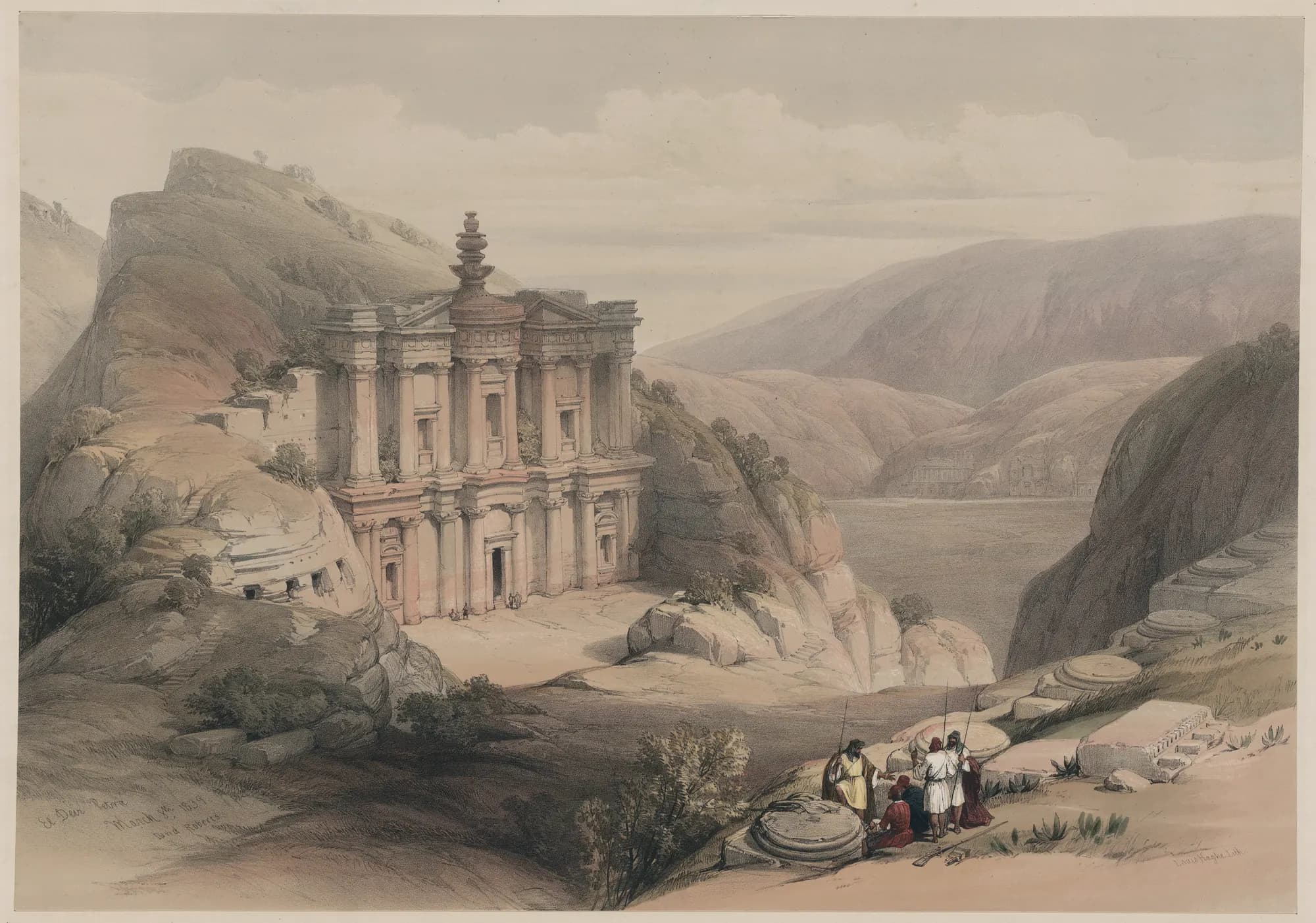
El Deir, Petra, David Roberts, 1839, Library of Congress. Public domain.
Old Testament · Book 31 of 66
Obadiah
Obadiah is the shortest book in the Old Testament, a single chapter of twenty-one verses. It announces God's judgment on Edom for rejoicing when Jerusalem fell and ends with the kingdom belonging to the LORD.
Obadiah is the shortest book in the Old Testament, a single chapter of twenty-one verses. It announces God's judgment on Edom for rejoicing when Jerusalem fell and ends with the kingdom belonging to the LORD.
What is Obadiah about?
Obadiah is the shortest book of the Old Testament, one chapter of a vision against Edom, the nation descended from Esau. Edom lives high in the clefts of the rock and thinks no one can bring it down, and the LORD says he will. The charge is what Edom did on the day Jerusalem fell: it stood aloof, then gloated, entered the gate, looted and handed over the fugitives. The book then widens to the day of the LORD on all the nations, when each deed returns on the doer. It ends with deliverance on Mount Zion and one last line: “the kingdom will belong to the LORD” (1:21).
All 1 chapters
Every chapter of the book, in one grid. Each cell opens that chapter.
- Edom brought down1:1 to 9
- The day you stood aloof1:10 to 14
- The day of the LORD1:15 to 21
The book is one chapter, and its three movements are verse ranges of it. The cell opens the chapter's Study level.
Who wrote it, where, when, for whom, and why?
The book calls itself the vision of Obadiah and gives what the Lord GOD says about Edom (1:1). It names no father, no town and no king. The name Obadiah is borne by other men in Scripture, among them the steward of Ahab's house who hid a hundred prophets (1 Kings 18:3 to 4), and the book ties its prophet to none of them.
This is the vision of Obadiah: This is what the Lord GOD says about Edom—We have heard a message from the LORD; an envoy has been sent among the nations to say, “Rise up, and let us go to battle against her!”—
Obadiah 1:1, Berean Standard Bible.
The vision is spoken against Edom, whose people live in the clefts of the rocks on the heights (1:3), in the mountains of Esau (1:8 to 9) and in Teman (1:9). It looks to Jerusalem, whose gate was entered (1:11 and 13), and to Zion (1:17 and 21). Its last verses name the Negev, the foothills, Ephraim, Samaria, Gilead, Zarephath and Sepharad (1:19 to 20).
The book names no year. It speaks of a day when strangers carried off Jerusalem's wealth, foreigners entered its gate and lots were cast for the city (1:11). Scripture records Edom's revolt and a raid on Jerusalem in the days of Jehoram (2 Kings 8:20; 2 Chronicles 21:16 to 17), and it records the Babylonian capture of the city (2 Kings 25:8 to 10). Psalm 137:7 asks the LORD to remember the sons of Edom on the day Jerusalem fell. Which day Obadiah recalls stands under the Hard Questions.
The vision is spoken to Edom in the second person through 1:16. Its hearers are the people of Judah, whose brother had stood aloof (1:11 to 12), and from 1:17 the book speaks of the house of Jacob and the exiles of Jerusalem (1:20).
The book gives its reason in the LORD's words: the violence against Edom's brother Jacob (1:10) and the rule that what Edom has done will be done to it (1:15). It ends with deliverance and the kingdom the LORD's (1:17 and 21).
Edom and Israel were brothers by descent: Esau is Edom (Genesis 36:8), and the law told Israel not to despise an Edomite, because he is its brother (Deuteronomy 23:7). Edom had refused Israel passage on the way from Egypt (Numbers 20:18 to 21). Amos charges Edom with pursuing his brother with the sword (Amos 1:11), and Jeremiah's oracle against Edom shares whole lines with Obadiah (Jeremiah 49:7 to 22).
Sources. In Obadiah, 1:1, 1:3, 1:8 to 9, 1:10 to 13, 1:15 to 17 and 1:19 to 21; Genesis 36:8; Numbers 20:18 to 21; Deuteronomy 23:7; 1 Kings 18:3 to 4; 2 Kings 8:20; 2 Kings 25:8 to 10; 2 Chronicles 21:16 to 17; Psalm 137:7; Jeremiah 49:7 to 22; Amos 1:11. Every verse is read in the Berean Standard Bible.
How is Obadiah arranged, and what is it for?
The three movements of its one chapter, then what it teaches and what it was given to do.
- Edom brought downObadiah 1:1 to 9, 9 verses, the turn at 1:4
The vision against Edom: the nest among the stars brought down, its treasure searched out, its allies false and its wise men gone.
- The day you stood aloofObadiah 1:10 to 14, 5 verses, the turn at 1:11
The charge: violence against a brother, and eight things Edom should not have done on the day Jerusalem fell.
- The day of the LORDObadiah 1:15 to 21, 7 verses, the turn at 1:15
The day near for all nations, the deed returned on the doer, deliverance on the holy mountain and the kingdom the LORD's.
The theme
The LORD judges Edom for its pride and for what it did to its brother on the day Jerusalem fell. The height Edom trusted will not keep it, and the allies it trusted will turn on it. Its charge is that it watched and then joined in, and the rule the book states is that the deed returns on the doer. The judgment on one nation opens onto the day of the LORD on every nation, and the last word is that the kingdom belongs to the LORD.
The purpose
Obadiah was given to answer what Edom had done to Judah and to say that the LORD had seen it. It told a people who had watched their city looted and their fugitives handed over that the proud neighbour would be brought down, that Zion would be holy again, and that the land would be possessed. It leaves the reader with the kingdom the LORD's.
The ladder of the day: 8 things Edom should not have done
At the crossroads1:14
- 8“deliver up their survivors”in the day of their distress
- 7“stand at the crossroads to cut off their fugitives”in the day of their distress
Inside the gate1:13
- 6“loot their wealth”in the day of their disaster
- 5“gloat over their affliction”in the day of their disaster
- 4“enter the gate of My people”in the day of their disaster
From a distance1:12
- 3“boast proudly”in the day of their distress
- 2“rejoice over the people of Judah”in the day of their destruction
- 1“gloat in that day”in that day
The foot: the day itself1:11
“you stood aloof”, and then “you were just like one of them”.
The three steps
- 1. From a distance, 3 lines, 1:12
- 2. Inside the gate, 3 lines, 1:13
- 3. At the crossroads, 2 lines, 1:14
Each step stands wider than the one below it at the desktop width, as Edom's part grows.
The turn, 1:15“As you have done, it will be done to you”Edom brought down
What the text says in these 9 verses, and the pages they open on.
The book opens as the vision of Obadiah and what the Lord GOD says about Edom. An envoy has gone out among the nations to call them to battle against her (1:1). The LORD will make Edom small and despised (1:2). Edom lives in the clefts of the rocks on the heights and asks who can bring it down, and the LORD answers that even from a nest among the stars he will bring it down (1:3 to 4). Thieves take only what they want and grape gatherers leave gleanings, but Esau will be searched out to his hidden treasures (1:5 to 6). His allies will deceive him and those who eat his bread will set a trap (1:7). The wise men of Edom will be destroyed and the mighty men of Teman terrified (1:8 to 9).
Though you soar like the eagle and make your nest among the stars, even from there I will bring you down,” declares the LORD.
- Study
Obadiah 1one chapter of 21 verses: Edom's pride, the day it stood aloof, and the day of the LORDShow the summary and 5 pagesShow summary, 5 pagesHide the summary
Twenty-one verses, the shortest book in the Old Testament, aimed entirely at Edom, the sons of Esau, dwelling in the clefts of the rock and saying in their heart, Who shall bring me down to the ground? The answer: 'Though you soar like the eagle and make your nest among the stars, even from there I will bring you down'. Thieves leave gleanings; Esau will be ransacked bare, betrayed by his own confederates. The sin is family treachery on the day Jerusalem fell, standing aside, gloating, looting, cutting down the refugees at the crossway. 'As you have done, it will be done to you' (v15). Deliverance stands on mount Zion, 'And the kingdom will belong to the LORD.'
On this chapter (5)
- The day of the LORD
The day the prophets name, near for all the nations.
- Jacob have I loved
Jacob and Esau, from Genesis to Romans.
- When was Obadiah written, and which fall of Jerusalem does it recall?
Answered under Where do readers disagree, lower on this page, with each reading and who holds it.
- Who borrowed from whom, Obadiah or Jeremiah 49?
Answered under Where do readers disagree, lower on this page, with each reading and who holds it.
- Obadiah 1:3
The verse on its own page, with the commentators on it by era.
- The day of the LORD
One oracle in two books
This is the vision of Obadiah: This is what the Lord GOD says about Edom—We have heard a message from the LORD; an envoy has been sent among the nations to say, “Rise up, and let us go to battle against her!”— “Behold, I will make you small among the nations; you will be deeply despised. The pride of your heart has deceived you, O dwellers in the clefts of the rocks whose habitation is the heights, who say in your heart, ‘Who can bring me down to the ground?’ Though you soar like the eagle and make your nest among the stars, even from there I will bring you down,” declares the LORD.
I have heard a message from the LORD; an envoy has been sent to the nations: “Assemble yourselves to march against her! Rise up for battle!” “For behold, I will make you small among nations, despised among men. The terror you cause and the pride of your heart have deceived you, O dwellers in the clefts of the rocks, O occupiers of the mountain summit. Though you elevate your nest like the eagle, even from there I will bring you down,” declares the LORD.
Characters (4)
Who the text names. A name with a page carries its door.
- Obadiah
The prophet whose vision this is, named in the first line alone.
- Esau and Edom
The nation descended from Esau, addressed as one proud dweller on the heights.
- The nations
Summoned by the LORD's envoy to rise up for battle against Edom.
- The wise men of Teman
The men of understanding Edom was known for, destroyed in that day.
Places (4)
Where these verses stand.
Themes (2)
What these verses raise, each on its own page where one stands.
- Pride
The pride of the heart that has deceived Edom.
- The Twelve
The book of the twelve prophets Obadiah stands in, fourth in order.
No New Testament passage quotes or names these chapters.
The day you stood aloof
What the text says in these 5 verses, and the pages they open on.
The reason for the judgment comes next. It is violence against Edom's brother Jacob, and for it Edom will be covered with shame and cut off forever (1:10). On the day strangers carried off Jerusalem's wealth and cast lots for the city, Edom stood aloof and was like one of them (1:11). Eight lines follow, each naming something Edom should not have done in the day of Judah's distress. It gloated, rejoiced and boasted from a distance (1:12). It entered the gate, gloated over the affliction and looted the wealth (1:13). Last, it stood at the crossroads to cut off the fugitives and handed over the survivors (1:14).
On the day you stood aloof while strangers carried off his wealth and foreigners entered his gate and cast lots for Jerusalem, you were just like one of them.
The eight lines of this movement are drawn as the ladder of the day, under The book as a whole.
Characters (4)
Who the text names. A name with a page carries its door.
- Jacob
Edom's brother, whose people suffered the violence.
- The people of Judah
Those Edom gloated over in the day of their destruction.
- Strangers and foreigners
Those who carried off the wealth and cast lots for Jerusalem.
- The fugitives
Those Edom cut off at the crossroads and handed over.
Places (3)
Where these verses stand.
- Jerusalem
The city whose gate was entered and over which lots were cast.
- The gate of My people
The gate Edom should not have entered.
- The crossroads
Where Edom stood to cut off those who fled.
Themes (2)
What these verses raise, each on its own page where one stands.
- Brother against brother
The violence against a brother, which the charge rests on.
- Standing by
Watching the day of a brother's disaster, and then joining in.
No New Testament passage quotes or names these chapters.
The day of the LORD
What the text says in these 7 verses, and the pages they open on.
The day of the LORD is near for all the nations, and what Edom did will be done to it (1:15). As the nations drank on the LORD's holy mountain, they will drink until they are as if they had never existed (1:16). On Mount Zion there will be deliverance and holiness, and the house of Jacob will reclaim its possession (1:17). Jacob and Joseph will be a fire and the house of Esau stubble (1:18). The land is possessed region by region, from the Negev and the foothills to Ephraim, Samaria and Gilead, and the exiles return as far as Zarephath and from Sepharad (1:19 to 20). The deliverers go up to rule the mountains of Esau, and the kingdom belongs to the LORD (1:21).
For the Day of the LORD is near for all the nations. As you have done, it will be done to you; your recompense will return upon your own head.
The land possessed, north to south
The regions (7)
- 1The mountains of Esau1:19, ApproximatePossessed by those from the Negev.
- 2The land of the Philistines1:19, ApproximatePossessed by those from the foothills.
- 3The fields of Ephraim and Samaria1:19, ApproximatePossessed by the house of Jacob.
- 4Gilead1:19, ApproximatePossessed by Benjamin.
- 5The land of the Canaanites as far as Zarephath1:20, LocatedPossessed by the exiles of the Israelites.
- 6The cities of the Negev1:20, ApproximatePossessed by the exiles from Jerusalem in Sepharad.
Sepharad1:20, UnlocatedThe place where the exiles of Jerusalem are, off the map; where it stood is asked under Where do readers disagree.
A solid circle is located, a dashed circle approximate, and a dashed box unlocated.
Characters (3)
Who the text names. A name with a page carries its door.
- The house of Jacob and the house of Joseph
A fire and a flame, set against the house of Esau.
- The exiles
The exiles of Israel and of Jerusalem who possess the land again.
- The deliverers
Those who go up to rule the mountains of Esau.
Places (6)
Where these verses stand.
- Mount Zion
Where there will be deliverance, and holiness.
- The Negev
The south, whose people possess the mountains of Esau.
- The Shephelah
The foothills, whose people possess the land of the Philistines.
- Gilead
The land east of the Jordan that Benjamin will possess.
Show the next 2
- Zarephath
The northern limit of the land the exiles of Israel possess.
- Sepharad
The place the exiles of Jerusalem return from, unlocated.
Themes (4)
What these verses raise, each on its own page where one stands.
- The day of the LORD
The day near for all the nations.
- The deed returned
As you have done, it will be done to you.
- The remnant
Those who escape and find deliverance.
- The kingdom
The last line of the book: the kingdom the LORD's.
No New Testament passage quotes or names these chapters.
Where the New Testament uses these chapters (2)each marked as a quotation or an allusion, with the evidence
- Later Christian readingThe deed returned, 1:15 at Matthew 7:2. The measure returned on the doer is linked in the store's cross references to the measure Jesus says will be measured back to those who judge. Held by the store's cross references, which link the two verses by theme. Matthew names no prophet and quotes no line of Obadiah.
- Later Christian readingObadiah 1:21 at Revelation 11:15. The kingdom the LORD's has been read beside the voices at the seventh trumpet, when the kingdom of the world becomes the kingdom of our Lord and of His Christ. Held by Robert Jamieson, A. R. Fausset and David Brown, Commentary Critical and Explanatory on the Whole Bible, on 1:21, who read the kingdom as the LORD's under Messiah. Revelation names no prophet.
- Author
- Obadiah (v. 1), no patronymic or home given
- Date
- Disputed: either shortly after 586 BC (Edom's complicity in Jerusalem's fall, Ps 137:7) or pre-exilic
- Audience
- The covenant community reflecting on Edom's fate
Where do readers disagree?
One list: the readings with their holders, and what the evidence does not settle.
When was Obadiah written, and which fall of Jerusalem does it recall?
- Shortly after the Babylonian capture of 586 BC. Held by Leslie C. Allen, The Books of Joel, Obadiah, Jonah and Micah (1976), and by Paul R. Raabe, Obadiah, Anchor Bible (1996).
- The raid in the days of Jehoram. Held by E. B. Pusey (1860) and by Carl Friedrich Keil (1868), in their commentaries on the Minor Prophets named under Sources.
- A prophet of the time of Hosea and Amos. Held by Ephrem the Syrian in his Commentary on Obadiah, on 1:1, who calls him a contemporary of Hosea, Joel, Amos and Isaiah.
What the evidence does not settle: The book names no king and no empire, so the date rests on which recorded fall of Jerusalem best fits 1:11 to 14; the teaching of the book reads the same on either date.
The argument in full
Shortly after the Babylonian capture of 586 BC. The looting, the lots cast for the city and the fugitives handed over fit the fall to Babylon, and Psalm 137:7, Lamentations 4:21 and Ezekiel 35:15 charge Edom with rejoicing at that same event.
The raid in the days of Jehoram. Edom revolted under Jehoram (2 Kings 8:20), and in his reign raiders broke into Judah and carried off the goods of the king's house (2 Chronicles 21:16 to 17). Obadiah names no Babylon, and the book stands among the early prophets of the Twelve.
A prophet of the time of Hosea and Amos. The book's place among the prophets of the eighth century is read as its time.
Who borrowed from whom, Obadiah or Jeremiah 49?
- Jeremiah took up Obadiah's oracle. Held by E. B. Pusey (1860), by Carl Friedrich Keil (1868), and by Carl Paul Caspari, Der Prophet Obadja ausgelegt (1842).
- Both drew on an older word against Edom. Held by Leslie C. Allen, The Books of Joel, Obadiah, Jonah and Micah (1976).
- The same words given to two prophets. Held by Adam Clarke, Commentary on the Bible, on 1:1, who sends the reader to Jeremiah 49:14, where the same expressions are found.
What the evidence does not settle: No text outside the two books says which came first, and the order of the shared lines differs between them (1:5 and Jeremiah 49:9 reverse the thieves and the grape gatherers).
The argument in full
Jeremiah took up Obadiah's oracle. Obadiah's first nine verses read as one tight unit, while the same lines in Jeremiah 49:7 to 22 stand scattered through a longer oracle with matter Obadiah lacks.
Both drew on an older word against Edom. Each text carries lines the other lacks and neither reads as a straight excerpt of the other, so both are read as taking up an earlier oracle.
The same words given to two prophets. The shared lines are read as one word of the LORD against Edom, spoken through both prophets.
Is Edom in this book one nation, or every proud enemy of God's people?
Jacob have I loved→- The nation of Edom, judged in history. Held by Ephrem the Syrian in his Commentary on Obadiah, on 1:10 and 18.
- A type of the last enemies of God. Held by Robert Jamieson, A. R. Fausset and David Brown, Commentary Critical and Explanatory on the Whole Bible, on 1:4 and 21.
- Every enemy of the church. Held by Jerome in his Commentary on Obadiah, on 1:15, and by Augustine of Hippo, The City of God (426), book 18, chapter 31.
What the evidence does not settle: The day of the LORD at 1:15 widens the book from Edom to all the nations in one verse, so the text supports the historical sentence and the wider one; how far the name Edom itself is read as a type is a judgment of reading.
The argument in full
The nation of Edom, judged in history. The Jews who came back from exile subdued the Edomites, and what David and Amaziah began against Edom was finished after the return.
A type of the last enemies of God. The nest among the stars echoes the king of Babylon in Isaiah 14:13, and Edom is read as the type of the last foes of Israel and of God (Isaiah 63:1 to 4).
Every enemy of the church. Jerome reads the judgment on Edom against the heretics who attack the church, and Augustine reads Edom as a part standing for all the nations.
Where is Sepharad?
- Sardis in Asia Minor. Held by Paul R. Raabe, Obadiah, Anchor Bible (1996).
- Spain. Held by Ephrem the Syrian in his Commentary on Obadiah, on 1:20, who reads it as a province far from Judea.
- The Bosporus. Held by Jerome in his Commentary on Obadiah, on 1:20, from his Hebrew teacher.
- Unknown. Held by Adam Clarke, Commentary on the Bible, on 1:20, who calls it a difficult word and lists the Bosporus, Spain and other guesses.
What the evidence does not settle: Sepharad occurs only at 1:20; the verse's point, that exiles return from far away, stands on any reading.
The argument in full
Sardis in Asia Minor. An Aramaic and Lydian inscription found at Sardis writes the city's name with the consonants of Sepharad.
Spain. The name was read as the far west, and the Jews of the Iberian lands are called Sephardim after it.
The Bosporus. Jerome renders the exiles of Jerusalem as those in the Bosporus.
Unknown. The name stands nowhere else in Scripture, so no other use fixes it.
Who are the deliverers of Obadiah 1:21, and what do the Hebrew and the Greek read there?
- Deliverers like the judges. Held by Albert Barnes, Notes on the Old Testament, on 1:21, who sets the word beside the saviours God raised up in Judges 3:9 and 15.
- Those who have been saved. Held by Adam Clarke, Commentary on the Bible, on 1:21, who notes that several Hebrew manuscripts read mushaim, those saved, as the Greek Septuagint reads.
- Christ and those he sends. Held by John Wesley, Explanatory Notes upon the Old Testament, on 1:21, and by Matthew Henry, Commentary on the Whole Bible, on 1:21, who reads the deliverers as the preachers of the gospel.
What the evidence does not settle: The consonants allow both the active and the passive reading, and the verse names no deliverer; Clarke also reads the historical deliverers Zerubbabel, Ezra, Nehemiah and the Maccabees.
The argument in full
Deliverers like the judges. The Hebrew moshi'im is active, those who save, and the Berean Standard Bible prints deliverers.
Those who have been saved. A small change of vowels makes the word passive, so the verse speaks of the rescued going up to Zion.
Christ and those he sends. The deliverers who go up Zion and the kingdom that is the LORD's are read as fulfilled in Christ and the apostles.
The Text and the Spade
- Busayra, ancient Bozrahexcavated by Crystal-M. Bennett, 1971-1974; Iron Age II occupation
The chief city of Edom, sitting on a spur with steep ground on three sides, with monumental buildings on an artificial platform at its center. Bozrah is named in the parallel Jeremiah oracle and in Isaiah 34:6, 'For the LORD has a sacrifice in Bozrah,' and again in Isaiah 63:1. Obadiah does not name it, and the excavation bears on the book the way the terrain does: Edom was a real kingdom with real fortifications in a country that made attackers work, which is the security verse 3 describes from the inside.
- The seal impression of Qos-gabri, king of Edom, from Umm el-Biyara7th century BC
A clay impression naming Qos-gabri king of Edom, found on the summit of Umm el-Biyara above the later site of Petra during Crystal-M. Bennett's excavations of the 1960s. The same king appears in the records of Esarhaddon and Ashurbanipal as an Assyrian tributary, which fixes an Edomite king in place and time from two independent directions. The find also puts Iron Age Edomite settlement on a cliff summit reached by one difficult ascent, which is the picture of verse 3 in physical form.
- The Edomite ostracon from Horvat Uzalate 7th century BC
A letter written in Edomite script and language, found at a Judahite fort in the eastern Negev and published by Itzhaq Beit-Arieh and Bruce Cresson in 1985. It opens with a blessing in the name of Qos, the god of Edom. Edomite writing inside a Judean fort documents Edomite presence and pressure along Judah's southern border in the generation before Jerusalem fell, which is the setting Obadiah's charge assumes.
- The copper works at Khirbet en-Nahas in the Faynan districtexcavated by Thomas E. Levy and Mohammad Najjar from 2002; dating contested
Industrial-scale copper smelting on the Edomite plateau, with slag mounds meters deep. Levy's radiocarbon program (published with colleagues in the Proceedings of the National Academy of Sciences, 2008) dates the main production to the tenth and ninth centuries BC, which supports the biblical picture of Edom as an organized kingdom in the era of David, Solomon, and Jehoram. Israel Finkelstein and others have argued for lower dates and a later Edomite state, and the question is unsettled. The dispute bears directly on the early dating of Obadiah, since the ninth-century reading needs an Edom capable of acting as a state at that time.
The pages Obadiah opens on
Studies7
Sources for this page
The movements, the chapter entry, the figures and the Context are read off the text of Obadiah. The works behind the readings under Where do readers disagree are Ephrem the Syrian, Commentary on Obadiah (fourth century); Jerome, Commentary on Obadiah (396); Augustine of Hippo, The City of God (426); Matthew Henry, Commentary on the Whole Bible (1710); John Wesley, Explanatory Notes upon the Old Testament (1765); Adam Clarke, Commentary on the Bible (1832); Albert Barnes, Notes on the Old Testament, 1832 to 1869; Carl Paul Caspari, Der Prophet Obadja ausgelegt (1842); E. B. Pusey, The Minor Prophets with a Commentary (1860); Carl Friedrich Keil, Biblical Commentary on the Minor Prophets (1868); Robert Jamieson, A. R. Fausset and David Brown, Commentary Critical and Explanatory on the Whole Bible (1871); Leslie C. Allen, The Books of Joel, Obadiah, Jonah and Micah (1976); and Paul R. Raabe, Obadiah (1996). The two New Testament rows under The day of the LORD are the store's cross references. Every verse quoted on this page is the Berean Standard Bible, read from the store.