
Ecclesiastes 2 and 1 Kings 11 · Story · Purpose and Futility
Solomon, Who Had Everything
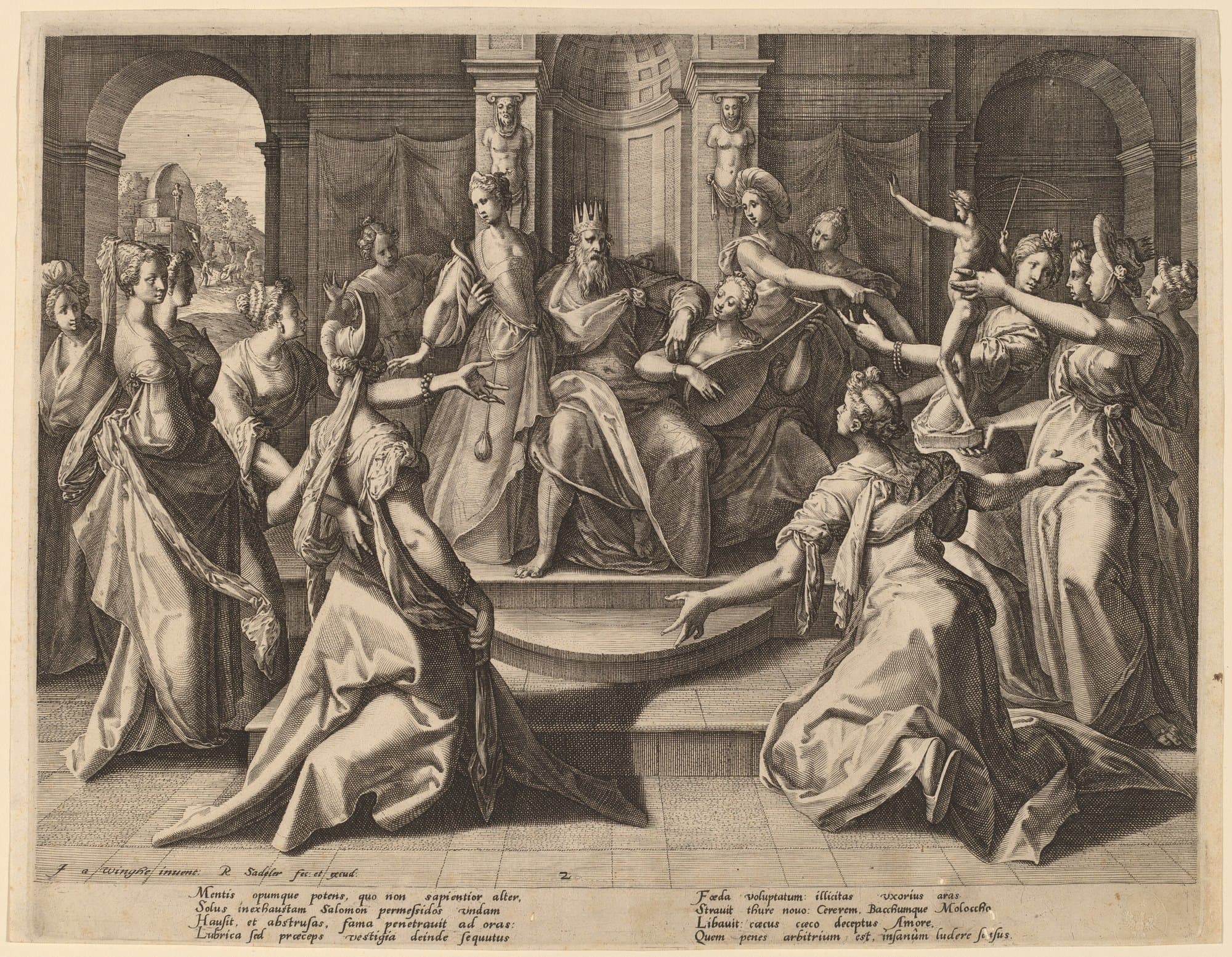
The Teacher of Ecclesiastes judged his pleasures, buildings and wealth futile, and Kings records that King Solomon's foreign wives turned his heart from the LORD.
“There was no silver, because it was accounted as nothing in the days of Solomon” (1 Kings 10:21).
Yet when I considered all the works that my hands had accomplished and what I had toiled to achieve, I found everything to be futile, a pursuit of the wind; there was nothing to be gained under the sun.
- Where
- Jerusalem
- Who
- Solomon
- When
- In Solomon's old age, near the end of a reign of forty years (1 Kings 11:4 and 1 Kings 11:42)
Summary
Ecclesiastes 2 records an experiment in which a king with every means at hand tries what wine, laughter and great works can give, enjoys them, and then weighs what they have left him. Kings sets the same kind of riches around Solomon in Jerusalem and then records how his long reign ended.
- Solomon had seven hundred wives of royal birth and three hundred concubines (1 Kings 11:3).
- The LORD said He would tear the kingdom from Solomon's son and leave him one tribe for the sake of David (1 Kings 11:11 to 13).
- Kings records that Solomon reigned forty years in Jerusalem over all Israel (1 Kings 11:42).
The Teacher's Test
The test began with the pleasures closest to hand.
Solomon, Who Had Everything reads two accounts of royal wealth side by side, one in the Teacher's own words and one in the history of Israel's kings. It belongs to the trial of purpose and futility because both accounts weigh what riches and pleasure can give a life.
Its question is what the Teacher gained and what he concluded, and how the history ends for the richest king of Israel. It gives the test in the Teacher's own order, the riches Kings records, the turning of Solomon's heart and two readings of who the Teacher is.
The book ends with the whole duty of man in Ecclesiastes 12:13, which Purpose and Futility teaches.
These are the words of the Teacher, the son of David, king in Jerusalem:The opening line sets the speaker in David's line and in Jerusalem, the frame for the test that follows.
I said to myself, “Come now, I will test you with pleasure; enjoy what is good!” But it proved to be futile. I said of laughter, “It is folly,” and of pleasure, “What does it accomplish?” I sought to cheer my body with wine and to embrace folly—my mind still guiding me with wisdom—until I could see what was worthwhile for men to do under heaven during the few days of their lives.The Teacher states his test in his own words and gives its first verdict before he describes his works.
The Teacher's Gains Beside Kings' Record
The Teacher's houses, treasure and pleasures have their counterparts in the history of Solomon.
Four of the Teacher's gains have a match in Kings' record of Solomon.
| The gain | The Teacher in Ecclesiastes 2 | Solomon in 1 Kings |
|---|---|---|
| Building | “I built houses and planted vineyards” (Ecclesiastes 2:4) | “He built the House of the Forest of Lebanon” (1 Kings 7:2) |
| Silver and gold | “I accumulated for myself silver and gold” (Ecclesiastes 2:8) | “silver as common in Jerusalem as stones” (1 Kings 10:27) |
| Greatness | “I became great and surpassed all” (Ecclesiastes 2:9) | “in riches and wisdom” (1 Kings 10:23) |
| Delight | “I refused my heart no pleasure” (Ecclesiastes 2:10) | “Solomon clung to these women in love” (1 Kings 11:2) |
The Works of a King
An eighteenth-century commentator reads the Teacher's delight, and the chapter returns to his verdict.
“He met with no disappointment in it to give him any disturbance: This was my portion of all my labour; he had this added to all the rest of his pleasures that in them he did not only see, but eat, the labour of his hands; and this was all he had, for indeed it was all he could expect, from his labours.”
Matthew Henry · Commentary on the Whole Bible · on Ecclesiastes 2:10Puritan
The Teacher's verdict on his works stands in Ecclesiastes 2:11. He comes back to it in Ecclesiastes 2:17, “So I hated life, because the work that is done under the sun was grievous to me.”
The Hebrew word behind futile has a study of its own.
Vanity Under the Sun reads the whole book of Ecclesiastes.
Riches and Wisdom in Kings
Kings measures Solomon's wealth in talents of gold and in the cargo of his ships.
Kings records that “The weight of gold that came to Solomon each year was 666 talents” (1 Kings 10:14). Once every three years his ships of Tarshish came home “bearing gold, silver, ivory, apes, and peacocks” (1 Kings 10:22).
Solomon tells the whole reign, from his anointing to his burial.
Solomon's Request tells how his wisdom began, in the dream at Gibeon of 1 Kings 3.
The Turning of His Heart
The law of the king and the LORD's own word frame the end of the reign.
The law of the king had said, “He must not take many wives for himself, lest his heart go astray. He must not accumulate for himself large amounts of silver and gold” (Deuteronomy 17:17).
“Solomon was master of a great deal of knowledge, but to what purpose, when he had no better a government of his appetites? He was drawn by them to the worship of strange gods, as Israel to Baal-peor by the daughters of Moab. This was the bad consequence of his multiplying wives.”
Matthew Henry · Commentary on the Whole Bible · on 1 Kings 11:2Puritan
For when Solomon grew old, his wives turned his heart after other gods, and he was not wholeheartedly devoted to the LORD his God, as his father David had been. Solomon followed Ashtoreth the goddess of the Sidonians and Milcom the abomination of the Ammonites. So Solomon did evil in the sight of the LORD; unlike his father David, he did not follow the LORD completely. At that time on a hill east of Jerusalem, Solomon built a high place for Chemosh the abomination of Moab and for Molech the abomination of the Ammonites. He did the same for all his foreign wives, who burned incense and sacrificed to their gods.These verses record the turning the law of the king had warned of.
The High Places teaches the shrines that Kings names in 1 Kings 11:7.
Molech and Topheth teaches the worship of the second god named in that verse.
Moab and Ammon teaches two of the peoples named among Solomon's wives in 1 Kings 11:1.
Now the LORD grew angry with Solomon, because his heart had turned away from the LORD, the God of Israel, who had appeared to him twice. Although He had warned Solomon explicitly not to follow other gods, Solomon did not keep the LORD’s command. Then the LORD said to Solomon, “Because you have done this and have not kept My covenant and My statutes, which I have commanded you, I will tear the kingdom away from you and give it to your servant. Nevertheless, for the sake of your father David, I will not do it during your lifetime; I will tear it out of the hand of your son. Yet I will not tear the whole kingdom away from him. I will give one tribe to your son for the sake of My servant David and for the sake of Jerusalem, which I have chosen.”The judgment falls on the next reign, and these verses give the reason the LORD gives for it.
The LORD then raised up adversaries against Solomon, Hadad the Edomite and Rezon the son of Eliada (1 Kings 11:14 and 1 Kings 11:23). Jeroboam son of Nebat, his own servant, rebelled against him (1 Kings 11:26).
Is the Teacher Solomon?
Barnes' Notes and Jamieson, Fausset and Brown hold that Solomon wrote the book, and E. H. Plumptre reads it as written in his person.
Solomon wrote the bookBarnes' Notes on the Bible; Jamieson, Fausset and Brown
The Introduction to Ecclesiastes in Barnes' Notes on the Bible states that “the constant tradition of the Jewish and Christian congregations has handed down Solomon as the author without question”. Jamieson, Fausset and Brown, in their Commentary Critical and Explanatory (1871), called Koheleth “a symbolical name for Solomon”.
Against it stands a note of E. H. Plumptre in his Ecclesiastes for the Cambridge Bible for Schools and Colleges (1888). He wrote that “the name of Solomon is not mentioned as it is in the titles of the other two books ascribed to him”.
A later writer speaks in Solomon's personE. H. Plumptre
Plumptre wrote on Ecclesiastes 1:12 that “A writer aiming at a dramatic impersonation of his idea of Solomon would naturally adopt some such form as this”. On Ecclesiastes 2:4 he wrote that “Here the writer throws himself into the surroundings of the historical Solomon”, and on Ecclesiastes 2:5 he called the word for orchards “originally Persian”.
Against it, Barnes' Notes answers that every word alleged to be later than the captivity has been shown in use before it, or formed by a process in use before it. Plumptre himself judged that the form of Ecclesiastes 1:12 does not by itself exclude the historical Solomon.
From the Hand of God
Near the end of the account of his test, the Teacher names eating and drinking as gifts of God.
Nothing is better for a man than to eat and drink and enjoy his work. I have also seen that this is from the hand of God. For apart from Him, who can eat and who can find enjoyment?The Teacher turns from his gains to the ordinary goods of food and work and says where they come from.
Sources
Scripture is the Berean Standard Bible.
- Barnes' Notes on the Bible, Introduction to Ecclesiastes.
- Robert Jamieson, A. R. Fausset and David Brown, Commentary Critical and Explanatory on the Whole Bible (1871), on Ecclesiastes 1:1.
- E. H. Plumptre, Ecclesiastes, Cambridge Bible for Schools and Colleges (1888), on Ecclesiastes 1:1, Ecclesiastes 1:12, Ecclesiastes 2:4 and Ecclesiastes 2:5.
- Matthew Henry, Commentary on the Whole Bible (1710), on Ecclesiastes 2:10 and 1 Kings 11:2.
Keep Studying
Studies4
People and groups8