
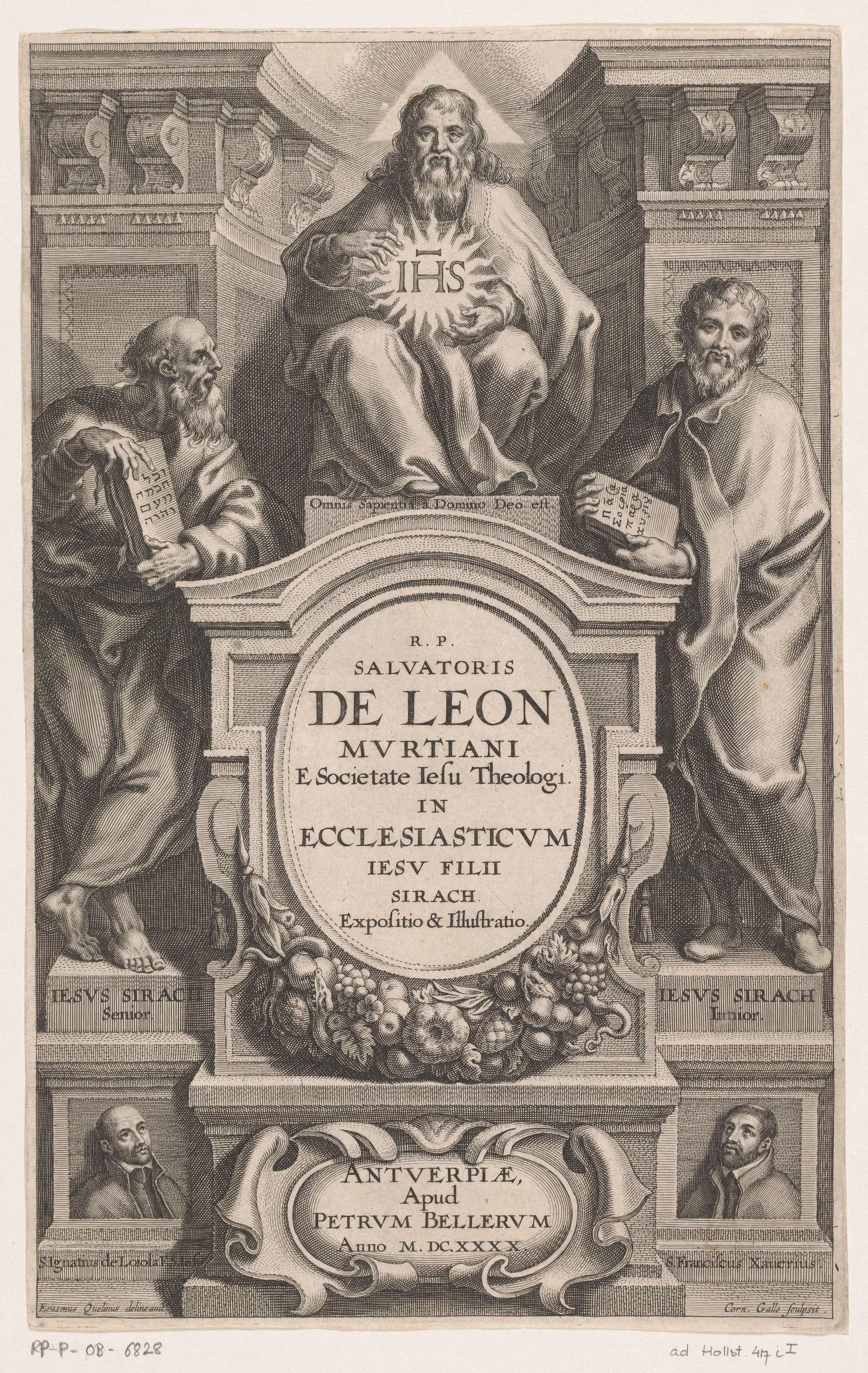
Cornelis Galle, Christ with Jesus Sirach Junior and Senior, 1640. Public domain.
Sirach 1 to 51 · Book · Apocrypha, a study resource beside the canon
Sirach
Sirach is a book of the Apocrypha in fifty-one chapters, written in Hebrew at Jerusalem and put into Greek by the author's grandson.
The first leaf of the lost Hebrew Sirach came to light in 1896.
Take My yoke upon you and learn from Me; for I am gentle and humble in heart, and you will find rest for your souls.
Take My yoke upon you and learn from Me; for I am gentle and humble in heart, and you will find rest for your souls.
- Date
- about 180 to 175 BC, by Box and Oesterley's dating (probable)
- Written by
- Jesus the son of Sirach of Jerusalem
- Occasion
- The author's grandson put the Hebrew book into Greek after he came into Egypt, as his Prologue tells.
- Edition
- Sirach in the King James Version Apocrypha, 1769 text (eBible.org); the Berean Standard Bible for the canon
Summary
The Greek manuscripts title the book the Wisdom of Jesus the son of Sirach. The English versions call it Ecclesiasticus, a title they take from the Latin Vulgate.
- Sirach tells the reader to honour a physician, for the Lord created him, Sirach 38:1.
- The Talmud calls it the Book of Ben-Sira, as Oesterley records.
- Augustine wrote in On the City of God, book 17, chapter 20, that the book was often ascribed to Solomon for a likeness of style.
The Book of Sirach
The writer signs the book with his name and his city, and calls himself the last of the sages.
Near the book's end the writer names himself: "Jesus the son of Sirach of Jerusalem" (Sirach 50:27). In the same verse he says that he "out of his heart poured forth wisdom".
He places himself after the older wise men of Israel: "I awaked up last of all, as one that gathereth after the grapegatherers" (Sirach 33:16). Box and Oesterley read the line as Ben Sira counting himself among the wise, like the authors of Proverbs and Ecclesiastes, though the last in the succession.
The Fear of the Lord in Ben Sira: the book's theme beside Proverbs
The Book at a Glance
Wisdom's hymn stands at chapter 24, near the middle of the fifty-one chapters.
The book runs in seven parts, from the grandson's preface to a closing prayer.
- The PrologueThe grandson's preface to his Greek translation.
- Sayings on wisdomSirach 1 to 23, opening with "All wisdom cometh from the Lord".
- Wisdom's hymnSirach 24, opening with "Wisdom shall praise herself".
- More sayingsSirach 25:1 to 42:14, on households, friends, the physician and the scribe.
- The works of GodSirach 42:15 to 43:33, opening with "I will now remember the works of the Lord".
- The praise of the fathersSirach 44 to 50, from "Let us now praise famous men" to Simon the high priest.
- The closing prayerSirach 51, a thanksgiving and a poem on seeking wisdom.
Each part with its chapters and its opening words in the King James text.
Sirach Beside the Canon
Sirach gives Elijah the work Malachi foretold for him.
Ben Sira praises Elijah as the one ordained to turn the heart of the father to the son, and "to restore the tribes of Jacob" (Sirach 48:10). The turning of the hearts comes from the last lines of Malachi.
And he will turn the hearts of the fathers to their children, and the hearts of the children to their fathers. Otherwise, I will come and strike the land with a curse.”Benson held that the son of Sirach grounded his hope of Elijah on this passage. The Cambridge Bible doubted that Sirach 48:10 proves more than his knowledge of the prophecy. Keil and Delitzsch read Sirach as taking the prophet to be Elijah himself, and judged that reading wrong.
Bonaventure, in his Commentary on Luke, set Sirach 48 beside the angel's word to Zechariah about John the Baptist.
And he will go on before the Lord in the spirit and power of Elijah, to turn the hearts of the fathers to their children and the disobedient to the wisdom of the righteous—to make ready a people prepared for the Lord.”Where the Book Came From
Box and Oesterley traced the book's author, its date, its translation and its lost Hebrew.
In R. H. Charles's Apocrypha and Pseudepigrapha of the Old Testament (1913), G. H. Box and W. O. E. Oesterley held that the author's name was Jesus, and that Sira was the name of his grandfather.
They placed the writing of the book in the years before the Maccabean conflict, since the book makes no allusion to the events that led up to it.
The grandson's Prologue dates his coming into Egypt to the "eight and thirtieth year" of Euergetes. Box and Oesterley reckoned that year as 132 BC, the thirty-eighth year of Ptolemy Euergetes II, and put the translation some few years later.
The Hebrew text, by their account, vanished from knowledge in the eleventh century. A single leaf of it, Sirach 39:15 to 40:7, came among manuscript fragments brought from the East by Mrs. Lewis and Mrs. Gibson. Schechter, then Reader in Talmudic at Cambridge, recognized it. The fragments had come from the Genizah at Cairo, and he went there and brought much of that collection to Cambridge. The manuscripts recovered by 1913 gave a Hebrew text for about two-thirds of the book.
Older Hebrew copies were found near the Dead Sea in the 1950s and 1960s. A scroll from Masada holds Sirach 39:27 to 44:17, and the Great Psalms Scroll from Qumran holds part of Sirach 51.
Who Receives the Book
Witnesses from the second century to the sixteenth set the book's standing.
The Didache and Barnabas quote Sirach, two African councils count it canonical, Jerome sets it outside the canon, Trent counts it in, and Article VI names it among the other books.
| Who | What they do with the book |
|---|---|
| The Didache, chapter 4 | quotes Sirach 4:31, as Oesterley records |
| The Epistle of Barnabas, chapter 19 | quotes the same saying of Sirach |
| The Councils of Hippo, AD 393, and Carthage, AD 397 | name Sirach among the canonical books, as Oesterley records |
| Jerome, his prefaces | found the book in Hebrew under the title Parables, and counted it among the books that are not in the canon |
| The Council of Trent, session 4, 1546 | lists Ecclesiasticus among the books of the Old Testament |
| The Church of England, Article VI | names Jesus the Son of Sirach among the other books the Church reads |
The Voices
The grandson told what his grandfather read and what a translation loses.
The grandson wrote that his grandfather Jesus "had much given himself to the reading of the law, and the prophets, and other books of our fathers". He warned his readers: "For the same things uttered in Hebrew, and translated into another tongue, have not the same force in them."
Books to Read Next
Three works give the book, its critical notes and its place in the church.
The Wisdom of Jesus the Son of Sirach, or Ecclesiasticus, King James Version Apocrypha
The King James translators · 1611
It gives the whole book with the grandson's Prologue in the King James English.
Read it free at eBible.orgThe Apocrypha and Pseudepigrapha of the Old Testament, vol. I
R. H. Charles, ed.; Sirach by G. H. Box and W. O. E. Oesterley · 1913
Box and Oesterley set out the book's date, its author, its recovered Hebrew and its teaching, and annotate the text.
Read it free at archive.orgEcclesiasticus, in The Catholic Encyclopedia
Francis Gigot · 1909
It gives the book's author and its place among the deuterocanonical books.
Read it free at New AdventThe Yoke of Instruction
Sirach ends on a yoke of instruction, which the Pulpit Commentary heard again in Matthew 11.
The book's last chapter calls the unlearned to the house of learning (Sirach 51:23): "Put your neck under the yoke, and let your soul receive instruction" (Sirach 51:26).
The Pulpit Commentary found that Matthew 11:29 and 30 have so much in common with Sirach 51:26 and 27 "that probably this passage was in our Lord's mind".
Sources
Scripture is the Berean Standard Bible.
- Sirach, King James Version Apocrypha, 1769 text (eBible.org USFX edition), public domain.
- The Prologue of the Wisdom of Jesus the Son of Sirach, King James Version with Apocrypha, public domain.
- G. H. Box and W. O. E. Oesterley, Sirach, in R. H. Charles (ed.), The Apocrypha and Pseudepigrapha of the Old Testament, vol. I, Oxford, 1913; public domain.
- Wikipedia, Sirach, citing D. R. Seely (2022), S. W. Crawford (2000) and G. Wilson (1997)
- Benson Commentary, the Cambridge Bible for Schools and Colleges and Keil and Delitzsch on Malachi 4:5 to 6, public domain.
- The Pulpit Commentary on Matthew 11:29, public domain.
- Bonaventure, Commentary on Luke, chapter 1.
- Jerome, Prologue to the Books of Solomon, tr. Kevin P. Edgecomb, 2006, released by the translator into the public domain.
- Jerome, the Prologus Galeatus, as printed at bible-researcher.com.
- The Council of Trent, session 4, 1546, the decree on the canonical Scriptures.
- The Church of England, Articles of Religion, Article VI, in the Book of Common Prayer of 1863.
- Francis Gigot, Ecclesiasticus, The Catholic Encyclopedia, vol. 5, 1909; public domain.
Keep Studying
Studies7
People and groups4
Places1
Go further2