
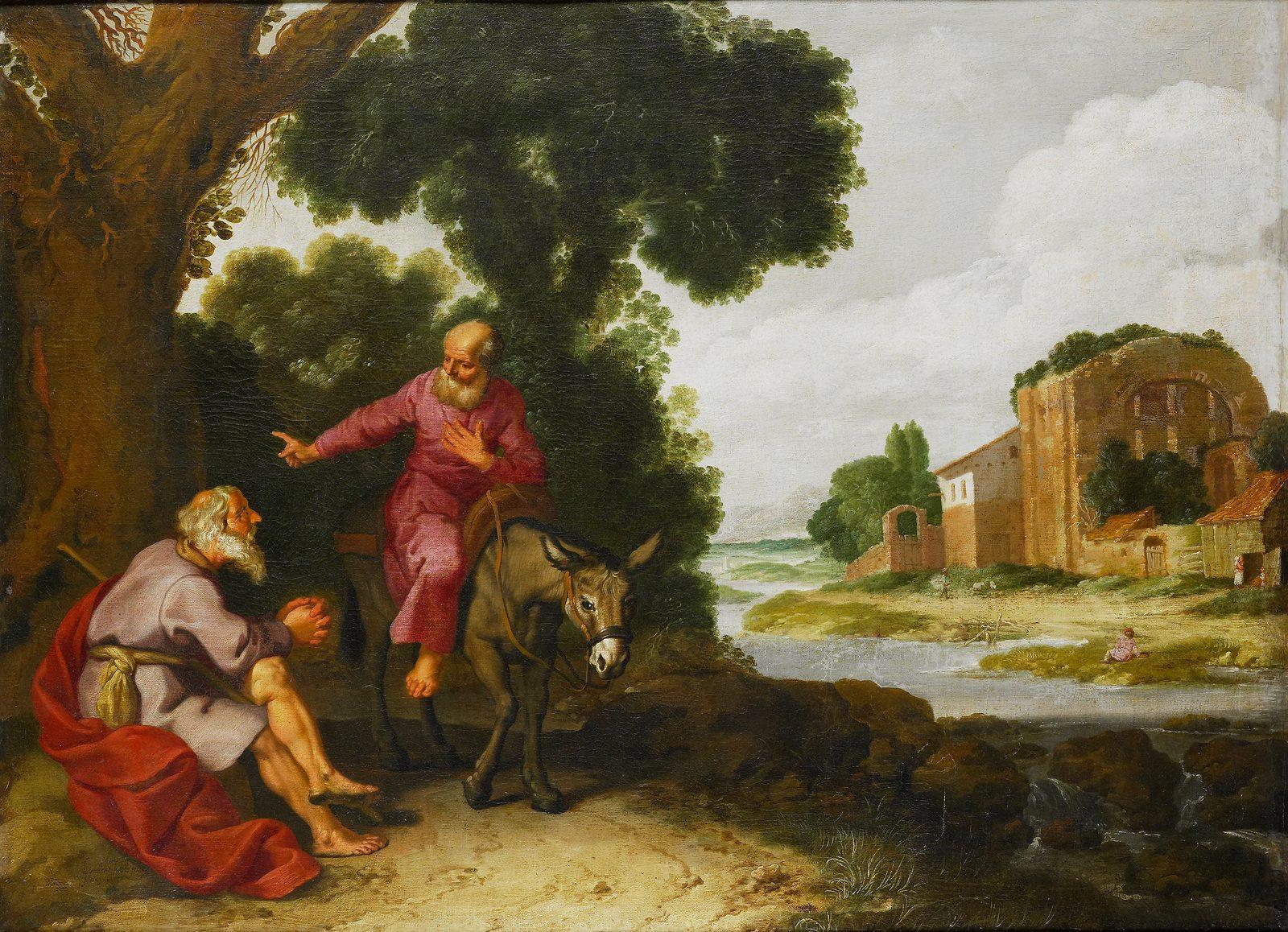
Lambert Jacobsz, The Prophet of Bethel Meets the Man of God from Judah, 1629. Public domain.
1 Kings 13 · Subject · Featured Study
A Name Given Before the Birth: Josiah and Cyrus
A man of God named Josiah at Jeroboam's altar about three centuries before Josiah's reform, and Isaiah named Cyrus before Cyrus freed the exiles.
Suddenly, as Jeroboam was standing beside the altar to burn incense, there came a man of God from Judah to Bethel by the word of the LORD. And he cried out against the altar by the word of the LORD, “O altar, O altar, this is what the LORD says: ‘A son named Josiah will be born to the house of David, and upon you he will sacrifice the priests of the high places who burn incense upon you, and human bones will be burned upon you.’”
- Books
- 1 Kings, 2 Kings, Isaiah, Ezra
- Hold in memory
- 1 Kings 13:2, Isaiah 46:10
A prophet cried out a king's name at an altar before that king was born.
Summary
Scripture names two kings long before they acted: Josiah of Judah and Cyrus of Persia.
- The altar at Bethel split the day the prophet spoke against it.
- Years later Josiah burned bones on that altar and spared the man of God's tomb.
- The LORD calls Cyrus His shepherd in Isaiah 44:28.
- Josephus and Keil read the word at Bethel as foretold, and Gill and Barnes the name of Cyrus.
- Critics since Julius Wellhausen hold that the Bethel prophecy was written after Josiah's reform.
Josiah Named at the Altar of Bethel
1 Kings 13 tells the word at Bethel and the fate of the man who spoke it.
That day the man of God gave a sign, saying, “The LORD has spoken this sign: ‘Surely the altar will be split apart, and the ashes upon it will be poured out.’” Now when King Jeroboam, who was at the altar in Bethel, heard the word that the man of God had cried out against it, he stretched out his hand and said, “Seize him!” But the hand he stretched out toward him withered, so that he could not pull it back. And the altar was split apart, and the ashes poured out, according to the sign that the man of God had given by the word of the LORD.The sign answered the king at once, while the word about Josiah waited for its king.
Albert Barnes, on 1 Kings 13:3, notes that a sign of this kind, a near prophecy given to prove a far one, had scarcely been given before this.
The old prophet's witness1 Kings 13:31 to 32
After he had buried him, the prophet said to his sons, “When I die, you must bury me in the tomb where the man of God is buried. Lay my bones beside his bones, for the message that he cried out by the word of the LORD against the altar in Bethel and against all the shrines on the high places in the cities of Samaria will surely come to pass.”The man who lied to the prophet ends by staking his own grave on the prophet's word.
Josephus gives the prophet a nameAntiquities of the Jews, Book 8
Josephus calls the man of God Jadon, and has him foretell the breaking of the altar so that the people would believe the rest of his word.
The Years Between the Word and the Deed
A timeline of the two words and their fulfilment, and the counts of the Josiah interval drawn as bars.
The word about Josiah waited about three centuries, and the word about Cyrus about two.
To scale: 5 of 6 stops dated; a ring is approximate; a bar is a span; a mark that would lie on another stands in a lane under the axis.
- The word at Bethelabout 930 BCJeroboam's first yearsA man of God from Judah names Josiah at Jeroboam's altar.1 Kings 13:2
- Isaiah's visionin the reigns of Uzziah to HezekiahThe kings named in Isaiah 1:1Isaiah sees his vision concerning Judah and Jerusalem.Isaiah 1:1
- Josiah is bornabout 648 BCEight years before his reign beganJosiah is eight years old when he becomes king.2 Kings 22:1
- Josiah's reign640 to 609 BCEdwin Thiele's reign datesJosiah reigns thirty-one years in Jerusalem.2 Kings 22:1
- Josiah at Bethelabout 622 BCHis eighteenth yearJosiah burns bones on the altar according to the word of the LORD.2 Kings 23:16
- Cyrus's first year538 BCThe first year of Cyrus king of PersiaCyrus's decree for the temple.Ezra 1:1
Six stops, each with its date, its reckoning and its verse.
The counts of the years from the word at Bethel run from 282 to 361.
The five counts as a table
| Count | Years | Verse |
|---|---|---|
| To Josiah's birth, on Thiele's dates | 282 | 2 Kings 22:1 |
| To Josiah's birth, Jamieson, Fausset and Brown | 326 | 2 Kings 23:16 |
| To the burning, on Thiele's dates | 308 | 2 Kings 23:15 |
| To the burning, Adam Clarke | 340 | 1 Kings 13:2 |
| To the burning, Josephus | 361 | 2 Kings 23:16 |
Five counts of the years from the word at Bethel, each from zero: two to Josiah's birth and three to the burning of the bones.
Albert Barnes, on Isaiah 45:1, puts the word to Cyrus not less than a hundred and fifty years before Cyrus took Babylon.
Josiah at Bethel
2 Kings 23 records Josiah's work at Bethel and in the cities of Samaria.
He even pulled down the altar at Bethel, the high place set up by Jeroboam son of Nebat, who had caused Israel to sin. Then he burned the high place, ground it to powder, and burned the Asherah pole. And as Josiah turned, he saw the tombs there on the hillside, and he sent someone to take the bones out of the tombs, and he burned them on the altar to defile it, according to the word of the LORD proclaimed by the man of God who had foretold these things.Kings ties Josiah's deed at Bethel to the word of the man of God, so the reader turns back to 1 Kings 13.
Then the king asked, “What is this monument I see?” And the men of the city replied, “It is the tomb of the man of God who came from Judah and pronounced these things that you have done to the altar of Bethel.” “Let him rest,” said Josiah. “Do not let anyone disturb his bones.” So they left his bones undisturbed, along with those of the prophet who had come from Samaria.The spared tomb ties the deed back to the old prophet's request in 1 Kings 13:31 to 32.
Just as Josiah had done at Bethel, so also in the cities of Samaria he removed all the shrines of the high places set up by the kings of Israel who had provoked the LORD to anger. On the altars he slaughtered all the priests of the high places, and he burned human bones on them. Then he returned to Jerusalem.Josiah does the same in the cities of Samaria, as 1 Kings 13:32 had said.
John Gill places the reform before the Passover of Josiah's eighteenth year (2 Kings 23:23). Adam Clarke notes that the Septuagint, the Greek translation of the Old Testament, gives 2 Kings 23:16 more fully, as does the Hexaplar Syriac. The fuller text recalls that the word was spoken at the feast, while the king stood at the altar.
Cyrus Named in Isaiah and Answered in Ezra
Isaiah names Cyrus in the LORD's account of His own deeds, and Ezra records his decree.
who says of Cyrus, ‘My shepherd will fulfill all that I desire,’ who says of Jerusalem, ‘She will be rebuilt,’ and of the temple, ‘Let its foundation be laid.’”The LORD names Cyrus in the same breath as the rebuilding of Jerusalem and the foundation of the temple.
This is what the LORD says to Cyrus His anointed, whose right hand I have grasped to subdue nations before him, to disarm kings, to open the doors before him, so that the gates will not be shut:The LORD speaks to Cyrus as His anointed and promises to open doors before him.
For the sake of Jacob My servant and Israel My chosen one, I call you by name; I have given you a title of honor, though you have not known Me.The naming serves God's people, though the king does not know their God.
“This is what Cyrus king of Persia says: ‘The LORD, the God of heaven, who has given me all the kingdoms of the earth, has appointed me to build a house for Him at Jerusalem in Judah. Whoever among you belongs to His people, may his God be with him, and may he go to Jerusalem in Judah and build the house of the LORD, the God of Israel; He is the God who is in Jerusalem.The decree cites the LORD by name, as Isaiah had cited Cyrus.
Isaiah 45:4, Ezra 1:2 to 3
Names Given Before a Birth
From Genesis 16 to Luke 1, Scripture tells of children named before they were born.
Of these seven, only Josiah and Cyrus were named generations before their birth.
| Name | Given by | Before the birth |
|---|---|---|
| Ishmael | The angel of the LORD, to Hagar | After she had conceived |
| Isaac | God, to Abraham | Before Sarah conceived |
| Solomon | The LORD, to David | Before the son was born |
| Josiah | The prophet who came to Bethel | About three centuries |
| Cyrus | The LORD, through Isaiah | More than a century |
| John | An angel, to Zechariah | Before his conception |
| Jesus | An angel, to Mary | Before His conception |
The Names and the Word for Name
Three Hebrew words from the lexicon of James Strong: the word for a name and the two names foretold.
shem (Hebrew, H8034)
A name, as a mark or memorial of who someone is; by extension honour, authority and character.
Yoshiyahu (Hebrew, H2977)
Josiah, the name of two Israelites.
Koresh (Hebrew, H3566)
Koresh, which English Bibles give as Cyrus, the Persian king.
What the Text Leaves Unsaid
Kings leaves three matters about Josiah and the man of God open.
Why God Named Them Beforehand
Isaiah 46 and 48 give the reason in the LORD's own words.
I declare the end from the beginning, and ancient times from what is still to come. I say, ‘My purpose will stand, and all My good pleasure I will accomplish.’Isaiah's argument against the idols rests on this claim.
Therefore I declared it to you long ago; I announced it before it came to pass, so that you could not claim, ‘My idol has done this; my carved image and molten god has ordained it.’Isaiah 48 speaks to a people who would credit their idols, which is why the naming came first.
Matthew Henry on the Two Names
Matthew Henry on the altar at Bethel and on Cyrus.
Matthew Henry (1662 to 1714)
Matthew Henry reads the sentence on the altar as a judgment fitted to its own use.
“That the altar he now consecrated should be desecrated. Idolatrous worship will not continue, but the word of the Lord will endure for ever. That the priests of the high places he now made should themselves be made sacrifices to the justice of God, and the first and only sacrifices upon this altar that would be pleasing to him.”
Matthew Henry · Commentary on the Whole Bible · on 1 Kings 13:2Puritan
Henry draws a line from Cyrus to Christ.
“Cyrus is preferred that Israel may be released. He shall have a kingdom, only that God's people may have their liberty; for their kingdom is not of this world, it is yet to come. In all this Cyrus was a type of Christ, who was made victorious over principalities and powers, and entrusted with unsearchable riches, for the use and benefit of God's servants, his elect.”
Matthew Henry · Commentary on the Whole Bible · on Isaiah 45:4Puritan
Spoken Before, or Written After?
Two readings of each name, with their holders and the objection to each.
Josiah was named three centuries aheadJosephus, Adam Clarke and C. F. Keil · Jewish and Christian commentators
Josephus tells the word at Bethel and Josiah's deed as one history and counts 361 years between them. Adam Clarke called it one of the most remarkable prophecies in the Old Testament. C. F. Keil, in his commentary on Kings (1872), held that it was fulfilled to the letter. He held that named persons are rare in prophecy but not wanting where God set a threat or a promise before an ungodly generation.
The objection, as Keil reports it from the critics of his day, is that the naming of a particular person has no analogy in prophecy and turns prediction into soothsaying.
The story was added to Kings after its main editingJulius Wellhausen and Abraham Kuenen · Nineteenth-century criticism
C. F. Burney, in his notes on the Hebrew of Kings (1903), names Wellhausen and Kuenen for the view that the story and 2 Kings 23:16 to 18 were added to Kings later. On their reading it is a prophecy after the event. Burney himself judged the story's Hebrew late and held that it took written form very soon after the altar was destroyed.
The objection is Burney's own: 1 Kings 12:26 to 33 was edited to lead up to the story, and 1 Kings 13:33 to 34 resumes the main account, so the chapters stand as one whole.
Cyrus was named before his birthJohn Gill and Albert Barnes · Protestant commentators
John Gill, on Ezra 1:2, writes that Isaiah prophesied of Cyrus and his edict two hundred years before he was born. Albert Barnes reads Isaiah 45:1 as spoken to Cyrus directly, long before he took Babylon.
The objection, from George Adam Smith as S. R. Driver reports him, is that the argument of Isaiah 41 to 48 treats the early victories of Cyrus as facts already known.
Isaiah 40 to 48 was written during the rise of CyrusAugust Dillmann, as S. R. Driver reports him · Nineteenth-century criticism
Driver's Introduction to the Literature of the Old Testament reports Dillmann's view that chapters 40 to 48 were written in the midst of Cyrus's successes, about 545 BC.
The objection is Isaiah 48:5, the LORD's own claim to have spoken first.
Books to Read Next
Four works on 1 Kings 13 and Isaiah 45, each free to read.
Biblical Commentary on the Books of the Kings
C. F. Keil, translated by James Martin · 1872
Keil comments on 1 Kings 13 and answers the critics who held the name was written after the event.
Read it at the Internet ArchiveNotes on the Hebrew Text of the Books of Kings
C. F. Burney · 1903
Burney weighs the Hebrew of 1 Kings 13 and names those who read it as written after Josiah's reform.
Read it at the Internet ArchiveAntiquities of the Jews
Flavius Josephus, translated by William Whiston · 1737
Josephus tells the word at Bethel in Book 8 and Josiah's reform in Book 10.
Read it at Project GutenbergAn Introduction to the Literature of the Old Testament
S. R. Driver · 1910
Driver sets out the dating of Isaiah 40 to 66 and the views of Dillmann and G. A. Smith.
Read it at the Internet ArchiveThe Name Given Before His Birth
The reader is asked to call on the name the angel gave Joseph.
She will give birth to a Son, and you are to give Him the name Jesus, because He will save His people from their sins.”The name and its reason are given together, before the child is born.
Sources
Scripture is the Berean Standard Bible.
- Flavius Josephus, Antiquities of the Jews, translated by William Whiston, 1737.
- C. F. Keil, Biblical Commentary on the Books of the Kings, translated by James Martin, T. and T. Clark, 1872, pages 202 to 203.
- C. F. Burney, Notes on the Hebrew Text of the Books of Kings, Clarendon Press, 1903, pages 179 to 180.
- S. R. Driver, An Introduction to the Literature of the Old Testament, 1910 printing, on Isaiah 40 to 66.
- Strong's Hebrew dictionary, entries H8034, H2977 and H3566.
- Edwin R. Thiele's reign dates for the kings of Israel and Judah.
- Adam Clarke, Commentary on the Bible, 1832.
- Jamieson, Fausset and Brown, Commentary Critical and Explanatory on the Whole Bible, 1871.
- John Gill, Exposition of the Old Testament, 1748 to 1763.
- Albert Barnes, Notes, Explanatory and Practical, on the Old and New Testaments, 1832 to 1869.
- Matthew Henry, Commentary on the Whole Bible, 1710.
- Jerome, Commentary on Isaiah.
Keep Studying
Read it4
People and groups7
Places1