
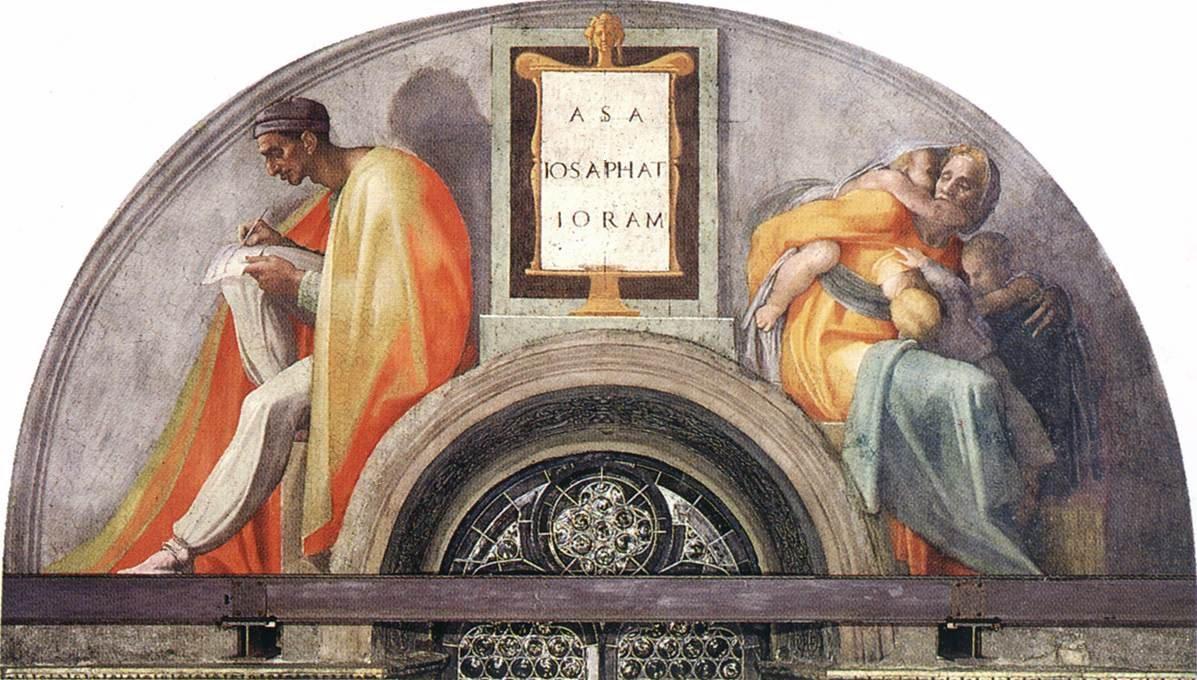
Michelangelo, lunette of Asa, Jehoshaphat and Joram, 1511 to 1512. Public domain.
1 Kings 14 to 2 Kings 18 · Debate · Featured Study
The Regnal Numbers of Kings
Each ruler of Israel and Judah is dated by a ruler of the other kingdom and given a length of reign.
And at the end of three years, the Assyrians captured it. So Samaria was captured in the sixth year of Hezekiah, which was the ninth year of Hoshea king of Israel.
- The question
- Kings dates each king by the years of the king in the other kingdom and gives the length of his reign: do the numbers fit together, and how?
- The texts
- 2 Kings 1:17, 2 Kings 3:1, 2 Kings 8:16, 1 Kings 15:25
Samaria fell in a year the text gives twice, once by Hezekiah and once by Hoshea.
Summary
Read as plain sums, some of the dates in Kings disagree with one another. Commentators explain them in three ways, and the records of Assyria fix some of the years.
- Keil held that reigns overlapped, and Thiele that the kingdoms counted years two ways.
- Barnes held that numbers were miscopied and notes crept in.
- Wellhausen held that the cross-dates were not part of the first arrangement.
The Numbers the Text Gives
Two verses each give the start of Jehoram's reign in Samaria.
The Regnal Numbers of Kings takes up the dates Kings gives its kings, from Rehoboam and Jeroboam to Hezekiah and Hoshea. It sets out the numbers as the text gives them, the three readings with their holders and objections, and the records of Assyria that fix some of the years.
So Ahaziah died according to the word of the LORD that Elijah had spoken. And since he had no son, Jehoram succeeded him in the second year of the reign of Jehoram son of Jehoshaphat over Judah.In the eighteenth year of Jehoshaphat’s reign over Judah, Jehoram son of Ahab became king of Israel, and he reigned in Samaria twelve years.Three Readings of the Numbers
The reckoning reading, the copying reading and the editor reading each answer the same three questions.
The readings part over whether the numbers are sound and over who wrote the cross-dates.
| The question | Two ways of counting, and shared reigns | Numbers miscopied | Cross-dates added later |
|---|---|---|---|
| How do the two notices of Jehoram's accession fit? | Jehoram of Judah ruled beside his father, and the first notice counts from those years together. | A figure or a phrase went wrong in copying. | They were not in the first arrangement of the book, so a mismatch is no surprise. |
| Are the numbers sound as they stand? | Yes, once the way each kingdom counted is known. | No; some figures disagree with others as they stand. | No; some figures look schematic. |
| Who wrote the cross-dates? | No later hand is needed; Keil held the clauses of the text sound. | Perhaps an early annotator whose notes slipped into the text. | A later hand than the first arrangement. |
Each Reading Stated
Each reading is set out with its holders and the verses it reads.
Two ways of counting, and shared reignsKeil, Thiele and Young; Wesley and Gill on the verses
C. F. Keil explains 2 Kings 1:17 by a co-regency. Jehoshaphat, he holds, made his son Jehoram king with him, and the second year of that shared reign was the eighteenth of Jehoshaphat.
Keil follows Ussher, Lightfoot and the Seder Olam in this, and he writes that the synchronism of the kings of Israel requires it. On 2 Kings 8:16 he holds that Jehoshaphat handed the government to Jehoram two years before he died.
Edwin Thiele, in the Journal of Near Eastern Studies of 1944, held that Israel began its regnal year in the spring month of Nisan and Judah in the autumn month of Tishri. He held that Judah first counted a king's years from the new year after he took the throne, and Israel counted the part-year in which he took it as his first.
Rodger Young, in the Journal of the Evangelical Theological Society of 2003, adds that a careful study of the dates requires coregencies for certain kings. He reads the eleventh year of 2 Kings 9:29 and the twelfth of 2 Kings 8:25 as one accession counted the two ways.
John Wesley, on 2 Kings 1:17, had already called Jehoram of Judah vice-king in his father's stead. John Gill, on 2 Kings 9:29, said Ahaziah began to reign with his father in the eleventh year and alone in the twelfth.
(In the eleventh year of Joram son of Ahab, Ahaziah had become king over Judah.)Numbers miscopiedAlbert Barnes and Adam Clarke
Albert Barnes, in the introduction to his Notes on 1 and 2 Kings, judged the numbers untrustworthy and in part self-contradictory. He gave the cause as corruption in copying, with numeral signs mistaken one for another.
Barnes also suspected that chronological notes made in a commentator's margin had entered the text, and that the whole series of synchronisms between Israel and Judah might have that origin.
Adam Clarke, on 1 Kings 16:23, held that the thirty-first year of Asa for Omri must be a mistake, because Zimri reigned seven days in Asa's twenty-seventh year.
In the thirty-first year of Asa’s reign over Judah, Omri became king of Israel, and he reigned twelve years, six of them in Tirzah.Cross-dates added laterJulius Wellhausen
Julius Wellhausen, in his Prolegomena to the History of Israel, held that the last reviser worked most freely in Kings, building its frame from dates and religious verdicts.
He argued that at first no effort was made to synchronise the reigns of the two kingdoms, and that the synchronisms do not belong to the original arrangement. He also judged the totals of Judah's kings to be built on round numbers of forty.
The First Kings by Their Numbers
Six kings from the division to Baasha, each with the two numbers Kings gives him.
Nadab is given two years, yet he began in Asa's second year and died in Asa's third.
| King | Began | Reigned |
|---|---|---|
| Jeroboam of Israel | at the division | 22 years |
| Rehoboam of Judah | at the division | 17 years |
| Abijam of Judah | Jeroboam's 18th year | 3 years |
| Asa of Judah | Jeroboam's 20th year | 41 years |
| Nadab of Israel | Asa's 2nd year | 2 years |
| Baasha of Israel | Asa's 3rd year | 24 years |
John Gill, on 1 Kings 15:1, reckoned from the eighteenth year of Jeroboam that Rehoboam died in the eighteenth year of his own reign, since the two began together.
The Records of Assyria
Two kings of Israel appear in the annals of Shalmaneser III, twelve of his years apart.
In D. D. Luckenbill's translation of 1926, Shalmaneser III names Ahab the Israelite among the kings he fought at Karkar in his sixth year. In his eighteenth year he received the tribute of Jehu, son of Omri.
George Smith, in The Assyrian Eponym Canon, calls an eclipse of the sun recorded in the canon an important proof of its correctness. He dates it 15 June 763 BC, in the year of the official he reads as Esdu-sarabe.
Between Ahab and Jehu, Kings gives Ahaziah two years and Jehoram twelve. Rodger Young dates Jehu's first year and Shalmaneser's eighteenth to 841 BC.
What the Text Leaves Unsaid
Kings leaves two things unsaid about its own numbers.
Kings never says in which month a king's year began or how the year of his accession was counted.
It names no rule for dating a king of one kingdom by the years of the other.
What the Readings Start From
The readings start from two facts.
THE VARIANCE IS REAL
Keil, who reconciles the pair, still calls the first at variance with the second.
THE GREEK HAS ITS OWN DATES
The Greek text of 1 Kings, in Brenton's edition of 1879, dates Jehoshaphat's accession to the eleventh year of Omri, where the Hebrew gives Ahab's fourth.
How the Teachers Read It
Albert Barnes wrote on the names of the two Jehorams.
Albert Barnes (1798 to 1870)
Barnes noted that two kings named Jehoram reigned at once, one in each kingdom.
“The similarity of names in the two royal houses of Israel and Judah at this time, and at no other, seems to be the consequence of the close ties which united the two reigning families, and is well noted among the ‘undesigned coincidences’ of the Old Testament. The accession of the Israelite Jehoram (Ahab’s brother) took place, according to 2Ki 3:1, in the eighteenth year of Jehoshaphat.”
Albert Barnes · Notes, Explanatory and Practical, on the Old and New Testaments (1832-1869) · on 2 Kings 1:17Evangelical
The Readings Weighed
Each reading faces an objection drawn from the opened sources.
The reckoning reading has the most holders among these writers.
| Reading | Held by | Tradition | Representative work |
|---|---|---|---|
| Two ways of counting, and shared reigns | C. F. Keil; Edwin Thiele; Rodger Young; John Wesley, John Gill and Albert Barnes on the verses | Protestant commentary and conservative chronology | Keil, The Books of the Kings (1872) |
| Numbers miscopied | Albert Barnes in his introduction; Adam Clarke on 1 Kings 16:23 | Protestant commentary | Barnes, Notes on 1 and 2 Kings, introduction |
| Cross-dates added later | Julius Wellhausen | German critical scholarship | Wellhausen, Prolegomena to the History of Israel |
The objection to the reckoning reading1 paragraph
Wolff, cited in Keil's notes, called the co-regency of Joram a pure fiction. And Thiele gave up his rule that the numbers held no factual error when he came to Hezekiah's reign.
The objection to the copying reading1 paragraph
On 2 Kings 1:17 itself Barnes allows that Jehoram of Judah may have had the royal title from his father's sixteenth year. The same year could then be called the eighteenth of one king and the second of the other.
The objection to the editor reading1 paragraph
Keil answered the view of Thenius, that a clause of 2 Kings 8:16 was a gloss, by calling its removal from the text an act of critical violence.
Books to Read Next
Three works are free to read, two of them in the public domain.
The Books of the Kings
C. F. Keil · 1872
Keil's commentary in the series of Keil and Delitzsch explains the Hebrew of 1 and 2 Kings.
Read at the Internet ArchiveAncient Records of Assyria and Babylonia, Volume 1
Daniel David Luckenbill · 1926
Luckenbill's first volume holds the records of the Assyrian kings from the earliest times to Sargon.
Read at the Internet ArchiveWhen Did Solomon Die?
Rodger C. Young · 2003
Young sets out Thiele's questions of reckoning and applies them to the reigns of Solomon's successors.
Read the author's copyWhen the Time Had Fully Come
The kings were counted by their years.
Kings sets a count of years beside the kings of Israel and Judah.
But when the time had fully come, God sent His Son, born of a woman, born under the law,Sources
Scripture is the Berean Standard Bible.
- C. F. Keil, The Books of the Kings, tr. James Martin, T. and T. Clark, 1872, pp. 288 to 290 and 336.
- Edwin R. Thiele, The Chronology of the Kings of Judah and Israel, Journal of Near Eastern Studies 3 (1944), p. 143.
- Rodger C. Young, When Did Solomon Die?, Journal of the Evangelical Theological Society 46/4 (2003), pp. 589 to 603.
- Albert Barnes, Notes on the Old Testament, introduction to 1 and 2 Kings, section 6, and on 2 Kings 1:17.
- Adam Clarke, Commentary on the Bible, 1832, on 1 Kings 16:23.
- John Wesley, Explanatory Notes upon the Old Testament, 1765, on 2 Kings 1:17.
- John Gill, Exposition of the Old Testament, on 1 Kings 15:1 and 2 Kings 9:29.
- Julius Wellhausen, Prolegomena to the History of Israel, tr. J. Sutherland Black and Allan Menzies, chapter 7, section 3.
- D. D. Luckenbill, Ancient Records of Assyria and Babylonia, vol. 1, University of Chicago Press, 1926, sections 590, 594, 611 and 672.
- George Smith, The Assyrian Eponym Canon, Samuel Bagster and Sons, pp. 82 to 83.
- The Septuagint Version of the Old Testament, with an English Translation, Samuel Bagster and Sons, 1879, 3 Kingdoms 16:28.
Keep Studying
Studies8
People and groups8
Go further4