

Cornelis van Poelenburch, The Prophet Elijah and the Widow of Zarephath, about 1630. CC0.
Genesis 10 · Place · Featured Study
Sidon
Genesis 10 names Sidon as Canaan's firstborn, and its port lay on the Phoenician coast.
Israel's border ran to Sidon, and the city never belonged to Israel.
And Canaan was the father of Sidon his firstborn, and of the Hittites,
- Today
- Saida, in southern Lebanon
- Region
- Phoenicia, north of Tyre
- Site
- 33.561, 35.372
- First named
- Genesis 10:15 “…Canaan was the father of Sidon his firstborn,…”
- Last named
- Acts 27:3 “…next day we landed at Sidon, and Julius…”
Israel's border ran to Sidon, and the city never belonged to Israel.
Summary
Sidon is the Phoenician port whose people Scripture calls the Sidonians.
- Ahab married Jezebel, daughter of the king of the Sidonians, and then served Baal.
- Jesus held up a widow of Sidon's country as the one Elijah was sent to.
- Isaiah calls Sidon the stronghold of the sea.
The Firstborn of Canaan
Genesis 10 gives the name twice, once as a son and once as a border.
And Canaan was the father of Sidon his firstborn, and of the Hittites,Sidon heads the list of Canaan's sons, ahead of the peoples Israel would meet in the land.
and the borders of Canaan extended from Sidon toward Gerar as far as Gaza, and then toward Sodom, Gomorrah, Admah, and Zeboiim, as far as Lasha.The border is measured from Sidon in the north to Gaza and the cities of the plain in the south.
Josephus writes that Sidonius built the city that bears his name, which the Greeks call Sidon. Strong's Hebrew dictionary counts the name Tsidon 22 times in the Hebrew Old Testament and the word for the Sidonians 16 times.
Sidon on the Map
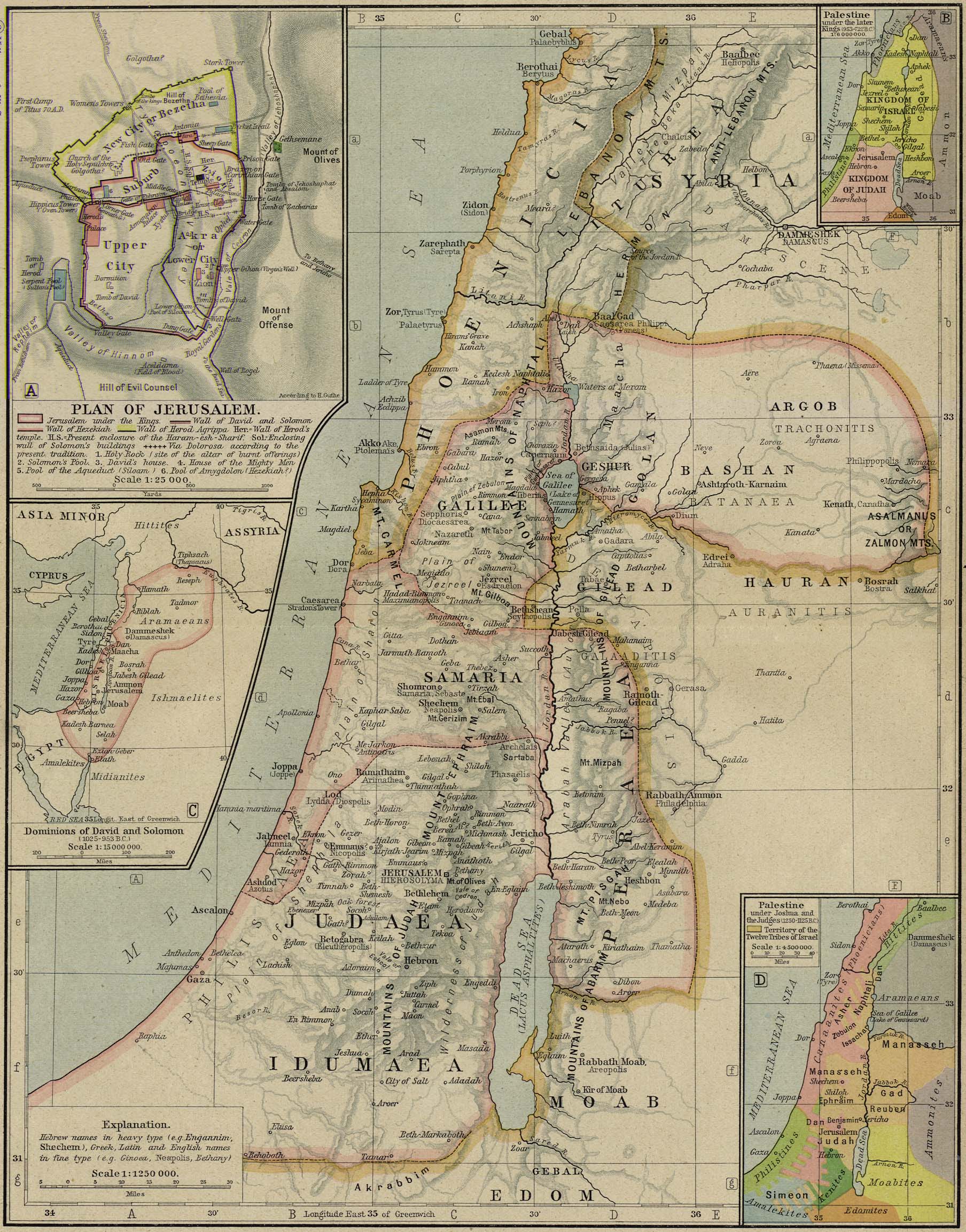
Sidon, Tyre and Zarephath lay on one stretch of coast.
Mark 7:31 takes Jesus north from Tyre through Sidon and back to the Sea of Galilee.
- Located: the site is known
- Identified: the point stands for an area, or is rounded
- The route, in the order the text gives
- 1Tyre, Jesus entered a house and could not escape notice Mark 7:24
- 2Zarephath, A widow of the town fed Elijah 1 Kings 17:9
- 3Sidon, The city the road passed through Mark 7:31
- 4Mount Hermon, The Sidonians called the mountain Sirion Deuteronomy 3:9
- 5Dan, As Laish, it lived quietly like the Sidonians, far from them Judges 18:7
- 6Sea of Galilee, The road came back to the lake on the way to the Decapolis Mark 7:31
Base map: Reference map of ancient Palestine, Rand McNally reference map (1926), public domain. Places with a place page stand at its coordinates and the others at the point cited for each, set on the plate by Jerusalem and Damascus, as the plate prints them.
Six places; the road joins three of them, and the other three carry their own verses.
Sidon from Genesis to Acts
The passages run from the blessing of Jacob to Paul's voyage to Rome.
Sidon stands in Scripture from the tribes' borders to the last chapters of Acts.
- The blessing of JacobZebulun's border shall extend to SidonGenesis 49:13
- The allotment of the landAsher's border runs as far as Greater SidonJoshua 19:28
- The days of the judgesIsrael serves the gods of Sidon among the gods of the nationsJudges 10:6
- The reign of SolomonSolomon asks Hiram for loggers, since Israel has none as skilled as the Sidonians1 Kings 5:6
- The prophecy of EzekielEzekiel sets his face against Sidon and prophesies against herEzekiel 28:21
- The prophecy of JoelJoel calls Tyre and Sidon to account for what they did to God's peopleJoel 3:4 to 6
- The ministry of JesusJesus says Tyre and Sidon would have repented at the miracles done in Chorazin and BethsaidaMatthew 11:21 to 22
- The reign of HerodThe people of Tyre and Sidon ask Herod for peace, because their region depends on his country for foodActs 12:20
- Paul's voyage to RomePaul lands at Sidon on the way to Rome and visits his friendsActs 27:3
Nine passages in the order of the canon, each with its verse.
The ministry of Jesus, The reign of Herod, Paul's voyage to Rome
The Harbour City
What the city made, and who ruled it.
Sidon was one of the chief cities of Phoenicia, and its name probably meant fishery. Homer praised its craftsmen for their glass, their purple dye and the embroidery of its women, and a mound of discarded murex shells near the southern harbour shows the scale of the dye works.
Under Persian rule Sidon eclipsed Tyre as the first city of Phoenicia, and Alexander the Great took it in 333 BC.
The king of the SidoniansThe sarcophagus of Eshmunazar II, found in 1855
The Phoenician inscription on the lid of the sarcophagus of Eshmunazar II calls him king of the Sidonians, probably in the fifth century BC. It names his mother as a priestess of Ashtart, the goddess of the Sidonians.
Solomon followed Ashtoreth the goddess of the Sidonians and Milcom the abomination of the Ammonites.Israel's king turned to the same goddess the coffin names.
Tyre, the daughter of SidonIsaiah 23:12; Adam Clarke; Albert Barnes
He said, “You shall rejoice no more, O oppressed Virgin Daughter of Sidon. Get up and cross over to Cyprus—even there you will find no rest.”Adam Clarke reads the Virgin Daughter of Sidon as a name for Tyre.
Clarke, on Isaiah 23:4, quotes the historian Justin: when the king of Ascalon took their city, the Sidonians took to their ships and built Tyre. Albert Barnes, on Ezekiel 28:21, holds that Sidon was more ancient than Tyre and was the first metropolis of Phoenicia.
What Scripture Leaves Unsaid
Two things about the city Scripture does not record.
Scripture gives no account of the founding of Sidon beyond the name in Genesis 10:15. Ezekiel's oracle against the city has no account of its fulfilment anywhere in Scripture.
Grace at the Edge of the Land
Elijah was sent to be fed by a widow of Sidon's country, and a woman of its district asked Jesus for mercy.
“Get up and go to Zarephath of Sidon, and stay there. Behold, I have commanded a widow there to provide for you.”The prophet is sent out of Israel to a Gentile town.
But I tell you truthfully that there were many widows in Israel in the time of Elijah, when the sky was shut for three and a half years and great famine swept over all the land. Yet Elijah was not sent to any of them, but to the widow of Zarephath in Sidon.In the synagogue at Nazareth, Jesus chose this widow as His example.
Now she was a Greek woman of Syrophoenician origin, and she kept asking Jesus to drive the demon out of her daughter.Mark makes plain that the woman Jesus answered was a Gentile.
Leaving that place, Jesus withdrew to the district of Tyre and Sidon. And a Canaanite woman from that region came to Him, crying out, “Lord, Son of David, have mercy on me! My daughter is miserably possessed by a demon.”Matthew calls her a Canaanite, of the people Genesis 10 traces to Sidon's father.
Mark 7:26, Matthew 15:21 to 22
The Voices
Three teachers on the Gentiles of Sidon, from Jerome to Barnes.
died 420 · Jerome
Catena Aurea by Aquinas
Idol-serving cities preferred to the towns of Galilee
The quotation1 quotation
“In this word Wo, these towns of Galilee are mourned for by the Saviour, that after so many signs and mighty works, they had not done penitence. And to these are preferred Tyre and Sidon, cities given up to idolatry and vices; For if the mighty works which have been done in you had been done in Tyre and Sidon, they would have long ago done penitence in sackcloth and ashes. We ask where it is written that the Lord did wonders in Corozaim and Bethsaida?”
Jerome · Catena Aurea by Aquinas · on Matthew 11:21 to 22Patristic
died 1107 · Theophylact of Ohrid
Commentary on Mark
Strangers who came to Christ from afar
The quotation1 quotation
“Even the Tyrians and Sidonians received benefit, despite being foreigners. Meanwhile His own kinsmen persecuted Him. So there is no benefit in kinship if there is no good character! Here even strangers came to Christ from afar, while the Jews persecuted Him who had come …”
Theophylact of Ohrid · Commentary on Mark · on Mark 3:8Patristic
1798 to 1870 · Albert Barnes
Notes, Explanatory and Practical, on the Old and New Testaments (1832-1869)
Zarephath belonged to the king of Sidon
The quotation1 quotation
“The dependence of Zarephath (Sarepta) on Sidon is indicated in the inscriptions of Sennacherib, where it is mentioned as belonging to Luliya (Elulaeus), king of Sidon, and as submitting to the Assyrian monarch on Luliya’s flight from his capital. Elijah may have been sent to this place, so near the city of Jezebel’s father, as one which it was most unlikely that he would visit.”
Albert Barnes · Notes, Explanatory and Practical, on the Old and New Testaments (1832-1869) · on 1 Kings 17:9Evangelical
Books to Read Next
Both works can be read free online.
History of Phoenicia
George Rawlinson · 1889
Rawlinson tells the history of the Phoenician cities, Sidon among them, from the classical writers and the inscriptions known in his day.
Read at Project GutenbergSidon: A Study in Oriental History
Frederick Carl Eiselen · 1907
Eiselen gathers what the Bible, the Assyrian and Egyptian monuments and the Greek writers say of the city.
Read at archive.orgThe Crumbs from the Table
“First let the children have their fill,” He said. “For it is not right to take the children’s bread and toss it to the dogs.” “Yes, Lord,” she replied, “even the dogs under the table eat the children’s crumbs.”Her answer is the faith Jesus rewards in the next verse.
A woman of the district of Tyre and Sidon asked for the crumbs, and Christ gave her what she asked. The city asks the reader to come to Christ as she did, with nothing to claim and every hope in His mercy.
Sources
Scripture is the Berean Standard Bible.
- Strong's Hebrew dictionary, h6721 and h6722.
- Flavius Josephus, Antiquities of the Jews 1.6.2, translated by William Whiston, public domain.
- OpenBible.info, Bible Geocoding Data, ancient.jsonl, CC BY.
- Jerome, as gathered in Thomas Aquinas's Catena Aurea, on Matthew 11:21.
- Theophylact of Ohrid, Commentary on Mark, 1107, on Mark 3:8.
- Albert Barnes, Notes, Explanatory and Practical, on the Old and New Testaments, on 1 Kings 17:9 and Ezekiel 28:21.
- Adam Clarke, Commentary on the Bible, 1832, on Isaiah 23:4.
- George Rawlinson, History of Phoenicia (London, 1889), public domain.
- Frederick Carl Eiselen, Sidon: A Study in Oriental History (New York, 1907), public domain.
Keep Studying
Read it4
People and groups6