
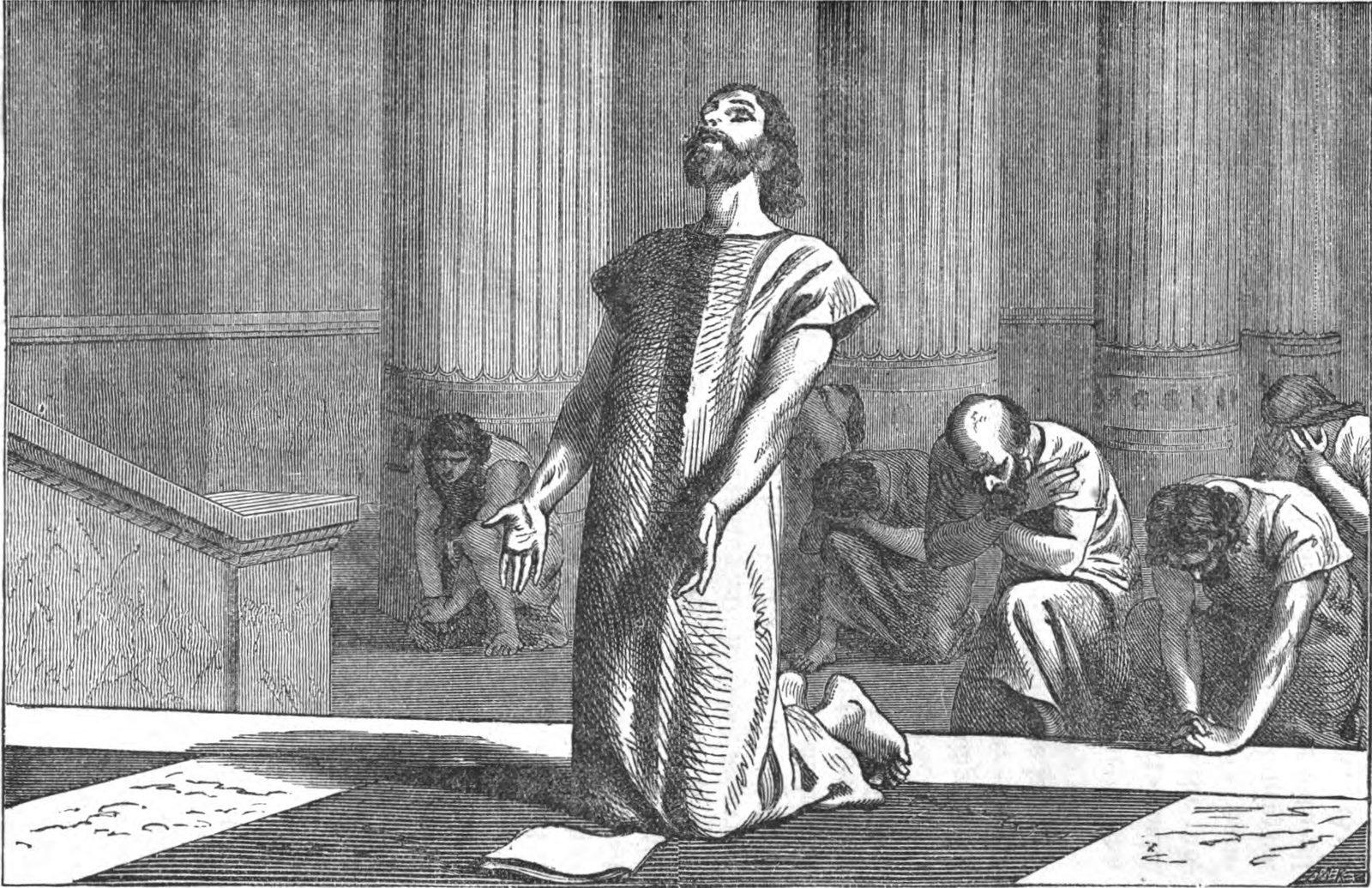
An engraving in The Story of the Bible, 1873. Public domain.
2 Kings 18 to 20 and 2 Chronicles 29 to 32 · Person · Featured Study
Hezekiah
Hezekiah son of Ahaz reigned over Judah in Jerusalem for twenty-nine years.
Hezekiah trusted in the LORD, the God of Israel. No king of Judah was like him, either before him or after him.
- The name means
- whom the LORD strengthens (C. F. Keil)
- Family
- father: Ahaz; mother: Abi daughter of Zechariah; son: Manasseh
- Places
- Jerusalem, Lachish, Samaria, Babylon
- First named
- 2 Kings 16:20 “…of David, and his son Hezekiah reigned in…”
- Last named
- Matthew 1:10 “Hezekiah was the…”
Hezekiah stripped the temple doors to pay Assyria, and then spread Assyria's letter before the LORD.
Summary
Hezekiah became king of Judah at twenty-five, in the third year of Hoshea of Israel. He opened the temple doors in his first month and removed the high places. He rebelled against Assyria, paid it tribute, and prayed when its army came. He fell ill, was given fifteen more years, and was buried among David's descendants.
- Three prophets of his day, Isaiah, Hosea and Micah, name his reign.
- His men copied out proverbs of Solomon.
- Chronicles says his heart grew proud and that he humbled it.
Where Hezekiah Stands in Scripture
His reign is told in 2 Kings, 2 Chronicles and Isaiah.
Hezekiah is first named at his father's death, when he took the throne. Second Kings 18 to 20 tells his reign, and Chronicles and Isaiah tell it again.
His name also stands in Proverbs, Jeremiah and Matthew.
In the third year of the reign of Hoshea son of Elah over Israel, Hezekiah son of Ahaz became king of Judah.His father Ahaz had reigned sixteen years before him.
His Life, Turn by Turn
His reign runs from the temple doors to the upper tombs of David's line.
Hezekiah reigned twenty-nine years, from the opened temple doors to a burial among David's sons.
- Becomes king at twenty-fiveJerusalem2 Kings 18:1 to 2
- Opens and repairs the temple doors in his first monththe house of the LORD2 Chronicles 29:3
- Breaks the bronze snake called NehushtanJudah2 Kings 18:4
- Rebels against the king of AssyriaJerusalem2 Kings 18:7
- Defeats the Philistines as far as GazaPhilistia2 Kings 18:8
- Sees Samaria fall in his sixth yearSamaria2 Kings 18:10
- Sends tribute to SennacheribLachish2 Kings 18:14
- Spreads the Assyrian letter before the LORDthe house of the LORD2 Kings 19:14
- Falls ill and is given fifteen yearshis sickbed2 Kings 20:1 to 6
- Shows his treasures to the envoys of Babylonhis treasure house2 Kings 20:13
- Humbles the pride of his heartJerusalem2 Chronicles 32:26
- Dies and is buriedthe upper tombs of David's line2 Chronicles 32:33
Twelve turns of his life, each with its verse.
Sends tribute to Sennacherib, Spreads the Assyrian letter before the LORD, Falls ill and is given fifteen years, Shows his treasures to the envoys of Babylon, Humbles the pride of his heart, Dies and is buried
The King Who Trusted
His story runs through 2 Kings 18 to 20 and 2 Chronicles 29 to 32.
Kings measures his reign first by his trust in the LORD.
The reform2 Kings 18:3 to 6; 2 Chronicles 29 to 31
He removed the high places, shattered the sacred pillars and cut down the Asherah poles.
He remained faithful to the LORD and did not turn from following Him; he kept the commandments that the LORD had given Moses.The next verse says the LORD was with him and he prospered.
Assyria2 Kings 18:7 to 19:37
He refused to serve Assyria, then confessed wrong to Sennacherib at Lachish when the fortified cities of Judah fell.
The illness2 Kings 20:1 to 11; Isaiah 38
Isaiah told him to put his house in order, for he would die. He prayed, and the LORD added fifteen years to his life.
This is a writing by Hezekiah king of Judah after his illness and recovery:The writing that follows is given in Isaiah alone.
The envoys of Babylon2 Kings 20:12 to 19; Keil and Henry
Merodach-baladan king of Babylon sent letters and a gift when he heard of the illness. Hezekiah showed his envoys everything in his storehouses.
Then Hezekiah humbled the pride of his heart—he and the people of Jerusalem—so that the wrath of the LORD did not come upon them during the days of Hezekiah.Chronicles alone tells that he humbled himself.
C. F. Keil reads the testing of 2 Chronicles 32:31 as permitted by God to try Hezekiah and to humble him. Matthew Henry drew a warning for good and useful men.
“When Hezekiah had destroyed other idolatries he began to idolize himself. O what need have great men, and good men, and useful men, to study their own infirmities and follies, and their obligations to free grace, that they may never think highly of themselves, and to beg earnestly of God that he will hide pride from them and always keep them humble!”
Matthew Henry · Commentary on the Whole Bible · on 2 Chronicles 32:25Puritan
The Prophets of His Reign
Isaiah, Hosea and Micah date their words by his reign.
Isaiah son of Amoz brought him the LORD's word in war and in sickness.
At the beginning of Jehoiakim's reign, elders of Judah stood up for Jeremiah. They recalled that Hezekiah heard Micah's warning and did not put him to death.
Did Hezekiah king of Judah or anyone else in Judah put him to death? Did Hezekiah not fear the LORD and seek His favor, and did not the LORD relent of the disaster He had pronounced against them? But we are about to bring great harm on ourselves!”Micah had foretold that Zion would be ploughed like a field.
The Circle of Hezekiah
Eight people stand around him in the text.
His circle ran from his parents to the kings of Assyria and Babylon.
Generation 1
- AhazHis father, king of Judah before him
- Abi daughter of ZechariahHis mother
Generation 2
- IsaiahThe prophet of his court
- EliakimHis palace administrator
- ShebnaHis scribe
- SennacheribThe king of Assyria who invaded Judah
- Merodach-baladanSon of Baladan, king of Babylon
Generation 3
- ManassehHis son, who reigned after him
Two of the eight were kings of other nations.
The Places of His Reign
Seven places mark his reign, from Gaza to Babylon.
Hezekiah reigned in Jerusalem while Assyria took Samaria and besieged Lachish.
- Located: the site is known
- Identified: the point stands for an area, or is rounded
- 1Jerusalem, The city to which Sennacherib sent his servants with a message. 2 Chronicles 32:9
- 2The Spring of Gihon, The spring whose upper outlet he channelled to the west side of the City of David. 2 Chronicles 32:30
- 3Gaza, The limit of his victory over the Philistines. 2 Kings 18:8
- 4Samaria, The capital of Israel, taken by Assyria in his sixth year. 2 Kings 18:10
- 5Lachish, The city where he sent word to the king of Assyria. 2 Kings 18:14
- 6Nineveh, The city to which Sennacherib withdrew. 2 Kings 19:36
- 7Babylon, The city to which Isaiah said his treasures would be carried. 2 Kings 20:17
Not placed: The Spring of Gihon (2), Gaza (3).
The coasts and rivers are simplified; each place stands at its place page's coordinates.
Two of the seven places lie outside the land, in Assyria and Babylon.
Questions His Life Raises
Three questions are taken up here from the text and its commentators.
How old was Ahaz when Hezekiah was born?2 Kings 16:2 and 2 Kings 18:2; Keil and Barnes
Ahaz was twenty years old when he became king, and he reigned in Jerusalem sixteen years. And unlike David his father, he did not do what was right in the eyes of the LORD his God.Hezekiah was twenty-five when he followed his father.
Read together, the numbers make Ahaz about eleven at his son's birth. Albert Barnes calls this not impossible but so unlikely that most commentators suggest a miscopied number.
C. F. Keil notes that the Greek, Syriac and Arabic of 2 Chronicles 28:1 make Ahaz twenty-five when he became king, and he judges that reading may be the better one.
Who were the men of Hezekiah?Proverbs 25:1
These are additional proverbs of Solomon, which were copied by the men of Hezekiah king of Judah:A new heading, the words of Agur, opens Proverbs 30.
The verse names none of the men and says only that they copied the proverbs.
Why was he buried in the upper tombs?2 Chronicles 32:33; C. F. Keil
C. F. Keil suggests that the old burial place of the kings had no more room, so graves were made higher up for Hezekiah and the kings after him.
What the Text Leaves Unsaid
The text leaves three things about him untold.
How Scripture Reads Him
Matthew names him in the line from David to Jesus.
The promise Isaiah brought him was that the LORD would defend Jerusalem for David's sake.
Uzziah was the father of Jotham, Jotham the father of Ahaz, and Ahaz the father of Hezekiah. Hezekiah was the father of Manasseh, Manasseh the father of Amon, Amon the father of Josiah,Matthew's line runs on through Josiah to the exile in Babylon.
‘I will defend this city and save it for My own sake and for the sake of My servant David.’”Isaiah gave the same promise again in his sickness, in 2 Kings 20:6.
Voices on Hezekiah
Matthew Henry's commentary appeared in 1710.
Matthew Henry (1662 to 1714)
Commentary on the Whole Bible
Matthew Henry read this verse as a lesson for anyone facing a hard duty.
“A firm belief of God's all-sufficiency to protect and reward us will conduce much to make us sincere, bold, and vigorous, in the way of our duty, like Hezekiah. When he came to the crown he found his kingdom compassed with enemies, but he did not seek for succour to foreign aids, as his father did, but trusted in the God of Israel to be the keeper of Israel.”
on 2 Kings 18:5Puritan
Was Any King Like Hezekiah?
Second Kings says the same of Hezekiah and of Josiah.
Neither before nor after Josiah was there any king like him, who turned to the LORD with all his heart and with all his soul and with all his strength, according to all the Law of Moses.Each king excelled in his own wayJohn Gill
John Gill holds that Hezekiah may have excelled Josiah in some things, and Josiah Hezekiah in others. He reads the two verses as praise of different gifts.
Albert Barnes answers that the phrase is not to be pressed in either verse.
A proverb of praiseAlbert Barnes
Albert Barnes holds that the phrase was probably a proverb. It meant no more than that each king was of singular piety, among the very best of Judah's kings.
Against this, John Gill's reading holds that each verse names its own ground, trust in the one and the Law of Moses in the other.
Books to Read Next
Both works are in the public domain, and each has a free copy to read.
The Books of the Kings
C. F. Keil · 1872
Keil discusses the age of Ahaz and the meaning of Hezekiah's name in his notes on 2 Kings 16 and 18.
Read at the Internet ArchiveThe Books of the Chronicles
C. F. Keil · 1872
Keil discusses the envoys of Babylon and the upper tombs in his notes on 2 Chronicles 32.
Read at the Internet ArchiveThat All the Kingdoms May Know
Hezekiah's prayer over the letter asked for more than his own rescue.
And now, O LORD our God, please save us from his hand, so that all the kingdoms of the earth may know that You alone, O LORD, are God.”The LORD's answer came through Isaiah in the next verse.
Sources
Scripture is the Berean Standard Bible.
- C. F. Keil, The Books of the Kings, translated by James Martin, T. and T. Clark, 1872, pp. 398 to 399 and 431.
- C. F. Keil, The Books of the Chronicles, translated by Andrew Harper, T. and T. Clark, 1872, p. 479.
- Matthew Henry, Commentary on the Whole Bible, 1710, on 2 Kings 18:5 and 2 Chronicles 32:25.
- Albert Barnes, Notes, Explanatory and Practical, on the Old and New Testaments, 1832 to 1869, on 2 Kings 18:2, 18:5 and 23:25.
- John Gill, Exposition of the Old Testament, 1748 to 1763, on 2 Kings 23:25.
Keep Studying
Read it4
Studies7
People and groups9
Subjects4
Church history1