
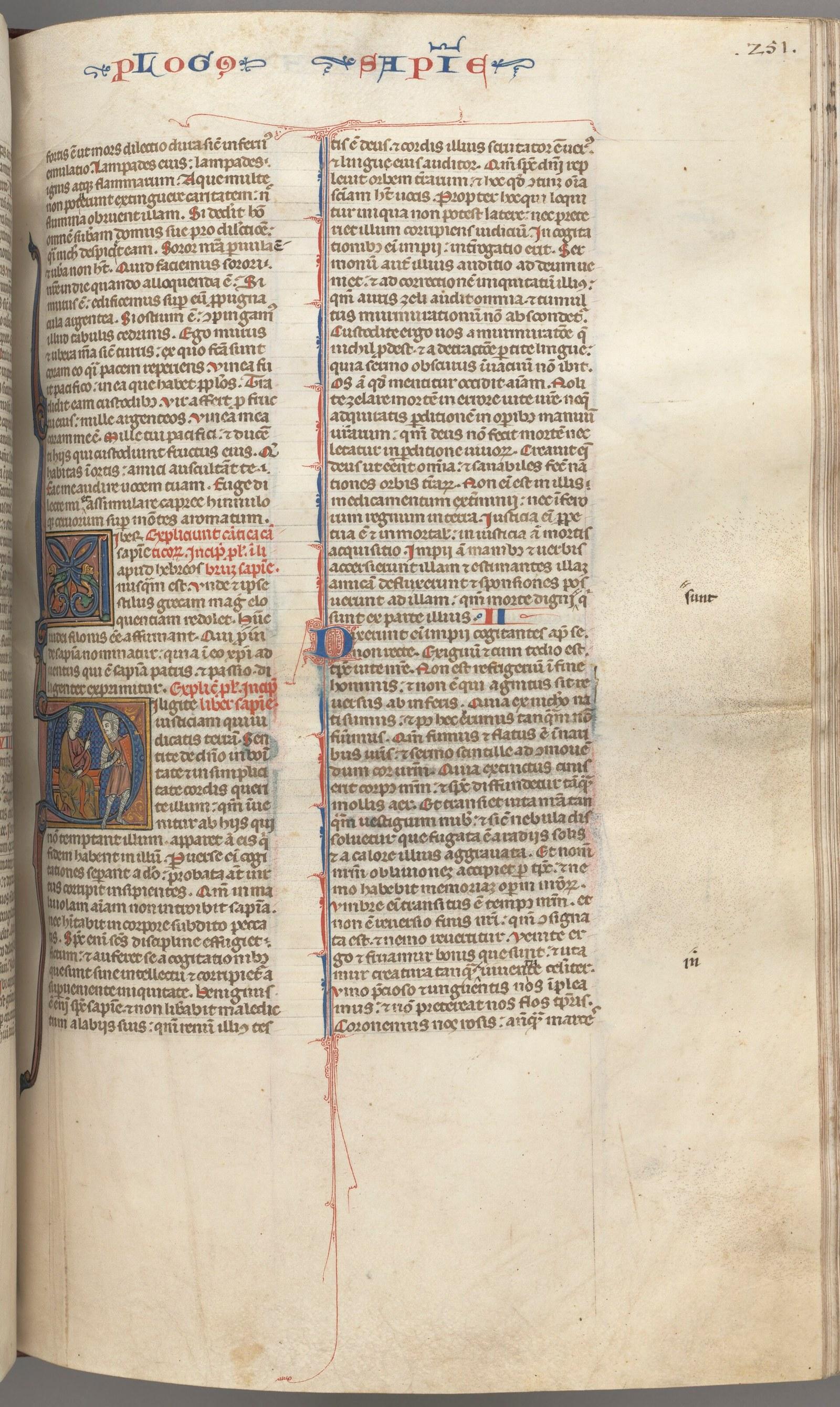
Southern France, Toulouse, Wisdom, 1275 to 1300. CC0.
Wisdom 1 to 19 · Book · Apocrypha, a study resource beside the canon
The Wisdom of Solomon
The Wisdom of Solomon is a book of the Apocrypha in nineteen chapters, in praise of Wisdom.
The Muratorian Canon says the book was written by the friends of Solomon in his honour.
Therefore give Your servant an understanding heart to judge Your people and to discern between good and evil. For who is able to govern this great people of Yours?”
Therefore give Your servant an understanding heart to judge Your people and to discern between good and evil. For who is able to govern this great people of Yours?”
- Date
- after 50 BC, by Holmes's dating (proposed)
- Edition
- The Wisdom of Solomon in the King James Version Apocrypha, 1769 text (eBible.org); the Berean Standard Bible for the canon
Summary
Holmes found the book's Greek full of compound words, a mark of Alexandrian Greek. He called its last section "a Midrash in glorification of the Jews".
- Wisdom 10:1 says Wisdom preserved the first-formed father of the world and brought him out of his fall.
- Holmes listed scholars' dates for the book from Grimm's 145 BC to Farrar's AD 40.
- Gigot pairs Romans 11:34 with Wisdom 9:13.
The Book of Wisdom
The book speaks first to kings and judges, and later in the voice of a king.
The Wisdom of Solomon opens by telling the judges of the earth to love righteousness and to seek the Lord in simplicity of heart (Wisdom 1:1).
Its voice is a king's. The writer speaks in the name of Solomon, though the name itself is never given, and says that God chose him to be king of his people (Wisdom 9:7).
The Book at a Glance
The book turns at Wisdom 6:9 and again at Wisdom 11:2.
Three sections: the end of the righteous and the wicked, the praise of Wisdom, and Wisdom in Israel's history.
- The end of the righteous and the wickedWisdom 1:1 to 6:8, which Holmes called the book of eschatology.
- The praise of WisdomWisdom 6:9 to 11:1, the king's praise of Wisdom, opening with "Unto you therefore, O kings, do I speak".
- Wisdom in Israel's historyWisdom 11:2 to 19:22, the wilderness and the plagues of Egypt, opening with "They went through the wilderness that was not inhabited".
Holmes's division, each section with its verses and its opening words in the King James text.
Wisdom Beside the Canon
The book retells Solomon's prayer and the manna, and its armour of God stands beside Ephesians 6.
At Gibeon Solomon asked God for an understanding heart (1 Kings 3:9). The Wisdom of Solomon gives the king a longer prayer, for the wisdom that sits by God's throne (Wisdom 9:4).
The book calls the manna "angels' food", "bread prepared without their labour" (Wisdom 16:20). Ellicott and Keil and Delitzsch both set it beside Psalm 78:25.
He rained down manna for them to eat; He gave them grain from heaven. Man ate the bread of angels; He sent them food in abundance.The Lord in the book arms himself: "He shall put on righteousness as a breastplate, and true judgment instead of an helmet" (Wisdom 5:18). Gigot, in the Catholic Encyclopedia, pairs that passage with Paul's armour of God.
Stand firm then, with the belt of truth buckled around your waist, with the breastplate of righteousness arrayed,Where the Book Came From
S. Holmes wrote the critical introduction in R. H. Charles's edition of 1913.
Holmes wrote that the book's authorship is unknown, and that it is perhaps the work of more than one writer.
Holmes inclined to a date between 50 and 30 BC for the first part and between 30 BC and AD 10 for the second.
He found the writer drawing his quotations from the Septuagint and not from the Hebrew Bible. He judged that the borrowing must have taken place outside Palestine, and that the only place left was Alexandria.
Who Receives the Book
Witnesses from about AD 200 to the sixteenth century set the book's standing.
The Muratorian Canon names the book, the early fathers name it the Wisdom of Solomon, Jerome keeps it outside the canon, Trent counts it in, and Article VI names it among the other books.
| Who | What they do with the book |
|---|---|
| The Muratorian Canon, about AD 200 | names the book Sapientia, as Holmes reads its Latin |
| Clement of Alexandria, Tertullian and Origen | speak of it as the Wisdom of Solomon, as Holmes records |
| The Council of Carthage, AD 397 | counts Wisdom among the five books of Solomon in the canonical Scriptures, as Oesterley records |
| Jerome, preface to the books of Solomon | says the book was never among the Hebrews and its style reeks of Greek eloquence |
| The Council of Trent, session 4, 1546 | lists Wisdom among the books of the Old Testament |
| The Church of England, Article VI | names The Book of Wisdom among the other books the Church reads |
Jerome added that some of the ancient scribes held the book to be the work of Philo Judaeus.
The Voices
Holmes judged the Solomon voice a device that left the book without a known author.
Holmes wrote of the king's voice: "This is, of course, a literary device and would deceive no one. But it made the book anonymous, and anonymous it still remains."
Books to Read Next
Three works give the book, its critical notes and its standing in the church.
The Wisdom of Solomon, King James Version Apocrypha
The King James translators · 1611
It gives the whole book in the King James English.
Read it in the readerThe Apocrypha and Pseudepigrapha of the Old Testament, vol. I
R. H. Charles, ed.; the Wisdom of Solomon by S. Holmes · 1913
Holmes sets out the book's sections, its date, its place and its language, and annotates the text.
Read it free at archive.orgBook of Wisdom, in The Catholic Encyclopedia
Francis Gigot · 1912
It gives the book's Greek origin, its Alexandrian author and its use by the New Testament writers.
Read it free at New AdventWisdom From the Throne
The king of the book learns that wisdom is a gift, and James tells every reader to ask for it.
Sources
Scripture is the Berean Standard Bible.
- The Wisdom of Solomon, King James Version Apocrypha, 1769 text (eBible.org USFX edition), public domain.
- S. Holmes, The Wisdom of Solomon, in R. H. Charles (ed.), The Apocrypha and Pseudepigrapha of the Old Testament, vol. I, Oxford, 1913; public domain.
- W. O. E. Oesterley, Sirach, section 8, in R. H. Charles (ed.), The Apocrypha and Pseudepigrapha of the Old Testament, vol. I, Oxford, 1913; public domain.
- Jerome, Prologue to the Books of Solomon, tr. Kevin P. Edgecomb, 2006, released by the translator into the public domain.
- Francis Gigot, Book of Wisdom, The Catholic Encyclopedia, vol. 15, 1912; public domain.
- Ellicott's Commentary for English Readers and Keil and Delitzsch on Psalm 78:25, public domain.
- The Council of Trent, session 4, 1546, the decree on the canonical Scriptures.
- The Church of England, Articles of Religion, Article VI, in the Book of Common Prayer of 1863.
Keep Studying
Studies8
People and groups1
Subjects1
Doctrines1