
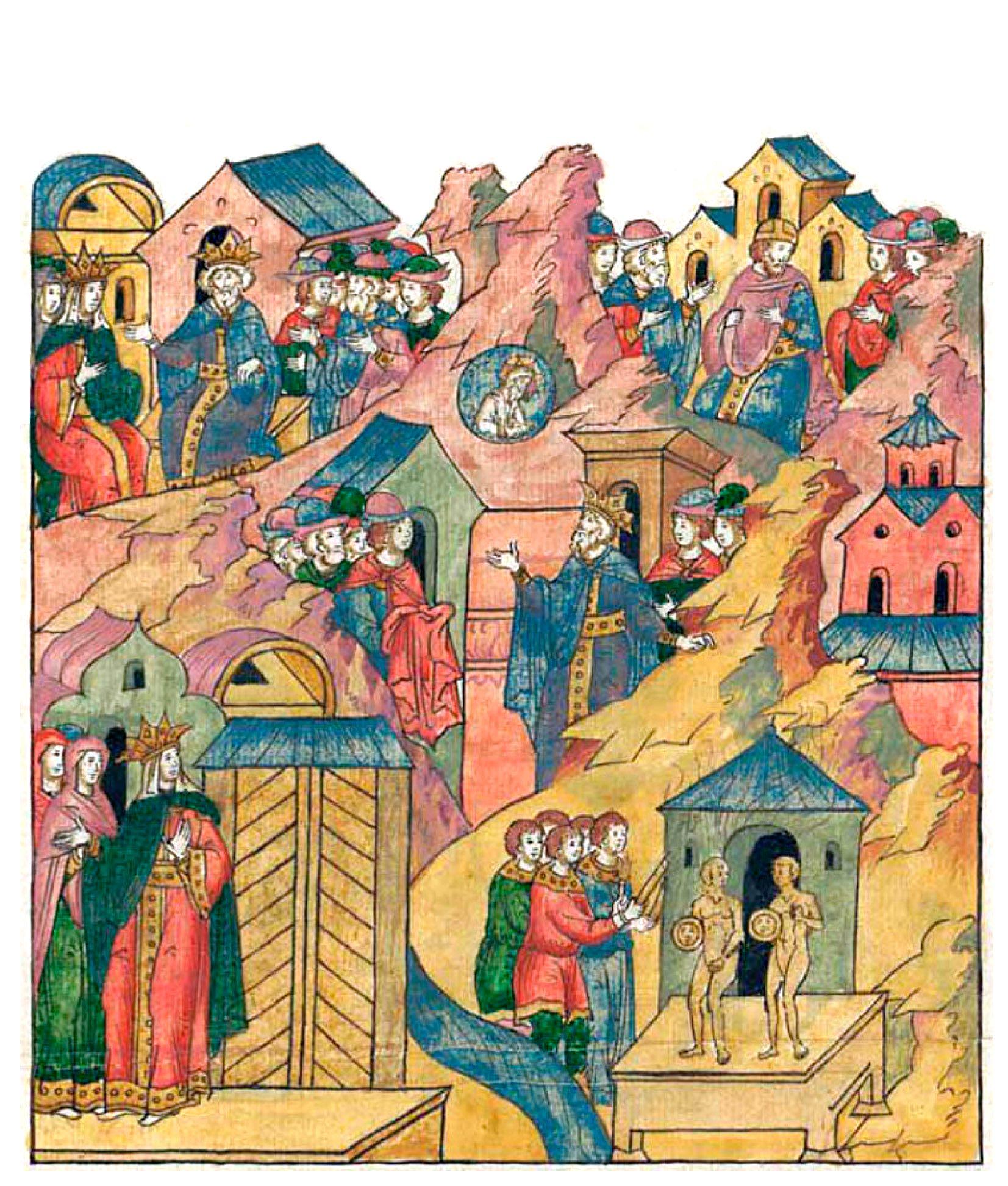
Illuminators of the Illustrated Chronicle of Ivan the Terrible, 1560s. Public domain.
1 Kings 15 and 2 Chronicles 15 · Subject · Featured Study
The Queen Mother in Israel and Judah
The king's mother held a rank of her own at the court of Judah.
Jeremiah named the queen mother in the same breath as the king.
King Asa also removed his grandmother Maacah from her position as queen mother because she had made a detestable Asherah pole. Asa chopped down the pole, crushed it, and burned it in the Kidron Valley.
- Books
- 1 Kings, 2 Chronicles, 2 Kings, Jeremiah
- Hold in memory
- 1 Kings 15:13
Summary
One Hebrew word, gebirah, means the great lady. It stands in six verses. Solomon gave his mother a seat at his right hand. Asa took the rank from his grandmother Maacah. Jehoiachin's mother went with him into exile. Kings also gives the name of the mother of most kings of Judah when each one starts to reign.
- Some read the rank as a true post at court.
- Matthew Henry ties the throne to the fifth commandment.
- Three Hebrew words carry the subject.
A Throne at the King's Right Hand
First Kings 2 gives the clearest picture of the rank.
So Bathsheba went to King Solomon to speak to him for Adonijah. The king stood up to greet her, bowed to her, and sat down on his throne. Then the king had a throne brought for his mother, who sat down at his right hand.The scene shows the rank at its height.
Albert Barnes reads the throne as proof of the high dignity of the queen mother and sets it beside 1 Kings 15:13. C. F. Keil reads the welcome as the reverence due to the queen mother.
The study of David and Bathsheba tells how she became Solomon's mother.
Five Kings' Mothers in Kings and Chronicles
Bathsheba, Maacah, Jezebel, Athaliah and Nehushta stand in the five rows.
The text shows a king's mother asking favours, giving counsel and sharing the king's exile.
| King's mother | Her king | What the text records |
|---|---|---|
| Bathsheba | Solomon | She brought Adonijah's request to the king and sat at his right hand |
| Maacah | Abijam her son and Asa her grandson | Asa removed her from her position as queen mother |
| Jezebel | Joram king of Israel | Jehu named her idolatry and witchcraft to her son |
| Athaliah | Ahaziah king of Judah | She was her son's counselor in wickedness |
| Nehushta | Jehoiachin | She surrendered with the king and went into exile in Babylon |
Why Asa Removed Her
The image was destroyed and the rank taken in one act.
Albert Barnes judges that the image stood in place of the usual Asherah. John Wesley holds that it was burned at the Kidron so that the ashes could be thrown into the water and put to no further use.
Matthew Henry reads the removal as a banishment from the court to a private life. In his comment on Chronicles he holds that Asa knew he must honour God more than his grandmother.
Maacah and the House of Rehoboam
Rehoboam's choice of heir shaped the court Asa inherited.
Rehoboam loved Maacah daughter of Absalom more than all his wives and concubines. In all, he had eighteen wives and sixty concubines, and he was the father of twenty-eight sons and sixty daughters. Rehoboam appointed Abijah son of Maacah as chief prince among his brothers, intending to make him king.The favour shaped the succession.
First Kings names Maacah as the mother of Abijam and again, in the Berean text, as the grandmother of Asa. Jamieson, Fausset and Brown hold that she was properly Asa's grandmother, called the king's mother from the post of dignity she held at the start of his reign.
Second Chronicles 13:2 gives the mother of Abijah as Micaiah daughter of Uriel, of Gibeah. Adam Clarke reports a Jewish reading that Maacah repented and was renamed, so that her former name should bring her no reproach.
The Mothers of the Kings of Judah
Seventeen kings from Rehoboam to Zedekiah have their mothers named.
Kings sets the mother's name beside the length of each reign.
| King | His mother | King | His mother |
|---|---|---|---|
| Rehoboam | Naamah the Ammonite | Hezekiah | Abi daughter of Zechariah |
| Abijam | Maacah daughter of Abishalom | Manasseh | Hephzibah |
| Asa | Maacah daughter of Abishalom (his grandmother in the Berean text) | Amon | Meshullemeth daughter of Haruz of Jotbah |
| Jehoshaphat | Azubah daughter of Shilhi | Josiah | Jedidah daughter of Adaiah of Bozkath |
| Ahaziah | Athaliah granddaughter of Omri king of Israel | Jehoahaz | Hamutal daughter of Jeremiah of Libnah |
| Joash | Zibiah of Beersheba | Jehoiakim | Zebidah daughter of Pedaiah of Rumah |
| Amaziah | Jehoaddan of Jerusalem | Jehoiachin | Nehushta daughter of Elnathan of Jerusalem |
| Azariah | Jecoliah of Jerusalem | Zedekiah | Hamutal daughter of Jeremiah of Libnah |
| Jotham | Jerusha daughter of Zadok |
Amaziah, Azariah, Jotham
Three Hebrew Terms of the Court
Three Hebrew terms of these verses, from the Hebrew dictionary of James Strong.
gebirah (Hebrew, H1377)
A mistress, the queen; it stands in six verses, five of them a king's mother and one Queen Tahpenes, the wife of Pharaoh.
miphletseth (Hebrew, H4656)
A terror, the name of Maacah's image; it stands twice in each of the two verses that tell her removal.
em (Hebrew, H517)
A mother; Kings calls Maacah Asa's mother with this word, where the Berean text gives grandmother.
What the Text Leaves Unsaid
The office is named and never described.
Scripture gives the queen mother a throne and a crown, and sets down no list of her duties.
Second Kings 10:13 speaks of the sons of the king and of the queen mother in Israel and names neither.
Kings names no mother at the accession of Jehoram and of Ahaz, and the text gives no reason.
The Queen Mother in the Fall of Jerusalem
The prophet's warning names the king's mother, and the exile takes her.
Say to the king and to the queen mother: “Take a lowly seat, for your glorious crowns have fallen from your heads.”The prophet speaks to the court before the fall.
Nebuchadnezzar carried away Jehoiachin to Babylon, as well as the king’s mother, his wives, his officials, and the leading men of the land. He took them into exile from Jerusalem to Babylon.The list of exiles shows her place at court.
Adam Clarke takes the king and queen of Jeremiah 13:18 to be Jeconiah and his mother, under whose care the young king was likely left. Jeremiah 29:2 dates his letter to the exiles after King Jeconiah, the queen mother and the court officials had gone from Jerusalem.
Voices on the Queen Mother
One commentator reads the throne as a son's duty.
Matthew Henry (1662 to 1714)
Commentary on the Whole Bible
The note sets the throne of 1 Kings 2:19 under a commandment.
“Solomon received her with all the respect that was due to a mother, though he himself was a king: He rose up to meet her, bowed himself to her, and caused her to sit on his right hand, according to the law of the fifth commandment.”
on 1 Kings 2:19Puritan
Was the Queen Mother an Office?
Albert Barnes, C. F. Keil and the International Standard Bible Encyclopedia see a post, and Matthew Henry sees a mother's honour.
A rank with privileges that could be taken awayAlbert Barnes, C. F. Keil and the International Standard Bible Encyclopedia
Albert Barnes, on Jeremiah 13:18, holds that the word means the great lady and that the king's mother took precedence over his wives. C. F. Keil writes that Maacah kept the post of queen mother, the gebirah, until Asa deposed her. The International Standard Bible Encyclopedia holds that the queen mother took rank almost with the king.
The objection: the same word names Tahpenes, the wife of Pharaoh, in 1 Kings 11:19.
The honour owed to a motherMatthew Henry
Matthew Henry reads Solomon's throne for Bathsheba as the respect due to a mother under the fifth commandment.
The objection: the text treats Maacah's place as a post that a king could take from her.
Books to Read Next
Keil's commentary on Kings is in the public domain and has a free copy to read.
The Books of the Kings
C. F. Keil · 1872
Keil explains the rank of the gebirah in his notes on 1 Kings 2 and 15.
Read at the Internet ArchiveA Crown That Fell
Asa showed that the LORD's commands stood above the rank.
And Asa did what was right in the eyes of the LORD, as his father David had done.The verdict on Asa explains why he removed her.
Sources
Scripture is the Berean Standard Bible.
- Albert Barnes, Notes, Explanatory and Practical, on the Old and New Testaments (1832 to 1869), on 1 Kings 2:19.
- Albert Barnes, Notes, Explanatory and Practical, on the Old and New Testaments (1832 to 1869), on 1 Kings 15:13.
- Albert Barnes, Notes, Explanatory and Practical, on the Old and New Testaments (1832 to 1869), on Jeremiah 13:18.
- Matthew Henry, Commentary on the Whole Bible (1710), on 1 Kings 2:19.
- Matthew Henry, Commentary on the Whole Bible (1710), on 1 Kings 15:13.
- Matthew Henry, Commentary on the Whole Bible (1710), on 2 Chronicles 15:16.
- Jamieson, Fausset and Brown, Commentary Critical and Explanatory on the Whole Bible (1871), on 1 Kings 15:10 to 13.
- Jamieson, Fausset and Brown, Commentary Critical and Explanatory on the Whole Bible (1871), on 1 Kings 15:13.
- John Wesley, Explanatory Notes upon the Old Testament (1765), on 1 Kings 15:13.
- Adam Clarke, Commentary on the Bible (1832), on 2 Chronicles 15:16.
- Adam Clarke, Commentary on the Bible (1832), on Jeremiah 13:18.
- C. F. Keil, The Books of the Kings (Edinburgh: T. and T. Clark, 1872), on 1 Kings 2:19 and 15:13.
- The International Standard Bible Encyclopedia, article Queen Mother, as biblehub.com prints it with no edition year.
Keep Studying
Read it4
Studies3
People and groups10
Places2
Symbols1
Doctrines1