
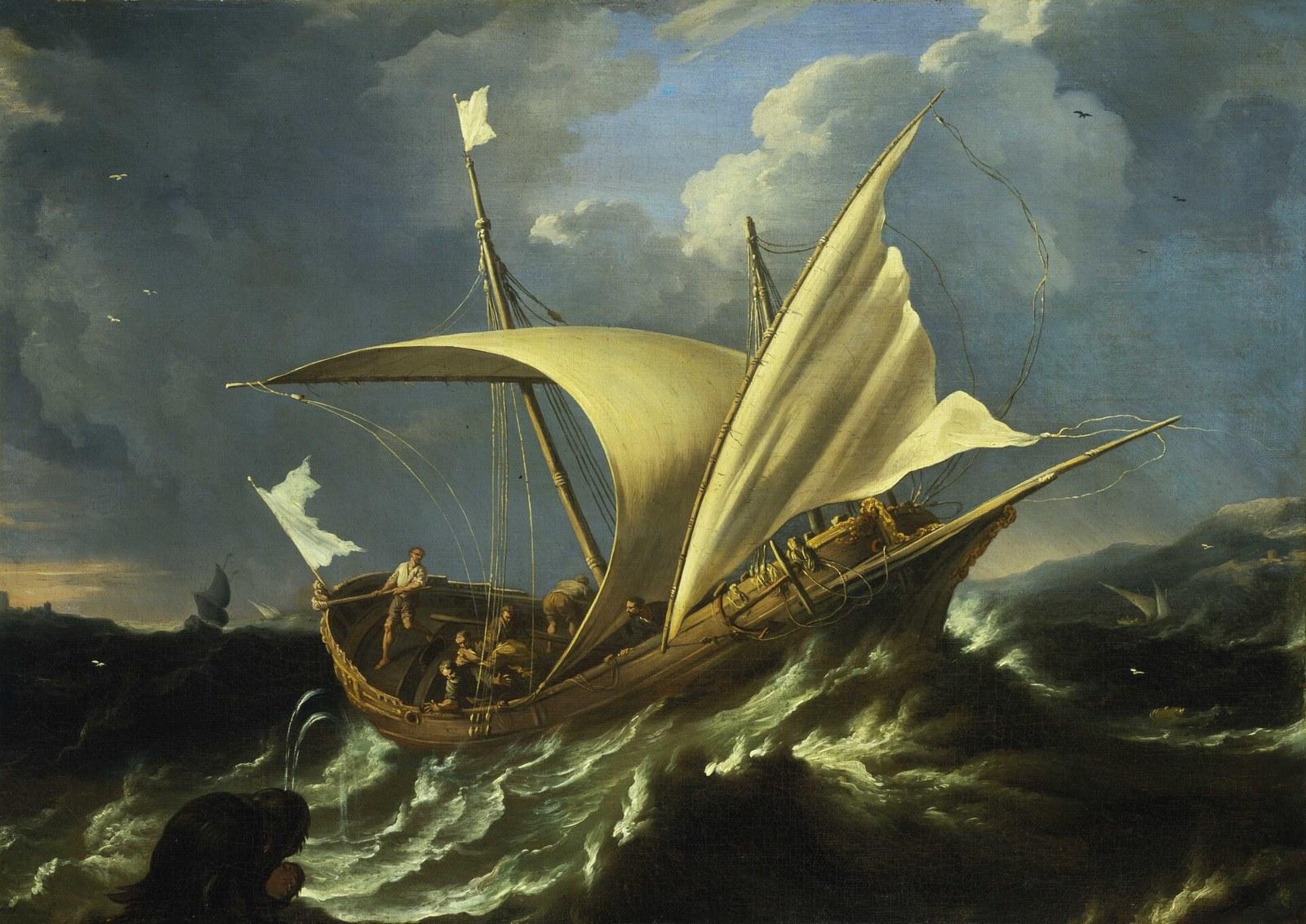
Carlo Antonio Tavella, Jonah and the Whale, mid seventeenth century. Public domain.
Jonah 1, 3 and 4 · Doctrine · Featured Study
Mercy to the Nations
The LORD spares foreign sailors and the Assyrian city of Nineveh in the book of Jonah. Jesus names the men of Nineveh at Matthew 12:41.
So should I not care about the great city of Nineveh, which has more than 120,000 people who cannot tell their right hand from their left, and many cattle as well?”
- First taught
- Genesis 12:3 “I will bless those who bless you and…”
- Fullest statement
- Jonah 4:11 “So should I not care about the great…”
Israel's enemy was spared at the word of an unwilling prophet.
Summary
This study asks how far the LORD's mercy reaches in the book of Jonah. It also asks what the sailors and Nineveh meant to Israel.
- The crew called on Israel's God by name, and a whole people believed Him.
- The king of Nineveh put on sackcloth, and God held back the harm He had warned of.
- Eleven passages from Genesis to Galatians show the nations blessed or spared.
- Tertullian, Jerome, Wesley and others disagree on what the book taught Israel.
The Sailors and the City
Jonah 1 follows a ship's crew, and Jonah 3 follows a city.
So they cried out to the LORD: “Please, O LORD, do not let us perish on account of this man’s life! Do not charge us with innocent blood! For You, O LORD, have done as You pleased.”This prayer comes before the sailors throw Jonah into the sea, while the storm still rages.
When the storm broke, each sailor cried out to his own god (Jonah 1:5). Jonah told them he worshipped the LORD, who made the sea and the dry land (Jonah 1:9).
And the Ninevites believed God. They proclaimed a fast and dressed in sackcloth, from the greatest of them to the least.Belief comes first in this verse, and the fast and the sackcloth follow from it.
Nineveh was the great city of Assyria, the empire that later carried Israel into exile. Its king left his throne, sat in ashes and ordered every person and animal to fast (Jonah 3:6 to 8). Sackcloth was rough cloth worn in mourning.
The Nations Across the Canon
The passages run from the promise to Abraham through the Prophets to the Gospels, Acts and Paul.
Each step shows a nation outside Israel blessed, welcomed or spared by the LORD.
- What the text says of the nations
- All the families of the earth will be blessed through him.
- What the text says of the nations
- A woman of Moab takes Naomi's people and Naomi's God as her own.
- What the text says of the nations
- Solomon asks the LORD to hear the foreigner who prays toward the temple.
- What the text says of the nations
- The Aramean commander confesses that Israel's God is the only God.
- What the text says of the nations
- The LORD makes His Servant a light for the nations.
- What the text says of the nations
- God's house will be called a house of prayer for all nations.
- What the text says of the nations
- They offer a sacrifice to the LORD and make vows to Him.
- What the text says of the nations
- God relents from the disaster when the city turns from its evil ways.
- What the text says of the nations
- Repentance is to be proclaimed in His name to all nations.
- What the text says of the nations
- God welcomes those from every nation who fear Him.
- What the text says of the nations
- Paul writes that Scripture foretold the gospel for the Gentiles to Abraham.
Ruth, Naaman and the sailors are single foreigners, and Nineveh is a whole city.
The sailors, Nineveh, The risen Christ, Peter in Caesarea, Paul to the Galatians
Gentiles are the peoples outside Israel. In the chain, Jonah follows Isaiah's promises and stands before the Gospels, a prophet of Israel sent to preach inside a Gentile city.
Joppa, the Port of Two Callings
One harbour town links the prophet who ran from the Gentiles and the apostle sent to them.
Now send men to Joppa to call for a man named Simon who is called Peter.The verse names the town, and the name joins Acts 10 to Jonah 1.
Nineveh in the Words of Jesus
Jesus sets the repentant Ninevites against the generation that heard Him.
The men of Nineveh will stand at the judgment with this generation and condemn it; for they repented at the preaching of Jonah, and now One greater than Jonah is here.Luke gives the saying to the crowds, where Matthew gives it to scribes and Pharisees.
Luke sets the men of Nineveh beside the Queen of the South (Luke 11:31). She was a foreign queen who came to hear Solomon (1 Kings 10:1). Both came from outside Israel, and Jesus says both will rise at the judgment.
The Voices
Three teachers, from the fourth century to the eighteenth, explain what Nineveh's turning shows of God.
Ambrose of Milan (died 397)
Ambrose of Milan carried the saying past Israel's judgment to the church.
“In this also is clearly expressed the mystery of the Church, which is gathered from the ends of the earth, in the penance of the Ninevites, and in the seeking of wisdom by the Queen of the South: so that she may know the peaceful words of Solomon, the Queen, indeed, whose kingdom is indivisible, arising from diverse and distant peoples into one body.”
Ambrose of Milan · Exposition of the Gospel of Luke, 7.96 · on Luke 11:31 to 32Patristic
Augustine of Hippo (died 430)
Augustine named the risk Nineveh took when it repented with no promise of mercy.
“In uncertainty they repented and obtained certain mercy.”
Augustine of Hippo · Explanation of the Psalms 50 · on Jonah 3:10Patristic
Matthew Henry (1662 to 1714)
Matthew Henry pointed to the offering God accepted from Nineveh.
“Thus he spared Nineveh, and did not the evil which he said he would do against it. Here were no sacrifices offered to God, that we read of, to make atonement for sin, but the sacrifice of God is a broken spirit; a broken and contrite heart, such as the Ninevites now had, it what he will not despise; it is what he will give countenance to and put honour upon.”
Matthew Henry · Commentary on the Whole Bible · on Jonah 3:10Puritan
What the Book Taught Israel
Four readings of the book's lesson about the nations stand among the fathers and the commentators.
The sailors foreshadow the nations turning to GodJohn Wesley
John Wesley, on Jonah 1:16, wrote that the sailors' fear of the LORD might be a type of the heathen turning from idols to God. A type is a person or event that points ahead to a later one.
Jonah fled because the grace was passing to the nationsTertullian; Gregory of Nazianzus; Jerome
“Did Jonah, then, on this account, think that repentance was unnecessary for the pagan Ninevites, when he tried to avoid his duty of preaching? Or was it not, rather, that he foresaw that the mercy of God would be poured out on the heathen also, and so feared it would prove him a false prophet? Actually it was because of a pagan city, which did not yet know God and which sinned in ignorance, that the prophet was almost lost. And he would have been lost, were it not for the fact that what he endured was a type of the Lord's suffering, by which pagan penitents also would be redeemed.”
Tertullian · On Purity 10 · on Jonah 1:17Patristic
Gregory of Nazianzus, in his second oration, wrote that Jonah saw the falling away of Israel and the gift of prophecy passing to the Gentiles. Jerome, on Jonah 4:1, tied the prophet's anger to the Gentiles coming in, in the words of Deuteronomy 32:21.
Nineveh's turning rebukes the covenant peopleJamieson, Fausset and Brown; Augustine of Hippo
Jamieson, Fausset and Brown, on Matthew 12:41, noted that heathens repented at a man's preaching. God's covenant people did not repent at the preaching of the Son of God.
Augustine, in his Sermon 72A, drew the same contrast. The Ninevites heard a servant and changed their ways, while the people of Jesus' day heard the Lord Himself.
God's pity covers the children and the cattleJohn Wesley; Jamieson, Fausset and Brown
John Wesley read the more than 120,000 of Jonah 4:11 as infants. In the cattle he heard that the LORD's tender mercies are over all His works. Jamieson, Fausset and Brown set the children and the animals against the plant Jonah grieved for.
Readers also differ on whether the book records events or teaches by a story, and that question has its own study.
Books to Read Next
Two older commentaries read the book of Jonah verse by verse.
Commentary on the Whole Bible
Matthew Henry · 1710
Henry follows the sailors, the city and the prophet's anger chapter by chapter.
Read it free at BibleHubExplanatory Notes upon the Old Testament
John Wesley · 1765
Wesley gives each phrase of Jonah a short note.
Read it free at BibleHubThe Prophet Who Knew
Jonah's own prayer names the reason he ran.
So he prayed to the LORD, saying, “O LORD, is this not what I said while I was still in my own country? This is why I was so quick to flee toward Tarshish. I knew that You are a gracious and compassionate God, slow to anger, abounding in loving devotion—One who relents from sending disaster.Jonah repeats the confession of Exodus 34:6 almost word for word.
The prophet was angry that this mercy reached Nineveh, and he asked the LORD to take his life (Jonah 4:3). His answer to the LORD's last question is never recorded.
In that question the LORD uses one Hebrew verb twice. Chus, to pity or care, names Jonah's care for the plant in Jonah 4:10. It names the LORD's care for Nineveh in Jonah 4:11, and the Berean renders it care both times.
When God relents, and the gracious and compassionate formula
Sources
Scripture is the Berean Standard Bible.
- The Hebrew text of Jonah 4:10 and Jonah 4:11, word by word, with Strong's numbers.
- Matthew Henry, Commentary on the Whole Bible (1710), on Jonah 3:10.
- John Wesley, Explanatory Notes upon the Old Testament (1765), on Jonah 1:16 and Jonah 4:11.
- Jamieson, Fausset and Brown, Commentary Critical and Explanatory on the Whole Bible (1871), on Matthew 12:41 and Jonah 4:11.
- Ambrose of Milan, Exposition of the Gospel of Luke 7.96.
- Augustine of Hippo, Explanation of the Psalms 50 and Sermon 72A.1.
- Tertullian, On Purity 10.
- Gregory of Nazianzus, In Defense of His Flight to Pontus, Oration 2.
- Jerome, Commentary on Jonah, on Jonah 4:1 to 2.
Keep Studying
Read it4
Studies6
People and groups6