
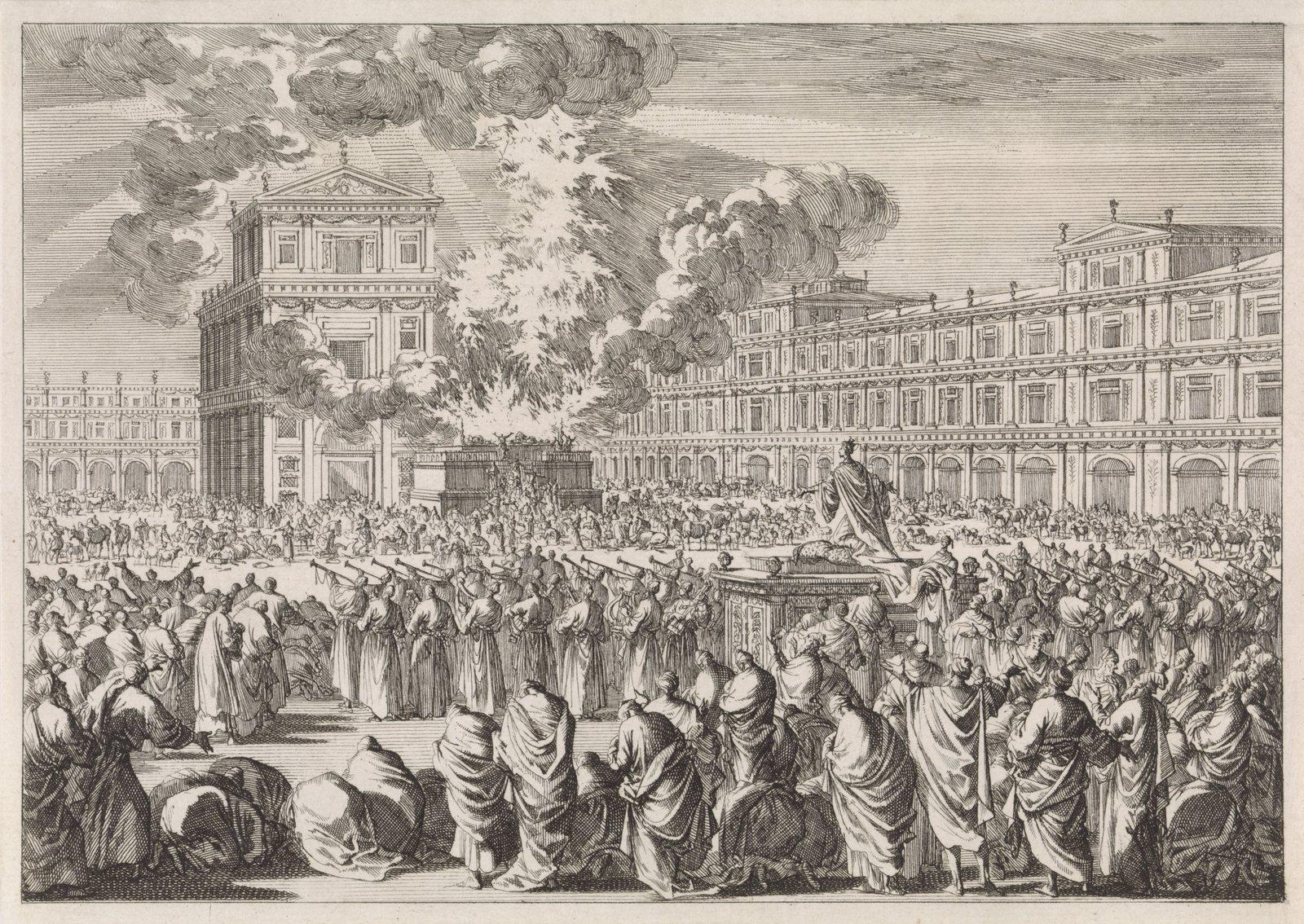
Jan Luyken, The Dedication of Solomon's Temple, 1700. Public domain.
2 Chronicles 6 and 7 · Subject · Featured Study
Praying Toward the House
In 2 Chronicles 6 Solomon asks God to hear every prayer made in the temple or toward it.
Now Solomon had made a bronze platform five cubits long, five cubits wide, and three cubits high, and had placed it in the middle of the courtyard. He stood on it, knelt down before the whole assembly of Israel, spread out his hands toward heaven,
- Book
- 2 Chronicles
- Hold in memory
- 2 Chronicles 7:14, 2 Chronicles 6:21
Chronicles alone records that Solomon knelt on a bronze platform to pray.
Summary
The prayer names seven troubles that would drive Israel to pray.
- The last trouble is exile, and the exiles face home as they pray.
- Fire and the LORD's answer followed the prayer.
- Jewish law and the New Testament read the direction of prayer in two ways.
The King on the Platform
2 Chronicles 6:13 to 21 sets the scene and the ground of the prayer.
May Your eyes be open toward this temple day and night, toward the place where You said You would put Your Name, so that You may hear the prayer that Your servant prays toward this place.This is the ground of all seven cases: the Name placed in the house.
Hear the plea of Your servant and of Your people Israel when they pray toward this place. May You hear from heaven, Your dwelling place. May You hear and forgive.The plea covers king and people alike, and forgiveness is its first request.
The Seven Cases of Solomon's Prayer
Every case names a trouble and the help Solomon seeks for it.
Solomon's seven cases run from a quarrel at the altar to captives in a foreign land.
- 1. A man sins against his neighbour and takes an oathJudge, condemning the wicked and justifying the righteous.2 Chronicles 6:22 to 23
- 2. Israel is defeated by an enemy for its sinForgive, and restore them to the land.2 Chronicles 6:24 to 25
- 3. The skies are shut and no rain fallsForgive, teach the good way and send rain.2 Chronicles 6:26 to 27
- 4. Famine, plague, blight, locusts or siegeForgive and repay each man, for You know his heart.2 Chronicles 6:28 to 31
- 5. A foreigner comes from a distant landDo all he asks, so that all peoples know Your name.2 Chronicles 6:32 to 33
- 6. Israel goes out to warHear their prayer and uphold their cause.2 Chronicles 6:34 to 35
- 7. Israel is taken captive to a land far or nearHear, uphold their cause and forgive.2 Chronicles 6:36 to 39
A table of the seven cases in the order of 2 Chronicles 6, each with the remedy Solomon asks.
How Chronicles ends the prayer2 Chronicles 6:41 to 42, with Barnes
Now therefore, arise, O LORD God, and enter Your resting place, You and the ark of Your might. May Your priests, O LORD God, be clothed with salvation, and may Your godly ones rejoice in goodness.Chronicles closes on the ark's entry into its rest, where Kings closes otherwise.
Albert Barnes held that both writers copied the prayer from one fuller document and that each gave it in shorter form.
In the House and Toward It
The place of prayer moves outward as the cases go on.
When Your people Israel are defeated before an enemy because they have sinned against You, and they return to You and confess Your name, praying and pleading before You in this temple,Defeat sends the people back to the house itself.
and when they return to You with all their heart and soul in the land of the enemies who took them captive, and when they pray in the direction of the land that You gave to their fathers, the city You have chosen, and the house I have built for Your Name,The farthest case gives the longest line of direction.
The first two cases are prayed inside the house. From the third on, the prayer is made toward it from wherever the trouble falls.
The Fire and the Answer
Chronicles follows the prayer with fire on the altar and a word from the LORD by night.
When Solomon had finished praying, fire came down from heaven and consumed the burnt offering and the sacrifices, and the glory of the LORD filled the temple.Chronicles sets the fire directly after the prayer's last word.
and if My people who are called by My name humble themselves and pray and seek My face and turn from their wicked ways, then I will hear from heaven, forgive their sin, and heal their land.The answer turns Solomon's request into a promise with conditions.
In the Berean text the words humble themselves and pray stand only in 2 Chronicles 7:14.
The Words of the Direction
Two Hebrew words of Solomon's prayer come from the STEP Bible lexicon of Tyndale House.
maqom (Hebrew, H4725)
A standing, a spot; it is the place God chose, twice in 2 Chronicles 6:20 and twice in 2 Chronicles 6:21.
derek (Hebrew, H1870)
A road as trodden, a course; it stands behind in the direction of in 2 Chronicles 6:34 and 2 Chronicles 6:38.
What the Text Leaves Unsaid
The prayer leaves these matters open.
Solomon sets no hour for the prayers and no form of words.
The prayer leaves unsaid what a captive should do if the house itself were gone.
From the House to the One Who Hears
The New Testament keeps the hearing God and loosens the place.
The house gave prayer a direction, and heaven was where it was heard.
“Believe Me, woman,” Jesus replied, “a time is coming when you will worship the Father neither on this mountain nor in Jerusalem.Jesus answers the question of which mountain, the question the direction of prayer raises.
Let us then approach the throne of grace with confidence, so that we may receive mercy and find grace to help us in our time of need.Hebrews names the place every prayer now faces.
Two Voices on Praying Toward the House
Two teachers weigh the direction of prayer, one from the fifth century and one from the eighteenth.
Theodoret of Cyrus (died 458)
Theodoret of Cyrus, in his commentary on Psalm 28:2, explains what facing the city meant.
“When blessed Daniel in Babylon prayed, he opened the windows facing Jerusalem, not under the impression that God was confined there but from his knowledge that the divine manifestation occurred there.”
Theodoret of Cyrus · Commentary on Psalm 28:2 · on Daniel 6:10Patristic
Matthew Henry (1662 to 1714)
Matthew Henry, in his Commentary on the Whole Bible of 1710, weighs the case of the foreigner.
“He supposed that strangers would come from afar to worship the God of Israel and to pay homage to him; and this also might reasonably be expected, considering what worthless things the gods of the nations were, and what proofs the God of Israel had given of his being Lord of the whole earth. Here are petitions very pertinent.”
Matthew Henry · Commentary on the Whole Bible · on 2 Chronicles 6:32Puritan
Does the Direction Still Bind?
Each reading has its holders, its works and an objection.
The one who prays turns toward the Holy of HoliesThe Mishnah; the Babylonian Talmud · Rabbinic Judaism
The Mishnah gives the rule in the fourth chapter of Berakhot. One who cannot turn his face toward Jerusalem should focus his heart toward the Holy of Holies. The Talmud, in Berakhot 30a, builds on verses of the prayer. One who prays outside the land turns his heart toward the land, one in the land toward Jerusalem, and one in Jerusalem toward the temple.
It concludes that all Israel turns its heart toward one place. The objection is John 4:21.
The house pointed to Christ in heavenMatthew Henry; Jamieson, Fausset and Brown · Protestant commentary
Henry, on 2 Chronicles 6:20, says Christians pray to be accepted in Christ, and that God now names no house as His beloved place. Jamieson, Fausset and Brown, on Daniel 6:10, tell the believer to turn to Christ in the heavenly temple from the land of captivity.
The objection is that Solomon's prayer itself sets the house in the line of prayer (2 Chronicles 6:38).
Books to Read Next
This commentary on the prayer is free to read.
Commentary on the Whole Bible
Matthew Henry · 1710
Henry turns the cases of the prayer into petitions a Christian may pray.
Read it at Bible HubHeard From Heaven
Solomon set one house before every trouble Israel would know, and he left the hearing to God.
Prayer still goes to the same God, now through Christ, who opened the way to the throne of grace.
Sources
Scripture is the Berean Standard Bible.
- The Berean text searched for toward this place, toward this temple, toward Your holy, toward Jerusalem, in the direction, bronze platform and humble themselves and pray.
- STEP Bible TBESH lexicon and TAHOT word index, Tyndale House, CC BY 4.0.
- Mishnah Berakhot 4:5 and 4:6, William Davidson Edition, CC BY-NC.
- Babylonian Talmud, Berakhot 30a:9, William Davidson Edition, CC BY-NC.
- Theodoret of Cyrus, Commentary on Psalm 28:2, 458.
- Matthew Henry, Commentary on the Whole Bible, 1710, on 2 Chronicles 6:20 to 32.
- Jamieson, Fausset and Brown, Commentary Critical and Explanatory on the Whole Bible, 1871, on Daniel 6:10.
- Albert Barnes, Notes on the Old Testament, 1832 to 1869, on 2 Chronicles 6:40 to 42.
Keep Studying
Read it4