
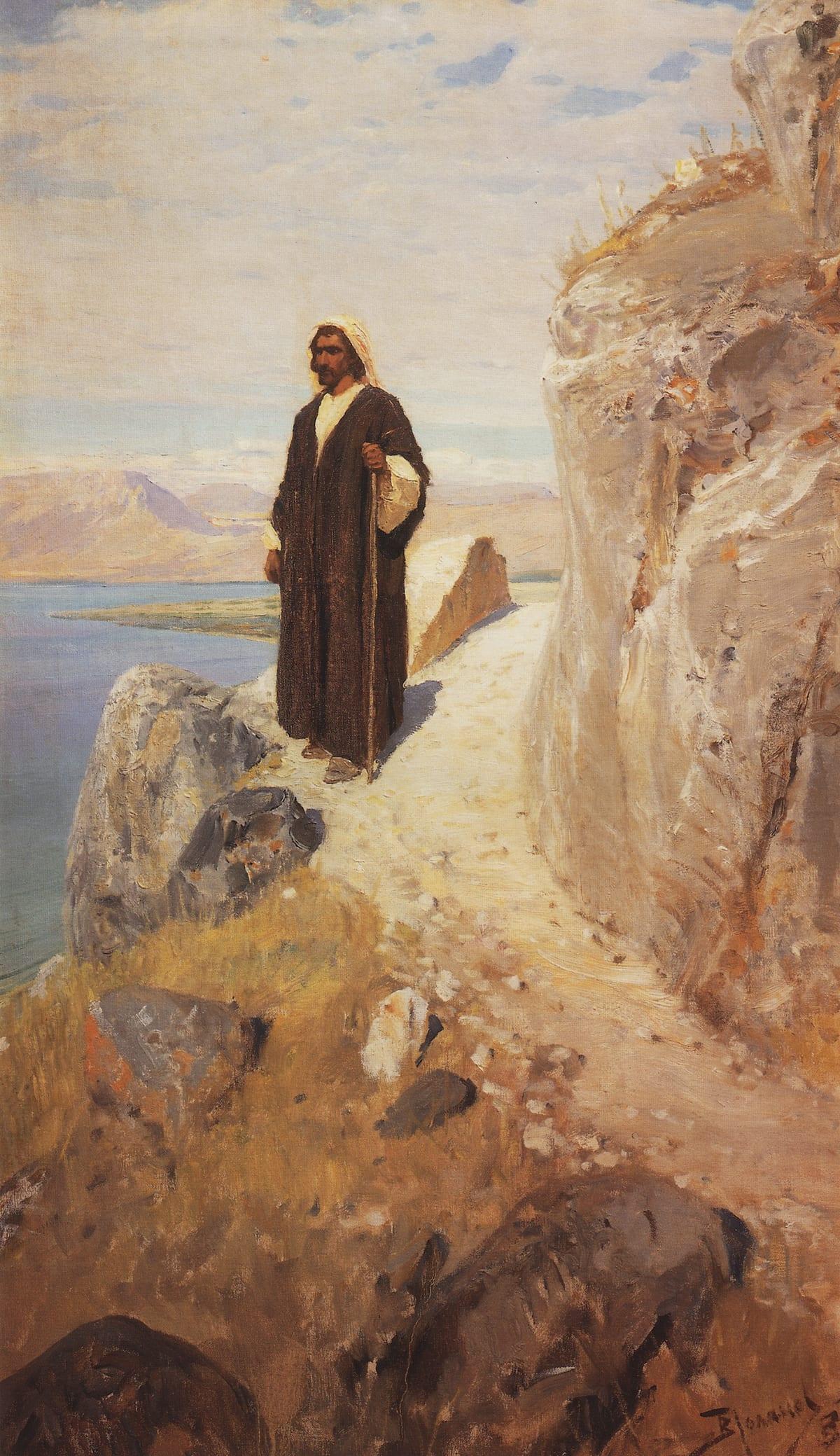
Vasily Polenov. Public domain.
1 Kings 9:11 · Place · Featured Study
Galilee
Galilee was the northern region of Israel, the land of Zebulun and Naphtali.
“What are these towns you have given me, my brother?” asked Hiram.
King Solomon gave twenty towns in the land of Galilee to Hiram king of Tyre, who had supplied him with cedar and cypress logs and gold for his every desire.
King Solomon gave twenty towns in the land of Galilee to Hiram king of Tyre, who had supplied him with cedar and cypress logs and gold for his every desire.
- Region
- Galilee lay between the Bay of Acre and the Sea of Galilee, on Smith's plate
- First named
- Joshua 20:7 “…they set apart Kedesh in Galilee in the…”
- Last named
- Acts 13:31 “…who had accompanied Him from Galilee to Jerusalem.…”
Summary
Its Hebrew name means a circuit, and Isaiah called it Galilee of the nations.
- The Berean text names Galilee in 66 verses, 6 of them in the Old Testament.
- John's Gospel sets Cana and Bethsaida in Galilee (John 2:1; John 12:21).
- The Greek name Galilaia stands 61 times in the New Testament, by Strong's count.
The Twenty Towns
Solomon's gift of Israel's land to a foreign king raised a question of the Law.
This study asks where Galilee lay, what Solomon's gift to Hiram cost and how a border land became the home of Jesus' ministry. It marks the region on an atlas plate, follows its name through Scripture and weighs what the name Cabul means.
Albert Barnes, the American commentator, holds that by the spirit of the Law Solomon had no right to give away any part of Israel's inheritance (Leviticus 25:13 to 34). He calls the gift a case of worldly policy setting the Law aside.
Solomon rebuilt the cities Hiram had given him and settled Israelites there.This is the verse the commentators set beside 1 Kings 9:13.
John Gill, the Baptist commentator, reads these cities as the twenty towns, given back to Solomon by Hiram. Adam Clarke, the Methodist commentator, suggests Hiram held them only until Solomon's debt was paid, or never took them at all.
The study of Solomon tells the reign that made the bargain.
Galilee on the Plate
George Adam Smith's plate of 1915 shows the hill country of Galilee in relief.
Four places of Galilee stand between the coast and the lake.
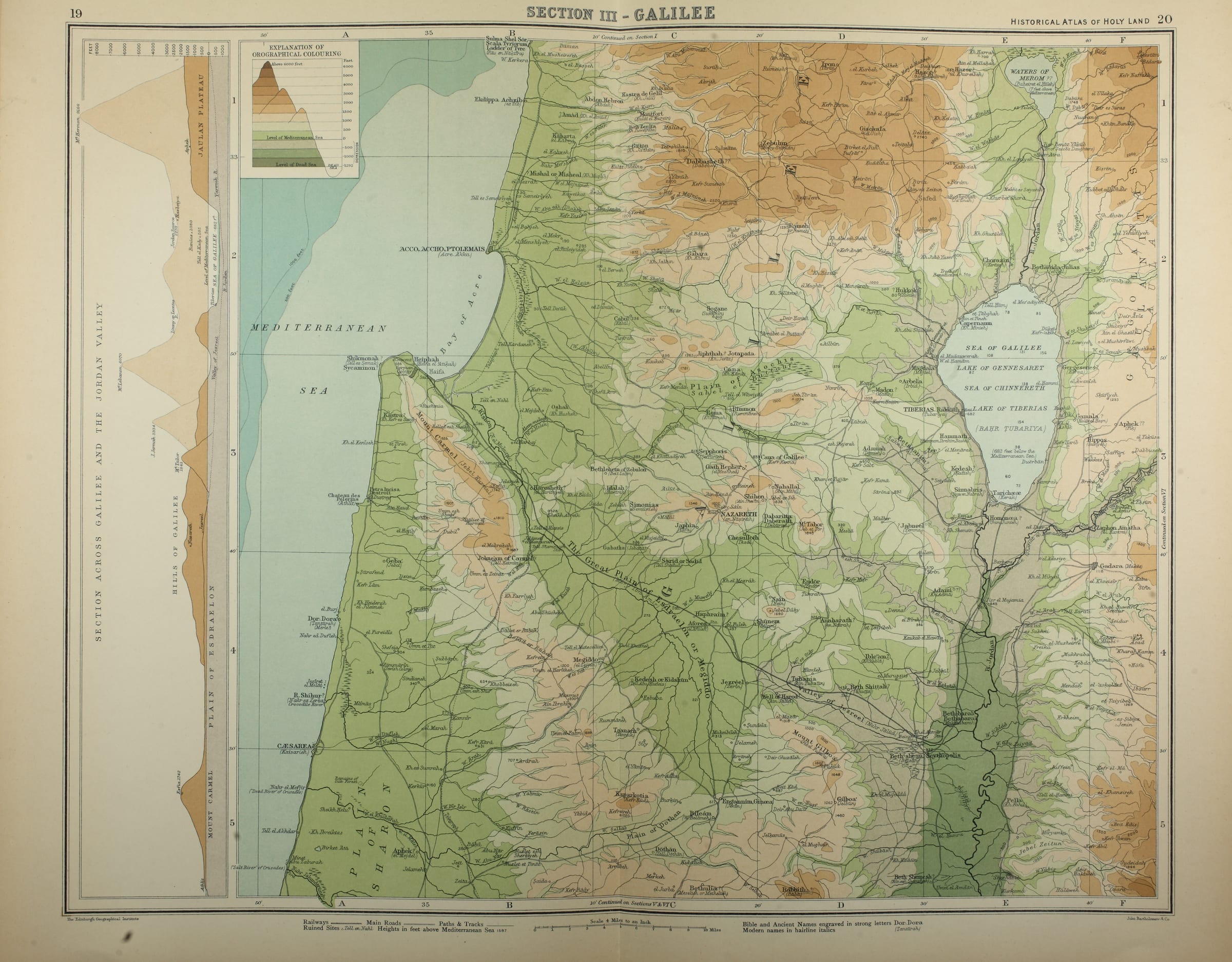
- AccoAsher failed to drive out the people of Acco. The plate letters Acco, Accho, Ptolemais on the Bay of Acre, the westernmost point.Judges 1:31
- CabulHiram gave Solomon's towns this name. The plate letters Cabul, Kabul, inland from the bay, with no query.1 Kings 9:13
- CapernaumJesus left Nazareth and lived in Capernaum by the sea. The plate letters it at Khirbet Minieh on the north-west shore, with Tell Hum to the north-east, the easternmost point.Matthew 4:13
- Gath HepherZebulun's border ran east to Gath-hepher. The plate letters Gath Hepher at el Meshhed and marks it with a query, the southernmost point.Joshua 19:13
George Adam Smith, Section III, Galilee, in his Atlas of the Historical Geography of the Holy Land, 1915, engraved by John Bartholomew and Co. Public domain; File:John Bartholomew & Co., Section III - Galilee (FL46962157 3907197).jpg.
Four numbered points, each where George Adam Smith's plate prints the place, with north at the top.
Three place pages teach Nazareth, Capernaum and the lake, and the study of Hazor teaches the great city of the north.
Galilee in Scripture, in Order
Each of these verses names Galilee.
Galilee moves from Israel's northern border to the ministry of Jesus and the church.
- The land dividedIsrael sets apart Kedesh in Galilee, in the hill country of Naphtali, as a city of refugeJoshua 20:7
- The days of PekahTiglath-pileser takes Galilee and all the land of Naphtali and carries the people to Assyria2 Kings 15:29
- Jesus' ministryJesus withdraws to Galilee when He hears that John has been imprisonedMatthew 4:12
- The early churchThe church in Judea, Galilee and Samaria has a time of peaceActs 9:31
Four moments from Joshua to Acts in the order of the canon, each with its verse.
The study of the fall of Samaria follows the end of the northern kingdom.
Galilee of the Nations
Isaiah gave the region a name, and the commentators trace it in two ways.
Nevertheless, there will be no more gloom for those in distress. In the past He humbled the land of Zebulun and the land of Naphtali, but in the future He will honor the Way of the Sea, beyond the Jordan, Galilee of the nations:Isaiah's name for the region stands at the end of this verse.
Adam Clarke writes that Zebulun, Naphtali and Manasseh, which he calls the country of Galilee all round the lake, suffered most in the first Assyrian invasion. He adds that they were the first to enjoy Christ's preaching.
Clarke holds that the region took its name from the Egyptians, Arabians and Phoenicians who lived there, on the witness of Strabo. The Glossa Ordinaria, the medieval gloss that Thomas Aquinas gathers on Matthew 4:15, traces the name to Solomon instead. It counts two Galilees, one of the Jews and one of the Gentiles, the second being the twenty cities given to Hiram.
Jamieson, Fausset and Brown, the Scottish commentators, note that in Christ's day the Galileans' speech gave them away (Matthew 26:73). Their distance from Jerusalem and Caesarea gave them a name for turbulence or for independence, as friend or enemy saw it.
What the Text Leaves Unsaid
The Old Testament gives Galilee no borders and names only one of its towns.
The verses of the Old Testament that name Galilee draw no border for it. The only town they name as a town of Galilee is Kedesh, in Joshua 20:7, Joshua 21:32 and 1 Chronicles 6:76.
Out of Galilee
In Jerusalem the crowd and the Pharisees held Galilee against Jesus.
Others declared, “This is the Christ.” But still others asked, “How can the Christ come from Galilee?The question shows what Jerusalem thought of the region.
“Aren’t you also from Galilee?” they replied. “Look into it, and you will see that no prophet comes out of Galilee.”This claim draws John Wesley's answer in his note on the verse.
Voices on Galilee
Matthew Henry weighs Solomon's gift, and John Wesley answers the Pharisees on Galilee's prophets.
Matthew Henry (1662 to 1714)
“It should seem, these were not allotted to any of the tribes of Israel (for the border of Asher came up to them, Josh. xix. 27 , which intimates that it did not include them), but continued in the hands of the natives till Solomon made himself master of them, and then made a present of them to Hiram. It becomes those that are great and good to be generous.”
Matthew Henry · Commentary on the Whole Bible · on 1 Kings 9:11Puritan
John Wesley (1703 to 1791)
“They knew Jonah arose out of Gethhepher; and Nahum from another village in Galilee. Yea, and Thisbe, the town of Elijah, the Tishbite, was in Galilee also. They might likewise have known that Jesus was not born in Galilee, but at Bethlehem, even from the public register there, and from the genealogies of the family of David.”
John Wesley · Explanatory Notes upon the New Testament · on John 7:52Evangelical
What Did Hiram Mean by Cabul?
Commentators read the name as displeasing, as dirt or as a border.
then turned eastward toward Beth-dagon, touched Zebulun and the Valley of Iphtah-el, and went north to Beth-emek and Neiel, passing Cabul on the left.Every reading must reckon with a Cabul already on Asher's border.
A Phoenician word for displeasingAlbert Barnes, Notes, on 1 Kings 9:12 to 13
Barnes reports that Cabul is said to be a Phoenician word meaning displeasing. He suggests that Hiram had hoped for the harbour of Acco and was the more disappointed to receive inland hill country.
The objection: Joshua 19:27 names a Cabul on Asher's border long before Hiram's day.
A land of dirtJohn Wesley, Explanatory Notes upon the Old Testament, on 1 Kings 9:13
Wesley reads Cabul as of dirt, as he says most interpret it. The land was good, he writes, but its thick, stiff clay took hard work, which suited the merchants of Tyre poorly.
The objection: Wesley himself grants that the land was very good, which sits uneasily with a name meaning dirt.
A borderAdam Clarke, Commentary on the Bible, on 1 Kings 9:13
Clarke says the learned are not agreed on the name. Because Cabul marked part of Asher's boundary in Joshua's day, some read it as border, and he notes that the Septuagint renders the word with the Greek for a boundary.
The objection: 1 Kings 9:13 says that Hiram called the towns by this name, which reads as a name he gave.
A Great Light
Isaiah's oracle runs on from the humbled land to a promise of light.
The people walking in darkness have seen a great light; on those living in the land of the shadow of death, a light has dawned.Matthew 4:16 carries these words over to the ministry of Jesus.
Sources
Scripture is the Berean Standard Bible.
- James Strong, Exhaustive Concordance of the Bible (1890), Hebrew entry 1551 and Greek entry 1056, with the occurrence counts of the site's lexicon.
- John Wesley, Explanatory Notes upon the Old Testament (1765), on 1 Kings 9:13.
- John Wesley, Explanatory Notes upon the New Testament (1755), on John 7:52.
- Albert Barnes, Notes, Explanatory and Practical, on the Old and New Testaments (1832 to 1869), on 1 Kings 9:11.
- Albert Barnes, Notes, Explanatory and Practical, on the Old and New Testaments (1832 to 1869), on 1 Kings 9:12.
- Albert Barnes, Notes, Explanatory and Practical, on the Old and New Testaments (1832 to 1869), on 1 Kings 9:13.
- Adam Clarke, Commentary on the Bible (1832), on 1 Kings 9:11.
- Adam Clarke, Commentary on the Bible (1832), on 1 Kings 9:13.
- Adam Clarke, Commentary on the Bible (1832), on Isaiah 9:1.
- Adam Clarke, Commentary on the Bible (1832), on Matthew 4:15.
- The Glossa Ordinaria, in Thomas Aquinas, Catena Aurea (1274), on Matthew 4:15.
- Jamieson, Fausset and Brown, Commentary Critical and Explanatory on the Whole Bible (1871), on Matthew 4:15.
- John Gill, Exposition of the Old Testament (1748 to 1763), on 2 Chronicles 8:2.
- Matthew Henry, Commentary on the Whole Bible (1710), on 1 Kings 9:11.
Keep Studying
Read it4
Subjects1
Go further7