
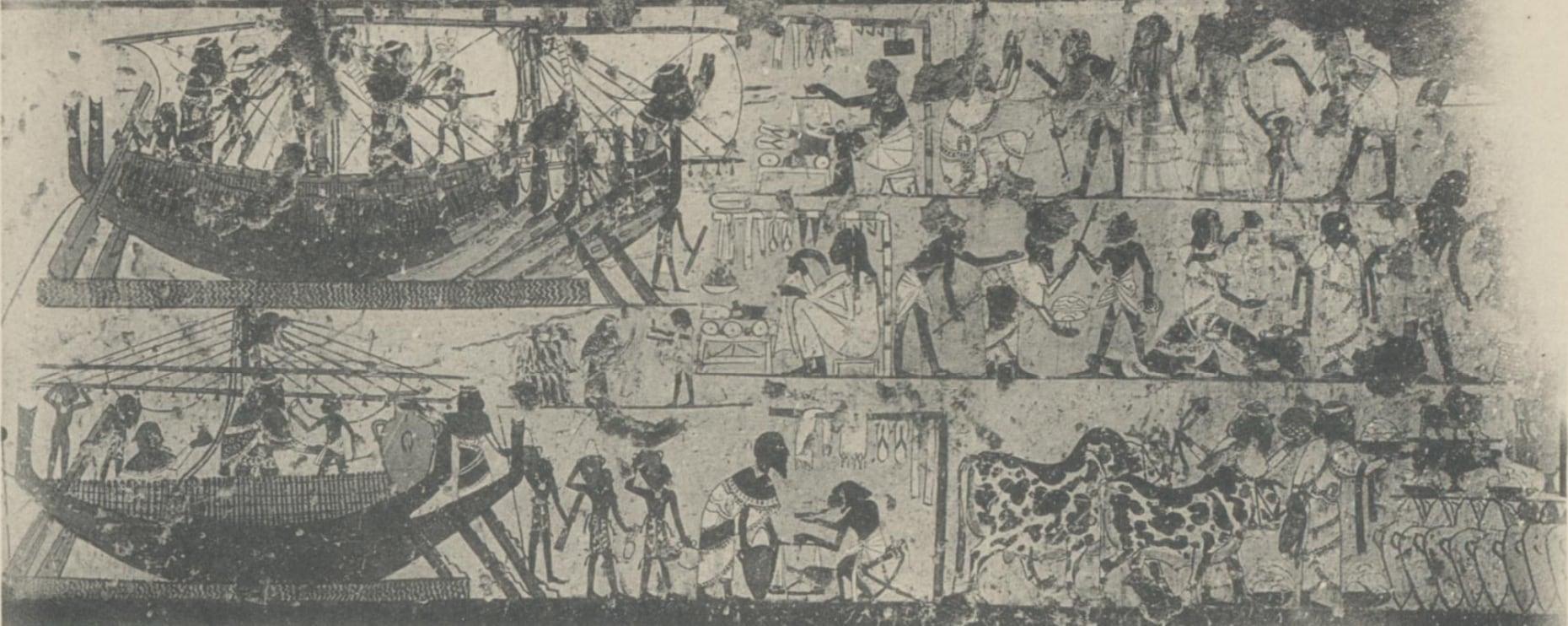
Canaanite ships at a port in Egypt, tomb of Kenamun, 1895. Public domain.
1 Kings 9:28 · Place · Featured Study
Ophir and Solomon's Fleets
Ophir was the land of gold that Solomon's ships reached by sea from his port on the Red Sea.
They sailed to Ophir and imported gold from there—420 talents—and delivered it to Solomon.
- Region
- Ophir lay somewhere beyond the Red Sea, by a voyage from Ezion-geber.
- First named
- Genesis 10:29 “Ophir, Havilah, and…”
- Last named
- Isaiah 13:12 “…rarer than the gold of Ophir.”
Jehoshaphat built a fleet for the same voyage, and it was wrecked before it left port.
Summary
Seven books of Scripture name Ophir, from Genesis to Isaiah.
- David set aside three thousand talents of the gold of Ophir for the temple (1 Chronicles 29:4).
- Psalm 45 dresses the queen in the gold of Ophir (Psalm 45:9).
- Job uses the gold of Ophir in a call to repentance (Job 22:24).
The Fleet at Ezion-geber
Solomon's ships sailed from the head of the Gulf of Akabah with Phoenician seamen aboard.
This study asks where Solomon's ships sailed and what they brought home. It sets the fleet's port on an old map of its voyage, follows the voyages in order and weighs where the land of gold lay.
And Hiram sent his servants, men who knew the sea, to serve in the fleet with Solomon’s servants.The voyage depended on the skill of Hiram's men.
Easton's Bible Dictionary (1897) sets Ezion-geber at the north-east end of the Gulf of Akabah, near Elath. Strong's dictionary glosses Ophir as a gold region in the East.
The study of Tyre teaches Hiram's treaties with David and Solomon and the timber his men cut. The study of Edom teaches the nation whose coast held the port.
The Fleet on Wyld's Plate
James Wyld's plate of 1819 draws one proposed track for the voyages.
Wyld sends the fleet from Ezion-geber down the Red Sea and along Africa to Sofala, which he names as Ophir.
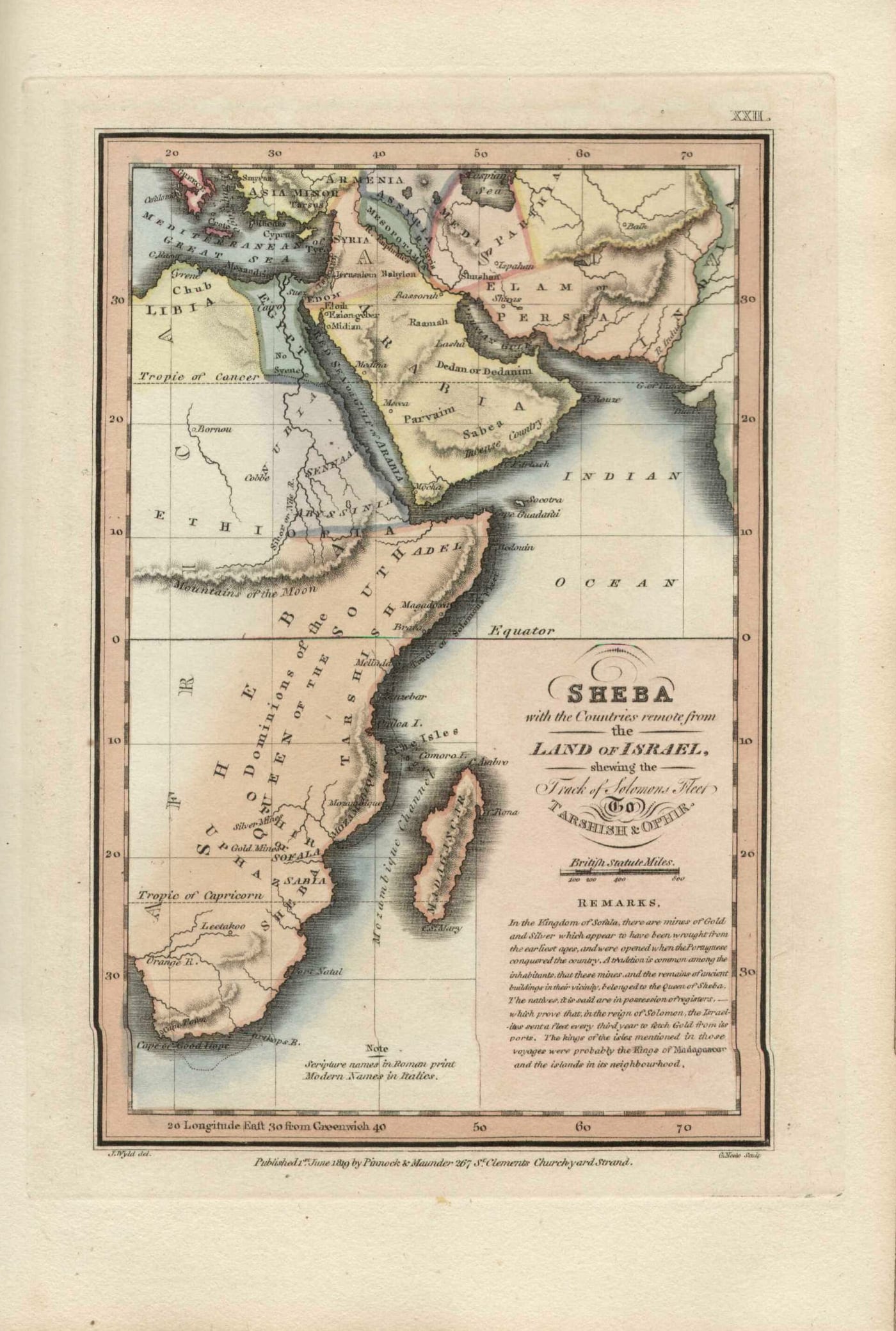
- Ezion-geberSolomon went to Ezion-geber and Eloth on the coast of Edom. Wyld prints the port beside Eloth at the head of the gulf; OpenBible scores no site for it above 500 of 1,000, so its place is proposed.2 Chronicles 8:17
- SabeaThe queen of Sheba came to test Solomon with hard questions. Wyld letters Sabea in southern Arabia.1 Kings 10:1
- TarshishSolomon had ships of Tarshish at sea with Hiram's fleet. Wyld letters Tarshish down the African coast, while Easton's dictionary sets it at a Phoenician port in Spain.1 Kings 10:22
- SofalaThe fleet reached Ophir and brought gold to Solomon. Wyld prints Ophir or Sofala beside gold and silver mines, one proposal among several.1 Kings 9:28
James Wyld the elder, Sheba and the Countries remote from the Land of Israel, shewing the Track of Solomons Fleet to Tarshish and Ophir, engraved by G. Neele, published by Pinnock and Maunder, 1819. Public domain; National Library of Israel, Eran Laor Cartographic Collection.
Four numbered points, each where James Wyld's plate prints the place, with north at the top. The plate prints Scripture names in Roman type and modern names in italics, with a scale in British statute miles. Scripture names no route.
The study of the Queen of Sheba teaches the land Wyld letters Sabea and the queen who came from it.
The Voyages, in Order
Kings and Chronicles each tell the voyages, and the two give the gold different weights.
Kings counts 420 talents of gold from Ophir and Chronicles counts 450.
- The fleet is builtSolomon assembles a fleet at Ezion-geber, near Eloth in Edom1 Kings 9:26
- The voyage in KingsThe fleet brings 420 talents of gold from Ophir1 Kings 9:28
- The cargoHiram's fleet also brings almug wood and precious stones from Ophir1 Kings 10:11
- The ships of TarshishSolomon's fleet of Tarshish brings gold, silver, ivory, apes and peacocks1 Kings 10:22
- The voyage in ChroniclesHiram's ships and crews reach Ophir with Solomon's servants and bring 450 talents2 Chronicles 8:18
Five moments from 1 Kings to 2 Chronicles in the order of the canon, each with its verse.
The study of Solomon tells the reign the fleet served, and the study of Solomon's Temple teaches the house the gold adorned.
The Ships and the Cargo
Commentators explain the two weights of gold, the name of the ships and the rare wood.
Albert Barnes, the American commentator, holds that one of the two numbers of talents has suffered in copying, as numbers often do.
Easton's dictionary explains that ships of Tarshish sometimes means large ships built for a long voyage, wherever they sailed.
The king made the almug wood into steps for the house of the LORD and for the king’s palace, and into lyres and harps for the singers. Never before had such almug wood been brought in, nor has such been seen to this day.)Kings sets the rare wood beside the gold as part of the fleet's worth.
The two books also differ on Jehoshaphat's fleet. Kings says he refused Ahaziah's sailors (1 Kings 22:49), while Chronicles says he allied with Ahaziah and a prophet foretold the wreck (2 Chronicles 20:37).
What the Text Leaves Unsaid
No verse gives Ophir's place or the length of the voyage there.
The three years of 1 Kings 10:22 belong to the ships of Tarshish. Barnes holds that the fleet of Tarshish was not the fleet of Ophir, so the length of the Ophir voyage is not recorded.
Wisdom Worth More Than Gold
Job and Isaiah take the gold of Ophir as their measure of worth.
It cannot be valued in the gold of Ophir, in precious onyx or sapphire.Wisdom is the one treasure no fleet could bring home.
I will make man scarcer than pure gold, and mankind rarer than the gold of Ophir.The prophet turns the measure of wealth into a measure of loss.
Voices on Ophir
Matthew Henry tied the fleet's port to David's conquest of Edom.
Matthew Henry (1662 to 1714)
“Probably that wilderness now began to be peopled by the Edomites, which it was not then. To them this port had belonged, but, David having subdued the Edomites, it now pertained to the crown of Judah. The fleet traded to Ophir in the East Indies, supposed to be that which is now called Ceylon.”
Matthew Henry · Commentary on the Whole Bible · on 1 Kings 9:26Puritan
Where Ophir Lay
Readers have placed Ophir in India, in Arabia and on the coast of Africa.
Their territory extended from Mesha to Sephar, in the eastern hill country.Readers who place Ophir in Arabia start from the land Genesis gives the sons of Joktan.
India or CeylonJosephus, Matthew Henry and John Wesley
Josephus, in Antiquities 8.6.4, calls the land of old named Ophir the Aurea Chersonesus, which belongs to India. John Wesley, the Methodist preacher, also places Ophir in the East Indies and explains the three years as a voyage that kept close to the coast. Easton's dictionary adds that the Septuagint reads Sophir and that Sofir is the Coptic name for India.
The objection: Genesis 10:28 to 29 names Ophir with Sheba among the sons of Joktan.
ArabiaAlbert Barnes and M. G. Easton
Barnes, on 1 Kings 9:28, says Arabia's claims are supported by the greatest number. Easton's dictionary says much may be said for a place somewhere in Arabia.
The objection: Barnes himself takes the almug wood to be red sandalwood, whose native land is India.
The coast of AfricaJames Wyld's plate, 1819
Wyld's printed remark says that Sofala's gold and silver mines were worked from the earliest ages, and that the people there credited them to the queen of Sheba. Barnes names eastern Africa as the third of the views most held.
The objection: the plate rests on what the people of Sofala told and names no ancient witness.
Adam Clarke, the Methodist commentator, wrote that no one knew for certain where Ophir was. OpenBible's data scores south-western Arabia 283, Punt 176 and Sopara in India 163, each of 1,000.
More Precious Than Gold
Solomon's ships crossed the sea for gold.
so that the proven character of your faith—more precious than gold, which perishes even though refined by fire—may result in praise, glory, and honor at the revelation of Jesus Christ.Peter sets the believer's tested faith above the metal kings sent fleets to find.
Sources
Scripture is the Berean Standard Bible.
- James Strong, Exhaustive Concordance of the Bible (1890), Hebrew dictionary, entry 211.
- M. G. Easton, Illustrated Bible Dictionary, third edition (1897), articles Ezion-geber, Ophir and Tarshish.
- Flavius Josephus, Antiquities of the Jews 8.6.4, translated by William Whiston (1737)
- OpenBible.info, Bible Geocoding Data, ancient.jsonl.
- Matthew Henry, Commentary on the Whole Bible (1710), on 1 Kings 9:26.
- John Wesley, Explanatory Notes upon the Old Testament (1765), on 1 Kings 9:28.
- Albert Barnes, Notes, Explanatory and Practical, on the Old and New Testaments (1832 to 1869), on 1 Kings 9:28.
- Albert Barnes, Notes, on 1 Kings 10:11.
- Albert Barnes, Notes, on 1 Kings 10:22.
- Albert Barnes, Notes, on 2 Chronicles 8:18.
- Adam Clarke, Commentary on the Bible (1832), on 1 Kings 9:28.