
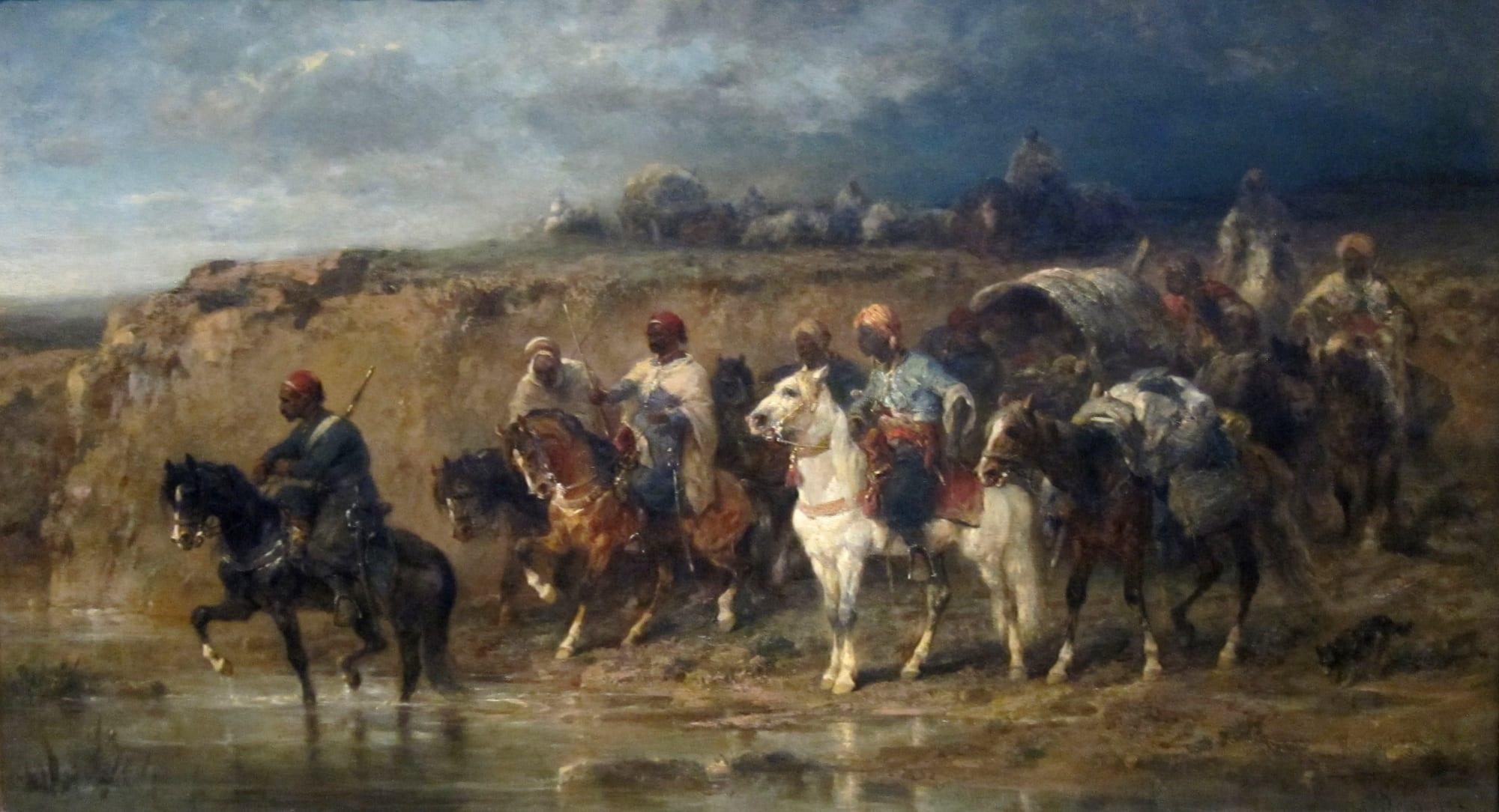
Adolf Schreyer, Arab Caravan, about 1860. Public domain.
Isaiah 60:6 · Place · Featured Study
Sheba
Sheba was the land of the Sabeans, whom Joel calls a distant nation.
Caravans of camels will cover your land, young camels of Midian and Ephah, and all from Sheba will come, bearing gold and frankincense and proclaiming the praises of the LORD.
- Region
- Ptolemy's map places the Sabei in south-west Arabia
- First named
- Genesis 10:7 “…And the sons of Raamah: Sheba and Dedan.”
- Last named
- Ezekiel 38:13 “Sheba and Dedan…”
The Sabeans swooped down on Job's oxen and donkeys and put his servants to the sword.
Summary
The prophets meet Sheba's people as traders at Tyre and as buyers of slaves.
- Strong's dictionary records the people's name, a Shebaite or Sabean, once, in Joel 3:8.
- Albert Barnes calls the Sabaeans a rich merchant people like the Phoenicians.
- Strong's lists Seba, a son of Cush, as a separate name, in 4 verses.
The Wares of Tyre's Market
Ezekiel lists the goods that came to Tyre from Sheba and the traders named with it.
This study asks what kind of land Sheba was, where Ptolemy drew it and what the prophets say of its people. It marks the land on his map, follows Sheba through the prophets, and weighs where the raiders of Job 1:15 came from.
In your marketplace they traded with you fine garments of blue, embroidered work, and multicolored rugs with cords tightly twisted and knotted.These are the wares of the traders named in the verse before, Sheba's among them.
Sheba on Ptolemy's Map
The Ulm edition of Ptolemy's Geography draws Arabia from the ancient geographer's tables.
Saba regia stands near the coast below the Sabei, and Omerita lies further east.
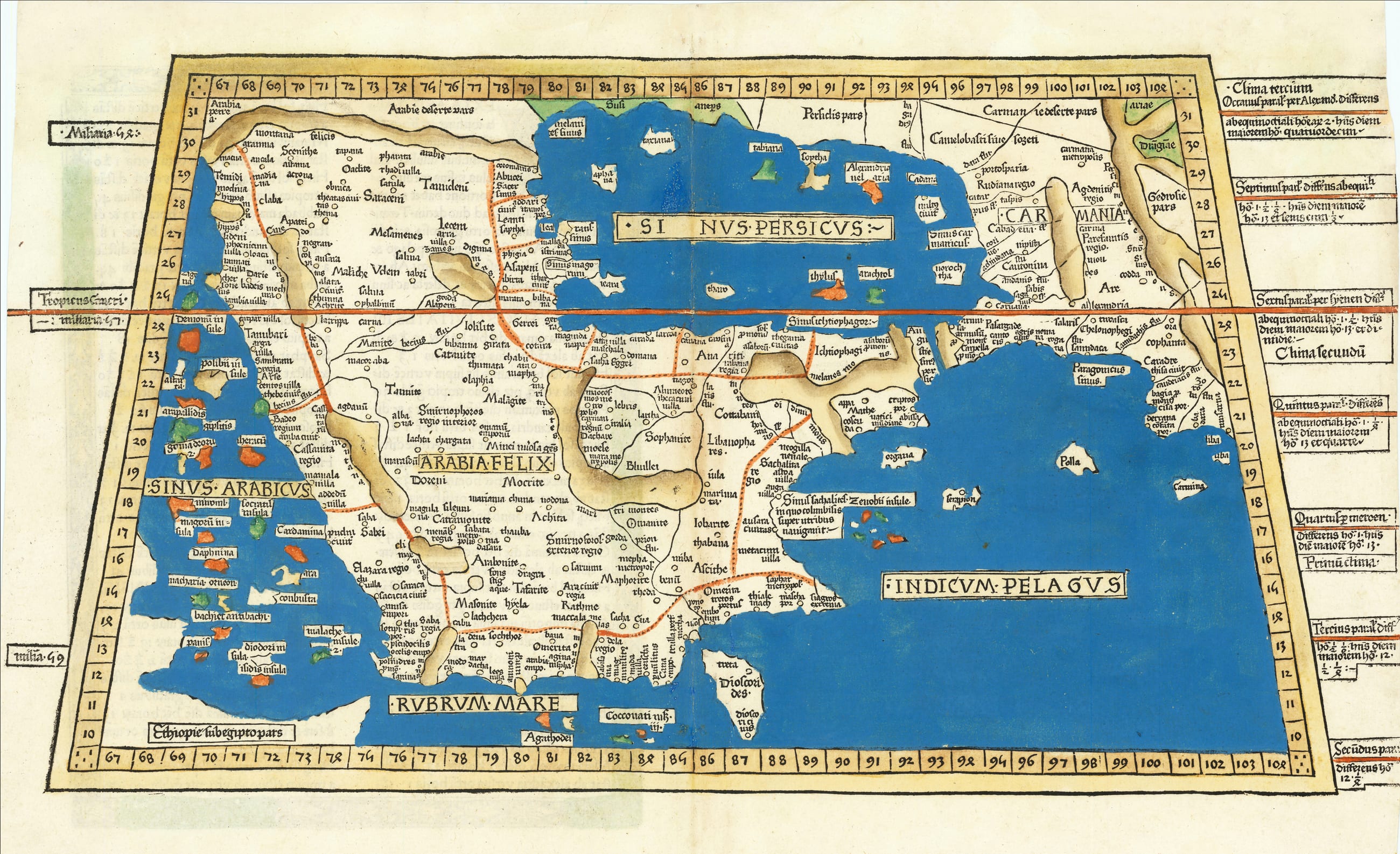
- Arabia FelixThe map letters ARABIA FELIX across the middle of the peninsula, the northernmost point.
- SabeiThe map letters Saba and Sabei inland from the Red Sea coast, the westernmost point.
- Saba regiaThe map letters Saba regia, a royal Saba, close to the shore.
- OmeritaThe map letters Omerita on the southern coast, the easternmost point. Barnes writes that the Greeks and Latins knew the Sabaeans by the name of one branch, the Homeritae.
Claudius Ptolemy, the sixth map of Asia, Arabia Felix, in the Ulm edition of his Geography, printed by Lienhart Holle, 1482. Public domain; File:1482 Ptolemaic map of the Arabian peninsula and the Persian Gulf.jpg.
Four numbered points, each where the Ulm map prints the name, with north at the top. The places are where Ptolemy set them, and the map gives no mark of doubt beside any of the four.
The study of the queen of Sheba tells her visit to Solomon in 1 Kings 10 and weighs where her kingdom lay.
Sheba in the Prophets, in Order
Each of these verses names Sheba or the Sabeans.
Ezekiel names Sheba twice, and Joel once.
- Ezekiel's lament for TyreThe merchants of Sheba trade with Tyre beside those of Asshur and ChilmadEzekiel 27:23
- Ezekiel's oracle on GogSheba and Dedan ask Gog whether he has come for plunderEzekiel 38:13
- Joel's oracle on Tyre and PhilistiaTheir sons and daughters will be sold to the SabeansJoel 3:8
Three moments from Ezekiel to Joel in the order of the canon, each with its verse.
The Camel Trade
Isaiah's picture of Sheba's caravans drew Albert Barnes to the camel trade of Arabia.
Then you will look and be radiant, and your heart will tremble and swell with joy, because the riches of the sea will be brought to you, and the wealth of the nations will come to you.The camels of Isaiah 60:6 bring this wealth of the nations.
Barnes, on Isaiah 60:6, writes that the camel was the chief beast of burden of Arabia and in a sense its wealth. He reads the verse as a promise that Arabia would receive the true religion and bring its merchandise to the church of God.
What the Text Leaves Unsaid
The commentators look to history for the fulfilment of Joel's oracle.
You sold the people of Judah and Jerusalem to the Greeks, to send them far from their homeland.Joel's sentence on Tyre answers the sale of Judah's people to the Greeks.
Barnes points to the slaves taken when Alexander captured Tyre. Adam Clarke, the Methodist commentator, cites Calmet's view that Jews under Persian rule bought Phoenician slaves and sold them on to the Sabeans.
Tribute to the King
The royal psalm asks for Sheba's gold, and John Wesley reads it of two kings.
Long may he live! May gold from Sheba be given him. May people ever pray for him; may they bless him all day long.The psalm sets the gift among its prayers for the king's long life.
Wesley reads the long life of Solomon and, beyond him, the endless life of Christ. He adds that such words, used of Christ and His kingdom, are commonly taken in a spiritual sense.
Voices on Sheba
Tertullian reads the gold of the nations as the Creator's gift, and Jamieson, Fausset and Brown read the gifts and prayers of Psalm 72:15.
Tertullian (died 220)
“Besides the generally known fact that the riches of the East, that is to say, its strength and resources, usually consist of gold and spices, it is certainly true of the Creator that he makes gold the riches of the other nations also.”
Tertullian · Against Marcion 3.13 · on Psalm 72:15Patristic
Jamieson, Fausset & Brown (1802 to 1910)
“In his prolonged life he will continue to receive the honorable gifts of the rich, and the prayers of his people shall be made for him, and their praises given to him.”
Jamieson, Fausset & Brown · Commentary Critical and Explanatory on the Whole Bible · on Psalm 72:15Reformed
Where Did the Raiders of Job 1:15 Come From?
Readers differ on whether Job's raiders were a desert band near Uz or a people of far Arabia.
a messenger came and reported to Job: “While the oxen were plowing and the donkeys were grazing nearby,The messenger's report begins here, before he names the raiders.
Raiders from the desert near UzAdam Clarke, Commentary on the Bible, on Job 1:15 and Ezekiel 27:23
Clarke reports that these Sabeans are supposed to have lived in Arabia Deserta, east of the land of Uz. He notes that the Septuagint, the Syriac and the Arabic read the word as a raiding party, and he describes such bands striking and fleeing back into the desert. On Ezekiel 27:23 he places that verse's Sheba near the country of the Edomites.
The objection: Barnes notes that the Hebrew of Job 1:15 is Sheba itself, the name the prophets give the land of merchants.
A people of far ArabiaAlbert Barnes, Notes, on Job 1:15; Thomas Aquinas, Commentary on Job
Barnes holds that the raiders were beyond doubt people of some part of Arabia Felix. Aquinas reads them as an enemy from far away, from whom the stolen herds could not easily be won back.
The objection: the messenger tells of a sudden strike and a quick escape, which suits a band near at hand.
Nations to Your Light
In Isaiah 60 the wealth of Sheba comes with praise to the LORD, as part of a promise to Zion.
Nations will come to your light, and kings to the brightness of your dawn.The promise of the chapter begins with nations and kings.
Sources
Scripture is the Berean Standard Bible.
- James Strong, Exhaustive Concordance of the Bible (1890), Hebrew entries 5434, 5436 and 7615, with the occurrence counts of the site's lexicon.
- Albert Barnes, Notes, Explanatory and Practical, on the Old and New Testaments (1832 to 1869), on Joel 3:8.
- Albert Barnes, Notes, Explanatory and Practical, on the Old and New Testaments (1832 to 1869), on Isaiah 60:6.
- Albert Barnes, Notes, Explanatory and Practical, on the Old and New Testaments (1832 to 1869), on Job 1:15.
- Jamieson, Fausset and Brown, Commentary Critical and Explanatory on the Whole Bible (1871), on Psalm 72:15.
- John Wesley, Explanatory Notes upon the Old Testament (1765), on Psalm 72:15.
- Adam Clarke, Commentary on the Bible (1832), on Joel 3:8.
- Adam Clarke, Commentary on the Bible (1832), on Job 1:15.
- Adam Clarke, Commentary on the Bible (1832), on Ezekiel 27:23.
- Thomas Aquinas, Commentary on Job (1274), on Job 1:15.
- Tertullian, Against Marcion, book 3, chapter 13.
Keep Studying
Read it4