
1 Kings 3:16 to 28 · Story · Wisdom
The Two Women and the Child
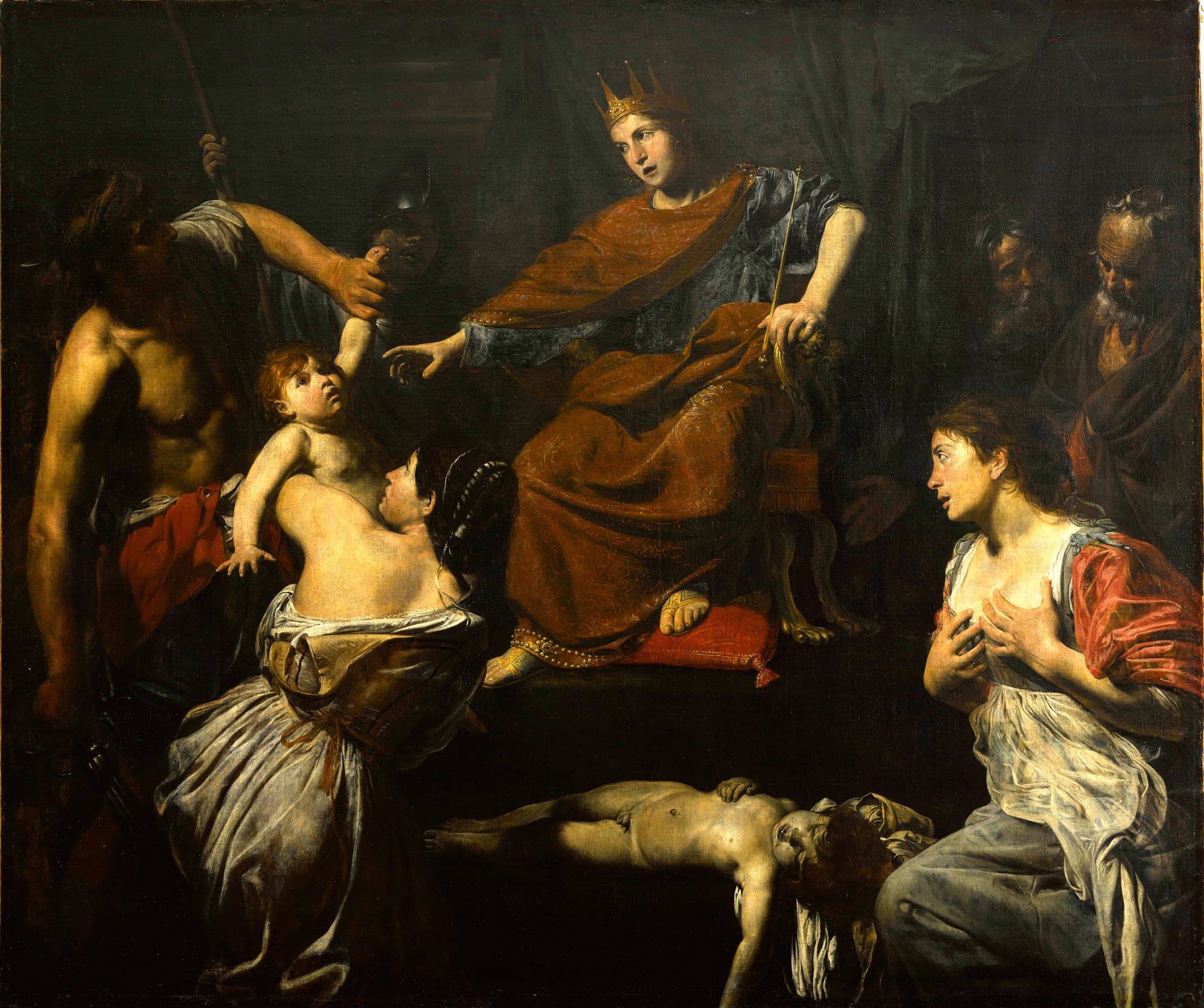
Two women claimed one living baby before Solomon, and his ruling showed Israel the wisdom of God in him.
With no witness to call, the king drew his evidence from the answer one woman gave to an order to cut the child in two.
When all Israel heard of the judgment the king had given, they stood in awe of him, for they saw that the wisdom of God was in him to administer justice.
- Where
- Jerusalem
- Who
- Solomon
- When
- Early in Solomon's reign, after the night at Gibeon (1 Kings 3:15 to 16)
Summary
1 Kings 3:16 to 28 tells of a case brought to Solomon "At that time", just after the night at Gibeon. Two prostitutes shared a house, each had borne a son, and one of the babies had died in the night. The king's ruling ended their quarrel over the surviving boy, and the account closes on what all Israel heard and saw.
- No one but the two women had been in the house when the child died and was exchanged (1 Kings 3:18 to 20).
- The woman who pleaded for the boy's life spoke because her compassion grew warm for him, nikhmeru rachameiha (1 Kings 3:26).
- The verdict of 1 Kings 3:28 is the only place in the chapter where the noun chokmah, wisdom, stands.
- In Matthew 12:42 Jesus says that One greater than Solomon is here.
A Case with No Witness
The case came from one house, where two births had been followed by a death in the night.
The Two Women and the Child belongs to the value of wisdom, because it is the first scene in which Solomon's gift from Gibeon is put to use. The chapter names that gift at its close.
The question the story answers is how the king found the truth when two women made equal claims and no one else could speak. It follows the hearing in order, sets out who said what, and teaches the Hebrew words for compassion and for cutting. It closes with the church's readings of the sword, from a test of love to a lie told for the truth.
The night at Gibeon, where Solomon asked for a heart to judge the people, comes just before this scene.
The writer calls the women zonot (H2181), which the Berean text renders "two prostitutes" (1 Kings 3:16).
One woman said, “Please, my lord, this woman and I live in the same house, and I gave birth while she was in the house. On the third day after I gave birth, this woman also had a baby. We were alone, with no one in the house but the two of us.The first woman's account opens with the facts a judge would need and ends by admitting that no one else was there to confirm them.
The Hearing in Twelve Steps
The account moves from the two births to the morning discovery, the quarrel, the sword and the verdict.
Until the sword the case rests on two women's words, and the king's order then draws out the answer that decides it.
- The first son is bornOne woman"I gave birth"1 Kings 3:17
- Another son is born three days laterOne woman"On the third day"1 Kings 3:18
- A son dies in the nightOne woman"because she rolled over on him"1 Kings 3:19
- The dead child is exchanged for the livingOne woman"in the middle of the night"1 Kings 3:20
- The exchange is found at dawnOne woman"when I examined him"1 Kings 3:21
- The quarrel before the throneBoth women"So they argued before the king"1 Kings 3:22
- The king sets the two claims side by sideThe king"This woman says"1 Kings 3:23
- A sword is broughtThe king"Bring me a sword"1 Kings 3:24
- The king's commandThe king"Cut the living child in two"1 Kings 3:25
- Two answers to the orderThe woman whose son was alive, then the other woman"Do not kill him!"1 Kings 3:26
- The rulingThe king"she is his mother"1 Kings 3:27
- All Israel hears of the judgmentThe narrator"they stood in awe of him"1 Kings 3:28
A timeline of twelve steps in 1 Kings 3:17 to 28, each with its speaker and words from the Berean text.
The king sets the two claims side by side, A sword is brought, The king's command, Two answers to the order, The ruling, All Israel hears of the judgment
Five Verses Against One Clause
The speeches are unequal in length, and the order to divide the child gives the case its second round.
The first woman tells her story across five verses, from the birth of her son to the morning she looked at the dead child (1 Kings 3:17 to 21).
The other woman answers in one clause, "the living one is my son and the dead one is your son" (1 Kings 3:22).
Then the king replied, “This woman says, ‘My son is alive and yours is dead,’ but that woman says, ‘No, your son is dead and mine is alive.’”The king repeats both claims as they were made, which shows that the hearing has reached a point testimony cannot pass.
The king continued, “Bring me a sword.” So they brought him a sword, and the king declared, “Cut the living child in two and give half to one and half to the other.”The order turns the hearing from what the women say about the past to what each will say about the child now.
Then the woman whose son was alive spoke to the king because she yearned with compassion for her son. “Please, my lord,” she said, “give her the living baby. Do not kill him!” But the other woman said, “He will be neither mine nor yours. Cut him in two!” Then the king gave his ruling: “Give the living baby to the first woman. By no means should you kill him; she is his mother.”The two answers are the evidence, and the ruling follows from them in the next breath.
What the Text Settles
The chapter's own words settle three details: the children's ages, the women of the ruling, and the wording of the king's request.
The text dates the younger child's birth "On the third day" and gives no age for either child at the hearing (1 Kings 3:18).
The ruling gives the child to "the first woman" (1 Kings 3:27), and in the verse before, the first to answer the order is the mother of the living boy. The account never says whether she is the woman who spoke first in 1 Kings 3:17.
The noun for wisdom is absent from the request of 1 Kings 3:9, a listening heart, and present in Chronicles, where Solomon asks for wisdom and knowledge (2 Chronicles 1:10).
Looking, Cutting and Compassion
Three Hebrew words carry the hearing: the woman's close look, the king's order and the mother's love.
When the first woman says she examined the dead child, the verb is va-etbonen, from bin (H995), the root of the discernment Solomon asked for at Gibeon (1 Kings 3:21).
The king's order is gizru, cut (H1504), and the other woman's answer takes up the same verb, gezoru, cut him (1 Kings 3:25 to 26). The verb stands thirteen times in the Hebrew Bible.
In 1 Kings 3:26 the verb is nikhmeru (H3648), they had grown warm, and its subject is rachameiha, her compassions. Rachamim (H7356), compassion, occurs 45 times in the Hebrew Bible.
The verdict joins the words of the request. Israel saw chokhmat Elohim, the wisdom of God, within him to do mishpat, justice, and the king's judging is shafat, the verb of his request to judge (1 Kings 3:28).
A King Who Heard Cases
In Israel the ruler sat as judge, so two women with no standing could bring their quarrel to the throne.
Moses judged the people's disputes in person, saying, "it is brought to me to judge between one man and another" (Exodus 18:16).
When Israel asked for a king, they wanted one "to judge us, to go out before us, and to fight our battles" (1 Samuel 8:20).
Absalom won hearts by complaining that "the king has no deputy to hear you" (2 Samuel 15:3), which shows that people expected the king himself to hear their cases.
What the Chapter Leaves Unsaid
Names, penalties and the king's thoughts are all absent from the account.
Neither woman is named, and neither is the child. The account records no penalty for the woman who lost her claim.
It gives no word of what the king was thinking when he called for the sword. The belief that the child was never in danger is an inference from the ruling (1 Kings 3:27), since the text records no intention behind the order.
One Greater Than Solomon
The chapter gives the credit for the ruling to God, and Jesus later measured Himself against Solomon's wisdom.
The Queen of the South will rise at the judgment with this generation and condemn it; for she came from the ends of the earth to hear the wisdom of Solomon, and now One greater than Solomon is here.The saying places Christ above the king whose fame drew a foreign ruler on a long journey.
The queen's visit is told in 1 Kings 10, where she came "to test him with difficult questions" (1 Kings 10:1). Jesus speaks of Solomon's wisdom as she heard it, and Paul names Christ "the power of God and the wisdom of God" (1 Corinthians 1:24).
Voices on the Hearing
An eighteenth-century commentary drew a lesson about infancy, and Jerome and Augustine read the women as figures.
1662 to 1714 · Matthew Henry
The death of the child drew from a commentary of 1710 a word about the dangers of infancy.
Read the page on Matthew Henry
“What anxiety is caused by little children, how uncertain their lives are, and to how many dangers they are continually exposed. The age of infancy is the valley of the shadow of death; and the lamp of life, when first lighted, is easily blown out. It is a wonder of mercy that so few perish in the perils of nursing.”
Matthew Henry · Commentary on the Whole Bible · on 1 Kings 3:21Puritan
Jerome's Letter 74 to Rufinus, written in 398, treats the narrative as a parable, with the false and true mothers as types of the Synagogue and the Church. The Nicene and Post-Nicene Fathers prints only an editors' summary of the letter.
Augustine, in his Sermon 10, read the two women as the synagogue and the church. Both readings are allegory, and they stand beside the chapter's own verdict, which comes first.
Questions Readers Ask
Readers have asked whether the king's order was a lie and what trade the two women followed.
The first question is whether the order to divide the child was a deception.
The order was a lie told to reach the truthJohn Cassian
In the conference the speaker is Abbot Joseph, who also calls the ruling a judgment that "every one has felt to have been inspired by God".
“What about Solomon, who in his first judgment manifested the gift of wisdom, which he had received of God, only by making use of falsehood? For in order to get at the truth which was hidden by the woman's lie, even he used the help of a lie most cunningly invented, saying: ‘Bring me a sword and divide the living child into two parts, and give the one half to the one and the other half to the other.’”
John Cassian · CONFERENCE 17.25 · on 1 Kings 3:24 to 28Patristic
The objection: the chapter calls the act a judgment and credits it to God's wisdom with no word of deceit (1 Kings 3:28).
The order was a test of loveMatthew Henry; Ambrose of Milan
Henry wrote that the king "could not try which the child loved best, and must therefore try which loved the child best".
Ambrose of Milan, in On the Duties of the Clergy, called the ruling "a sign of wisdom to distinguish between secret heart-thoughts, to draw the truth from hidden springs".
The objection: the king's words are a plain command (1 Kings 3:25), and nothing in the text marks them as a test.
The second question is what the word zonot says about the two women.
They kept a tavernAdam Clarke
Adam Clarke, in his Commentary on the Bible, followed the Chaldee, the old Aramaic rendering, which reads tavern-keepers. He reasoned, "If these had been harlots, it is not likely they would have dared to appear before Solomon".
The objection: zonah is the word used of Rahab (Joshua 2:1), and the innkeeper reading there is a commentator's inference from outside the text.
The word allows either trade, and they lived unmarriedJohn Wesley
John Wesley, in his Explanatory Notes upon the Old Testament (1765), gave "victuallers" as a second sense and judged "that they are unmarried persons, seems probable", since no husband appears.
The objection: the reason rests on what the chapter leaves out, and the Berean text renders the word "prostitutes" (1 Kings 3:16).
Hearing the Answer
The scene closes the opening chapter of the reign and points ahead to a promise for every believer.
The answer of love settled a case that testimony could not. James later promised wisdom from God to anyone who asks for it in faith.
Sources
Scripture is the Berean Standard Bible.
- STEP Bible, Translators Amalgamated Hebrew Old Testament, the tagged Hebrew text (Tyndale House, Cambridge), CC BY 4.0.
- STEP Bible, Translators Brief lexicon of Extended Strongs for Hebrew (Tyndale House, Cambridge), CC BY 4.0.
- Matthew Henry, Commentary on the Whole Bible (1710), on 1 Kings 3:21 and 3:23.
- John Cassian, Conferences 17.25, tr. C. S. Gibson, Nicene and Post-Nicene Fathers, second series, vol. 11 (1894)
- Ambrose of Milan, On the Duties of the Clergy 2.8.46 to 47, tr. H. de Romestin, E. de Romestin and H. T. F. Duckworth, Nicene and Post-Nicene Fathers, second series, vol. 10 (1896)
- Jerome, Letter 74 to Rufinus (398), the editors' summary, tr. W. H. Fremantle and others, Nicene and Post-Nicene Fathers, second series, vol. 6 (1893)
- Augustine of Hippo, Sermon 10, on 1 Kings 3:16 to 28 (a modern translation, cited only)
- Adam Clarke, Commentary on the Bible, on 1 Kings 3:16.
- John Wesley, Explanatory Notes upon the Old Testament (1765), on 1 Kings 3:16.
Keep Studying
In this value4
People and groups6
Doctrines1