
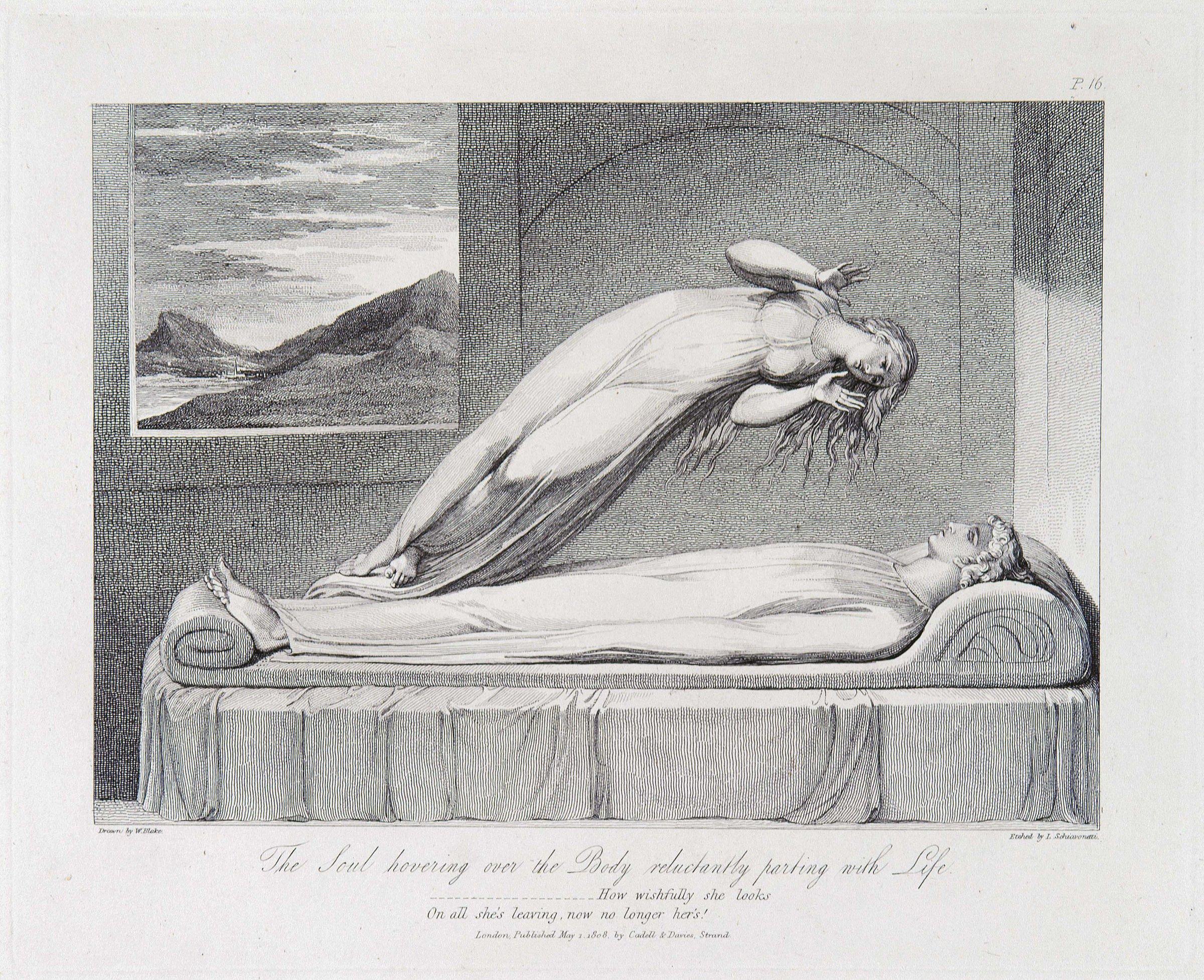
William Blake, The Soul hovering over the Body, 1808. Public domain.
Ecclesiastes 3, 9 and 12 · Debate · Featured Study
The Dead Know Nothing? Death and the Spirit in Ecclesiastes
Commentators part over what three verses of Ecclesiastes say of the dead and the spirit.
For the living know that they will die, but the dead know nothing. They have no further reward, because the memory of them is forgotten.
- The question
- Ecclesiastes says the dead know nothing and that the spirit returns to God: what does the book teach about the dead?
- The texts
- Ecclesiastes 9:5, Ecclesiastes 12:7, Ecclesiastes 3:21
One Hebrew letter decides whether Ecclesiastes 3:21 says that the spirit of man goes up or asks whether it does.
Summary
Readers take the Teacher's words on the dead in three ways: as death seen by the living, as the Old Testament's dark Sheol, or as a sleep until the resurrection. A fourth reading takes the spirit that returns to God as the breath of life.
- Three commentators read the verse on the spirit of man as a question, and three read it as a statement.
- Ellen G. White cites three verses of Ecclesiastes 9 for the unconscious state of the dead.
- The book names Sheol once, in Ecclesiastes 9:10.
The Texts Behind the Question
The book's words on the spirit answer its words on the dead.
The two verses stand three chapters apart, and every reading below has to answer both.
before the dust returns to the ground from which it came and the spirit returns to God who gave it.Three Readings of Ecclesiastes 9:5
The readings part over what the verse describes and what the dead know.
Only the third reading denies that the soul lives on after death.
| The question | Death seen from this life | The Old Testament's Sheol | Asleep until they are raised |
|---|---|---|---|
| What does the verse describe? | The dead as the living see them. | The state of the dead as the Old Testament mostly saw it. | The state of every person between death and the resurrection. |
| What do the dead know? | Nothing of what is done on the earth. | Nothing, and they feel and desire nothing. | Nothing at all until they are raised. |
| Does the soul live on? | Yes, and the righteous know much. | Yes, in Hades, as a shadow of life. | No, the dead are unconscious. |
Each Reading Stated
Each reading has its holders and its own ground in the text.
Death seen from this lifeJamieson, Fausset and Brown; Matthew Poole; John Gill
Jamieson, Fausset and Brown limit the verse to what the dead know by their bodily senses and of worldly affairs. Matthew Poole limits it to the actions and events of this world, as the end of verse 6 does.
John Gill holds that the verse does not speak of the spirits of the dead, and that the righteous dead know much.
The Old Testament's SheolKeil and Delitzsch
Keil and Delitzsch hold that the dead, as not living, are without knowledge, feeling and desire. They write that elsewhere the soul in Hades is neither annihilated nor sleeping, and that Ecclesiastes gives in a rugged way the view of Hades that prevails in the Old Testament.
On their reading, the New Testament first removes the confusion of the Old Testament's picture of the dead.
Asleep until they are raisedEllen G. White; Martin Luther, as White quotes him
In chapter 33 of The Great Controversy, Ellen G. White sets Psalm 146:4 beside Ecclesiastes 9:5, 6 and 10 as the testimony of David and Solomon that the dead are not conscious.
She quotes Luther's Exposition of Ecclesiastes, printed in London in 1573: “Solomon judgeth that the dead are asleep, and feel nothing at all.”
Statement or Question
The verse on the spirit of man and beast reads one way with the Hebrew vowels and another way in the old versions.
Who knows if the spirit of man rises upward and the spirit of the animal descends into the earth?This is the verse whose Hebrew pointing the commentators dispute.
In the Hebrew text the words for going up and going down, ha'olah and hayyoredet, are pointed with the article. Read that way, the verse speaks of the spirit that goes up. Read with the interrogative he, the same letters ask whether it goes up.
Those who read a question rest on the old versions or on the mood of the passage.
| Holder | Reads | The ground given |
|---|---|---|
| Albert Barnes | A statement | The Hebrew as now pointed allows only the reading of the King James Version. |
| Jamieson, Fausset and Brown | A statement | The verse marks how few people grasp the difference between man and beast. |
| Matthew Poole | A statement | Few know that the spirit of man goes up, though it does. |
| Keil and Delitzsch | A question | The Septuagint, the Targum, the Syriac, Jerome and Luther all read it so. |
| The Cambridge Bible | A question | The four ancient versions agree, and the context asks a sceptical question. |
| George Barton | A question | The question is a strong denial, made in a mood of despondent pessimism. |
Keil and Delitzsch hold that the vowels were set to bring the verse into accord with Ecclesiastes 12:7. The Pulpit Commentary says the Masoretes pointed the text for dogmatical purposes. Barton names Geiger and Siegfried for that view and calls it a mistake.
The Grave in Ecclesiastes 9
Hezekiah's prayer speaks of Sheol as the Teacher does.
Whatever you find to do with your hands, do it with all your might, for in Sheol, where you are going, there is no work or planning or knowledge or wisdom.The Teacher draws a rule for the living from the silence of Sheol.
For Sheol cannot thank You; Death cannot praise You. Those who descend to the Pit cannot hope for Your faithfulness. The living, only the living, can thank You, as I do today; fathers will tell their children about Your faithfulness.Hezekiah gives thanks as one of the living.
Both verses speak of what the dead cannot do, and both turn at once to the living.
What the Text Leaves Unsaid
Ecclesiastes names no resurrection and no place for the spirit.
The Berean text of Ecclesiastes never uses the words raise or resurrection.
Albert Barnes notes that the book says no more of the future of the spirit than that it returns to God.
The Spirit Returns to God
Readers part over whether the spirit that returns to God lives on.
By the sweat of your brow you will eat your bread, until you return to the ground—because out of it were you taken. For dust you are, and to dust you shall return.”The first half of the verse on the spirit takes up the sentence on Adam.
Barnes and Jamieson, Fausset and Brown read the second half as the spirit living on with God.
George Barton reads the spirit as the breath of life, the breath that came from God and goes back to Him. On his reading the return of the spirit to God is what Qoheleth held, and the question about the spirit that goes upward comes from a mood of despondent pessimism.
The Cambridge Bible reports that some interpreters, Warburton among them, saw in the verse the spirit absorbed into the World-Soul. Barnes answers that absorption has no warrant in the book and would not fit the judgment the book announces in its last verse.
How the Teachers Read It
Ambrose read the book's dust in the light of the resurrection.
Ambrose of Milan (died 397)
He held that a body gone back to dust can still be raised.
“The resurrection as a fact is not to be rejected because of an exceptional situation. Yet, since all things earthly return and crumble into the earth, I wonder how there can be any doubt even concerning the instances noted. For the most part, the sea itself also casts up on neighboring shores whatever human bodies it has swallowed. And if this were not so, it surely would not be difficult for God to join what has been scattered and to unite again what has been dispersed.”
Ambrose of Milan · On the Death of Satyrus 2.58 · on Ecclesiastes 3:20Patristic
The Readings Weighed
Every reading has its objector.
Three readings answer the verse on the dead, and a fourth answers the verse on the spirit.
| Reading | Held by | Tradition | Representative work |
|---|---|---|---|
| Death seen from this life | Jamieson, Fausset and Brown; Matthew Poole; John Gill | Protestant commentary | Gill, Exposition of the Entire Bible |
| The Old Testament's Sheol | Keil and Delitzsch | Old Testament scholarship | Keil and Delitzsch, Biblical Commentary on the Old Testament |
| Asleep until they are raised | Ellen G. White; Martin Luther, as White quotes him | Seventh-day Adventist teaching | White, The Great Controversy (1911), chapter 33 |
| The breath reading | George Barton | Critical scholarship | Barton, A Critical and Exegetical Commentary on the Book of Ecclesiastes (1908) |
Against the first reading1 paragraph
The Cambridge Bible reads the verse as shutting out, in that phase of the Teacher's feeling, any reward in a life after death.
Against the second reading1 paragraph
Ellicott's Commentary holds that by the end of the book the Teacher has risen above the doubts of Ecclesiastes 3:21.
Against the third reading1 paragraph
Gill reads Ecclesiastes 12:7 as the soul going at once to God, and the Geneva Bible's note says the soul does not sleep.
Against the fourth reading1 paragraph
The Pulpit Commentary grants that many critics see nothing more than the breath in the verse, and calls that a feeble conclusion for the book.
Books to Read Next
Two of the works this question rests on are free to read.
A Critical and Exegetical Commentary on the Book of Ecclesiastes
George Aaron Barton · 1908
Barton sets out the Hebrew of the question about the spirit and his reading of its return on pages 110 to 113.
Read at the Internet ArchiveThe Great Controversy
Ellen G. White · 1911
Chapter 33, The First Great Deception, gives her whole teaching on the state of the dead.
Read at Project GutenbergThe God of the Living
Barnes, on the spirit's return to God, points to the burning bush, which Jesus read as proof that the dead rise.
But concerning the dead rising, have you not read about the burning bush in the Book of Moses, how God told him, ‘I am the God of Abraham, the God of Isaac, and the God of Jacob’? He is not the God of the dead, but of the living. You are badly mistaken!”Sources
Scripture is the Berean Standard Bible.
- Hebrew word tags for Ecclesiastes 3:21, 9:5 and 12:7.
- On Ecclesiastes 3:21: Barnes' Notes; Jamieson, Fausset and Brown; Matthew Poole; Keil and Delitzsch; the Cambridge Bible; the Pulpit Commentary.
- On Ecclesiastes 9:5: Barnes' Notes; Jamieson, Fausset and Brown; Matthew Poole; Gill's Exposition; Keil and Delitzsch.
- On Ecclesiastes 12:7: Barnes' Notes; Jamieson, Fausset and Brown; Gill's Exposition; the Geneva Study Bible; the Cambridge Bible; the Pulpit Commentary.
- George Aaron Barton, A Critical and Exegetical Commentary on the Book of Ecclesiastes (1908), pages 110 to 113.
- Ellen G. White, The Great Controversy (1911), chapter 33, The First Great Deception.
- Ambrose of Milan, On the Death of Satyrus 2.58.
Keep Studying
Read it4
People and groups2
Doctrines1
Trials of life2