
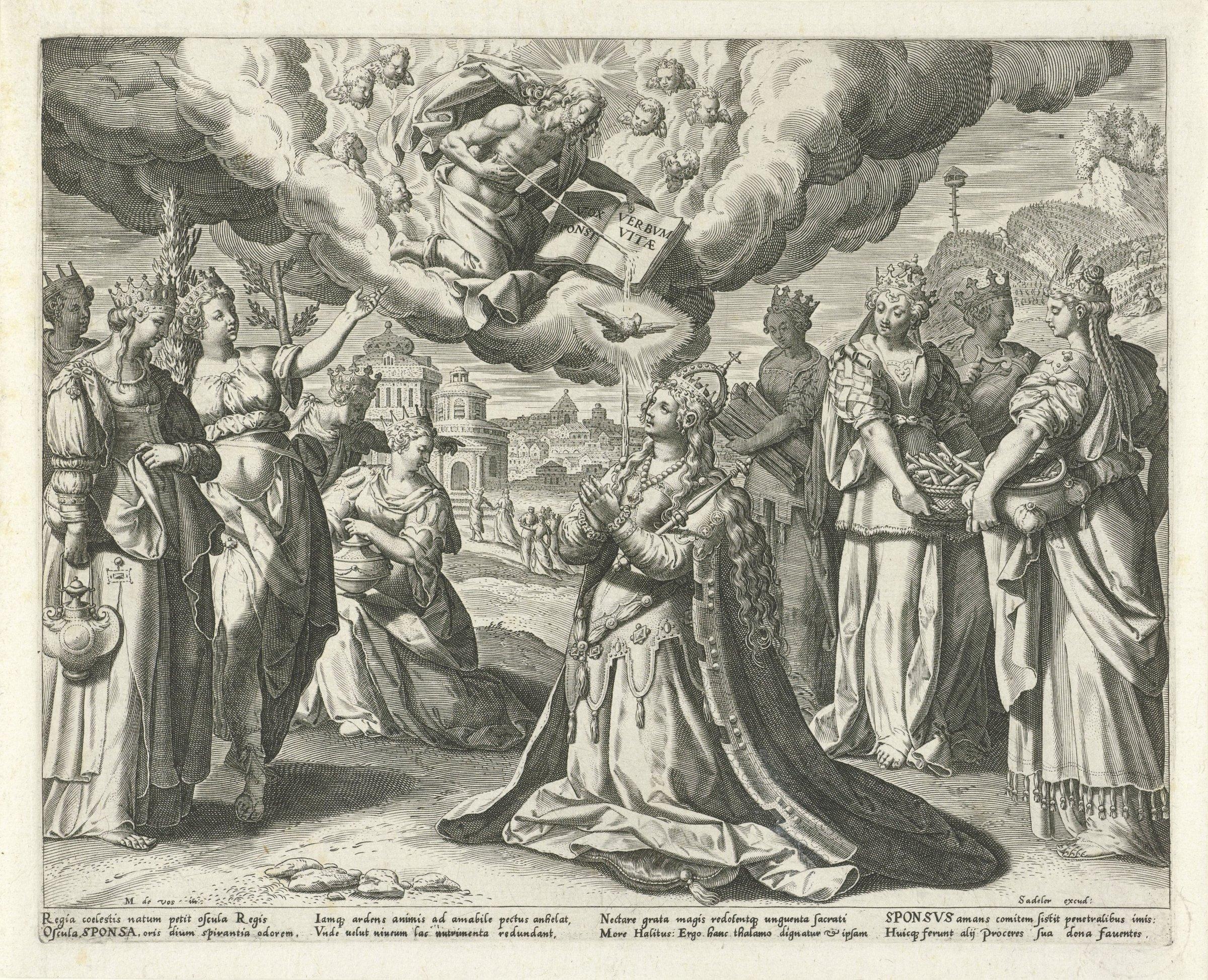
Johann Sadeler after de Vos, Christ Gives His Blood to His Bride, 1590. CC0.
Song of Solomon 8:6 to 7 · Passage · Featured Study
Love as Strong as Death
Near the close of the Song of Solomon two verses set love beside death, Sheol, fire, the floods and a man's wealth.
Set me as a seal over your heart, as a seal upon your arm. For love is as strong as death, its jealousy as unrelenting as Sheol. Its sparks are fiery flames, the fiercest blaze of all.
- The passage
- Song of Solomon 8:6 to 7, Song of Solomon 8:4, Genesis 38:18, Jeremiah 22:24, Proverbs 30:16, Hosea 13:14
- Books
- Song of Solomon, Genesis, Jeremiah, Proverbs, Hosea
- Hold in memory
- Song of Solomon 8:6, Song of Solomon 8:7
Here the poem pauses to define its subject.
Summary
The bride asks her beloved to carry her as a seal, and gives the strength of love as her reason. Readers have heard in her words the love of a husband and wife, the love of the LORD and Israel, and the love of Christ and His church. Each reading has its holders among the commentators.
- The Targum, an old Aramaic paraphrase of the Song, hears Israel and the LORD in the two verses.
- Augustine, Matthew Henry and Hudson Taylor are quoted on the verses.
- The verses follow the Song's third charge not to rush love.
The Two Verses
The bride asks to be carried as a seal and gives her reasons.
Mighty waters cannot quench love; rivers cannot sweep it away. If a man were to give all the wealth of his house for love, his offer would be utterly scorned.She names what love outlasts and what it cannot be bought with.
Albert Barnes calls the first of the two verses the key-note of the poem. He sets it beside Paul's praise of love in 1 Corinthians 13 as its Old Testament counterpart.
Six Rungs of the Two Verses
The bride's request stands first, and five things are set beside love after it.
The ladder climbs from a signet on the arm to the price of a whole house.
| Rung | The image | What the line says of love |
|---|---|---|
| 1 | A seal on the heart and on the arm | The bride asks to be carried as close as a signet |
| 2 | Death | Love is as strong as death, which none escapes |
| 3 | Sheol, the place of the dead | Love's jealousy lets go no more than Sheol does |
| 4 | Fire | Its sparks are flames, the fiercest blaze of all |
| 5 | Mighty waters and rivers | The floods cannot put love out or sweep it away |
| 6 | All the wealth of a house | A man who offered it for love would be scorned |
Where the Verses Stand
The verses come after the last charge to the daughters of Jerusalem and before the Song's closing scenes.
O daughters of Jerusalem, I adjure you: Do not arouse or awaken love until the time is right.It gives the charge for the third and last time.
The same charge stands at Song of Solomon 2:7 and Song of Solomon 3:5. After its third telling the bride comes up from the wilderness leaning on her beloved, and then she says what that love is.
Whose Love Is This?
Three readings name a different speaker, each with its holders and its objection.
A bride to her husbandAlbert Barnes; the Cambridge Bible; Keil and Delitzsch
Barnes hears the bride as she clings to her husband's arm and rests her head on him. Keil and Delitzsch give the verses to Shulamith, answering Solomon.
The objection: Barnes reports that allegorical readers find the verses fulfilled in Israel's return to the land or in Christ's coming to His church.
Israel to the LORD, and the LORD to IsraelThe Aramaic Targum to the Song of Songs
The Targum makes the request for the seal the prayer of Israel on the day of its return: set us as a seal on Your heart, so that we are never exiled again. It makes the line on the waters the LORD's answer, that if all the nations gathered like the waters of the sea they could not quench His love for His people.
The objection: the Cambridge Bible reads the request as a woman's wish to be united with her lover in the closest way, and the jealousy as her fear for her own love.
The church to ChristJohn Gill; Jamieson, Fausset and Brown
Gill reads the words as still the words of the church, speaking to Christ as she walks with Him. Jamieson, Fausset and Brown hold that the church's love to the point of death flows from His, and set Romans 8:35 to 39 beside the verse.
The objection: Keil and Delitzsch read the speaker as the bride of the Song answering her husband.
A Seal on the Heart
A seal was a signature ring, and six Hebrew words carry the images of the request.
The Cambridge Bible and Keil and Delitzsch explain the seal from two texts. Ellicott calls the seal a symbol of something especially dear and precious.
“What pledge should I give you?” he asked. She answered, “Your seal and your cord, and the staff in your hand.” So he gave them to her and slept with her, and she became pregnant by him.It shows a seal kept on the body, where the bride asks to be kept.
“As surely as I live,” declares the LORD, “even if you, Coniah son of Jehoiakim king of Judah, were a signet ring on My right hand, I would pull you off.It shows a signet as a thing its owner wore and valued.
Six Hebrew words behind the seal, death, Sheol and the flame, each with its word study.
| Hebrew | Word | Sense |
|---|---|---|
| חוֹתָם | chotam | a signet, a seal |
| אַהֲבָה | ahavah | love |
| מָוֶת | mavet | death |
| קִנְאָה | qinah | jealousy, zeal; Ellicott reads it here as strong passion, from a word meaning to be red with flame, and the line beside it shows the sense is good |
| שְׁאוֹל | sheol | the world of the dead |
| שַׁלְהֶבֶת | shalhevet | a flare of fire |
Ellicott notes that the last phrase of the line on fire reads literally a flame of Yah, the only place a sacred name stands in the book. He reads it as a way of saying the flame is great beyond measure. The Cambridge Bible reads it as a flame kindled and cherished by God.
Death and Sheol in Scripture
Proverbs counts Sheol among the never satisfied, Hosea promises a ransom from it, and Paul takes up Hosea's taunt.
Sheol, the barren womb, land never satisfied with water, and fire that never says, ‘Enough!’It sets Sheol and fire, two of the Song's images, side by side.
Death and Sheol take and never give back. The Song sets love beside them as a power of the same size.
I will ransom them from the power of Sheol; I will redeem them from Death. Where, O Death, are your plagues? Where, O Sheol, is your sting? Compassion is hidden from My eyes.Hosea sets death and Sheol together, as the Song does.
“Where, O Death, is your victory? Where, O Death, is your sting?”Paul takes up Hosea's taunt of death for the day the dead are raised.
How the Verses Have Been Taught
Writers of the fifth, eighteenth and nineteenth centuries wrote on the verses.
Augustine of Hippo (died 430)
EXPLANATIONS OF THE PSALMS 48:12
Augustine compared the force of love with the force of death.
“When death comes, it cannot be resisted. By whatever arts, whatever medicines, you meet it; the violence of death can none avoid who is born mortal; so against the violence of love can the world do nothing. For from the contrary the similitude is made of death; for as death is most violent to take away, so love is most violent to save. Through love many have died to the world, to live to God.”
on Song of Solomon 8:6Patristic
Matthew Henry (1662 to 1714)
Commentary on the Whole Bible
Henry read the floods as the troubles a believer's love outlasts, and as the trials Christ's love passed through.
“The overflowing of these waters will strike no damp upon it, but it will enable a man to rejoice in tribulation. Though he slay me, I will love him and trust in him. No waters could quench Christ's love to us, nor any floods drown it; he waded through the greatest difficulties, even seas of blood.”
on Song of Solomon 8:7Puritan
Hudson Taylor (1832 to 1905)
Union and Communion; or, Thoughts on the Song of Solomon
Hudson Taylor read the bride's love as the work of grace in her heart.
“The love which grace has begotten in the heart of the bride is itself divine and persistent; many waters cannot quench it, nor the floods drown it.”
on Song of Solomon 8:7English evangelical
Love That Cannot Be Bought
The last line turns from death to money.
Greater love has no one than this, that he lay down his life for his friends.Jamieson, Fausset and Brown set this saying of Jesus beside the seal and the strength of love.
Sources
Scripture is the Berean Standard Bible.
- Ellicott's Commentary for English Readers; Albert Barnes, Notes; Henry's Concise Commentary; John Gill, Exposition; Jamieson, Fausset and Brown, Commentary (1871); the Cambridge Bible for Schools and Colleges; Keil and Delitzsch, Biblical Commentary on the Old Testament, each on Song of Solomon 8:6.
- Strong's Hebrew lexicon, h2368, h160, h4194, h7068, h7585 and h7957.
- The Aramaic Targum to the Song of Songs, 8:6 and 8:7, with the English of Jay Treat (CC-BY-NC-SA)
- Augustine, Explanations of the Psalms 48:12; Matthew Henry, Commentary on the Whole Bible (1710), on Song of Solomon 8:7; Hudson Taylor, Union and Communion (1893)
Keep Studying
Studies1
People and groups2
Symbols1
Values1