
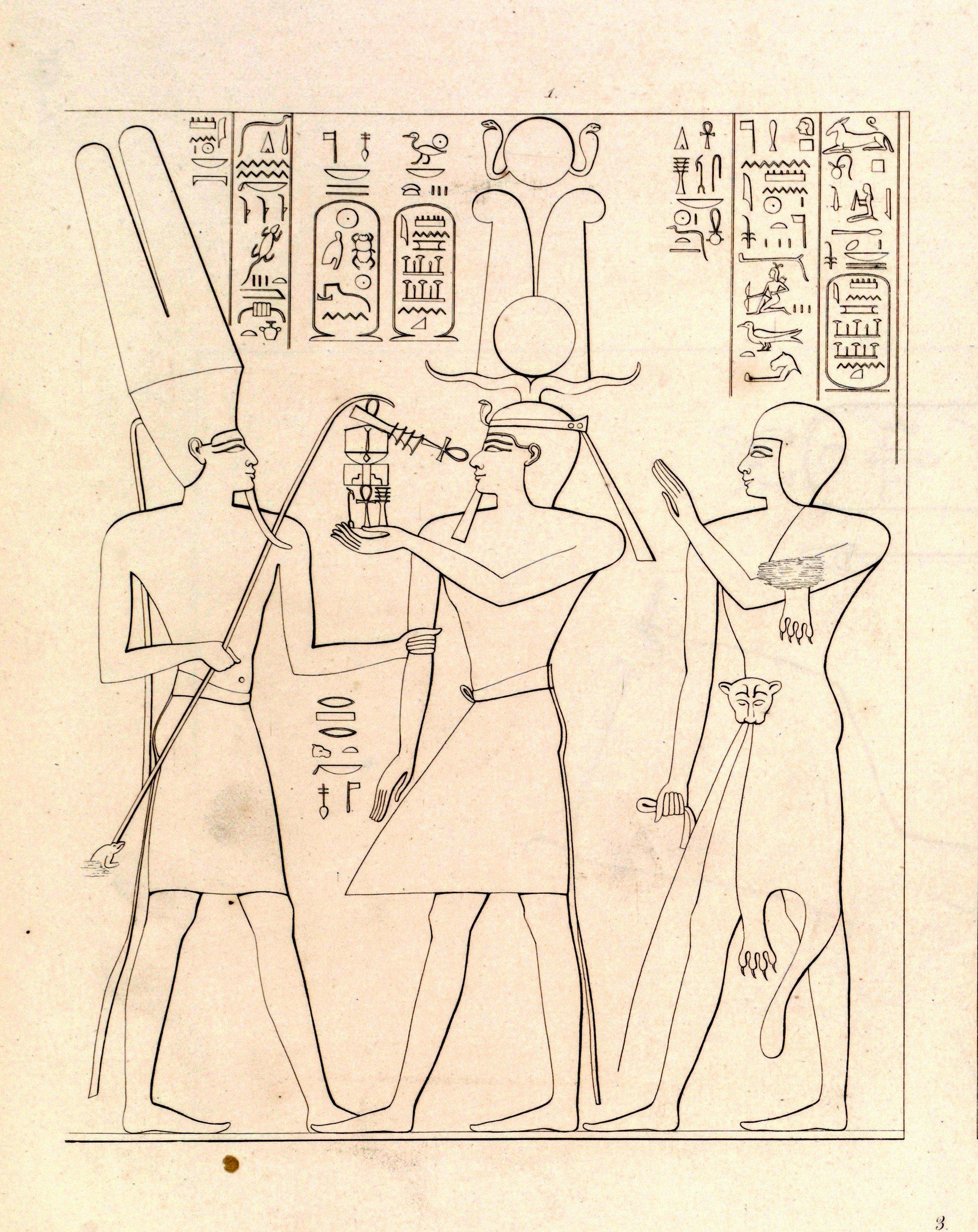
Ippolito Rosellini, Shoshenq I, 1832. Public domain.
1 Kings 14 and 2 Chronicles 12 · Story · Featured Study
Shishak's invasion and the Bubastite Portal
A wall at Karnak in Egypt lists the towns Shishak claimed after his raid on Judah.
Solomon's five hundred gold shields were carried off, and bronze took their place.
When the LORD saw that they had humbled themselves, the word of the LORD came to Shemaiah, saying, “They have humbled themselves; I will not destroy them, but will soon grant them deliverance. My wrath will not be poured out on Jerusalem through Shishak.
- Where
- Jerusalem, Egypt
- Who
- Rehoboam, Shishak, Shemaiah
- When
- the fifth year of Rehoboam king of Judah
Summary
In the fifth year of Rehoboam, Shishak king of Egypt came up with chariots, horsemen and troops beyond number. He took the fortified cities of Judah and reached Jerusalem. When the king and the leaders humbled themselves, the LORD spared the city, but Shishak carried off the treasures of the temple and the palace.
- Kings gives four verses to the raid and Chronicles twelve.
- Breasted dated the gate at Karnak to about 924 BC.
- Breasted could place nineteen names on the map.
The Raid in Two Accounts
Each account gives what the other leaves out.
First Kings 14:25 to 28 gives the year, the plunder and the bronze shields. Second Chronicles 12:1 to 12 adds the army, the cities taken, the prophet's word and the humbling of the king.
In the fifth year of Rehoboam’s reign, Shishak king of Egypt came up and attacked Jerusalem. He seized the treasures of the house of the LORD and of the royal palace. He took everything, including all the gold shields that Solomon had made.In the fifth year of Rehoboam’s reign, because they had been unfaithful to the LORD, Shishak king of Egypt came up and attacked Jerusalem with 1,200 chariots, 60,000 horsemen, and countless troops who came with him out of Egypt—Libyans, Sukkites, and Cushites. He captured the fortified cities of Judah and came as far as Jerusalem.Chronicles gives the cause first, the faithlessness of king and people.
The Invasion, Step by Step
The steps run from Rehoboam's accession to the bronze shields.
The raid came in Rehoboam's fifth year, after the fortresses were built and the Law forsaken.
- Rehoboam becomes king at forty-oneJerusalem1 Kings 14:21
- He fortifies fifteen cities of Judah and BenjaminJudah and Benjamin2 Chronicles 11:5 to 10
- He and all Israel forsake the Law of the LORDJudah2 Chronicles 12:1
- Shishak comes up in the fifth year with 1,200 chariotsJudah2 Chronicles 12:2 to 3
- The fortified cities fall, and Shishak comes to JerusalemJudah and Jerusalem2 Chronicles 12:4
- Shemaiah brings the LORD's word against themJerusalem2 Chronicles 12:5
- The king and the leaders humble themselvesJerusalem2 Chronicles 12:6 to 7
- Shishak takes the treasures and the gold shieldsthe temple and the palace2 Chronicles 12:9
- Rehoboam makes bronze shields in their placethe palace gate1 Kings 14:27
Each step is drawn in the order of 1 Kings 14 and 2 Chronicles 11 and 12; only the raid carries a year.
The king and the leaders humble themselves, Shishak takes the treasures and the gold shields, Rehoboam makes bronze shields in their place
What Judah Lost
The new shields were kept for the king's visits to the temple.
King Solomon made two hundred large shields of hammered gold; six hundred shekels of gold went into each shield. He also made three hundred small shields of hammered gold; three minas of gold went into each shield. And the king put them in the House of the Forest of Lebanon.Then King Rehoboam made bronze shields in their place and committed them to the care of the captains of the guard on duty at the entrance to the royal palace. And whenever the king entered the house of the LORD, the guards would bear the shields, and later they would return them to the guardroom.Matthew Henry comments on the bronze shields.
“This was an emblem of the diminution of his glory. Sin makes the gold become dim, changes the most fine gold, and turns it into brass. We commend Rehoboam for going to the house of the Lord, perhaps the oftener for the rebuke he had been under, and do not condemn him for going in pomp.”
Matthew Henry · Commentary on the Whole Bible · on 1 Kings 14:27 to 28Puritan
The Wall at Karnak
Breasted counted the captives on the relief and the names that can still be read.
James Henry Breasted, in his Ancient Records of Egypt of 1906, places the relief on the outside of the south wall of the great temple at Karnak, between the Bubastite gate and the hypostyle hall. He holds that Sheshonk built the gate and its court in his twenty-first year.
On the relief Amon leads five lines of sixty-five captives, and the goddess of Thebes leads five lines more of ninety-one. Each captive stands for a town, and its name is set in a walled ring below the captive's head and shoulders.
Most of the names on the wall can no longer be placed.
The four counts as a table
| Part of the list | Names |
|---|---|
| Name rings on the relief | 156 |
| Legible names | 75 |
| Sure identifications | 17 |
| Likely identifications | 2 |
Breasted gives the counts in sections 711 and 718.
Rosellini's plate copies one captive and his ring large, beside rows of the name rings.
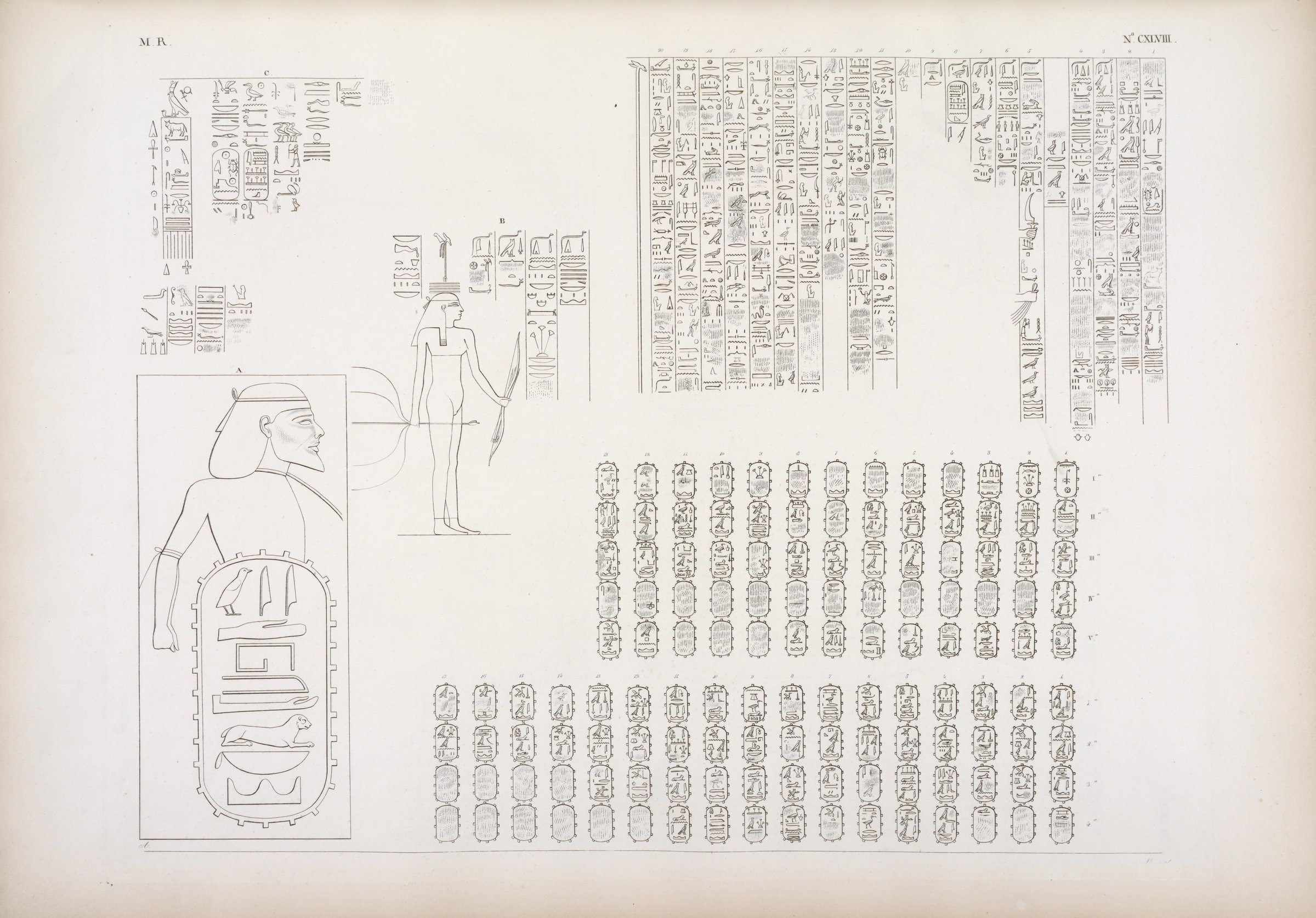
- A figure drawn largeRosellini drew this one apart from the rows, at a larger size.
- A standing figureA figure holding a bow, drawn from the relief.
- The inscriptionColumns of hieroglyphs from the text of the relief.
- The upper rows of ringsName rings in five rows, one for each captive town.
- The lower rows of ringsA second block of name rings.
- The plate numberPlate CXLVIII, that is 148, of Rosellini's work.
Ippolito Rosellini, I monumenti dell'Egitto e della Nubia, plate 148, 1832, titled Il re di Giuda prigione del Faraone Sciscionk (Sesac). New York Public Library scan. Public domain, via Wikimedia Commons.
Breasted names Rosellini's plate 148 among the publications of the relief, in the note to section 709.
Breasted judged that the inscriptions of the relief are made of stock phrases from older monuments. Without the short notice in the Old Testament, he wrote, one could hardly have guessed that the relief marked one campaign.
The page Jeroboam I and the Divided Kingdom names the towns of the northern kingdom on the list.
Where the Text Is Silent
Neither account tells two things.
Neither account names the fortified cities Shishak took.
Neither says whether Shishak entered Jerusalem or received the treasures at its gate. Breasted looked for Jerusalem on the wall and judged it lost in one of the gaps of the list. Adam Clarke, on 2 Chronicles 12:6, held that this repentance was the sole reason the city was not destroyed.
Serving God or Serving Kings
Chronicles gives the purpose of Judah's service to Shishak.
The leaders had answered Shemaiah that the LORD is righteous.
Nevertheless, they will become his servants, so that they may learn the difference between serving Me and serving the kings of other lands.”Voices on Shishak's Invasion
Two commentaries trace the raid to the fall before it.
Matthew Henry (1662 to 1714)
Commentary on the Whole Bible
Matthew Henry compares Rehoboam with his father and grandfather.
“This was what he came for. David and Solomon, who walked in the way of God, filled the treasuries, one by war and the other by merchandise; but Rehoboam, who forsook the law of God, emptied them.”
on 2 Chronicles 12:9Puritan
Jamieson, Fausset & Brown (1802 to 1910)
Commentary Critical and Explanatory on the Whole Bible
Jamieson, Fausset and Brown date the turn in Rehoboam's reign.
“During the first three years of his reign his royal influence was exerted in the encouragement of the true religion. Security and ease led to religious decline, which, in the fourth year, ended in open apostasy. The example of the court was speedily followed by his subjects, for ‘all Israel was with him,’ that is, the people in his own kingdom.”
on 2 Chronicles 12:1Reformed
Is Judah's King on the Wall?
Early and later Egyptologists read one name ring two ways.
Rosellini's readingIppolito Rosellini, 1832
Rosellini titled his plate 148 The king of Judah, prisoner of the Pharaoh Sciscionk. Albert Barnes, in his Notes on 1 Kings 14:26, reports that the entry he writes YUDeH-MALK was proposed to be read as Judah, king.
The objection is that the ring stands among the towns of the list, and Barnes reports that others take it for an unknown town.
Breasted's readingJames Henry Breasted, 1906
Breasted, in section 713, held that No. 29, which he writes Yw-d-h-m-rw-k, is not to be rendered the king or kingdom of Judah. In his note he says Brugsch showed that rendering impossible long before, and that Müller proposed Hand of the King.
The objection is that Breasted himself calls the place unknown, so the ring still has no town to point to.
Books to Read Next
Both works are free to read at the Internet Archive.
Ancient Records of Egypt, Volume 4
James Henry Breasted · 1906
Breasted translates the Karnak relief and goes through the list of towns ring by ring.
Read at the Internet ArchiveThe Books of the Kings
C. F. Keil · 1872
Keil's commentary explains 1 Kings 14 in the series of Keil and Delitzsch.
Read at the Internet ArchiveAn Easy Yoke
Chronicles sets the service of foreign kings against the service of the LORD.
Take My yoke upon you and learn from Me; for I am gentle and humble in heart, and you will find rest for your souls. For My yoke is easy and My burden is light.”Sources
Scripture is the Berean Standard Bible.
- James Henry Breasted, Ancient Records of Egypt, vol. 4, University of Chicago Press, 1906, sections 709 to 718.
- Albert Barnes, Notes, Explanatory and Practical, on the Old Testament, on 1 Kings 14:26.
- Matthew Henry, Commentary on the Whole Bible, 1710, on 1 Kings 14:27 to 28 and 2 Chronicles 12:9.
- Adam Clarke, Commentary on the Bible, 1832, on 2 Chronicles 12:6.
- Jamieson, Fausset and Brown, Commentary Critical and Explanatory on the Whole Bible, 1871, on 2 Chronicles 12:1.
- C. F. Keil, The Books of the Kings, tr. James Martin, T. and T. Clark, 1872.
Keep Studying
Read it4