
1 Kings 3:3 to 15 · Story · Wisdom
Solomon's Request
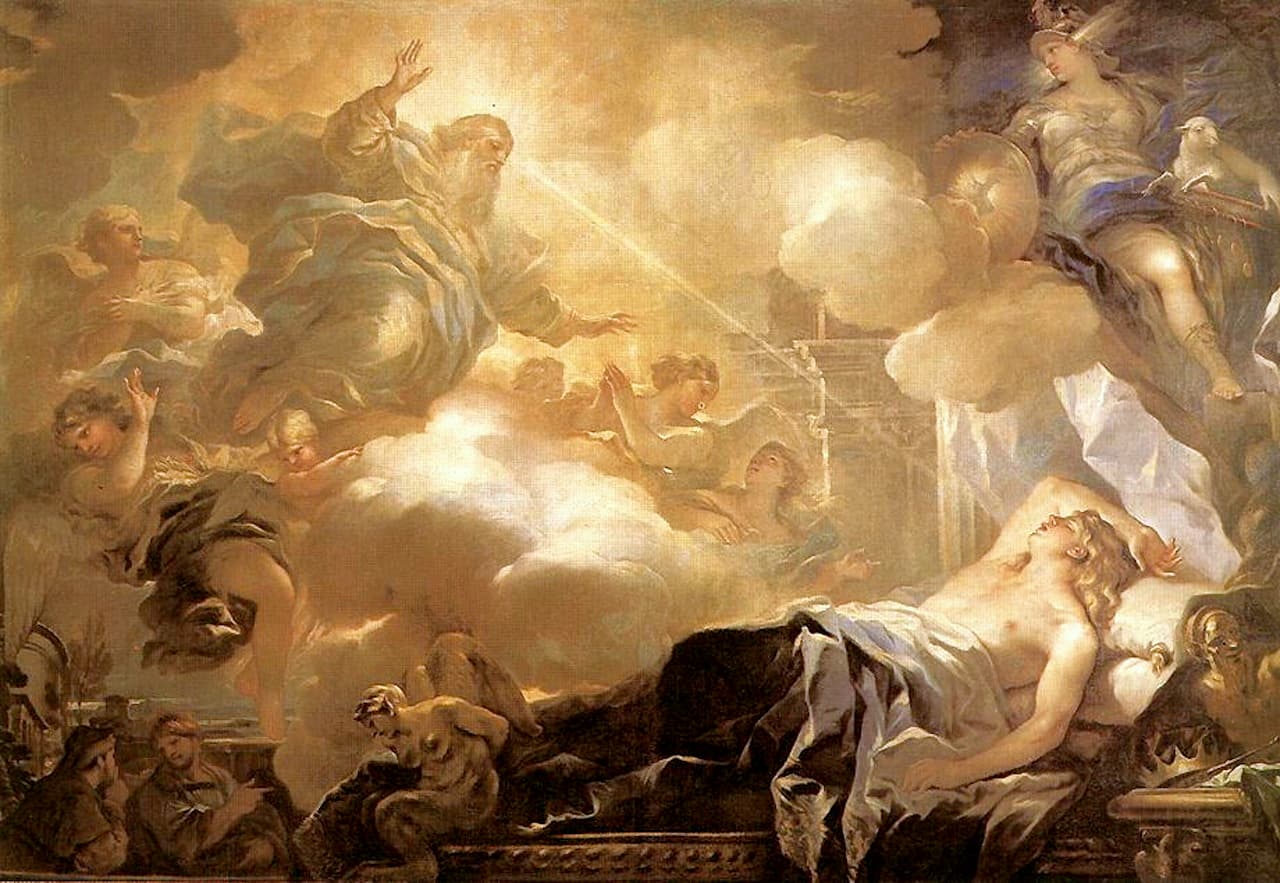
At Gibeon the LORD appeared to King Solomon in a dream, and Solomon asked Him for an understanding heart to judge His people.
Told to ask for anything at all, the new king asked for the one thing a judge of a nation could not do without.
Therefore give Your servant an understanding heart to judge Your people and to discern between good and evil. For who is able to govern this great people of Yours?”
- Where
- Gibeon
- Who
- Solomon
- When
- Early in Solomon's reign, before the house of the LORD was built (1 Kings 3:2)
Summary
The story stands in 1 Kings 3:3 to 15, and the Chronicler tells it again in 2 Chronicles 1:7 to 12. It comes early in the reign, while Israel still worshiped on the high places, and it is the first of the two times the LORD appeared to Solomon (1 Kings 9:2). The king confessed that he was too inexperienced to rule so great a people. The Lord was pleased with his prayer and gave him more than he sought.
- The Hebrew of the request in 1 Kings 3:9 is lev shomea, a heart that listens, while in 2 Chronicles 1:10 the king asks for wisdom and knowledge.
- The wisdom, the riches and the honor were given outright, and only long life was promised on a condition (1 Kings 3:14).
- In old age his wives turned his heart after other gods, and the LORD was angry with the king who had seen Him twice (1 Kings 11:4 and 1 Kings 11:9).
A King at Gibeon
Solomon offered his sacrifices at Gibeon in the years before the temple stood in Jerusalem.
Solomon's Request belongs to the value of wisdom, because in it wisdom comes to a king as a gift from God for the work of judging. The rest of his reign is measured against this night, from the court case that follows it to the turning of his heart at the end.
The question the story answers is what Solomon asked for, what God gave him, and on what terms. It follows the night in order and sets the tellings of Kings and Chronicles side by side. It teaches the Hebrew words of the request and gives the readings of commentators on the high place and the dream.
The writer of Kings explains the worship of the day with one fact: "a house for the Name of the LORD had not yet been built" (1 Kings 3:2).
And Solomon loved the LORD and walked in the statutes of his father David, except that he sacrificed and burned incense on the high places. Now the king went to Gibeon to sacrifice there, for it was the great high place. Solomon offered a thousand burnt offerings on the altar there.The writer sets Solomon's love for the LORD beside the one fault he names, so the gift that follows comes to a man whose flaw is already on record.
From Gibeon to the Turning of His Heart in Twelve Steps
The account runs from the offerings at Gibeon to the feast in Jerusalem, and two later verses close its frame.
God gave Solomon more than he asked at Gibeon, and the king whose heart later turned away had seen the LORD there and once again.
- Solomon loves the LORD but worships at the high places"except that he sacrificed"1 Kings 3:3
- He goes to Gibeon, the great high place, to sacrifice"a thousand burnt offerings"1 Kings 3:4
- The LORD appears to him in a dream and invites a request"One night at Gibeon"1 Kings 3:5
- He remembers God's kindness to David and names his own weakness"I am only a little child"1 Kings 3:7
- Solomon makes his one request"to discern between good and evil"1 Kings 3:9
- The request pleases the Lord"it pleased the Lord"1 Kings 3:10
- God grants the heart he asked for"a wise and discerning heart"1 Kings 3:12
- God gives more than was sought"what you did not request"1 Kings 3:13
- Long life is promised on a condition"I will prolong your days"1 Kings 3:14
- He wakes, worships before the ark and holds a feast"So he returned to Jerusalem"1 Kings 3:15
- Years later the LORD appears to him again"a second time"1 Kings 9:2
- In old age his heart turns and the LORD is angry"who had appeared to him twice"1 Kings 11:9
A timeline of twelve steps, ten from 1 Kings 3:3 to 15 and two from 1 Kings 9:2 and 1 Kings 11:9, each with words from the Berean text.
God grants the heart he asked for, God gives more than was sought, Long life is promised on a condition, He wakes, worships before the ark and holds a feast, Years later the LORD appears to him again, In old age his heart turns and the LORD is angry
The Prayer and the Answer
Solomon's prayer opens with thanks, turns to confession, and ends in a single request.
Solomon begins with what God had already done, the "much loving devotion" shown to David and kept by setting David's son on his throne (1 Kings 3:6).
And now, O LORD my God, You have made Your servant king in my father David’s place. But I am only a little child, not knowing how to go out or come in. Your servant is here among the people You have chosen, a people too numerous to count or number.Solomon measures himself against the size of his task before he asks for anything, and the request grows out of that confession.
Now it pleased the Lord that Solomon had made this request. So God said to him, “Since you have asked for this instead of requesting long life or wealth for yourself or death for your enemies—but you have asked for discernment to administer justice— behold, I will do what you have asked. I will give you a wise and discerning heart, so that there has never been nor will ever be another like you.God names what a new king might have sought for himself and sets the request for justice against it before He grants it.
Moreover, I will give you what you did not request—both riches and honor—so that during all your days no man in any kingdom will be your equal. So if you walk in My ways and keep My statutes and commandments, just as your father David did, I will prolong your days.”God speaks of gifts the king never sought, and He ties the last of them to the way Solomon will walk.
Two Tellings of One Night
The Chronicler tells the night at Gibeon more briefly and in other words.
A reader who says that Solomon did not ask for wisdom is right about the wording of 1 Kings 3:9. He is wrong about Chronicles, where the noun chokhmah stands in the king's own mouth, beside madda, knowledge (2 Chronicles 1:10).
The Chronicler keeps the request and the gifts, names wisdom outright, and gives no line for the Lord's pleasure or the condition.
| Point | 1 Kings 3 | 2 Chronicles 1 |
|---|---|---|
| When God speaks | "in a dream" | "That night" |
| The request | "an understanding heart to judge" | "wisdom and knowledge" |
| What was not asked | "long life or wealth for yourself" | "riches or wealth or glory" |
| What is added | "both riches and honor" | "riches and wealth and honor" |
| The Lord's pleasure | "it pleased the Lord" | No line |
| What God asks of Solomon in return for it | "if you walk in My ways" | No line |
A Heart That Listens
The Hebrew of the request names a heart that hears, and God's answer turns on the same verbs.
The request of 1 Kings 3:9 is lev shomea. Lev (H3820) is the heart, and shomea is a form of shama (H8085), to hear, so the king asks for a heart that listens.
He wants that heart for two tasks, lishpot, to judge (H8199), and le-havin, to distinguish (H995), between tov and ra, good and evil.
God gives the request back in other words. He says Solomon asked havin lishmoa mishpat, to understand how to hear judgment, which the Berean text renders "discernment to administer justice" (1 Kings 3:11).
The gift is lev chakham ve-navon, a heart wise (H2450) and understanding (1 Kings 3:12). Navon comes from bin (H995), the root of the request's le-havin, so God gives the very discernment Solomon named.
In 1 Kings 3 the noun chokmah, wisdom (H2451), stands only once, at the close of the chapter. There all Israel sees "the wisdom of God" in the king's judgment of two women (1 Kings 3:28).
Gibeon and Jerusalem
Before the temple was built, Israel's tent of worship and its ark stood in two different towns.
The Chronicler explains why the king chose Gibeon: it was "the location of God’s Tent of Meeting, which Moses the servant of the LORD had made in the wilderness" (2 Chronicles 1:3).
The bronze altar of the tabernacle was at Gibeon too, while David had brought the ark to a tent he had pitched for it in Jerusalem (2 Chronicles 1:4 to 5).
One nineteenth-century reading joins the sacrifices at Gibeon and in Jerusalem into a single plan for the opening of the reign.
“Solomon determined to inaugurate his reign by a grand religious ceremonial at each of the two holy places which at this time divided between them the reverence of the Jews. Having completed the religious service at Gibeon, where was the tabernacle of the congregation, he proceeded to Jerusalem, and sacrificed before the ark of the covenant, which was in Mount Zion 2Sa 6:12. A great feast naturally followed on a large sacrifice of peace-offerings.”
Albert Barnes · Notes, Explanatory and Practical, on the Old and New Testaments (1832-1869) · on 1 Kings 3:15Evangelical
What the Account Leaves Unsaid
The account gives the king's words about himself and leaves his years unstated.
The text gives no age for Solomon at Gibeon. When he calls himself a little child (1 Kings 3:7), he is confessing inexperience. John Wesley, in his Explanatory Notes upon the Old Testament, and Jamieson, Fausset and Brown each estimate his age from this verse, and each estimate is an inference.
The Gift and the Condition
Solomon's old age is judged by what he had received when the reign began.
Now the LORD grew angry with Solomon, because his heart had turned away from the LORD, the God of Israel, who had appeared to him twice. Although He had warned Solomon explicitly not to follow other gods, Solomon did not keep the LORD’s command.The writer names the two appearances as the ground of the LORD's anger, so the night at Gibeon becomes part of the charge against the king.
The second appearance came after the temple was dedicated, "as He had appeared to him at Gibeon" (1 Kings 9:2).
Albert Barnes measured the end of the reign against the condition of 1 Kings 3:14. He wrote, "The promise here was only conditional", and held that when the condition was broken "the right to the promise was forfeited".
The account sets the gift and the fall side by side and states no rule. The lesson that wisdom given by God does not keep a heart that turns away is an inference from the two scenes.
Psychologists Igor Grossmann and Ethan Kross named the gap between judging other people's problems well and one's own badly "Solomon's paradox" after this king, in Psychological Science (2014).
The New Testament gives a request like Solomon's to every believer: "Now if any of you lacks wisdom, he should ask God" (James 1:5).
Voices on Solomon's Dream
Matthew Henry read the dream as a meeting with God and the request as a prayer that gained more than it sought.
1662 to 1714 · Matthew Henry
The night setting of the dream gives a reason God meets people in quiet.
Read the page on Matthew Henry
“Silence and retirement befriend our communion with God. His kindest visits are often in the night, Ps. xvii. It was in a dream, when he was asleep, his senses locked up, that God's access to his mind might be the more free and immediate.”
Matthew Henry · Commentary on the Whole Bible · on 1 Kings 3:4Puritan
1662 to 1714 · Matthew Henry
The Lord's pleasure in the request yields a rule about the prayers God accepts.
“Those are accepted of God who prefer spiritual blessings to temporal, and are more solicitous to be found in the way of their duty than in the way to preferment. But that was not all; it was a prevailing prayer, and prevailed for more than he asked.”
Matthew Henry · Commentary on the Whole Bible · on 1 Kings 3:10Puritan
Questions Readers Ask
Commentators differ on whether the worship at Gibeon was wrong and on whether a choice made in a dream was a real choice.
The first question is whether God approved the sacrifices at the high place of Gibeon.
God accepted worship at the high places before the temple stoodAlbert Barnes
Barnes held that "God so far overlooked this ignorance that He accepted the worship thus offered Him, as appears from the vision vouchsafed to Solomon on this occasion."
He still saw a danger in the practice and wrote, "The existence of the worship at high places did, in fact, facilitate the division of the kingdom."
The objection: the writer of Kings counts the high places as the one exception to Solomon's love for the LORD (1 Kings 3:3).
Gibeon alone was lawful, because the tabernacle stood thereMatthew Henry
Henry wrote of Gibeon that "that was the great high place, and should have been the only one, because there the tabernacle and the brazen altar were".
The objection: the writer calls Gibeon "the great high place" (1 Kings 3:4), still one of the high places that 1 Kings 3:3 counts as the king's fault.
The second question is whether a choice made in sleep showed anything of the king's character.
The dream repeated a desire he held awakeJamieson, Fausset and Brown
Jamieson, Fausset and Brown, in their Commentary Critical and Explanatory (1871), wrote: "His dream was but an imaginary repetition of his former desire, but God's grant of it was real."
The objection: the Lord was pleased that Solomon "had made this request" (1 Kings 3:10), which treats the request as his own act.
The choice sprang from his will and shows his characterAlbert Barnes
Barnes wrote that although the choice was made in a dream, "we must regard it as springing from his will in some degree, and therefore as indicative of his moral character."
The objection: the account calls the whole exchange a dream and says nothing of the king's will (1 Kings 3:15).
The Gift at Work
The summary of the reign shows the promise of Gibeon kept, and the next scene shows it used.
And God gave Solomon wisdom, exceedingly deep insight, and understanding beyond measure, like the sand on the seashore.The writer's summary of the reign shows God's word at Gibeon kept in full measure.
The first test of the gift came soon after the dream, when two women brought one living child before the king.
Sources
Scripture is the Berean Standard Bible.
- STEP Bible, Translators Amalgamated Hebrew Old Testament, the tagged Hebrew text (Tyndale House, Cambridge), CC BY 4.0.
- Matthew Henry, Commentary on the Whole Bible (1710), on 1 Kings 3.
- Albert Barnes, Notes, Explanatory and Practical, on the Old and New Testaments (1832 to 1869), on 1 Kings 3.
- Robert Jamieson, A. R. Fausset and David Brown, Commentary Critical and Explanatory on the Whole Bible (1871), on 1 Kings 3:5 and 3:7.
- John Wesley, Explanatory Notes upon the Old Testament (1765), on 1 Kings 3:7.
- Igor Grossmann and Ethan Kross, Exploring Solomon's paradox: self-distancing eliminates the self-other asymmetry in wise reasoning about close relationships in younger and older adults, Psychological Science 25 (8): 1571 to 1580, 2014.
Keep Studying
Studies6
In this value4
People and groups7
Show the next 1 title
Places1